The Challenge of Scaling Without Constraints
In modern biopharmaceutical engineering, designing a high-capacity pharmaceutical solution preparation system demands more than just adherence to current Good Manufacturing Practices (cGMP) and automated recipe execution. It requires a holistic understanding of cross-border supply chains, plant footprints, and physical transport limitations.
When an international pharmaceutical manufacturer contracted Ningbo Everheal Pharmaceutical Equipment Co., Ltd. to design and build a state-of-the-art large volume parenteral parenteral line, the technical baseline seemed clear: a massive 16,000L Purified Water (PW) and Water for Injection (WFI) storage system. However, a late-stage engineering modification requested by the client threatened to derail the entire project’s viability.
By analyzing the project through a joint lens of modular pharmaceutical plant layout principles and global maritime freight constraints, Everheal’s project management team engineered a brilliant turnaround. We replaced a massive, un-shippable vessel with a high-efficiency, fully optimized 9,000L integrated system, ensuring a 100% logistical success rate while protecting the client's capital expenditure (CAPEX).
1. The Complexity of Cross-Border Turnkey Pharmaceutical Production Line Construction
Building a turnkey pharmaceutical production line across international borders is an intricate dance between mechanical engineering, biochemical process isolation, and physical logistics. Global biopharma firms increasingly rely on an expert customized pharmaceutical equipment manufacturer to deliver complex systems—such as those used for anticancer drugs preparation, lyophilized drugs preparation, and large-volume infusions—ready for validation upon arrival.
As Ningbo Everheal, our commitment extends beyond fabricating stainless steel vessels that pass strict Riboflavin clean-in-place (CIP) spray-ball tests. Our responsibility encompasses ensuring that these heavy, high-purity systems can actually reach the client's cleanroom floors safely, affordably, and on schedule. This case study demonstrates how operational foresight and deep engineering domain expertise averted a multimillion-dollar logistics nightmare during a critical international holiday window.
2. The Client’s Pain Points: A Late-Stage Engineering Modification Meets Hard Maritime Realities
During the detailed technical alignment phase, our client faced sudden shifts in their regional regulatory landscape, requiring an immediate upgrade to their raw water treatment capabilities. They issued an urgent change request: their facility needed to integrate a PW and WFI system integration package directly upstream of their main formulation storage array. This required adding a heavy-duty PW Generator (Purified Water Generator) and a multi-effect WFI Distiller (Water for Injection Distiller) into the immediate layout.
However, the client’s original facility blueprint relied on a colossal 16,000L WFI storage and distribution tank. When our engineering team mapped out the physical layout of the new, combined WFI generation and storage system, a major problem emerged regarding pharmaceutical equipment shipping dimensions.
The Logistical Stand-Off
The Physical Barrier: A standard 16,000L pharmaceutical-grade jacketed vessel, complete with its insulation layers, top-mounted agitator ports, and supporting skid framework, easily exceeds a diameter of 3.5 meters and a total shipping height that defies standard freight boundaries.
The Container Crisis: Ocean freight standardly relies on 40-foot High Cube (HC) containers, which have a maximum internal width of 2.352 meters and a height of 2.698 meters.
The Financial Penalty: Transporting the 16,000L tank would require an Out-Of-Gauge (OOG) shipping strategy using Flat Rack containers or heavy-lift Breakbulk vessels. For a transnational route, this meant:
· A 400% spike in freight costs.
· Lengthy permit approval delays from maritime authorities.
· A high risk of cosmetic or structural damage to the mirror-polished Ra ≤ 0.4μm) interior surfaces during exposed transit.
The client was stuck in an engineering deadlock: they desperately needed the expanded integrated water treatment capabilities, but their initial 16,000L storage design was physically impossible to ship via standard international ocean lanes.
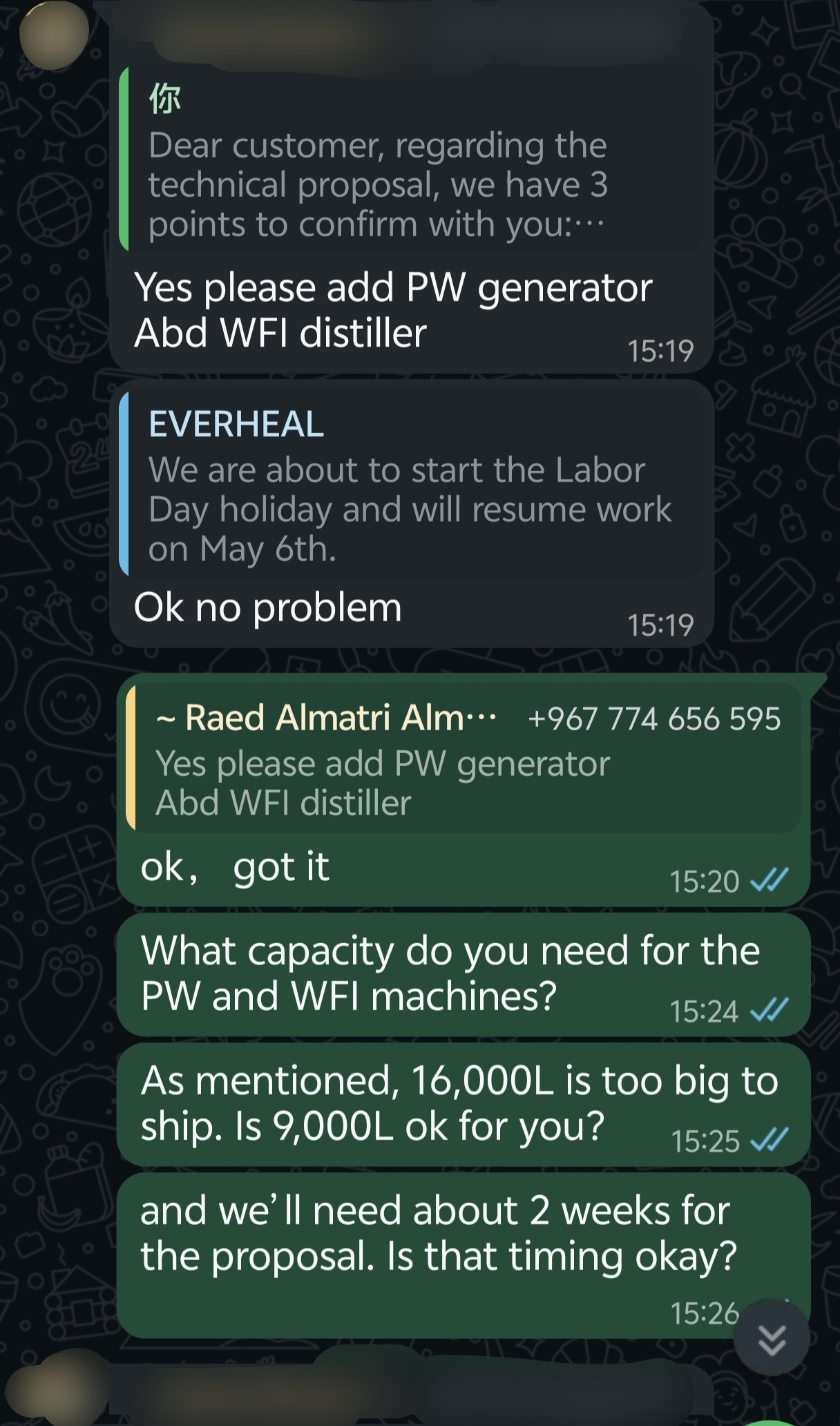
3. The Everheal Intervention: Proactive Risk Management and Redesigning the WFI Generation and Storage System
At Ningbo Everheal, project managers are seasoned engineers first and coordinators second. Viola, our Senior Project Manager assigned to this account, immediately recognized the shipping risks before fabrication even began. Leveraging her extensive history in delivering pharmaceutical water system design projects across Europe and the Americas, she issued an immediate risk alert to the client’s executive board.
Instead of passively accepting the client’s design and leaving them to handle the logistical fallout, Viola gathered Everheal’s process engineers to look for an alternative solution. We asked a fundamental question: Can we achieve the client's required daily operational buffer capacity without using a single 16,000L tank?
[Traditional Mindset: Massive Static Buffer]
16,000L Storage Tank (Too large for container shipping)
↓
[Everheal Dynamic Integration Solution]
High-Output PW Gen + WFI Distiller ➔ 9,000L Optimized Tank (Fits 40' HC Container)
The Alternative Concept: Dynamic Generation Over Massive Storage
Everheal’s engineering team performed a detailed fluid dynamics and consumption analysis of the client's large volume parenteral parenteral line production cycles. We discovered that the client’s reliance on a 16,000L tank was an over-engineered safety buffer meant to compensate for a traditionally slow water replenishment rate.
Viola presented a smarter, cost-effective pharmaceutical engineering solution:
Ⅰ. Downsize the Storage Vessel: Reduce the static storage tank from 16,000L down to a highly optimized 9,000L capacity.
Ⅱ. Maximize the Replenishment Rate: Increase the operational output efficiency of the newly integrated PW Generator and Multi-Effect WFI Distiller.
Ⅲ. Optimize the Dimensions: By shrinking the tank volume to 9,000L and engineering a modular, low-profile top dish assembly, the entire vessel’s maximum shipping width and height were brought safely under the threshold required for standard 40-foot High Cube ocean containers.
4. Precise Design for Global Transit and cGMP Compliance
Modifying a pharmaceutical solution preparation system from 16,000L down to 9,000L without reducing daily batch throughput requires precise calculation. The system could not afford a single drop in pressure or a breakdown in the loop's thermal management.
Balance of Fluid Dynamics and Logistics
Let Vinitial = 16,000L represent the client's original static volume, and Voptimized = 9,000L represent our redesigned capacity. To prevent any supply shortages during peak filling sequences on the large volume parenteral parenteral line, the generation rate of the integrated water system had to be elevated.
Our engineers recalculated the required continuous output of the WFI Distiller (Qgen in liters per hour) against the peak volumetric discharge rate of the filling lines (Qdischarge). By ensuring that:
Qgen≥Qdischarge-Voptimized/Δtpeak
where Δtpeak represents the maximum continuous duration of the filling batch, we proved that the smaller 9,000L tank, backed by our high-output generation skid, provided an identical operational safety window as the bulky 16,000L tank.
Implementing a Modular Plant Layout
Next, our design team adjusted the modular pharmaceutical plant layout. The 9,000L tank was mounted on an ultra-low-profile 316L stainless steel skid base. The piping network for the automated valves, TOC (Total Organic Carbon) monitoring sensors, and conductivity meters was rerouted into a compact, wrap-around geometric pattern.
This smart engineering ensured that the entire PW and WFI system integration package could be split into three modular, pre-tested sub-assemblies. Each sub-assembly was designed to glide smoothly into standard shipping containers with millimetric precision, eliminating any risk of structural scraping or damage during transit.
5. Unwavering Commitment to Project Timelines
Engineering brilliance means nothing if communication stalls. Just as the final 3D CAD design modifications were completed and prepared for the client's formal Sign-Off, the calendar hit a major international holiday season. For many global suppliers, production lines go dark and account management goes silent.
Knowing that the client’s local civil works and cleanroom validation schedules were locked in, Viola and the Everheal project team established an extraordinary, cross-departmental holiday coverage matrix.
Instead of waiting for the holiday period to end, our teams remained online across overlapping time zones. We held daily technical reviews with the client's validation and logistics teams, clearing all engineering questions, updating the P&ID (Piping and Instrumentation Diagrams), and securing the final manufacturing approval ahead of schedule. This round-the-clock dedication ensured that when factory production resumed, our raw materials were already staged, certified, and ready for fabrication.
6. Measurable Success and Value Delivered
The factory acceptance testing (FAT) of the 9,000L integrated pharmaceutical solution preparation system was a complete success. The system met all cGMP, FDA, and EMA compliance baselines, demonstrating pristine surface finishing and fully automated Siemens PLC loop controls.
The tangible benefits delivered to our client include:
· 100% Shipping Feasibility: The entire system—including the 9,000L tank, PW Generator, and WFI Distiller—was securely packed into standard ocean containers. Out-of-gauge shipping risks were completely avoided.
· Massive Cost Reductions: By eliminating the need for specialized open-top or flat-rack ocean containers, escort vehicles, and custom port-handling permits, the client saved tens of thousands of dollars in direct international logistics costs.
· Optimized Facility Footprint: The downsized 9,000L vessel gave the client more floor space within their Class C/D cleanroom areas. This extra space improved operator movement and simplified future maintenance access around the WFI generation and storage system.
· Zero Project Delays: Thanks to our holiday coverage, engineering approvals were secured early, allowing the system to ship precisely on schedule.
Client Endorsement
Upon successful installation and initial commissioning, the Project Director of the client’s manufacturing facility shared this feedback:
"We are incredibly grateful to the Everheal team for their exceptional thoroughness and expertise before the holiday break. Their proactive warning about the 16,000L shipping constraints saved us from a logistical disaster. The optimized 9,000L integrated water system performs flawlessly, and their creative engineering saved us an immense amount of trouble and unforeseen costs downstream!"
7. Everheal’s Guarantee for Global Pharmaceutical Infrastructure
Choosing a partner for turnkey pharmaceutical production line construction involves more than comparing equipment price sheets; it requires finding a partner with deep operational experience, technical expertise, and absolute reliability.
At Ningbo Everheal Pharmaceutical Equipment Co., Ltd., we combine world-class manufacturing precision with real-world project insight. Whether you are dealing with challenging cleanroom spaces, complex process chemistries for anticancer drugs, or difficult international shipping routes, our team designs solutions that work on every level. We don't just build machinery—we ensure your project succeeds from our factory floor to your final market validation.
Project Data Reference Sheet
Parameter | Original Proposed Plan | Everheal Optimized Plan | Net Project Improvement |
Storage Tank Volume | 16,000 Liters | 9,000 Liters | Optimized space footprint |
System Architecture | Isolated Standalone Tank | Integrated PW/WFI Skid | Higher operational efficiency |
Shipping Profile | Out-of-Gauge (OOG) Flat Rack | Standard 40' High Cube | Reduced shipping risk |
Logistics Feasibility | High Risk (Size Violations) | 100% Compliant | Guaranteed safe transit |
Holiday Delays | Expected 2-3 Week Allocation | 0 Days Lost (Holiday Matrix) | Maintained critical path |


