In pharmaceutical manufacturing, material transfer contamination control is not a small detail. It is a critical part of GMP compliance, cross-contamination prevention, and cleanroom efficiency. When comparing interlocking pass boxes vs air showers, the right choice depends on your process risk, cleanroom classification, transfer frequency, and validation strategy.
Introduction: Why Material Transfer Control Matters
Every time materials move between controlled and less-controlled areas, contamination risk increases. This is true for raw materials, packaging components, tools, and finished products. A well-designed transfer solution helps reduce particle migration, protects cleanroom integrity, and supports a stable GMP workflow.
For pharmaceutical plants, especially those handling sterile preparation, purified water systems, and formulation lines, material transfer equipment must do more than "move items." It must support dust control, pressure control, workflow control, and operator discipline. That is why many facilities compare interlocking pass boxes and air showers during cleanroom planning.
What Is an Interlocking Pass Box?
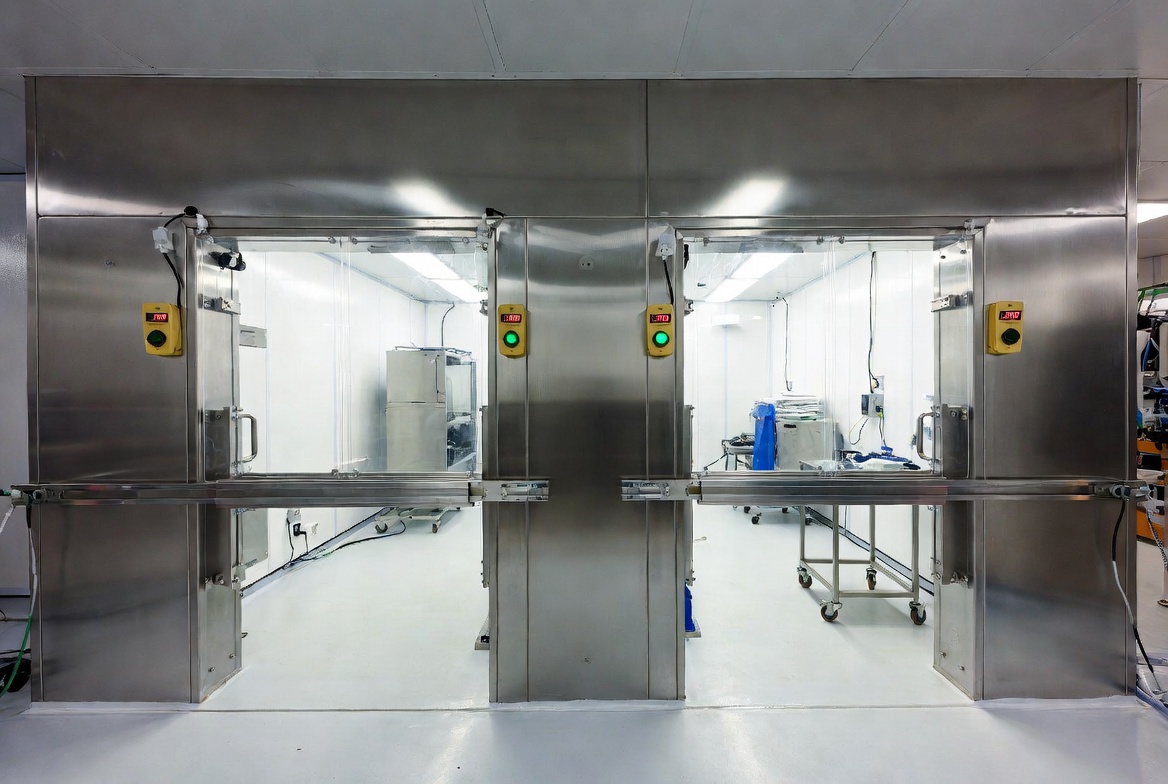
An interlocking pass box is a controlled transfer chamber installed between two rooms of different cleanliness levels. Its main function is to allow materials to pass from one side to another without both doors opening at the same time.
This simple interlock mechanism helps reduce air exchange between spaces. In pharmaceutical facilities, pass boxes are commonly used for:
- Raw material transfer.
- Packaging material transfer.
- Tool and instrument transfer.
- Sample transfer.
- Waste movement in controlled zones.
A pass box is especially useful when the goal is to preserve room pressure hierarchy and reduce the risk of contamination during short transfers.
Types of Pass Boxes
There are several pass box configurations:
- Mechanical interlocking pass box, suitable for basic controlled transfers.
- Electronic interlocking pass box, offering stronger operational control.
- Static pass box, used when no active decontamination is needed.
- Dynamic pass box, often equipped with HEPA filtration or UV features for higher control needs.
For pharma users, the more important question is not only the box type, but whether the pass box is aligned with your GMP flow design and validation requirements.
What Is an Air Shower?
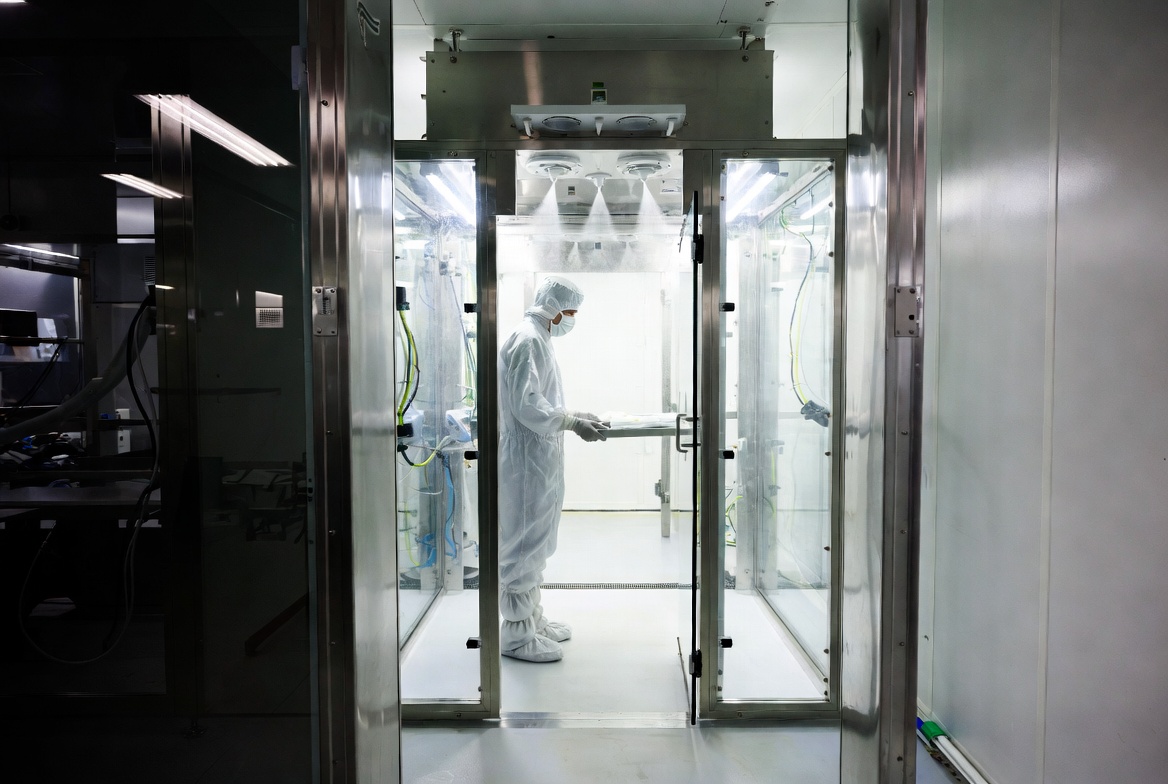
An air shower is a personnel or material decontamination chamber that uses high-velocity filtered air to remove loose particles from surfaces before entry into a cleaner area. In many facilities, air showers are used for personnel, trolleys, or materials entering a higher-grade controlled room.
Air showers are designed to reduce surface contamination caused by particles attached to clothing, cartons, containers, or equipment surfaces. They are not a substitute for full cleaning or sterilization, but they are an important particle-reduction barrier in cleanroom entry workflows.
Air showers are often used in:
- Pharmaceutical manufacturing.
- Biotechnology facilities.
- Medical device plants.
- Microelectronics and precision manufacturing.
- Controlled logistics areas.
Core Differences
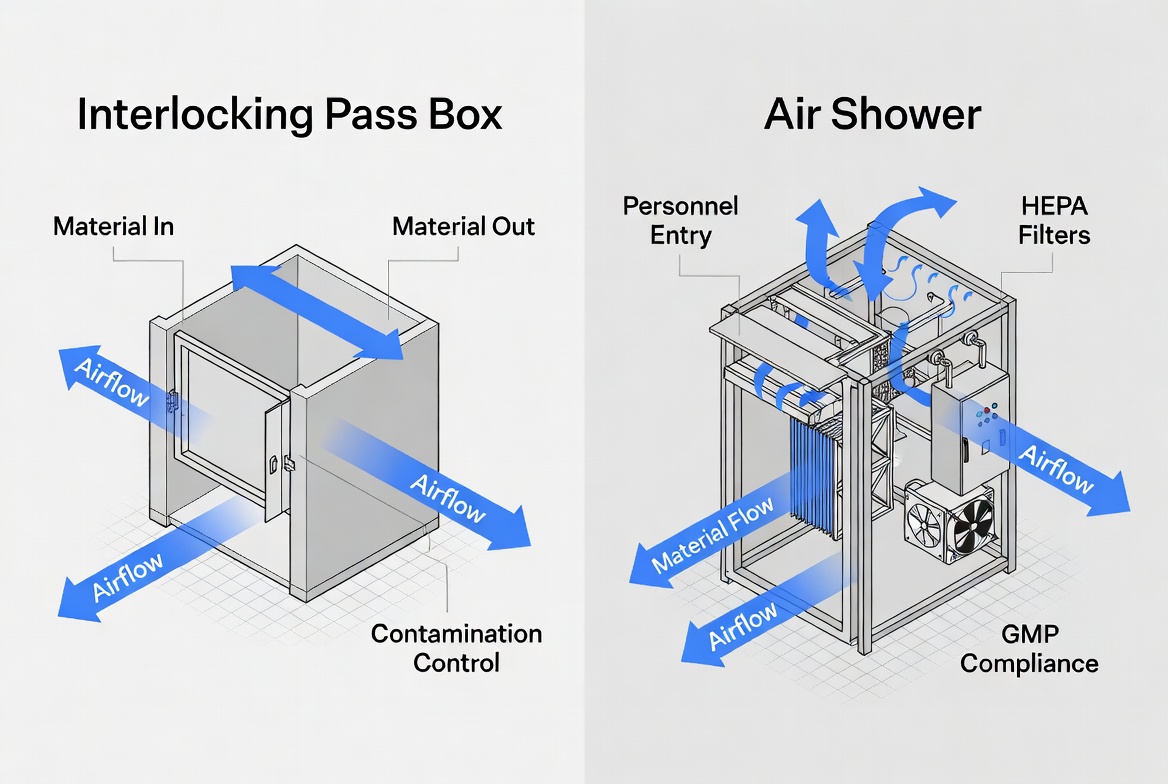
The main difference is simple: pass boxes control transfer access, while air showers actively remove particles. A pass box primarily prevents direct room-to-room contamination during transfer. An air shower adds a decontamination step by blowing filtered air over the item or person being transferred.
| Factor | Interlocking Pass Box | Air Shower |
| Main function | Controlled transfer | Particle removal |
| Contamination control method | Door interlock and separation | HEPA-filtered high-velocity airflow |
| Best for | Short material transfers | Dusty or particle-sensitive entries |
| Validation focus | Interlock integrity, pressure control, cleaning | Air velocity, filtration performance, cycle effectiveness |
| Energy use | Lower | Higher |
| Space requirement | Smaller | Larger |
| Typical use case | Between adjacent rooms | Entry into cleaner areas |
In practice, many pharmaceutical plants use both solutions in different parts of the facility.
Which One Is Better?
There is no universal winner. The better choice depends on the contamination risk and process design.
Choose an interlocking pass box if:
- Materials are already clean and sealed.
- You need to reduce air exchange between adjacent rooms.
- The transfer frequency is moderate or high.
- Floor space is limited.
- You want a simple, cost-efficient GMP transfer solution.
Choose an air shower if:
- Materials or carts carry loose particles.
- Transfer is into a stricter cleanliness zone.
- The process requires an additional particle-reduction step.
- You need a stronger visible hygiene barrier for operations discipline.
In many pharmaceutical factories, the smartest design is a combined contamination control strategy: pass boxes for room-to-room transfer and air showers for entry into more critical zones.
GMP and Compliance Considerations
From a GMP perspective, the equipment must support repeatable, documented control. The decision should not be made only on price or appearance. It should be based on risk, validation effort, cleaning procedures, maintenance, and flow efficiency.
Important compliance points include:
- Door interlock reliability.
- Cleanable internal surfaces.
- Smooth, corrosion-resistant materials.
- Clear operating SOPs.
- Maintenance access without disrupting cleanroom discipline.
- Validation evidence for airflow, filtration, or interlock function.
For sterile or high-risk operations, contamination control equipment should be part of the overall facility concept, not treated as an isolated purchase.
Practical Selection Criteria
When helping pharmaceutical plants plan a new facility, we usually evaluate the following factors first:
1. What is being transferred?
Raw material, tools, packaging, semi-finished product, or sensitive finished product?
2. How clean is the material at transfer?
Sealed cartons and bags require different protection than exposed components.
3. What cleanliness level must be protected?
A Grade D area has different needs than a Grade A/B critical zone.
4. How often will transfers happen?
High-frequency transfer favors operational simplicity and speed.
5. How much floor space is available?
Air showers need more room and more installation planning.
6. What is the validation burden?
Some facilities prefer simpler systems with lower maintenance and fewer qualification variables.
This is where factory layout planning becomes important. A good transfer solution must match the personnel flow, material flow, and pressure cascade of the entire plant.
Expert Insight: Common Design Mistakes
One common mistake is using an air shower where a pass box is enough. This creates unnecessary cost, energy use, and operational friction. Another mistake is choosing a pass box without considering whether the material still needs external surface decontamination before entry.
Other frequent errors include:
- Poor location of the transfer point.
- Inconsistent SOPs for opening and closing doors.
- Overlooking cleaning access and maintenance clearance.
- Failing to integrate transfer equipment with HVAC pressure design.
- Selecting equipment before finalizing the cleanroom flow diagram.
A better approach is to design the transfer strategy together with cleanroom zoning, water system routes, formulation zones, and sterilization logistics. That is especially relevant in pharmaceutical plants that require coordinated utility and process infrastructure.
Industry Example: Material Transfer in a Sterile Prep Facility
In a sterile formulation facility, packaging materials may enter through a pass box after outer cleaning and de-dusting. In a separate zone, personnel or carts may pass through an air shower before moving into a controlled corridor.
This division of labor makes the workflow more efficient:
- The pass box handles frequent, controlled material transfers.
- The air shower handles contamination reduction at zone entry.
- The room pressure hierarchy stays stable.
- Operators understand where each control step belongs.
For a full production line, this layered approach usually offers better real-world performance than relying on only one device.
How to Improve Transfer Control
To get the best contamination control result, use these practical steps:
- Map every transfer path before equipment selection.
- Separate clean material flow from dirty return flow.
- Use clear SOPs for door sequencing and entry behavior.
- Train operators to avoid bypassing transfer rules.
- Schedule routine checks for interlock function, filters, and airflow.
- Connect the transfer solution to the cleanroom qualification plan.
These steps matter because contamination control is only effective when equipment, people, and procedures work together.
Conclusion
When comparing interlocking pass boxes vs air showers, the correct answer is not "which is better" in general, but which is better for your transfer risk. Pass boxes are ideal for controlled room-to-room material movement, while air showers are better when you need active particle reduction before entry into a cleaner zone.
For pharmaceutical manufacturers, the best solution is often a facility-wide contamination control strategy that connects material transfer equipment, cleanroom zoning, HVAC design, and GMP workflow planning. That approach reduces risk, improves compliance, and supports long-term operational stability.
CTA
If you are planning a new pharmaceutical plant or upgrading an existing production line, choose transfer equipment as part of the overall facility design—not as a standalone purchase. A tailored layout and contamination control plan can improve GMP compliance, reduce operational mistakes, and support cleaner, safer production.
FAQ
1. What is the main function of an interlocking pass box?
An interlocking pass box allows materials to move between rooms while preventing both doors from opening at the same time, helping reduce contamination risk.
2. What is the main function of an air shower?
An air shower uses filtered high-velocity air to remove loose particles from people or materials before entry into a cleaner area.
3. Can an air shower replace a pass box?
No. They serve different purposes. An air shower reduces particles, while a pass box controls transfer access and room separation.
4. Which is more energy efficient?
An interlocking pass box is generally more energy efficient because it does not require continuous high-velocity airflow.
5. Where should these devices be used in a pharma plant?
Pass boxes are often used between adjacent controlled rooms, while air showers are commonly placed at entry points to cleaner zones.
References
1. Syntegon – Pure media and formulation systems
https://www.syntegon.com.cn/solution-finder/pharma/pure-media-and-formulation-systems/
2. Syntegon – Drug product formulation systems
https://www.syntegon.com.cn/solutions/pharma/drug-product-formulation-systems/
3. Centec – PW generator / purified water system overview
https://www.centec.de/zh/product-page/pw-erzeuger
4. Shanghai Jingze – Aseptic compounding system overview
http://winatechgroup.com/product/showproduct.php?id=13
5. Pharma liquid preparation system catalog overview
https://pharmec.en.made-in-china.com/product-group/SektRVulhiaK/Pharmaceutical-Liquid-Preparation-System-catalog-1.html
6. 2026 industry discussion on pharmaceutical liquid preparation systems
https://www.cnblogs.com/deepagents/articles/20158021
7. 2026 industry discussion on supplier capability evaluation
https://www.cnblogs.com/deepagents/articles/20158347


