In high-vibration pharmaceutical environments, HEPA filter sealing method is not a minor design choice; it directly affects contamination control, maintenance frequency, and long-term GMP reliability. This article compares gel-seal vs gasket-seal HEPA filters from an engineering, operations, and compliance perspective, with practical insights for cleanrooms, pharmaceutical production lines, and vibration-prone installations
Why Seal Integrity Matters in High-Vibration Areas
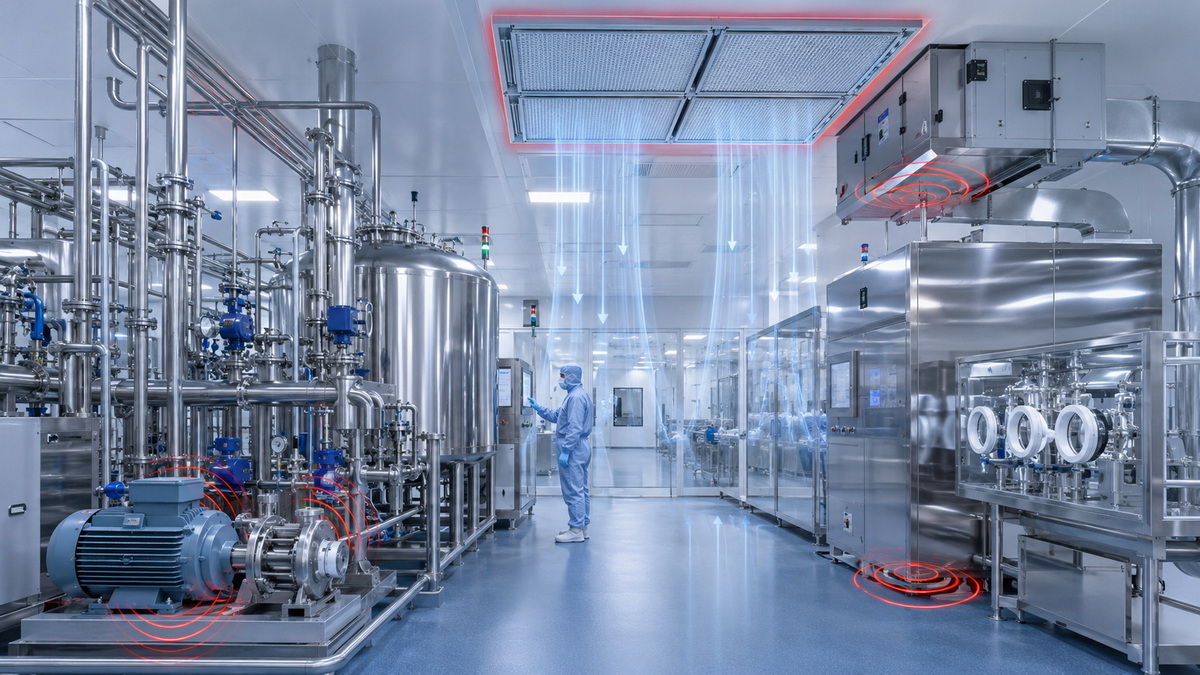
High-vibration environments are common in pharmaceutical plants. Equipment such as compressors, pumps, air handlers, filling lines, and large-scale preparation systems can all transmit vibration into surrounding HVAC and cleanroom structures. Over time, that movement can weaken the interface between a filter and its housing, creating a risk of bypass leakage.
For pharmaceutical manufacturers, this is more than a maintenance issue. A small leak can undermine air cleanliness, pressure cascade stability, and validation status. In GMP-regulated facilities, long-term integrity is especially important because repeated requalification consumes both time and budget. That is why the sealing mechanism of a HEPA filter deserves the same attention as the filter media itself.
What Gel-Seal HEPA Filters Are
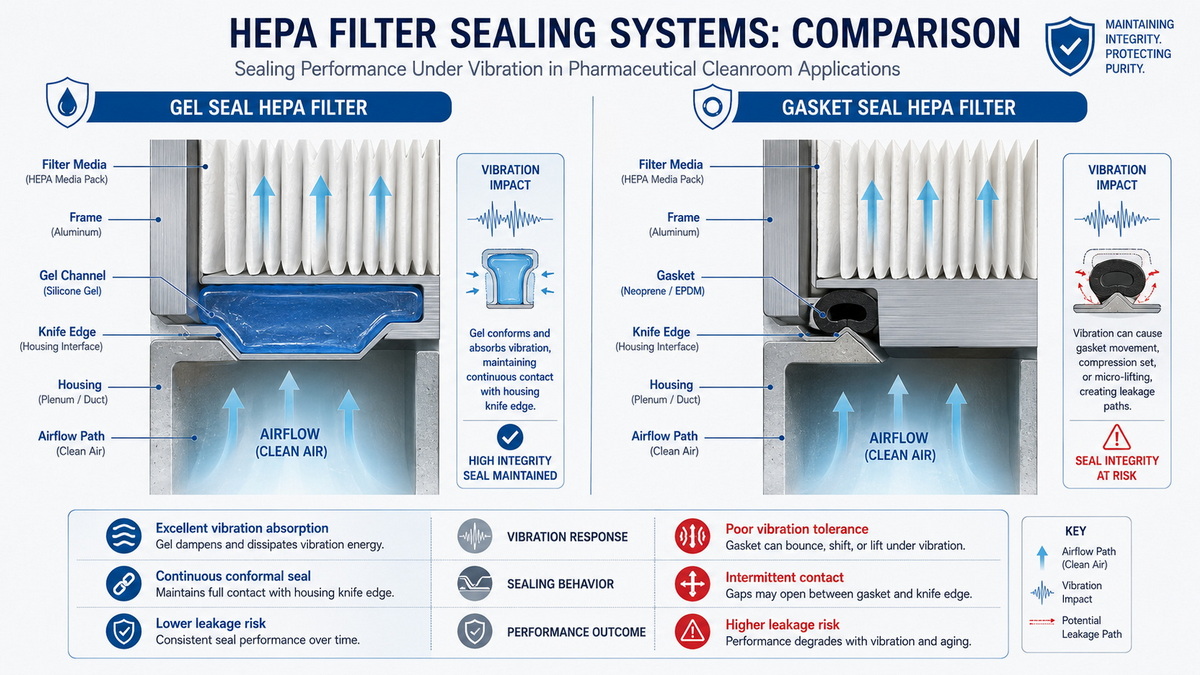
Gel-seal HEPA filters use a liquid gel seated in a channel or knife-edge track to create the sealing interface. The filter is installed into a compatible housing, and the gel conforms to the mating surface to form a tight barrier. This design is widely used in applications that demand stable sealing performance and low bypass risk.
From an engineering point of view, gel-seal systems are valued for their uniform contact, strong resistance to small housing irregularities, and reliable performance during long operating cycles. They are often preferred in critical cleanrooms where consistent leak control is essential.
What Gasket-Seal HEPA Filters Are
Gasket-seal HEPA filters rely on a compressible gasket material, such as neoprene, polyurethane, or other elastomeric compounds, to create the seal between the filter and the frame. When properly installed and compressed, the gasket forms an effective barrier against air leakage.
This design is often simpler and more familiar to maintenance teams. It is also common in many cleanroom and HVAC systems because it can be easier to source, install, and replace. However, gasket performance can be more sensitive to installation quality, compression consistency, and long-term mechanical stress.
Gel-Seal vs Gasket-Seal: Core Differences
The right choice depends on your operating environment, vibration level, maintenance discipline, and contamination risk tolerance. The table below gives a practical side-by-side view.
| Factor | Gel-Seal HEPA Filters | Gasket-Seal HEPA Filters |
| Sealing principle | Liquid gel forms a knife-edge seal | Compressible gasket forms the seal |
| Resistance to vibration | High; generally better for movement and structural vibration | Moderate; performance may drift if compression changes |
| Leak control consistency | Very strong when housing is compatible | Good, but more dependent on installation quality |
| Maintenance sensitivity | Lower sensitivity to minor surface irregularities | More sensitive to gasket aging, compression set, and torque variation |
| Installation complexity | Requires compatible housing and careful handling | Usually simpler and more familiar |
| Replacement cycle risk | Lower risk of seal degradation from compression set | Higher risk over time if gasket hardens or deforms |
| Best-fit use case | Critical cleanrooms, high-risk areas, high-vibration zones | General cleanrooms, lower-vibration HVAC systems |
In most high-vibration settings, gel-seal systems tend to offer stronger long-term sealing stability. Gasket-seal filters remain viable, but they demand tighter installation control and more frequent inspection.
Long-term Integrity Under Vibration
Vibration affects HEPA filters in several ways. It can loosen fasteners, change compression force, fatigue surrounding frame components, and gradually deform gasket material. When that happens, a seal that was initially adequate may become vulnerable to leakage during normal operation.
Gel-seal filters usually perform better in this scenario because the gel can maintain contact even when the housing experiences small mechanical shifts. Gasket systems depend more heavily on constant compression. Once the gasket takes a compression set, the seal may no longer recover fully after thermal cycling or repeated vibration.
For pharmaceutical facilities, that difference matters most in 24/7 production areas, aseptic zones, and rooms located near rotating equipment. Long-term stability should be measured not only by filter efficiency, but also by how well the seal holds after months or years of real-world stress.
Maintenance and Validation Impacts
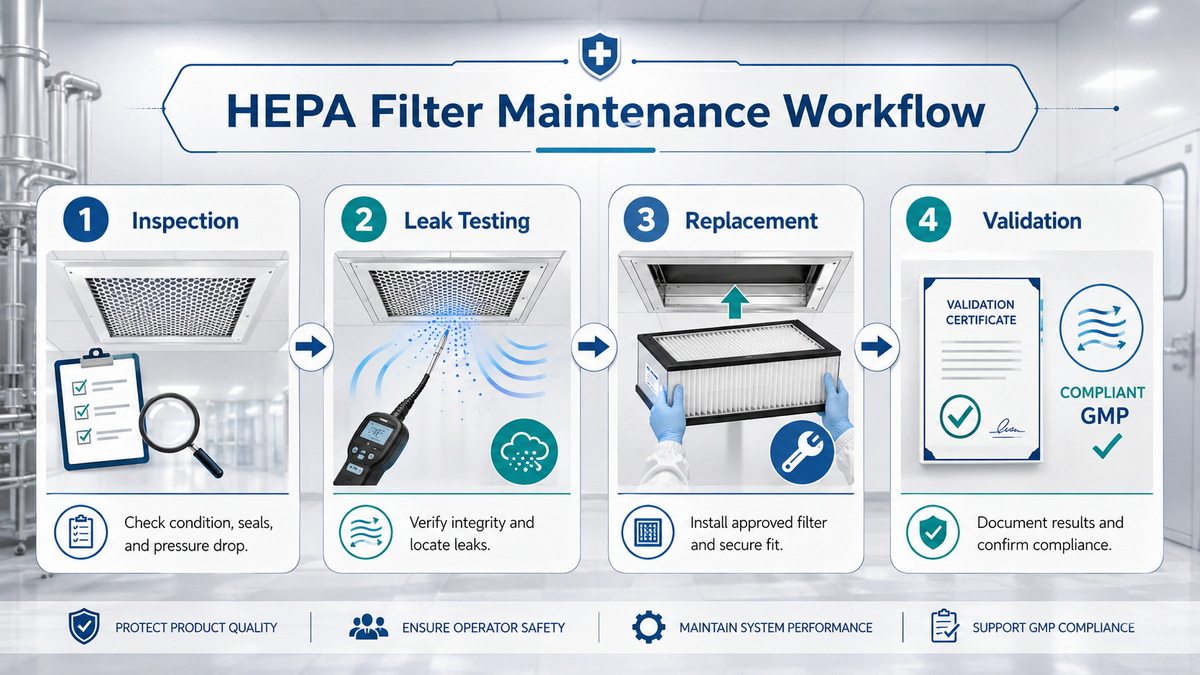
In GMP environments, the total cost of ownership includes more than the filter price. It also includes installation labor, integrity testing, downtime, and requalification. A filter that is cheaper upfront can become more expensive if it fails leak tests more often or requires earlier replacement.
Gel-seal filters can reduce the likelihood of seal-related failures, especially where vibration is persistent. Gasket-seal filters may be easier to handle, but they often require more attention to torque, alignment, gasket condition, and replacement timing. For validation teams, the key question is not only "Does it pass today?" but "Will it keep passing under operating stress?"
Best Use Cases for Each Type
Use gel-seal HEPA filters when:
- The environment has continuous or intermittent vibration.
- The room supports aseptic or high-containment pharmaceutical processes.
- Long requalification intervals are important.
- You want stronger protection against seal drift over time.
Use gasket-seal HEPA filters when:
- The HVAC system is lower risk and more conventional.
- Installation simplicity is a priority.
- Spare parts and maintenance familiarity matter more than maximum vibration resistance.
- The facility already has a validated gasket-based platform.
For a company designing complete pharmaceutical production infrastructure, this distinction is especially important. A purified water system, sterilization equipment, and formulation line may all operate correctly, but if the surrounding cleanroom filtration strategy is weak, contamination control can still suffer.
Practical Selection Checklist
Before choosing between gel-seal and gasket-seal HEPA filters, evaluate the following:
1. Vibration source intensity: identify pumps, compressors, fans, conveyors, and nearby machinery.
2. Cleanroom criticality: determine whether the room supports aseptic filling, formulation, weighing, or support functions.
3. Maintenance capability: assess whether staff can consistently install and inspect filters to specification.
4. Housing compatibility: confirm the frame design, knife-edge geometry, and allowable filter format.
5. Validation burden: consider how often integrity testing and requalification will be required.
6. Lifecycle cost: compare replacement frequency, downtime risk, and labor cost, not just purchase price.
This simple checklist often reveals that the cheapest option is not the most reliable option.
Expert Insight for Pharmaceutical Plants
From a pharma engineering perspective, seal integrity should be treated as part of contamination control strategy, not as a standalone consumable. In facilities that combine sensitive processes such as purified water preparation, large-volume solution preparation, and sterile production support, environmental stability is part of the total GMP system.
A strong design approach is to match the filter seal type to the actual mechanical environment. If vibration is expected, the filtration design should be selected with the same rigor used for utility systems and process skids. That approach reduces validation surprises and supports long-term operational consistency.
Conclusion
For high-vibration pharmaceutical environments, gel-seal HEPA filters usually provide superior long-term sealing integrity, while gasket-seal HEPA filters remain a practical option in lower-risk applications. The best choice depends on vibration level, validation demands, maintenance capability, and the criticality of the cleanroom. In pharma facilities, that decision should be made as part of a broader contamination control and lifecycle strategy, not as a simple component purchase.
Call to Action
If your project includes a pharmaceutical cleanroom, sterile production area, purified water system, or complete plant layout, align the HEPA filtration strategy with the actual vibration conditions of the facility. A tailored engineering review can help prevent seal leakage, reduce revalidation risk, and improve long-term GMP stability.
FAQ
1. Are gel-seal HEPA filters better than gasket-seal filters?
Yes, in high-vibration environments gel-seal filters usually offer more stable long-term sealing performance. Gasket-seal filters can still work well in lower-vibration settings.
2. Why does vibration affect HEPA filter integrity?
Vibration can loosen connections, deform sealing materials, and create small gaps that allow air bypass. Over time, this may reduce filtration reliability.
3. Which seal type is easier to maintain?
Gasket-seal filters are often easier to install and replace. Gel-seal filters may offer better stability, but they require compatible housings and careful handling.
4. Where are gel-seal HEPA filters most useful?
They are most useful in aseptic rooms, critical clean zones, and areas with continuous mechanical vibration from nearby equipment.
5. What should pharma plants consider before choosing a filter seal type?
They should assess vibration intensity, room criticality, housing compatibility, maintenance capability, and lifecycle cost.
References
1. Syntegon China, Drug product formulation systems: [https://www.syntegon.com.cn/solutions/pharma/drug-product-formulation-systems/]
2. Syntegon China, Pure media and formulation systems: [https://www.syntegon.com.cn/solution-finder/pharma/pure-media-and-formulation-systems/]
3. Centec GmbH, PW generator for pharmaceutical purified water: [https://www.centec.de/zh/product-page/pw-erzeuger]
4. Sino Pharmatec, Solution Preparation System: [https://pharmatec-gmp.com/product/Solution-Preparation-System.html]
5. Winatech Group, Aseptic formulation solutions: [http://winatechgroup.com/product/showproduct.php?id=13]
6. Shanghai Yideer, Sterile preparation solution system: [http://www.sh-ideal.com/cn/productsdetail.aspx?menuObjectId=FBA035D4-7B1B-4875-A303-2989829BC33E&objectId=B316CDD3-E1CF-45FE-A5A...]


