In pharmaceutical liquid preparation, precision is not a nice-to-have. It directly affects batch consistency, compliance, yield, and patient safety. That is why the debate between load cell integration and flow meter dosing matters so much in automated liquid dispensing. [tian-sure]
For plants producing large-volume preparations, lyophilized-drug solutions, anticancer formulations, and other high-value liquids, the right dosing architecture can improve repeatability and reduce rework. In many cases, the best choice depends on whether the process needs true mass control, fast inline feedback, or both. [psctexas]
What Load Cell Integration Means
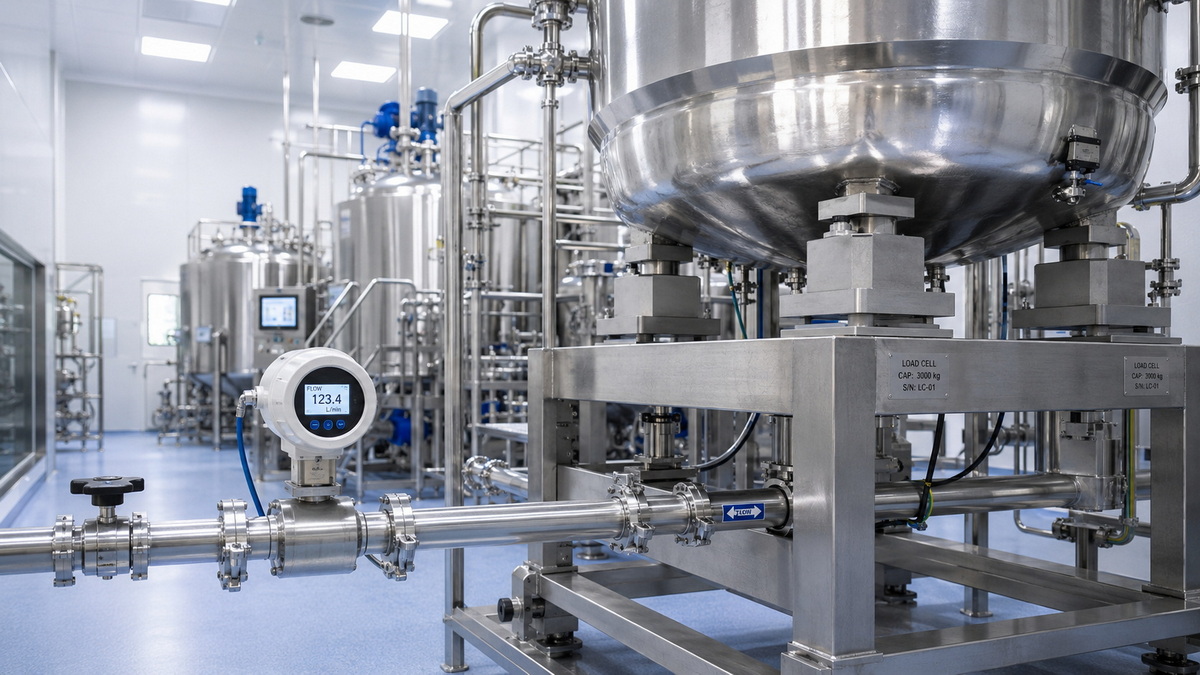
Load cell integration is a gravimetric dosing method. It measures the actual weight of a tank, vessel, or dispensing container and controls liquid addition based on mass change. In pharmaceutical systems, this approach is often favored when batch accuracy and traceability are critical. [palamaticprocess]
This method is especially useful when liquid density, temperature, or viscosity may vary. Because the system reads weight directly, it is less exposed to errors caused by fluid property changes than purely volumetric methods. That makes it a strong fit for formulation lines that must stay stable across multiple products and seasons. [kgrape.co]
What Flow Meter Dosing Means
Flow meter dosing is a volumetric or mass-flow-based method that measures liquid moving through a pipe and uses that signal to control pump output. In practical terms, it gives you fast, inline visibility into what is happening during transfer or filling. [psctexas]
This approach is often attractive in continuous or semi-continuous dispensing because it can react quickly and support live correction. However, its accuracy depends heavily on meter type, fluid behavior, air entrainment, pulsation, and installation quality. A dosing pump alone is not enough for critical applications; measurement and correction are what make the system more reliable. [psctexas]
Accuracy Differences That Matter
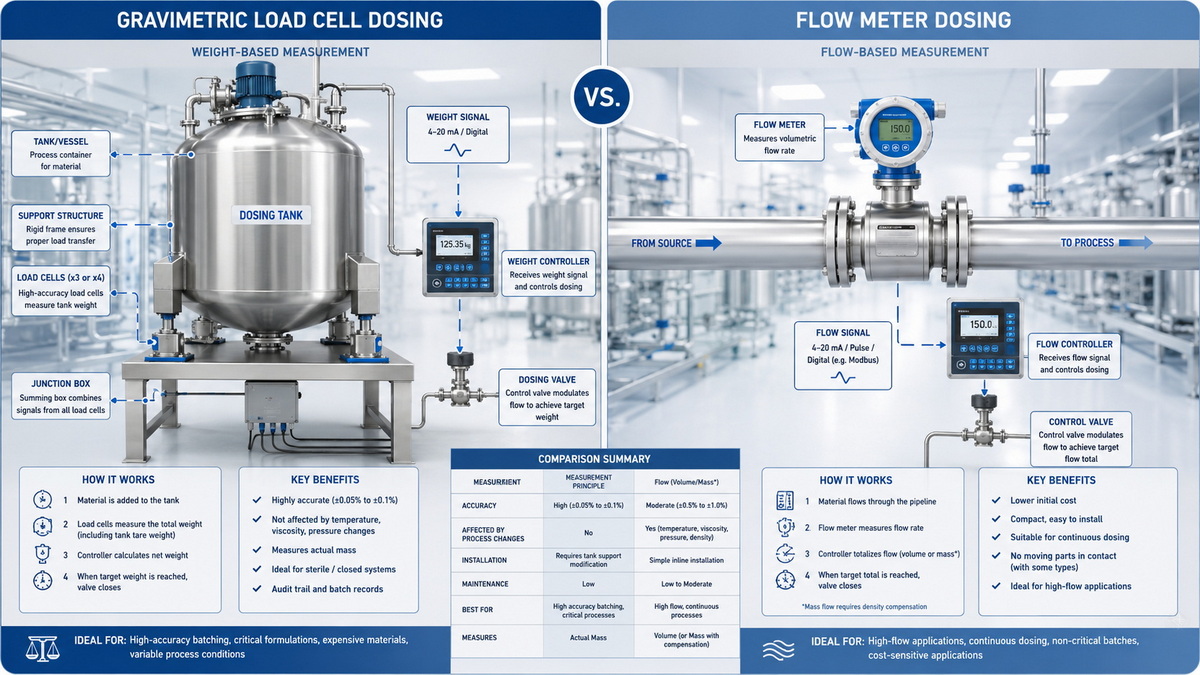
The biggest difference between the two methods is what they measure. Load cells measure the final mass in the vessel, while flow meters measure liquid movement in the line. That distinction influences accuracy, repeatability, and how the system behaves under real production conditions. [psctexas]
Load Cell Strengths
- Direct weight-based control.
- Less sensitive to density changes.
- Strong fit for batching and recipe verification.
- Easier to relate to final batch mass.
- Good for closed tanks and integrated formulation vessels. [palamaticprocess]
Flow Meter Strengths
- Fast inline measurement.
- Better for continuous dosing and transfer.
- Useful for real-time pump correction.
- Compact and responsive in pipe-based systems.
- Strong for automated liquid dispensing where speed matters. [psctexas]
Accuracy Trade-off
In practice, load cell systems often win when the target is batch-level precision, while flow meter systems often win when the target is process responsiveness. If your product is expensive, potent, or highly regulated, the final gravimetric check from load cells can be especially valuable. If your line needs high throughput and dynamic control, flow-based feedback may be more efficient. [psctexas]
GMP and Validation Considerations
From a GMP perspective, the key question is not only "which is accurate," but also "which is easier to validate, document, and keep in control." Pharmaceutical formulation systems must support repeatability, traceability, and data integrity across campaigns. [tian-sure]
Load cell systems are often easier to explain to auditors because the control logic ties directly to weight, which is intuitive for batch records. Flow meters can still be fully compliant, but they require strong attention to calibration, installation conditions, and signal stability. In regulated facilities, validation effort should be considered part of the total cost of ownership, not an afterthought. [psctexas]
Maintenance and Reliability
Maintenance is where many real-world decisions are made. Load cells are mechanically simple in concept, but they can be affected by vibration, structural loading, misalignment, and tank support issues. Flow meters, by contrast, can be influenced by fouling, bubble formation, pulsation, and flow-profile disturbance. [psctexas]
For pharmaceutical plants, reliability should be measured in more than uptime. It should include calibration stability, cleaning compatibility, integration with PLC/SCADA, and the operator's ability to troubleshoot quickly. A system that is theoretically accurate but difficult to maintain will create hidden losses over time. [tian-sure]
Best Fit by Application
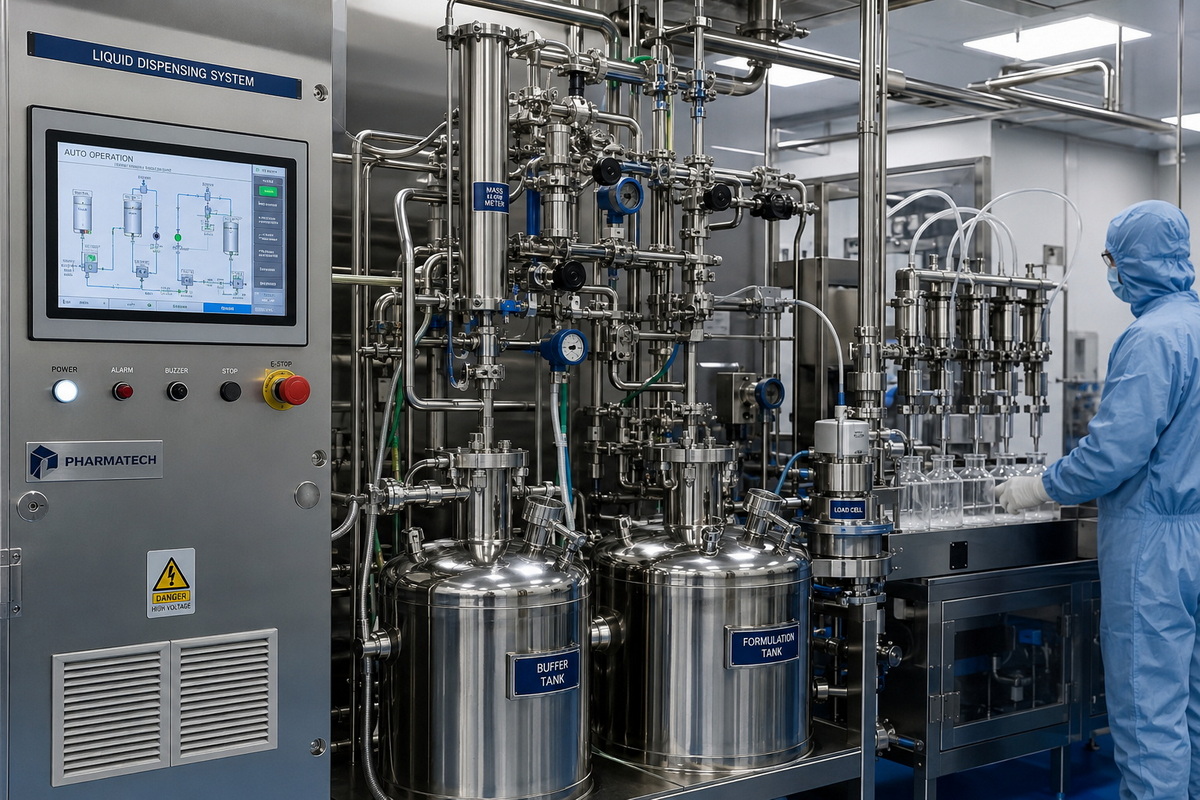
The right selection depends on the production scenario, not on one technology being universally "better." In a large-volume preparation system, you may even combine both methods: load cells for batch verification and flow meters for transfer control. That hybrid architecture is often the most robust choice in modern pharmaceutical plants. [psctexas]
| Application Scenario | Better Choice | Why |
| Large batch compounding | Load cell integration | Direct mass measurement supports final batch accuracy. (palamaticprocess) |
| Continuous liquid transfer | Flow meter dosing | Inline feedback improves response speed. (psctexas) |
| High-value or potent drugs | Load cell integration | Better for precise batch verification and reduced deviation risk. (patheon) |
| Fast-moving production lines | Flow meter dosing | Supports real-time correction and throughput. (psctexas) |
| Variable-density liquids | Load cell integration | Weight is less affected by fluid property changes. (palamaticprocess) |
A Practical Selection Framework
A simple selection rule can save weeks of debate. Start with the question of whether the process is fundamentally batch-based or flow-based. Then look at product sensitivity, required precision, cleaning strategy, and validation burden. [tian-sure]
1. Define the acceptable dosing error window.
2. Identify whether the process is batch, semi-batch, or continuous.
3. Check whether fluid density or viscosity changes between recipes.
4. Review cleaning and sterilization requirements.
5. Compare calibration and validation workload.
6. Estimate the cost of deviation, rework, or scrapped material.
If the cost of dosing error is high, gravimetric control usually deserves serious attention. If production speed and live correction matter more, inline flow measurement may be the better investment. [psctexas]
Expert View from Pharmaceutical Line Design
From a plant-design perspective, the best systems are often built around process intent, not device preference. For purified water preparation, pharmaceutical solution preparation, and other high-compliance systems, the dosing layer should match the validation model, cleaning design, and recipe complexity. [njtsjx]
In our experience as a pharmaceutical equipment manufacturer, customers usually gain the most when dosing technology is selected together with the full line layout, not in isolation. That is especially true for turnkey preparation systems, where tanks, pumps, valves, control logic, and sanitation architecture must all work as one. [syntegon.com]
Industry Trends Worth Noting
The industry is moving toward smarter dosing systems that combine automation, feedback correction, and data traceability. Recent discussions in pharmaceutical and process engineering continue to emphasize dosing precision, GMP compatibility, and digital control as core procurement criteria. [cnblogs]
That trend favors systems that can do more than just "move liquid." Buyers increasingly expect recipe management, batch record support, alarm handling, and integration with plant-wide automation. In that environment, both load cells and flow meters remain relevant, but they are increasingly part of a broader digital process control strategy. [tian-sure]
CTA Placement
A strong CTA should appear after the selection framework and again at the end. The message should connect the article to a practical business outcome: better line design, lower deviation risk, and faster project execution. For example: "Plan your pharmaceutical liquid preparation line with a dosing architecture built for GMP precision."
FAQs
1. Is load cell integration more accurate than flow meter dosing?
Often yes for batch-level mass accuracy, because load cells measure actual weight directly. Flow meters can still be very accurate, but they are more dependent on fluid conditions and installation quality. [psctexas]
2. Which method is better for pharmaceutical liquid dispensing?
It depends on the process. Load cells usually suit batch compounding and final verification, while flow meters suit continuous dosing and fast inline correction. [palamaticprocess]
3. Can both technologies be used together?
Yes. Many advanced systems use flow meters for real-time control and load cells for batch confirmation, which improves both speed and confidence. [tian-sure]
4. Which is easier to validate under GMP?
Load cell systems are often easier to explain and document because the control basis is direct weight measurement. Flow meters can also be validated, but they usually need tighter attention to calibration and process conditions. [patheon]
5. What matters most when choosing a dosing system?
Accuracy requirement, product sensitivity, batch size, cleaning needs, validation workload, and total cost of ownership should all be reviewed together. [palamaticprocess]
Reference
1. Syntegon China, "Pharmaceutical formulation systems." [https://www.syntegon.com.cn/solution-finder/pharma/pharmaceutical-formulation/] [syntegon.com]
2. Syntegon China, "Pure media and formulation systems." [https://www.syntegon.com.cn/solution-finder/pharma/pure-media-and-formulation-systems/] [syntegon.com]
3. Ningbo medical water equipment product page, formulation-related pharmaceutical water equipment overview. [https://www.njtsjx.com/njtsjx918-Products-4487298/] [njtsjx]
4. Palamatic Process, "How to select your dosing system?" [https://www.palamaticprocess.com/en-us/blog/how-select-your-dosing-system] [palamaticprocess]
5. PSCTexas, "How to Improve Dosing Pump Performance with Flow Meters." [https://psctexas.com/how-can-you-improve-your-dosing-pump-performance-with-flow-meters/] [psctexas]
6. Patheon, "Pharmaceutical Formulation Development: Principles & Process." [https://www.patheon.com/us/en/insights-resources/blog/inside-pharmaceutical-formulation-development.html] [patheon]
7. PMC article on automated liquid medication dispensing accuracy. [https://pmc.ncbi.nlm.nih.gov/articles/PMC10647870/] [pmc.ncbi.nlm.nih]
8. Deepagents industry article on dosing systems and GMP trends. [https://www.cnblogs.com/deepagents/articles/20158347] [cnblogs]


