Article
In pharmaceutical water treatment, sub-micron filtration and ultrafiltration (UF) are often discussed as if they solve the same problem. They do not. In purified water systems, the right choice depends on whether your priority is particle reduction, bacterial control, or true endotoxin management. [manufacturing-journal]
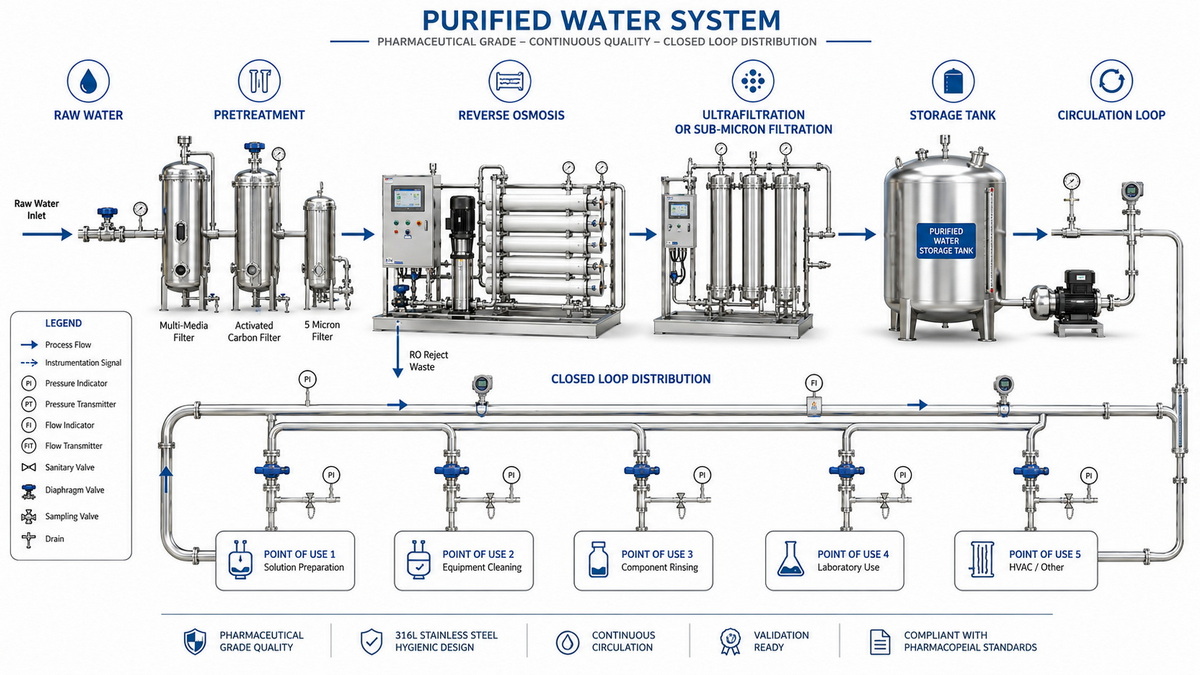
Why endotoxin control matters in purified water systems
Endotoxins are fragments of Gram-negative bacterial cell walls that can trigger pyrogenic reactions and pose a serious risk in pharmaceutical manufacturing. Regulatory and pharmacopoeial expectations for downstream drug safety make endotoxin control a design issue, not just a testing issue. For water used in high-risk or aseptic applications, this means the water loop, storage, and point-of-use design must all support contamination control. [gmp-compliance]
In practice, this is why many manufacturers evaluate filtration not only by pore size, but by how reliably the whole system lowers bioburden and endotoxin risk. That broader system view is especially important for companies planning complete Purified Water Preparation Systems, where pre-treatment, membrane selection, storage hygiene, and distribution layout all affect final water quality. [membrane-solutions.com]
Sub-micron filtration explained
Sub-micron filtration usually refers to microporous filtration in the approximate range of 0.05 to 0.22 micron, depending on application and membrane type. It is designed to remove fine particulates, colloids, and many bacteria, but it is not primarily an endotoxin-removal technology. In other words, it improves water cleanliness, but it does not always provide a strong endotoxin barrier. [us.elgalabwater]
This makes sub-micron filtration useful as a protective and polishing step in a purified water train. It can reduce downstream fouling, improve stability, and help protect more sensitive membranes or final-use points. However, when endotoxin control is the main target, sub-micron filtration alone is usually not the best final solution. [gmp-compliance]
Ultrafiltration explained
Ultrafiltration uses a much tighter membrane, commonly in the 0.001 to 0.01 micron range, and is far better suited to retaining macromolecules, colloids, bacteria, and endotoxin-associated contamination. Industry sources consistently describe UF as especially effective for endotoxin reduction in water systems. In pharmaceutical water applications, that makes UF a stronger choice when the process goal is low endotoxin risk, not just clearer water. [manufacturing-journal]
UF is often selected where the water system feeds sensitive biotech, injectable, or high-purity operations. It is also favored when the plant wants a non-thermal purification step that can be integrated into a compact skid. Still, UF must be designed and validated correctly, because membrane performance depends on feed quality, sanitization strategy, and operational discipline. [gmp-compliance]
Side-by-side comparison
| Factor | Sub-Micron Filtration | Ultrafiltration (UF) |
| Typical pore range | About 0.05–0.22 micron (us.elgalabwater) | About 0.001–0.01 micron (us.elgalabwater) |
| Main purpose | Fine particle and bacterial reduction (us.elgalabwater) | Endotoxin, bacteria, and colloid reduction (manufacturing-journal) |
| Endotoxin removal strength | Limited to moderate, depending on membrane and system design (gmp-compliance) | Strong, especially for water and low-binding feeds (manufacturing-journal) |
| Best use case | Polishing, prefiltration, fouling protection (us.elgalabwater) | High-purity water, sensitive pharma and biotech use (manufacturing-journal) |
| Cost and complexity | Usually lower | Usually higher |
| Validation burden | Moderate | Higher, because performance must be proven in context |
| Main risk | False confidence if used as the only endotoxin barrier | Poor performance if sanitization or pretreatment is weak |
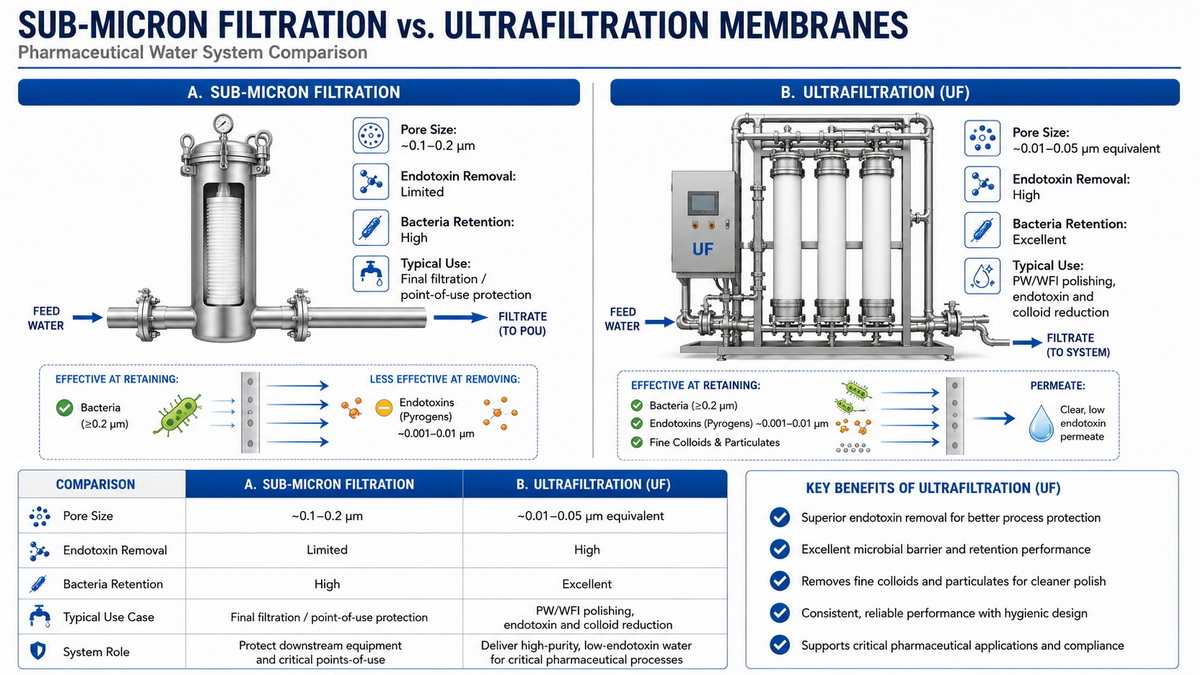
Which one removes endotoxin better?
If the goal is endotoxin removal, UF is generally the stronger technology. That is because its membrane structure is tighter and more suitable for retaining endotoxin-related contamination in pharmaceutical water. Sub-micron filtration helps improve water quality, but it is usually better understood as a support step rather than the primary endotoxin-control layer. [manufacturing-journal]
That said, a water system should never rely on membrane selection alone. Endotoxin risk also depends on raw water quality, carbon bed control, RO performance, storage tank hygiene, loop velocity, sanitization method, and point-of-use design. A well-built system with upstream control can often outperform a poorly managed system with a technically "better" membrane. [gmp-compliance]
How to choose the right technology
A practical selection process should start with the actual end use of the water. If the water is mainly supporting cleaning, general formulation, or noncritical utility functions, sub-micron filtration may be adequate as part of a broader train. If the water feeds sensitive production steps, biotech processing, or endotoxin-sensitive applications, UF deserves serious consideration. [gmp-compliance]
Use these questions to guide selection:
1. What is the water used for?
2. What endotoxin risk exists at the point of use?
3. Is the system intended for purified water only, or as feed for WFI or pure steam generation?
4. Can the plant support regular sanitization and integrity checks?
5. Does the layout minimize stagnation, dead legs, and microbial re-growth? [fda]
For OEM and project teams, the best answer is usually not "one membrane replaces everything." It is "the membrane must fit the process, and the process must fit the compliance target." [membrane-solutions.com]
Design considerations for pharma plants
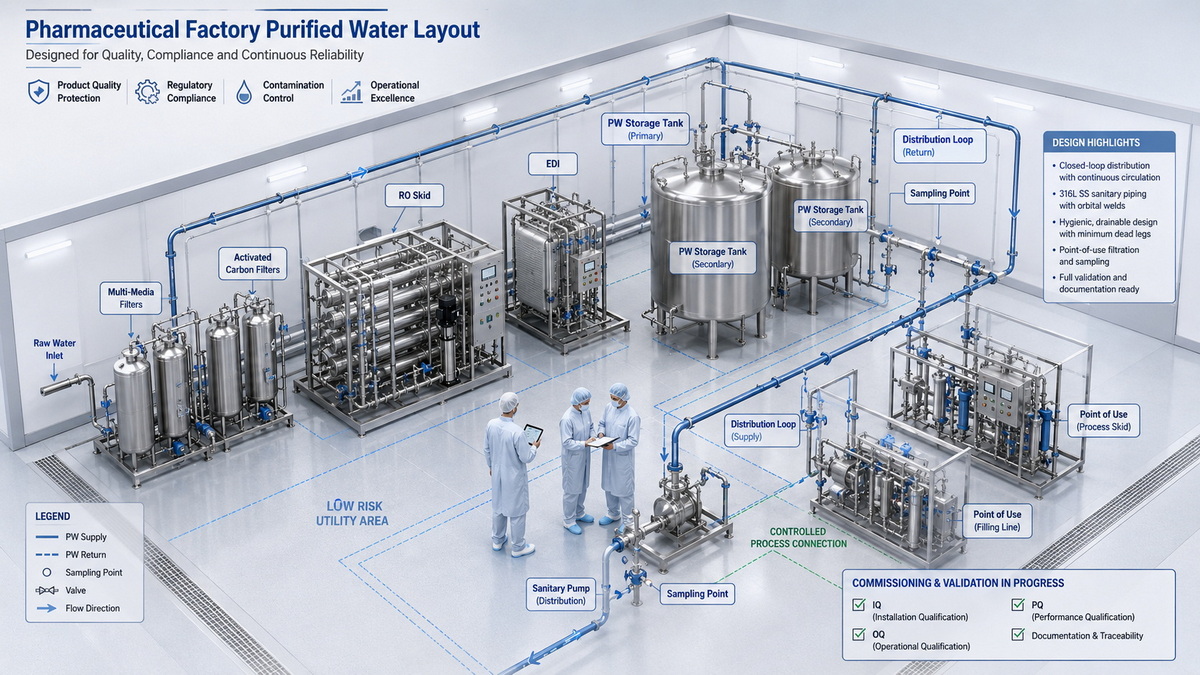
For buyers planning a complete purified water line, filtration should be evaluated together with the entire water architecture. Pretreatment, RO, UF or polishing filtration, storage, circulation, and distribution all influence endotoxin control. If any one segment is poorly designed, the whole system can become difficult to validate. [membrane-solutions.com]
From an engineering perspective, the most important design factors include:
- Feed water quality, because membrane life and performance depend on pretreatment.
- Loop hygiene, because stagnant water encourages biofilm formation.
- Sanitization strategy, thermal or chemical depending on system design.
- Instrumentation and monitoring, including conductivity, TOC, temperature, and microbial control.
- Point-of-use design, to avoid dead legs and contamination traps. [fda]
This is where an experienced equipment supplier adds real value. A manufacturer like Ningbo Everheal Medical Equipment Co., LTD. can support not only equipment supply, but also plant layout, process integration, and production-line planning for pharmaceutical customers that need a complete system rather than a single component. [everhealgroup]
Industry insight for 2026
The broader water-treatment market is moving toward higher purification performance, measurable contaminant reduction, and more reliable system quality. That trend is being driven by stronger expectations around safety, trace contaminants, and process consistency. In pharma manufacturing, the implication is clear: buyers now expect filtration decisions to be justified by risk, data, and validation logic rather than by marketing language alone. [market-prospects]
That shift also favors suppliers who can connect membrane choice to real plant outcomes. In other words, the competitive advantage is no longer just "we sell UF." It is "we can design a water system that performs, validates, and fits the plant's production goals." [everhealgroup]
Expert recommendation
From a technical and commercial standpoint, the strongest strategy is often a layered control approach. Use pretreatment to protect the system, use sub-micron filtration where it adds value, and use UF when endotoxin risk is the defining requirement. This gives you better reliability than forcing one membrane to solve every problem. [manufacturing-journal]
For high-value pharmaceutical projects, the decision should be made with a full risk assessment, not only a catalog specification. If the plant is producing endotoxin-sensitive products, UF is usually the more defensible choice. If the objective is general polishing and protection, sub-micron filtration can be more economical and easier to operate. [gmp-compliance]
Practical operation checklist
To improve real-world performance, follow this workflow:
1. Verify feed-water pretreatment is stable.
2. Confirm the membrane stage matches the target contaminant.
3. Establish sanitization frequency before contamination rises.
4. Test water quality at both system and point-of-use locations.
5. Review endotoxin risk during qualification and routine revalidation. [gmp-compliance]
This checklist is especially useful for engineers, validation teams, and procurement managers who need to balance compliance, cost, and uptime. It also supports better project communication between equipment suppliers and pharmaceutical plant owners. [everhealgroup]
CTA
If your project requires a purified water system with endotoxin-control-focused membrane design, the next step is a process review, not a product-only quote. A tailored layout, membrane selection, and distribution plan can materially improve validation success and long-term operating stability. [everhealgroup]
Image and video placement suggestions
Place visuals at the following points to improve UX:
- After the introduction: a simple system flow diagram showing raw water → pretreatment → RO → UF/sub-micron filtration → storage → distribution.
- In the comparison section: a two-column membrane comparison chart.
- In the design considerations section: a factory layout illustration showing skid placement, tank placement, and loop routing.
- Near the checklist: a short process video explaining sanitization and sampling points.
AI image prompts
1. Purified water system diagram
"A clean pharmaceutical purified water treatment system schematic, showing raw water, pretreatment, reverse osmosis, ultrafiltration, storage tank, circulation loop, stainless steel piping, technical style, white and blue color palette, high detail, infographics, modern industrial design."
2. Membrane comparison visual
"A professional side-by-side industrial infographic comparing sub-micron filtration and ultrafiltration membranes in pharmaceutical water systems, labeled pore size, endotoxin removal, bacteria retention, and use case, minimal clean layout, high readability."
3. Pharma plant layout
"A modern pharmaceutical factory layout with purified water skid systems, stainless steel tanks, distribution loop, validation team, cleanroom environment, isometric view, realistic technical illustration, white and light blue tones."
FAQ
1. Is sub-micron filtration enough for endotoxin removal?
Usually not as the primary solution. It helps reduce particulates and bacteria, but UF is generally stronger for endotoxin-focused applications. [manufacturing-journal]
2. Why is UF better for pharmaceutical purified water?
Because UF has much smaller pores and is more effective at retaining endotoxin-related contamination and fine bioburden. [manufacturing-journal]
3. Does purified water always need endotoxin testing?
Not always. Pharmacopoeial requirements for purified water do not generally require endotoxin testing, but testing can be appropriate for biotech, WFI feed, or high-risk uses. [gmp-compliance]
4. Can UF replace RO in a water system?
No. UF and RO serve different functions, and UF is typically a polishing or control step rather than a substitute for RO pretreatment and desalting. [membrane-solutions.com]
5. What should pharma buyers focus on besides the membrane?
They should focus on sanitization, loop design, pretreatment stability, monitoring, and validation strategy. Those factors often determine the real-world endotoxin outcome. [gmp-compliance]
Reference
1. ELGA LabWater. "Sub-micron Filtration." [https://us.elgalabwater.com/technologies/sub-micron-filtration] [us.elgalabwater]
2. Manufacturing Journal. "Why Ultrafiltration Is Critical for Endotoxin Removal." [https://manufacturing-journal.net/press-release/4337-why-ultrafiltration-is-critical-for-endotoxin-removal] [manufacturing-journal]
3. ECA Academy. "Does Purified Water have to be tested for Endotoxins?" [https://www.gmp-compliance.org/gmp-news/does-purified-water-have-to-be-tested-for-endotoxins] [gmp-compliance]
4. FDA. "Pyrogen and Endotoxins Testing: Questions and Answers." [https://www.fda.gov/regulatory-information/search-fda-guidance-documents/pyrogen-and-endotoxins-testing-questions-and-answers] [fda]
5. FDA. "The Bacterial Endotoxins Specification – Points to Consider." [https://www.fda.gov/media/183132/download] [fda]
6. Market Prospects. "Drinking Water Treatment Trends in 2026." [https://www.market-prospects.com/articles/drinking-water-treatment-trends-2026-pfas-microplastics] [market-prospects]
7. Research Nester. "Water Purification Systems Market Size & Share." [https://www.researchnester.com/reports/water-purification-systems-market/6505] [researchnester]
8. Everheal official website. [https://www.everhealgroup.com] [everhealgroup]


