Designing or upgrading a Water for Injection (WFI) distribution loop is a strategic decision that directly affects microbiological risk, energy cost, and regulatory compliance for any modern pharmaceutical plant. As a manufacturer of advanced filling and sealing lines (FFS, BFS) and turnkey pharma production systems in China, our team at Ningbo Everheal Medical Equipment has supported multiple clients in choosing between ozone and hot water sanitization for new WFI loops and retrofits. From both an engineering and validation perspective, this is no longer a "one size fits all" question: the effectiveness of each approach depends on water temperature regime, loop design, and your risk tolerance for biofilm and endotoxin. [everhealgroup]
Understanding WFI Distribution Loops and Sanitization Needs
Water for Injection is the highest purity water used in injectable products, typically distributed either as hot WFI (≈75–90°C) or as cold WFI (~15–25°C) in newer energy‑optimized systems. Regardless of temperature strategy, the distribution loop must maintain microbial control and prevent biofilm build‑up over years of operation, which is why a robust sanitization concept is critical. [ask.pharmaguideline]
Key challenges include:
- Continuous risk of microbial ingress from tank headspace, dead legs, and poorly circulated branches. [pdaisrael.co]
- Formation of biofilm on internal stainless‑steel surfaces if control measures or sanitization frequency are insufficient. [ask.pharmaguideline]
- Maintaining compliance with pharmacopoeias and cGMP expectations throughout the system lifecycle, not only at qualification. [europeanpharmaceuticalreview]
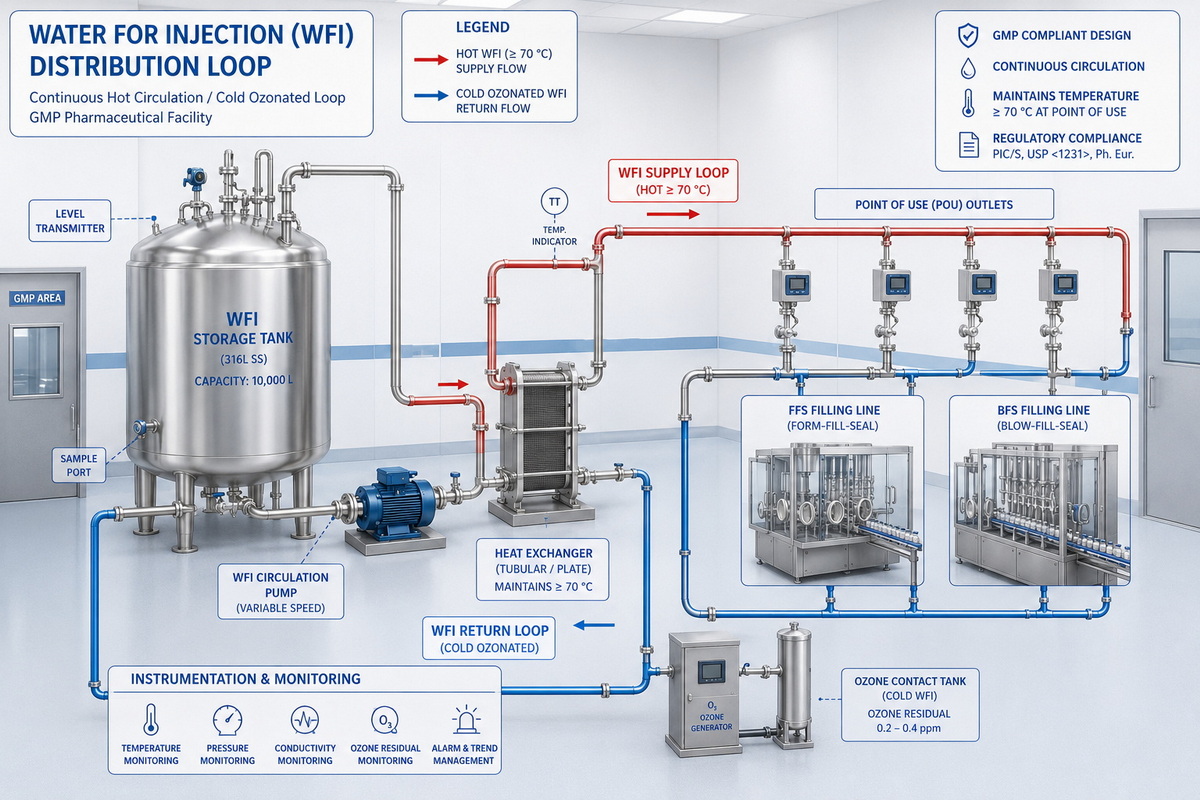
How Hot Water Sanitization Works in WFI Loops
In hot WFI systems, the loop is continuously operated at elevated temperature, typically 75–90°C, which already suppresses microbial growth and provides constant "background" sanitization. In addition, many designs include periodic high‑temperature cycles (≥121°C) for steam‑like sterilization, especially after maintenance or contamination events. [sacome]
Typical hot sanitization practice:
- Operational loop temperature: about 75–90°C for continuous circulation. [manufacturingchemist]
- Routine sanitization cycles: 65–80°C for 1–2 hours (per updated USP and industry forums) or superheating above 121°C under pressure when needed. [pdaisrael.co]
- Heat is delivered via heat exchangers and controlled through automated valves and temperature sensors. [sacome]
From a design engineer's viewpoint, a well‑insulated hot loop at ~80°C is extremely forgiving: even slightly cooler points can still reach temperatures above 60°C, which are sufficient for reliable microbial kill if exposure time is adequate. [ask.pharmaguideline]
Suggested image here:
- Temperature profile diagram of a hot WFI loop.
- AI prompt idea:
- "Scientific infographic of hot WFI loop temperature profile, stainless steel piping at 80–90°C, labeled sections for tank, distribution, return, minimalistic pharma style, blue and orange color gradient, vector art."
How Ozone Sanitization Works in Cold or Ambient WFI Systems
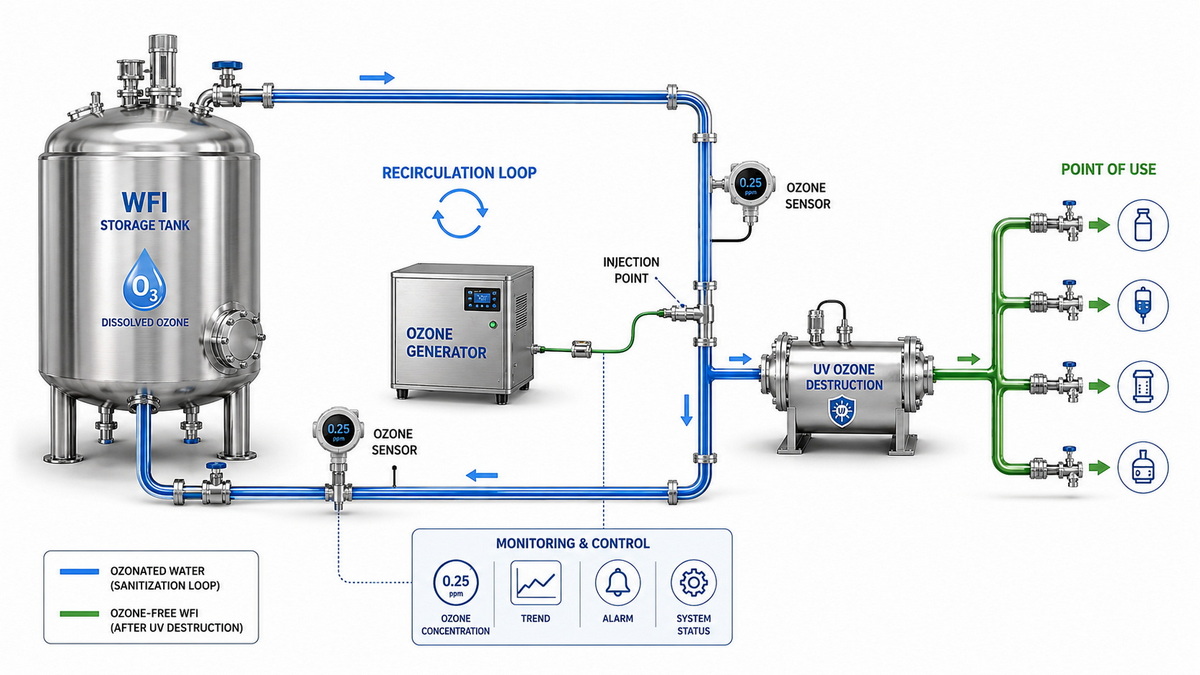
Ozone is a powerful oxidant that kills bacteria, viruses, and oxidizes organic impurities far faster than chlorine, making it attractive for cold or ambient WFI systems where continuous heat is not desired. In these designs, ozone is dissolved in the WFI storage tank and recirculated through the distribution loop, then destroyed via UV just before water reaches points of use. [blog.veoliawatertechnologies]
Key technical points:
- Ozone is most effective and stable between ~10–25°C; its half‑life drops sharply as temperature rises above ~35–40°C. [gmp-compliance]
- For short‑term sanitization (1–2 h) in ambient systems, ozone concentrations >50 ppb are often targeted, while continuous ozonation may use ≥20 ppb with longer contact times. [gmp-compliance]
- Residual ozone is typically removed using UV lamps placed before the WFI loop outlets, ensuring no ozone reaches product contact points. [manufacturingchemist]
Compared to hot systems, ozone sanitization is particularly suited when you want cold WFI for product or process reasons, or when energy consumption of hot storage and distribution is a major concern. [blog.veoliawatertechnologies]
Direct Comparison – Ozone Vs Hot Water for WFI Loops
Effectiveness, Reliability, and Validation
Hot WFI systems operated continuously at ≥75–80°C are widely regarded as the most effective and reliable method for microbiological control in WFI loops. Ozone‑based systems are effective, but their performance depends heavily on correct concentration, contact time, system cleanliness, and accurate online monitoring. [ispeboston]
From an industry expert perspective:
- Hot water
- Provides predictable microbial kill when loops are kept hot and periodic higher‑temperature cycles are applied. [pdaisrael.co]
- Easier to defend during audits because thermal sanitization has long regulatory history and clear guidance in pharmacopeias and industry best practice documents. [sacome]
- Ozone
- Delivers rapid kill of microbes and strong oxidation of organics, with reported 3–5 log reductions within a few minutes under suitable conditions. [ispeboston]
- Requires robust ozone measurement, control logic, and UV destruction to prove residual removal and avoid product impact. [manufacturingchemist]
Cost, Energy, and Sustainability
Continuous hot WFI loops impose high operating costs due to heating and insulation, especially in large facilities or multi‑building campuses. By contrast, calculations from industry presentations show that maintaining ozonated ambient systems can be 5–7 times cheaper per year than maintaining hot WFI at elevated temperatures. [pdaisrael.co]
Key cost drivers:
- Hot water
- High energy consumption for maintaining 75–90°C and for periodic 121°C sterilization cycles. [manufacturingchemist]
- Potential need for more robust insulation and heat recovery systems.
- Ozone
- Lower energy for water heating but added capital and operating cost for ozone generators, off‑gas destruction, UV systems, and safety controls. [ispeboston]
- Often favorable total lifecycle cost when cold WFI is acceptable for the process. [blog.veoliawatertechnologies]
Materials Compatibility, Safety, and Maintenance
Ozone is a strong oxidant and may attack elastomers, certain plastics, and even stainless steel surfaces over long exposure if materials are not carefully selected. Hot water, while thermally stressful, is generally more benign for correctly chosen 316L stainless steel and pharmaceutical‑grade gaskets. [linkedin]
- Safety
- Hot water hazards are familiar (burns, steam release) and can be mitigated with insulation and procedural controls.
- Ozone is a respiratory irritant and requires strict leak control, ventilation, and off‑gas destruction to protect personnel. [linkedin]
- Maintenance
- Hot systems must manage rouging and thermal expansion, but maintenance routines are well documented. [ask.pharmaguideline]
- Ozone systems require regular calibration of sensors, lamp replacement for UV units, and inspection of ozone‑exposed components. [gmp-compliance]
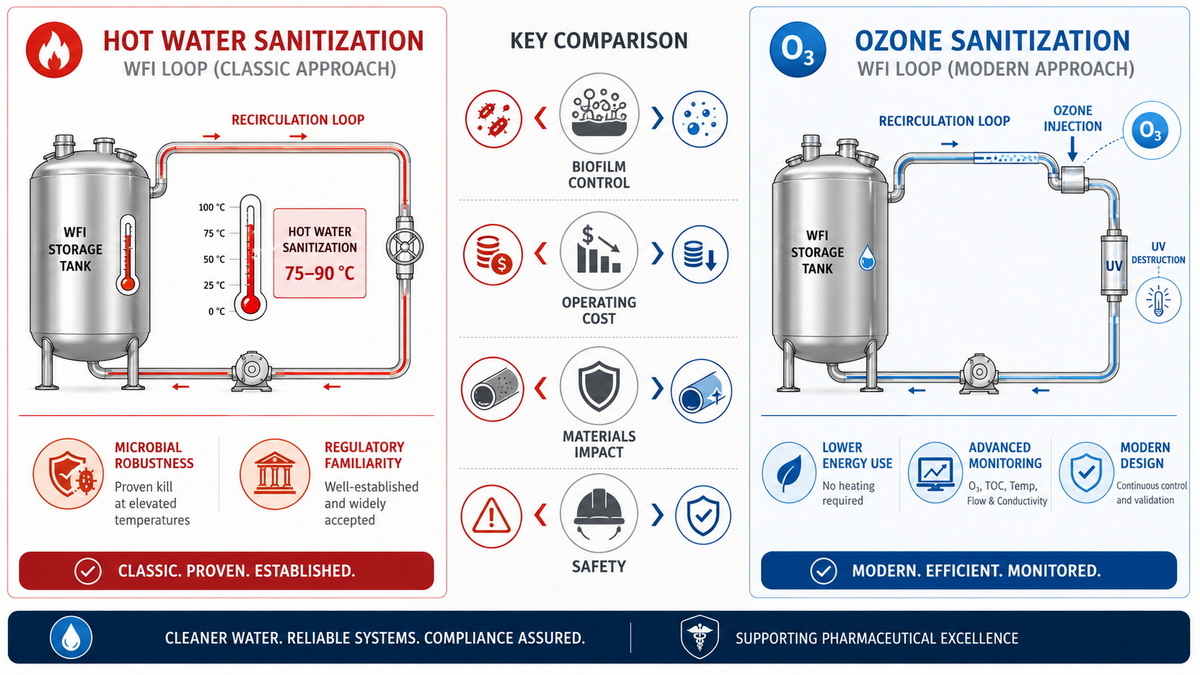
Ozone Vs Hot Water – Core Decision Matrix for WFI Loops
Engineer‑Friendly Overview Table
| Dimension | Hot Water Sanitization (Hot WFI) | Ozone Sanitization (Cold/Ambient WFI) |
| Typical operating temp | Loop at 75–90°C, periodic 121°C cycles possible (ask.pharmaguideline) | Loop at ~10–25°C with ozone; residuals removed by UV (gmp-compliance) |
| Microbial control | Very strong, continuous at high temp, robust against excursions (pdaisrael.co) | Strong when ozone level and contact time tightly controlled (gmp-compliance) |
| Biofilm management | Excellent for preventing biofilm; hot cycles help disrupt layers (linkedin) | Can control early biofilm; less effective on mature, established biofilm (linkedin) |
| Regulatory perception | Long track record; widely preferred by FDA, EMA, WHO (linkedin) | Accepted but seen as more complex to validate and monitor (gmp-compliance) |
| Energy footprint | High, especially for large loops and 24/7 hot operation (pdaisrael.co) | Lower heating cost; added power for ozone and UV systems (blog.veoliawatertechnologies) |
| Operating cost | Medium to high, dominated by heat energy use (pdaisrael.co) | Often lower; some studies show 5–7× cheaper vs hot systems (pdaisrael.co) |
| Materials & wear | Thermal stress and rouging; manageable with proper design (ask.pharmaguideline) | Oxidative stress on elastomers and plastics; careful material selection needed (linkedin) |
| Safety profile | Familiar high‑temp hazards; well‑understood controls (ask.pharmaguideline) | Ozone exposure risk; requires leak detection and off‑gas destruction (linkedin) |
| Best fit scenarios | High‑risk injectables, strict regulators, multi‑use hot WFI demand (sacome) | Energy‑sensitive plants, cold WFI requirement, advanced monitoring capability (blog.veoliawatertechnologies) |
Hybrid Strategies – When "Hot Vs Ozone" Becomes "Hot + Ozone"
Modern pharma plants do not always treat this as a binary choice; hybrid concepts are increasingly deployed to balance robustness and energy efficiency. For example, some facilities use cold WFI with continuous ozonation, combined with periodic hot water sanitization or superheating to >121°C as an additional safety layer or contingency mode. [pdaisrael.co]
Common hybrid approaches:
- Cold WFI distribution with continuous low‑level ozone plus periodic hot water flushes. [manufacturingchemist]
- Hot WFI storage with ambient loops that receive ozone sanitization on a scheduled basis. [pdaisrael.co]
- System designs that can switch between hot and cold operation, using ozonation during cold phases and thermal cycles after major maintenance. [manufacturingchemist]
For global manufacturers focused on flexibility, energy savings, and Annex 1 compliance, these hybrids offer a practical way to phase in cold WFI without sacrificing sterility assurance.
Expert Design Considerations for New WFI Loops
As a turnkey pharma equipment supplier, we see a consistent set of questions from engineering teams when they evaluate ozone vs hot water for a new WFI loop.
1. Product and Process Requirements
- Do your products or processes require cold WFI (for stability or process design)? If yes, ozone (potentially with hybrid hot back‑up) is usually the more logical anchor. [blog.veoliawatertechnologies]
- If your entire aseptic strategy is built around hot WFI availability, hot water sanitization remains the simplest and strongest baseline. [sacome]
2. Regulatory Strategy and Site History
- Sites with a history of microbial deviations or biofilm events often favor hot systems because they are easier to justify to regulators and internal QA. [ask.pharmaguideline]
- For new plants targeting global submissions, hot WFI loops are still seen as the "low‑argument" option in inspections, while ozone requires more detailed data packages, including on‑line monitoring trends and ozone decay mapping. [ispeboston]
3. Lifecycle Cost and Sustainability
- If corporate ESG targets emphasize energy reduction, cold WFI with ozone (plus robust control) can deliver significant operational cost savings versus permanently hot loops. [blog.veoliawatertechnologies]
- A structured total cost of ownership (TCO) model should compare capex and 10–15 year opex, including energy, maintenance, downtime, and validation overhead for both options. [pdaisrael.co]
Practical Implementation Steps for Pharma Engineering Teams
To move from concept to a validated system, engineering and QA teams should follow a structured decision and implementation process.
Step‑By‑Step Approach
1. Define the user requirement specification (URS)
- Specify whether WFI must be delivered hot, cold, or both, and define microbial and endotoxin limits at each point of use. [europeanpharmaceuticalreview]
2. Select temperature and sanitization concept
- Choose hot, cold, or hybrid WFI distribution and decide whether thermal, ozone, or combined sanitization best fits URS and regulatory expectations. [sacome]
3. Perform design qualification (DQ)
- For ozone: define target ozone concentrations, monitoring points, and UV destruction capacity across the loop. [gmp-compliance]
- For hot water: verify that all loop locations reach required temperatures and dwell times, including dead legs and low‑flow branches. [ask.pharmaguideline]
4. Plan installation qualification (IQ) and operational qualification (OQ)
- Ensure correct material certificates, surface finish, weld documentation, and that all sensors for temperature and ozone are correctly installed and calibrated. [europeanpharmaceuticalreview]
5. Execute performance qualification (PQ)
- Demonstrate that routine operation and sanitization cycles consistently meet microbial specifications over a defined period (often several weeks to months). [europeanpharmaceuticalreview]
6. Establish lifecycle monitoring and trending
- Implement routine microbiological sampling, TOC, conductivity, and—where relevant—ozone residual monitoring at critical points. [europeanpharmaceuticalreview]
Where Ningbo Everheal's Expertise Fits into Your WFI Strategy
For clients designing or upgrading filling and sealing production lines, WFI strategy and process equipment must be aligned from the early layout stage. Our engineering team regularly works with pharma manufacturers to:
- Integrate FFS and BFS machines with hot or cold WFI loops, ensuring point‑of‑use temperatures, flow rates, and sanitization strategies match product and process needs. [everhealgroup]
- Support layout and piping design for cleanrooms, WFI distribution, and CIP/SIP connections, optimizing loop length, slopes, and drainability.
- Provide input on sanitization concepts (hot, ozone, or hybrid) that best suit your regulatory targets and utilities infrastructure, while protecting machine uptime and long‑term reliability. [everhealgroup]
If you are planning a new aseptic line or modernizing an existing facility, our combined experience in process equipment and water systems allows us to guide you to a sanitization strategy that is technically sound and inspection‑ready.
So, Which Is More Effective – Ozone or Hot Water?
From a pure robustness and regulatory comfort perspective, hot water sanitization is generally more effective and forgiving for WFI distribution loops, particularly when operated continuously at 75–90°C with the ability to run 121°C sterilization cycles when needed. However, when energy consumption and sustainability are critical, and when the process requires cold WFI, ozone‑based systems or hot–ozone hybrids can achieve comparable microbiological performance with lower lifecycle costs—provided that the plant invests in strong monitoring, control, and validation. [ispeboston]
In practice, the "most effective" solution is the one that matches your temperature regime, risk profile, and regulatory strategy, not just the one with the strongest theoretical kill rate.
Call to Action: Plan Your Next WFI Loop with Integrated Filling Lines
If your team is currently evaluating Ozone vs Hot Water for a new or upgraded WFI distribution loop, we recommend involving both water system and filling line stakeholders early. Our engineers at Ningbo Everheal can help you perform a concept review of your target WFI strategy, loop layout, and integration with filling and sealing equipment, so that your final design is microbiologically robust, energy‑efficient, and aligned with your regulatory roadmap. [everhealgroup]
Reach out to our technical team to discuss your WFI concept, layout options, and equipment integration for FFS, BFS, and other critical aseptic lines.
FAQs: Ozone Vs Hot Water in WFI Distribution Loops
Q1: Is ozone sanitization acceptable for WFI loops under current regulations?
Yes. Ozone is accepted by regulators when properly controlled and validated, but hot water still enjoys broader historical use and simpler justification during inspections. [gmp-compliance]
Q2: Can I convert an existing hot WFI loop to an ozonated cold system?
Conversion is possible but complex: it requires re‑engineering of heat exchangers, insulation strategy, ozone injection, UV destruction, automation, and a full re‑qualification of the water system. [blog.veoliawatertechnologies]
Q3: Does ozone completely replace the need for periodic hot sanitization?
Not necessarily. Many sites use hybrid concepts where ozone provides routine microbial control and hot sanitization remains a back‑up for heavy contamination events or after major maintenance. [ispeboston]
Q4: Which approach is better for minimizing biofilm formation?
Continuous hot WFI operation is generally more effective at preventing biofilm formation; ozone can control early biofilms but may struggle against mature layers in complex piping. [linkedin]
Q5: How should I choose between hot water and ozone for a new greenfield plant?
Start from your WFI temperature requirement, regulatory strategy, and ESG/energy targets, then work with process and utility experts to compare TCO and risk; many manufacturers ultimately choose hot WFI or a hybrid as a balanced solution. [sacome]
References
1. GMP‑Compliance. "Ozone Concentration during the Sanitization of PW and WFI Systems." [Link]. [gmp-compliance]
2. Veolia Water Technologies. "Why pharmaceutical manufacturers are moving to cold WFI systems." 2026. [Link] [blog.veoliawatertechnologies]
3. PDA / industry presentation. "PowerPoint – Ozone in PW & WFI Storage Systems – Microbial Control Methods and Cost Comparison." [Link] [pdaisrael.co]
4. Pharmaguideline Forum. "WFI loop sanitation temperature – USP 1231 update and practical guidance." [Link] [ask.pharmaguideline]
5. SACOME. "Loops of Purified Water (PW) and Water for Injection (WFI)." [Link] [sacome]
6. Manufacturing Chemist. "Beyond WFI generation: safe and efficient distribution of water for injection." [Link] [manufacturingchemist]
7. LinkedIn – Sanjay Badani. "Why Hot Water Sanitization is Better than Ozone Sanitization in a Purified Water Loop." [linkedin]
8. ISPE Boston. "Ozone Sanitization – Technical Presentation." [ispeboston]
9. Everheal Group. "BFS Machine Manufacturer – EVERHEAL." [everhealgroup]


