Laboratory glassware sterilization is not just about reaching the right temperature. It is about how much you can process per cycle, how evenly steam or hot air reaches every surface, and how efficiently your team uses floor space and labor. For pharmaceutical and laboratory operations, the choice between horizontal and vertical sterilization cabinets can materially affect throughput, workflow, and long-term operating cost. [winatechgroup]
For facilities planning clean utilities, sterile processing, or integrated pharmaceutical production lines, this decision should be made with the same discipline used for purified water systems, formulation equipment, and cleanroom layout. A good cabinet design is not only a sterilization machine; it is part of a broader production strategy. [syntegon.com]
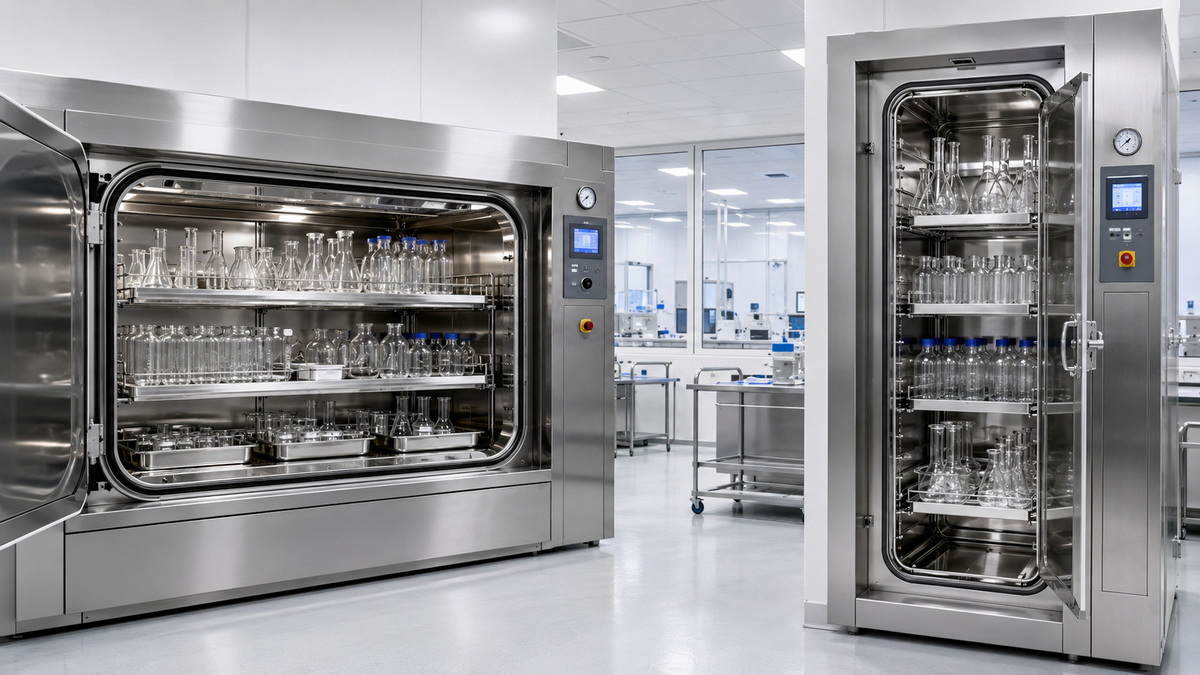
What Sterilization Cabinets Do in Modern Labs
Sterilization cabinets are used to treat glassware, stainless-steel tools, containers, and other reusable items before they re-enter production or testing workflows. In pharma-adjacent environments, these systems support contamination control, process consistency, and compliance-driven operations. Their role becomes especially important where glassware must be reused frequently and where downtime directly affects batch readiness. [winatechgroup]
In practice, the cabinet must do three things well:
- Deliver uniform sterilization across every loaded item.
- Handle the required volume without crowding.
- Fit smoothly into the facility's layout and workflow.
When those three goals are balanced, the cabinet becomes a productivity tool rather than a bottleneck. [centec]
Horizontal vs Vertical Design
Horizontal sterilization cabinets load glassware from the side and typically spread trays or racks across a wider footprint. Vertical sterilization cabinets load from the front or top-oriented chamber design and often use height more aggressively to increase capacity in a smaller floor area. In simple terms, horizontal systems often favor accessibility and orderly tray placement, while vertical systems often favor space efficiency. [centec]
That difference matters because lab glassware is rarely uniform. Beakers, bottles, flasks, pipettes, and media containers vary in height and shape, so the cabinet architecture influences both how much fits inside and how easy it is to arrange items correctly. [syntegon.com]
Horizontal Sterilization Cabinets
Horizontal cabinets are often preferred when operators want clear access, straightforward loading, and a stable tray-based workflow. They are easier to organize when the glassware mix includes many wide items or when users need visual confirmation of spacing during loading. For some laboratories, that simplicity reduces loading errors and shortens training time. [winatechgroup]
They can also be useful in facilities where the workflow is linear, with washing, drying, sterilization, and storage arranged in sequence. In such cases, the cabinet becomes part of a smooth production line rather than an isolated unit. [syntegon.com]
Vertical Sterilization Cabinets
Vertical cabinets are attractive when floor space is limited and the operation needs to maximize volume per square meter. By using vertical stacking, they can deliver high capacity without demanding the same footprint as a wide horizontal chamber. This is especially valuable in compact QC labs, pilot plants, and facilities where cleanroom real estate is expensive. [centec]
They are often a strong fit where standardized containers are stacked efficiently and where a disciplined loading pattern can be maintained. However, because the chamber is more height-oriented, operators must pay more attention to circulation paths, rack design, and the risk of overcrowding. [centec]
Capacity Is Not Only About Size
Many buyers assume a larger chamber automatically means higher usable loading capacity. In reality, usable capacity depends on more than internal volume. Rack geometry, airflow or steam penetration, container shape, loading discipline, and cycle validation all determine how much can be processed effectively in one run. [centec]
This is why two cabinets with similar dimensions can produce very different real-world throughput. A well-designed cabinet with efficient racks and repeatable loading patterns may outperform a larger unit that is awkward to fill or difficult to validate consistently. [winatechgroup]

The Practical Capacity Formula
When evaluating a sterilization cabinet, use this simple lens:
1. Count the number of glassware items that can be loaded without blocking circulation.
2. Check whether all items receive consistent exposure.
3. Compare cycle time, not just chamber volume.
4. Estimate labor time for loading, unloading, and rework.
5. Evaluate how often the cabinet can run each day.
The best solution is the one that delivers the highest usable throughput, not just the biggest chamber on paper. [centec]
Performance Comparison Table
| Criterion | Horizontal Sterilization Cabinets | Vertical Sterilization Cabinets |
| Floor space use | Needs more horizontal space | Better for compact facilities |
| Loading visibility | Easier to inspect during loading | More dependent on rack discipline |
| Glassware diversity | Good for mixed shapes and sizes | Best for more standardized items |
| Capacity efficiency | Strong when trays are optimized | Strong when height is used well |
| Operator ergonomics | Often easier for frequent access | Can require more lifting or reach planning |
| Workflow fit | Good for linear processing lines | Good for space-limited rooms |
| Expansion potential | Easier to scale with larger footprint | Easier to scale vertically |
This table shows the real tradeoff: horizontal designs often win on accessibility, while vertical designs often win on footprint efficiency. The right choice depends on whether your limiting factor is space, labor, or throughput. [winatechgroup]
Which Cabinet Maximizes Loading Capacity?
The answer depends on what you mean by capacity. If you measure pure chamber utilization in a compact room, a vertical cabinet often has the advantage. If you measure how quickly a team can load mixed glassware safely and repeatably, a horizontal cabinet may deliver better practical efficiency. [winatechgroup]
In pharmaceutical facilities, I usually recommend evaluating three separate capacity metrics:
- Physical capacity, meaning how much fits inside.
- Effective capacity, meaning how much can be sterilized without crowding.
- Operational capacity, meaning how many productive cycles can be completed per shift.
A cabinet that looks smaller on paper may actually be more productive if it shortens loading time and reduces rejects. [centec]
Industry Planning Insights
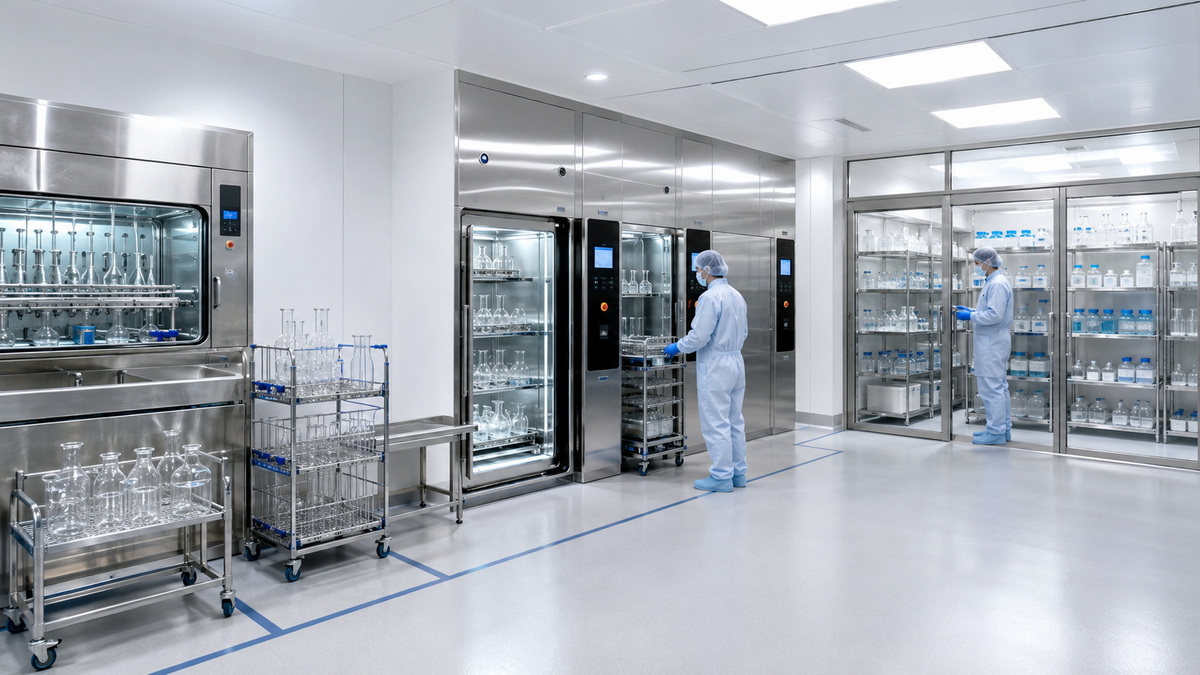
For pharma plants, sterilization equipment should not be selected in isolation. It should fit into the broader utility and production architecture, including purified water preparation, formulation systems, cleanroom flow, and material transfer routes. That is especially important for manufacturers building end-to-end production lines rather than buying a single machine. [syntegon.com]
From a planning perspective, the strongest installations usually share three traits:
- The cabinet is placed close to washing and preparation areas.
- The rack system matches the most common glassware formats.
- The loading pattern is standardized and documented.
These choices reduce travel time, lower handling risk, and improve daily output. [winatechgroup]
Validation and Sterility Assurance
A sterilization cabinet should be selected with validation in mind from the start. In regulated environments, teams need confidence that every cycle is repeatable, that temperature distribution is consistent, and that the load configuration does not undermine performance. That means the cabinet design, rack design, and operating SOPs should all be aligned. [centec]
One practical lesson from industry projects is that many capacity problems are not caused by the chamber itself. They are caused by loading habits that change from operator to operator. Standardized loading maps, visual aids, and training are often as important as the machine specification. [winatechgroup]
Expert Loading Methods
If your goal is to maximize throughput, use loading methods that protect airflow or steam access. The following practices usually help:
1. Leave consistent spacing between glassware items.
2. Keep tall and short items separated when possible.
3. Avoid blocking vents, ducts, or circulation channels.
4. Use dedicated racks for repeat product families.
5. Train operators with visual load maps.
These practices improve reproducibility and reduce the risk that a high-capacity load becomes an underperforming cycle. [centec]
Common Mistakes to Avoid
A frequent mistake is choosing a cabinet based only on chamber dimensions. Another is ignoring how the cabinet will be used day after day by real operators under production pressure. In many plants, the best-performing system is the one that is easy to load correctly every time. [winatechgroup]
Other common issues include:
- Overpacking the chamber to save time.
- Mixing incompatible glassware sizes in one load.
- Choosing a design that does not match the room layout.
- Neglecting rack standardization.
- Failing to account for future expansion needs.
Avoiding these mistakes often matters more than chasing the largest nominal capacity. [centec]
How to Choose the Right Type
If your facility has limited floor space and a relatively standardized glassware mix, a vertical sterilization cabinet is often the smarter choice. If your team handles a wider variety of items and values visibility and loading ease, a horizontal cabinet may be more practical. [winatechgroup]
A good decision framework is:
- Choose vertical when footprint is tight and standardized loading is possible.
- Choose horizontal when accessibility and mixed-load flexibility matter more.
- Choose custom design when production volume, room layout, or validation requirements are unusually demanding.
For pharmaceutical manufacturers, custom engineering is often the best route because it allows the cabinet to be integrated into the overall plant layout instead of forcing the layout to adapt to the machine. [syntegon.com]
Conclusion
Horizontal and vertical sterilization cabinets solve the same core problem in different ways. Horizontal designs usually offer easier access and more intuitive loading, while vertical designs usually make better use of limited floor space. The right choice depends on the glassware mix, operator workflow, room dimensions, and how aggressively the facility needs to maximize usable loading capacity. [winatechgroup]
For pharmaceutical and laboratory projects, the best equipment decision is rarely the largest machine or the cheapest one. It is the system that fits the process, supports repeatable loading, and integrates cleanly into the broader production line. That is where custom engineering creates lasting value. [syntegon.com]
FAQ
1. Which sterilization cabinet holds more glassware?
A vertical cabinet often has an advantage in footprint efficiency, but the actual usable capacity depends on rack design, glassware shape, and loading discipline. [centec]
2. Is a horizontal cabinet easier to operate?
Often yes, because side loading and tray visibility can make arrangement simpler and training easier. [winatechgroup]
3. Which type is better for a small lab?
A vertical cabinet is usually better when floor space is limited, especially in compact QC or pilot areas. [centec]
4. Can one cabinet handle mixed glassware sizes?
Yes, but horizontal cabinets generally provide more flexibility for mixed loads, while vertical cabinets work best with standardized rack patterns. [winatechgroup]
5. What matters most when choosing a cabinet?
The most important factors are usable capacity, loading efficiency, validation consistency, workflow fit, and integration with the rest of the facility. [syntegon.com]
References
1. Syntegon China. "Pure media and formulation systems." [https://www.syntegon.com.cn/solution-finder/pharma/pure-media-and-formulation-systems/] [syntegon.com]
2. Shanghai Jingze Clean Equipment Co., Ltd. "Sterile formulation preparation system." [http://winatechgroup.com/product/showproduct.php?id=13] [winatechgroup]
3. Syntegon China. "Drug product formulation systems." [https://www.syntegon.com.cn/solutions/pharma/drug-product-formulation-systems/] [syntegon.com]
4. Centec GmbH. "PW generator — ultrapure water system for pharmaceutical water." [https://www.centec.de/zh/product-page/pw-erzeuger] [centec]


