When manufacturers evaluate large-volume parenterals (LVPs), the real decision is rarely only about packaging. It is about total cost, contamination risk, line flexibility, validation burden, and long-term operating efficiency. For many sterile drug producers, the choice between Form-Fill-Seal (FFS) and pre-made pouch filling can materially affect CAPEX, OPEX, floor space, and batch economics.
Why this comparison matters for LVPs
Large-volume parenterals are among the most demanding sterile dosage forms. They require a tightly controlled environment, reliable aseptic processing, and equipment that supports consistent quality at scale. In practice, the packaging strategy influences not only unit cost, but also how easily a plant can expand, automate, and comply with GMP expectations.
For manufacturers planning new facilities or upgrading an existing line, this comparison is especially relevant because it sits at the intersection of engineering design and commercial performance. From an industry perspective, the packaging format can change the entire layout of the production hall, the sterilization strategy, and even the utility load of the facility.
What each technology means
Form-Fill-Seal (FFS)
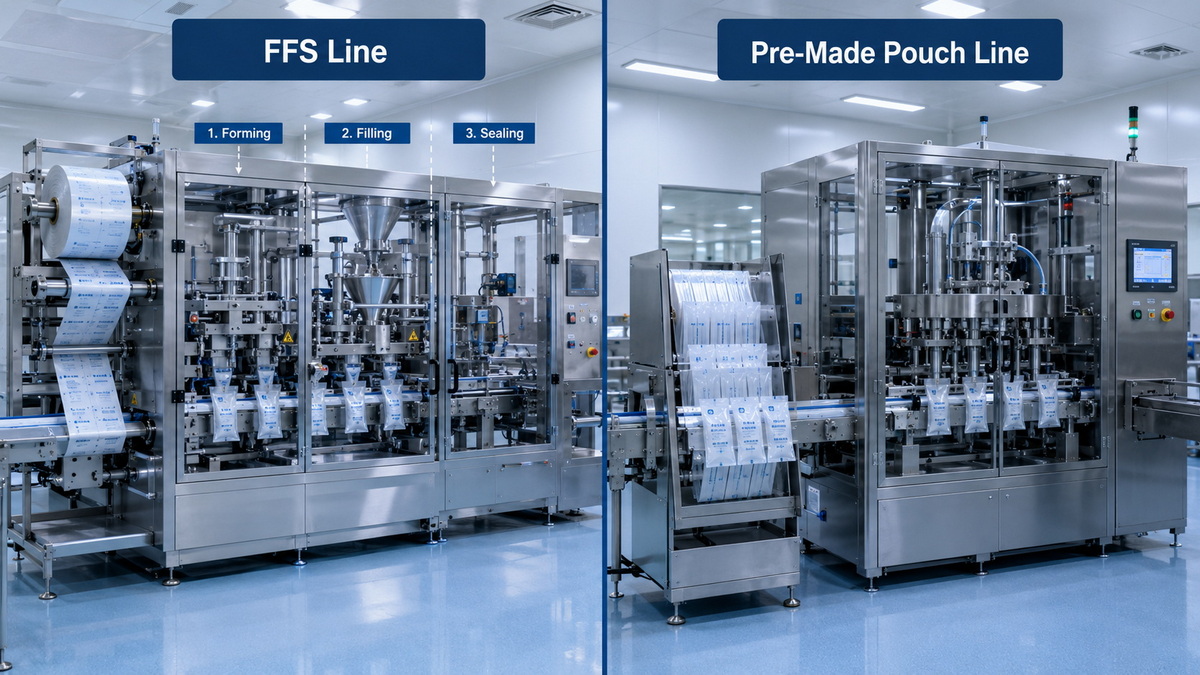
FFS systems form the container, fill it with product, and seal it in one integrated process. In sterile drug manufacturing, this can reduce handling steps and help limit human intervention. The main advantage is process integration: fewer transfers often mean fewer contamination risks and potentially lower labor dependence.
For LVPs, FFS is attractive when the manufacturer wants high throughput, standardized packaging, and a compact line footprint. It is especially useful in greenfield projects where the entire facility can be designed around the technology from the beginning.
Pre-made pouch filling
Pre-made pouch filling uses ready-formed pouches that are supplied to the line, then filled and sealed. This approach usually offers more packaging flexibility and lower complexity at the front end of equipment design. It can be easier to introduce into an existing plant because it may require less structural redesign than a fully integrated FFS setup.
The tradeoff is that the process includes an additional packaging supply chain. That means pouch procurement, storage, quality control, and inventory management all become part of the cost model.
Cost structure by category
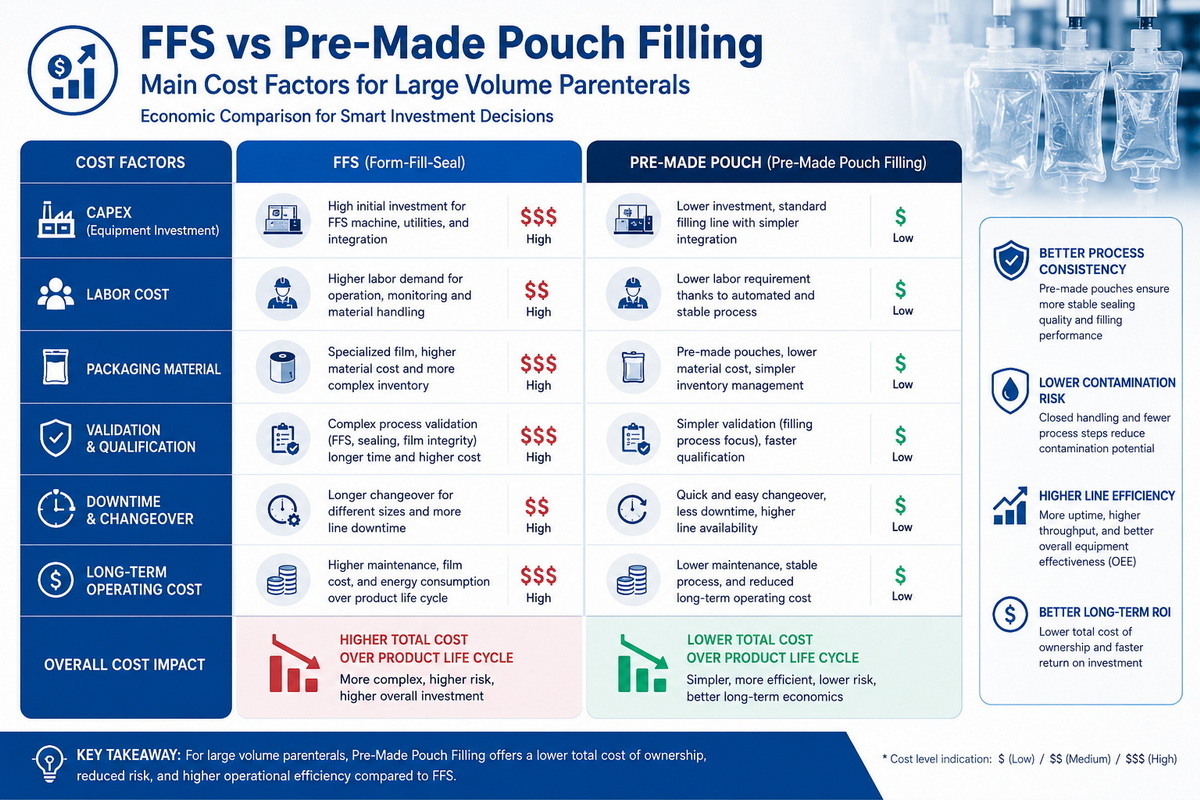
The cost difference is not just machine price. It is a bundle of capital expenditure, operating cost, quality cost, and business risk. A meaningful comparison must examine all four.
| Cost category | FFS | Pre-made pouch filling |
| CAPEX | Usually higher initial investment for integrated line design and automation | Often lower initial equipment cost |
| OPEX | Can be lower over time due to reduced manual handling and material steps | May be higher due to pouch purchasing and inventory handling |
| Labor | Lower reliance on operators once the line is stable | More operator involvement in material handling and line support |
| Floor space | Often more compact when designed well | May still be efficient, but material staging can add complexity |
| Validation | Higher upfront engineering effort | Potentially faster implementation, but ongoing pouch qualification matters |
| Supply chain | Less dependence on pre-formed packaging supply | More dependent on pouch vendor continuity and consistency |
For LVP plants, the lowest purchase price is not always the lowest total cost. A line that reduces interventions, rejects, and downtime can outperform a cheaper system over five to ten years.
FFS cost advantages
FFS can create value when the plant volume is high enough to justify the initial engineering effort. It is often favored in larger, more standardized manufacturing environments where repeatability is critical. Once stable, the automation level can reduce manual contact, which is valuable for sterile manufacturing.
Another important advantage is space efficiency. In a well-designed facility, integrated forming and filling can reduce intermediate handling zones and simplify the material flow. That can be particularly useful in new plant planning, where layout efficiency affects both construction cost and operational performance.
FFS also tends to support stronger long-term consistency. Fewer packaging supply variations can reduce process variability, especially when the same container format is used across multiple batches.
Pre-made pouch cost advantages
Pre-made pouch filling usually wins when speed of implementation and flexibility matter more than full process integration. It can be a practical choice for manufacturers launching a product line quickly or operating with moderate output volumes. For some companies, the lower starting CAPEX is the main reason to choose it.
It can also be easier to manage for product portfolios that need different pouch sizes or formats. If the business expects frequent packaging changes, pre-made pouches can reduce the need for major machine reconfiguration. That makes it a useful option for multiproduct facilities or contract manufacturing environments.
However, this flexibility comes with an ongoing packaging cost. The pouch itself becomes a purchased input that affects total unit economics, and that cost must be tracked against the savings from lower system complexity.
Hidden cost drivers often missed
Many project teams underestimate the costs that appear after installation. These hidden factors often decide whether a technology is truly economical.
- Sterile environment burden. Aseptic operations require high-quality utilities, cleanroom discipline, and robust sterilization support.
- Water system performance. Reliable Purified Water Preparation Systems are essential for cleaning, formulation, and process support.
- Cleaning and sterilization load. Equipment such as sterilization cabinets and validated cleaning loops affect uptime and throughput.
- Downtime risk. Packaging supply interruptions, seal defects, and maintenance delays can quickly erode savings.
- Product loss. Even a small reduction in reject rate can matter greatly in sterile, high-value LVP production.
This is where facility design becomes part of cost analysis. A strong upstream utility and cleanroom strategy often matters as much as the packaging machine itself.
A practical decision framework
Manufacturers can compare the two technologies using a simple decision sequence.
1. Define annual volume. Higher volumes usually justify more integrated automation.
2. Identify product variety. Fewer SKUs favor FFS; more packaging variation can favor pre-made pouches.
3. Estimate validation effort. The more complex the process, the more time and documentation it may require.
4. Map the facility layout. Greenfield projects often benefit more from FFS because the plant can be built around the line.
5. Model total cost of ownership. Include labor, packaging materials, utilities, downtime, and quality losses.
6. Review supply resilience. If packaging supply continuity is uncertain, reduce dependence on pre-formed components.
7. Evaluate sterility strategy. Aseptic risk profile should be part of the economic equation, not a separate discussion.
This framework is useful because it shifts the discussion from "Which machine is cheaper?" to "Which system creates the best long-term production economics?"
Where each option fits best
FFS is often the better fit when the goal is long-term scale, strong standardization, and a more integrated sterile manufacturing model. It is especially compelling in new facilities or in high-volume plants where every minute of uptime matters.
Pre-made pouch filling often fits faster commercial launches, smaller batches, and operations that need packaging flexibility. It can also be a reasonable bridge solution when a company wants to start production before investing in a fully integrated line.
For many manufacturers, the answer is not absolute. The right choice depends on product mix, growth plan, local labor cost, available cleanroom space, and the plant's utility infrastructure.
Expert view from plant planning
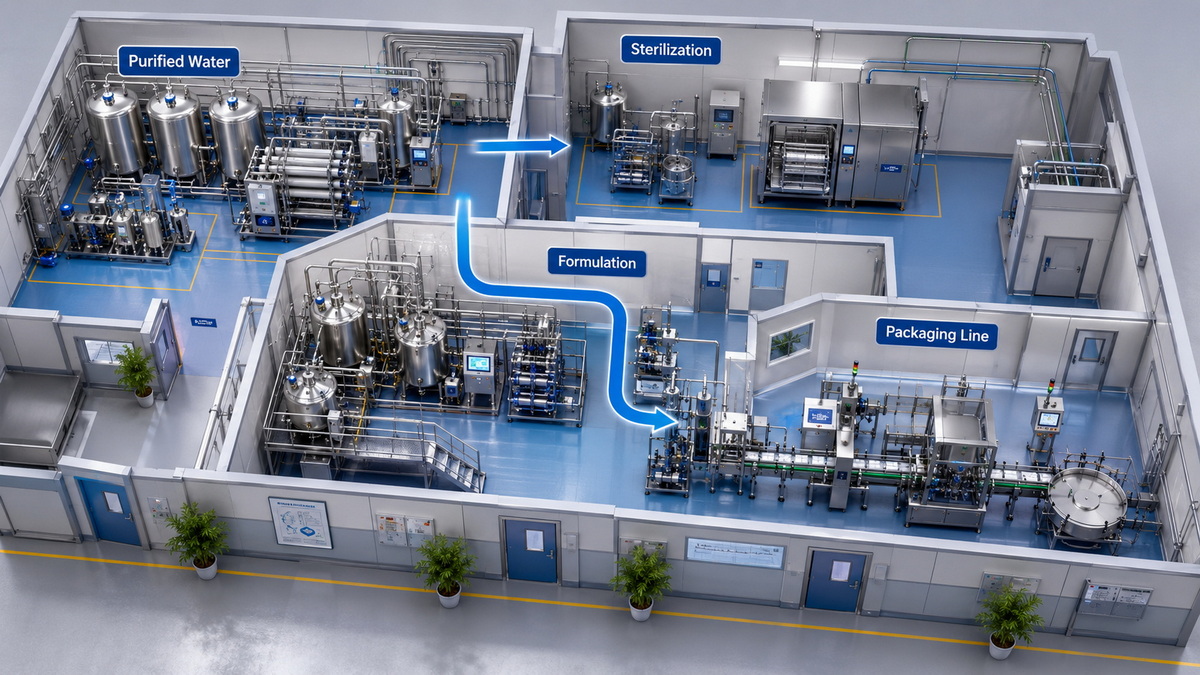
From a facility-planning standpoint, the packaging line should never be isolated from the rest of the plant design. The choice between FFS and pre-made pouch filling influences upstream water systems, cleanroom zoning, material flows, and sterilization support. That is why experienced manufacturers often evaluate packaging technology together with Purified Water Preparation Systems, sterilization equipment, and formulation systems.
In projects for LVPs, the most successful plants usually follow one principle: design the line around the business model, not just around the machine catalog. A system that looks expensive on day one may become the lower-cost option once downtime, validation, and labor are fully included.
CTA
If your goal is to build or upgrade an LVP production line, the best next step is to evaluate the packaging strategy together with water systems, sterilization equipment, and facility layout. A coordinated design review can reveal which option delivers the best total cost, not just the lowest initial price.
FAQ
1. Which is cheaper: FFS or pre-made pouch filling?
Pre-made pouch filling usually has lower initial equipment cost, while FFS may deliver lower long-term operating cost in high-volume production.
2. Which option is better for sterile LVP products?
FFS often offers stronger integration and fewer handling steps, which can be attractive for sterile applications. The final choice still depends on line design, validation, and output scale.
3. Is pre-made pouch filling easier to implement in an existing plant?
Yes. It is often easier to introduce because it typically requires less facility redesign than a fully integrated FFS line.
4. Does FFS always save money?
Not always. FFS can be more economical over time, but only when production volume, utilization rate, and facility design justify the higher upfront investment.
5. What should be included in a cost analysis beyond machine price?
Include labor, pouch or film cost, utilities, downtime, validation, reject rate, maintenance, and cleanroom support systems.
References
1. [Syntegon China – Drug Product Formulation Systems]
2. [Syntegon China – Pure Media and Formulation Systems]
3. [Centec – PW Generator / Pharmaceutical Purified Water System]
4. [Sino Pharmatec – Solution Preparation System]
5. [Qingqingquan – Pharmaceutical Grade High-Purity Water Systems]
6. [Shanghai Jingze – Aseptic Solution Preparation]


