


Views: 222 Author: Everheal Medical Equipment Publish Time: 2026-06-15 Origin: Everheal


For manufacturers operating multi-ingredient chemical mixing tanks, cleaning is not a side task. It is a critical control point that affects product quality, batch consistency, operator safety, and regulatory compliance. In pharmaceutical, biotech, and high-purity chemical production, the choice between Automated CIP (Clean-in-Place) and manual scouring can shape everything from downtime to validation effort.
From a plant design and process-engineering perspective, this comparison is especially important when tanks are used for large-volume preparations, sensitive formulations, or cross-contamination-prone products. The wrong cleaning strategy can increase residue carryover, extend changeover time, and create avoidable compliance risk. The right one can improve uptime, reduce human variability, and support cleaner, more scalable production.

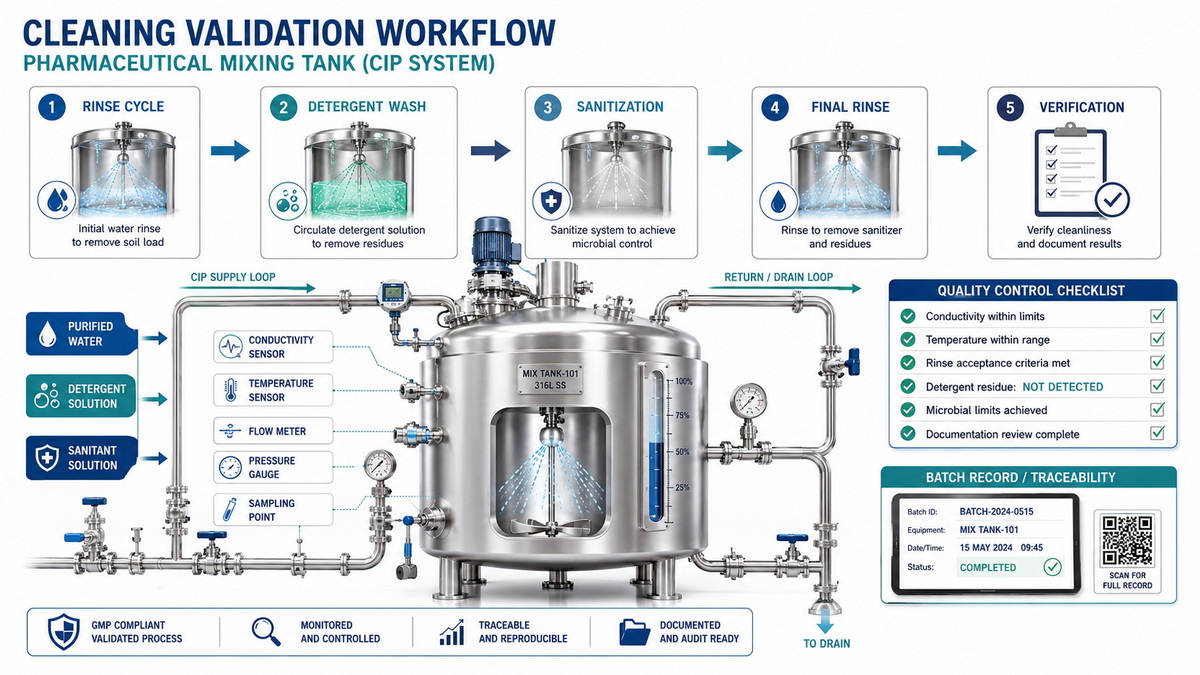
Automated CIP is a closed-loop cleaning method that circulates water, detergents, heat, and sometimes sanitizing agents through a tank and its connected piping without dismantling the equipment. In a well-designed system, spray devices, pump flow, temperature, chemical concentration, and cycle time are controlled by a programmed sequence. This makes the process repeatable and easier to validate.
In regulated industries, CIP is often preferred because it supports documented, reproducible cleaning performance. It is especially valuable when a tank is used frequently, has complex geometry, or processes ingredients that leave sticky, oily, or hard-to-remove residues. For multi-ingredient systems, the main advantage is consistency.
- Repeatability: Every cycle follows the same validated parameters.
- Lower operator dependency: Cleaning quality depends less on manual technique.
- Better documentation: Cycle data can be recorded for compliance review.
- Reduced exposure: Operators have less direct contact with chemicals and residues.
- Scalability: Suitable for repeated use in high-throughput plants.
Manual scouring is the traditional cleaning approach in which operators physically scrub the tank interior using brushes, pads, detergents, and rinse water. It is often used for smaller vessels, low-frequency cleaning, legacy installations, or tanks with limited CIP access. For some difficult residues, manual intervention still plays a practical role even in modern plants.
The strength of manual scouring is flexibility. A trained operator can focus on problem areas, inspect surfaces closely, and address localized deposits that automated spray coverage might miss. However, the method is highly dependent on human skill, time, and discipline.
- Variable results: Cleaning quality depends on the individual operator.
- Higher contamination risk: Human contact increases cross-contamination potential.
- Longer downtime: Cleaning and inspection usually take more time.
- Ergonomic burden: Repetitive work can be physically demanding.
- Harder validation: Proving consistent cleaning performance is more difficult.
The table below shows the practical differences between automated CIP and manual scouring for multi-ingredient mixing tanks.
| Criteria | Automated CIP | Manual Scouring |
|---|---|---|
| Cleaning consistency | High, if properly designed and validated | Variable, depends on operator |
| Cross-contamination control | Strong | Moderate to weak |
| Labor requirement | Lower | Higher |
| Downtime | Shorter in repeated cycles | Longer |
| Documentation | Automatic and traceable | Manual records only |
| Validation support | Easier | More difficult |
| Initial investment | Higher | Lower |
| Long-term operating cost | Often lower | Often higher |
| Suitability for regulated plants | Excellent | Limited, unless tightly controlled |
| Best use case | High-frequency, critical, multi-product production | Small-batch, low-frequency, or special cleaning cases |

For multi-ingredient chemical mixing tanks, cleaning efficiency depends on residue type, tank geometry, spray coverage, and cleaning chemistry. Automated CIP performs best when deposits are predictable and when the tank is engineered with hygienic design principles such as smooth surfaces, proper drainability, and full spray coverage. It is particularly effective for routine cleaning between similar formulations.
Manual scouring can remove stubborn local deposits, but it is not always the most efficient or most reproducible method. In real operations, even highly experienced operators may miss crevices, gaskets, weld transitions, or impeller regions. That is why many plants use a hybrid strategy: CIP for routine cycles and manual cleaning only for exception handling or periodic deep-clean verification.
If your process handles viscous, film-forming, or active ingredients with strong adhesion, cleaning performance should be tested using worst-case residues rather than average product conditions. This is where process engineering and cleaning validation need to work together.
In pharmaceutical and fine chemical facilities, contamination control is not optional. Automated CIP helps reduce the risk by limiting open handling and creating a closed cleaning pathway. This is especially valuable in plants producing multiple formulations, where allergen-like crossovers, potent compounds, or trace residues may create batch-release concerns.
Manual scouring requires more controls to reach a comparable level of assurance. Those controls may include operator qualification, validated cleaning SOPs, environmental monitoring, detailed inspection checklists, and re-cleaning rules. Even with these controls, the process can still be harder to standardize across shifts and teams.
- Automated CIP supports data integrity and repeatability.
- Manual scouring requires stronger procedural discipline.
- Multi-product plants often benefit from automated cleaning records.
- For potent or high-risk ingredients, reducing direct access is a major safety plus.
A common mistake is to compare only the upfront cost. Manual scouring is cheaper to start, but it may cost more over the lifecycle because of labor hours, slower changeovers, inconsistent yields, and repeat cleaning events. Automated CIP requires engineering investment, utility planning, and validation, but it often pays back through reduced downtime and more predictable operation.
For a plant with frequent product changes, automated CIP can deliver better ROI because every saved cleaning hour compounds over time. It can also reduce the hidden costs of contamination investigations, rejected batches, and operator fatigue. For lower-throughput facilities, manual cleaning may still be economical if complexity and regulatory pressure are limited.
- Labor time per cleaning cycle.
- Water, steam, detergent, and energy consumption.
- Batch changeover frequency.
- Product value and contamination risk.
- Validation and revalidation workload.
- Production losses caused by downtime.
Despite the advantages of CIP, manual scouring remains relevant in some situations. It may be suitable for small vessels, infrequent use, pilot lines, legacy systems without CIP integration, or tanks handling products that form unusual residues not fully addressed by standard cycles. It also works as a backup method when a cleaning system is offline.
In practice, manual cleaning is often best treated as a supporting method, not the primary strategy, in modern regulated plants. Where possible, the plant design should minimize the need for manual entry by improving tank geometry, spray coverage, drainability, and automation compatibility.
Across pharma and high-purity manufacturing, the trend is clearly moving toward more automated, digitally traceable cleaning systems. Plants are increasingly looking for equipment that integrates process control, cleaning validation support, and energy-efficient operation. For suppliers of purified water systems, sterilization equipment, and formulation systems, this shift is reshaping how new production lines are designed.
A modern factory layout should consider cleaning at the design stage, not after commissioning. That means planning for utility routing, CIP skids, drain slopes, hygienic pipework, and maintenance access. In many cases, cleaning strategy is no longer just an operational choice; it is a core part of plant architecture.
From an engineering standpoint, the best cleaning method is the one that matches the product risk, production frequency, and compliance burden. If your plant handles multiple ingredients, frequent switches, or high-value formulations, automated CIP is usually the stronger choice. If the facility is small, low-volume, or still in an early production stage, manual scouring may be acceptable as a transitional solution.
1. Define residue characteristics and worst-case products.
2. Map tank geometry, piping, and dead legs.
3. Evaluate cleaning frequency and changeover pressure.
4. Compare validation requirements and regulatory expectations.
5. Estimate labor, utilities, downtime, and rework cost.
6. Select a cleaning strategy with room for future automation.
For most multi-ingredient chemical mixing tanks, automated CIP is the stronger long-term strategy because it improves repeatability, reduces contamination risk, and supports modern compliance expectations. Manual scouring still has value in niche cases, but it is usually best for exception handling rather than as the primary cleaning method. In regulated environments, the real question is not whether cleaning should happen, but whether it should be standardized, documented, and scalable.
For manufacturers planning new facilities or upgrading existing ones, cleaning strategy should be built into the production line from the beginning. That is where plant layout, utility design, equipment selection, and process validation come together. A well-designed system can save time every day and reduce risk every batch.
If your facility is evaluating automated CIP systems, purified water infrastructure, sterilization equipment, or turnkey formulation line design, we can help you plan a cleaner, safer, and more efficient production layout. Contact Ningbo Everheal Medical Equipment Co., LTD. to discuss a customized solution for your multi-ingredient mixing process.
Not always. Automated CIP is usually better for regulated, high-frequency, or multi-product plants, but manual scouring can still be practical for small or low-volume systems.
Yes, in some cases, but it requires stronger procedures, training, documentation, and verification to achieve consistent results.
The biggest advantage is repeatability. A validated cycle gives more consistent cleaning quality than manual work.
A hybrid approach works well when CIP handles routine cleaning and manual cleaning is reserved for stubborn residues, inspections, or special situations.
Check residue type, tank design, product switching frequency, compliance requirements, utilities, and total cost of ownership.
Below are credible sources you can cite on your published page. Please add them as clickable links in the final article footer:
1. FDA – Process Validation: General Principles and Practices
https://www.fda.gov/media/71021/download
2. FDA – Guide to Inspections of Cleaning Validation
3. ICH Q7 – Good Manufacturing Practice Guide for Active Pharmaceutical Ingredients
https://database.ich.org/sites/default/files/Q7%20Guideline.pdf
4. EU GMP Annex 15 – Qualification and Validation
https://health.ec.europa.eu/system/files/2016-11/2008_09_annex15_en_0.pdf
5. ISPE – Baseline Guide: Biopharmaceutical Manufacturing Facilities
6. Syntegon – Pharmaceutical Formulation Systems
https://www.syntegon.com.cn/solution-finder/pharma/pharmaceutical-formulation/
7. Syntegon – Drug Product Formulation Systems
https://www.syntegon.com.cn/solutions/pharma/drug-product-formulation-systems/


