The Technical Challenge of Balancing Flow and Storage
In the design of a cGMP pharmaceutical water system design, achieving the precise equilibrium between generation capacity and static buffer storage is a critical engineering challenge. Over-sizing generation equipment results in capital inefficiency, excessive energy consumption, and high risks of system stagnation. Conversely, under-sizing results in process starvation, stalling downstream formulation and packaging suites.
Following our successful intervention to downsize a client's bulk storage tank from an un-shippable 16,000L volume to a container-optimized 9,000L vessel, Ningbo Everheal Pharmaceutical Equipment Co., Ltd. was tasked with solving an immediate secondary technical challenge. The client had provided an extensive data spreadsheet outlining their peak utility demands. However, they lacked the specialized empirical formulas required to perform a comprehensive pharmaceutical water system sizing calculation. They were unsure what generation capacities were needed to keep their newly streamlined 9,000L tank continuously balanced under varying peak-load manufacturing schedules.
By deploying our cross-functional engineering framework, Everheal’s technical team processed the client’s raw operational data, calculated consumption profiles, and delivered a complete technical design in just 40 minutes. We recommended a synchronized configuration: a 6,000 L/h purified water preparation system paired with a 4,000 L/h multi-effect water distilled machine. This setup eliminated capacity waste while creating a future-proof foundation for subsequent facility scaling.
1. The Critical Role of Parametric Balancing in High-Purity Water Networks
Modern biopharmaceutical engineering depends heavily on reliable utilities. Whether preparing a high-volume parenteral injection, a sensitive oncology formulation, or managing a lyophilized drugs block, the purity and availability of Purified Water (PW) and Water for Injection (WFI) are critical. As a premier high-efficiency pharmaceutical equipment manufacturer, Ningbo Everheal recognizes that providing a reliable utility loop involves more than fabricating high-quality stainless steel equipment. It requires acting as an expert engineering partner capable of translating complex operational schedules into reliable mechanical capacities.
When executing a scalable pharmaceutical water plant layout, process engineers cannot view generation and storage as separate components. They must be handled as a single integrated ecosystem. This case study looks at the math, collaborative framework, and rapid response strategy that allowed Everheal to transform a raw user requirement specification (URS) into a fully optimized, high-performance utility asset.
2. The Client’s Pain Points: Data Ambiguity and the Risk of Imbalanced System Sizing
After approving our design for a container-optimized 9,000L storage vessel, the client's engineering team faced a common problem: matching generation rates to the new volume. They provided their internal load data via a spreadsheet, which contained detailed consumption rates across multiple filling bays. However, translating these independent data points into a cohesive utility model required specialized expertise.
The Dangers of Inaccurate Sizing Calculations
The client was hesitant to proceed without verifiable calculations for two main reasons:
The Risk of Over-Sizing: The client’s initial thought was to purchase an oversized 10,000 L/h generation system to ensure complete safety. However, oversized systems lead to short-cycling. If a system shuts down frequently because storage fills too quickly, it creates thermal cycling stresses and increases the risk of microbial biofilm generation in stagnant loop zones. This also leads to unnecessary utility expenditure on steam, electricity, and chilled water.
The Risk of Under-Sizing: If the generation rate fell short during peak wash-down and production shifts, the 9,000L tank would drain completely. This would trigger low-level automated safety alarms, causing expensive shutdowns across the entire turnkey pharmaceutical production line solutions network.
The Expertise Gap: The client needed to establish a reliable PW generator and WFI distiller matching architecture, but lacked the dynamic load calculation models required to confidently finalize equipment orders.
The project stalled as the client spent days attempting to model dynamic consumption variables, creating a bottleneck for the entire facility timeline.
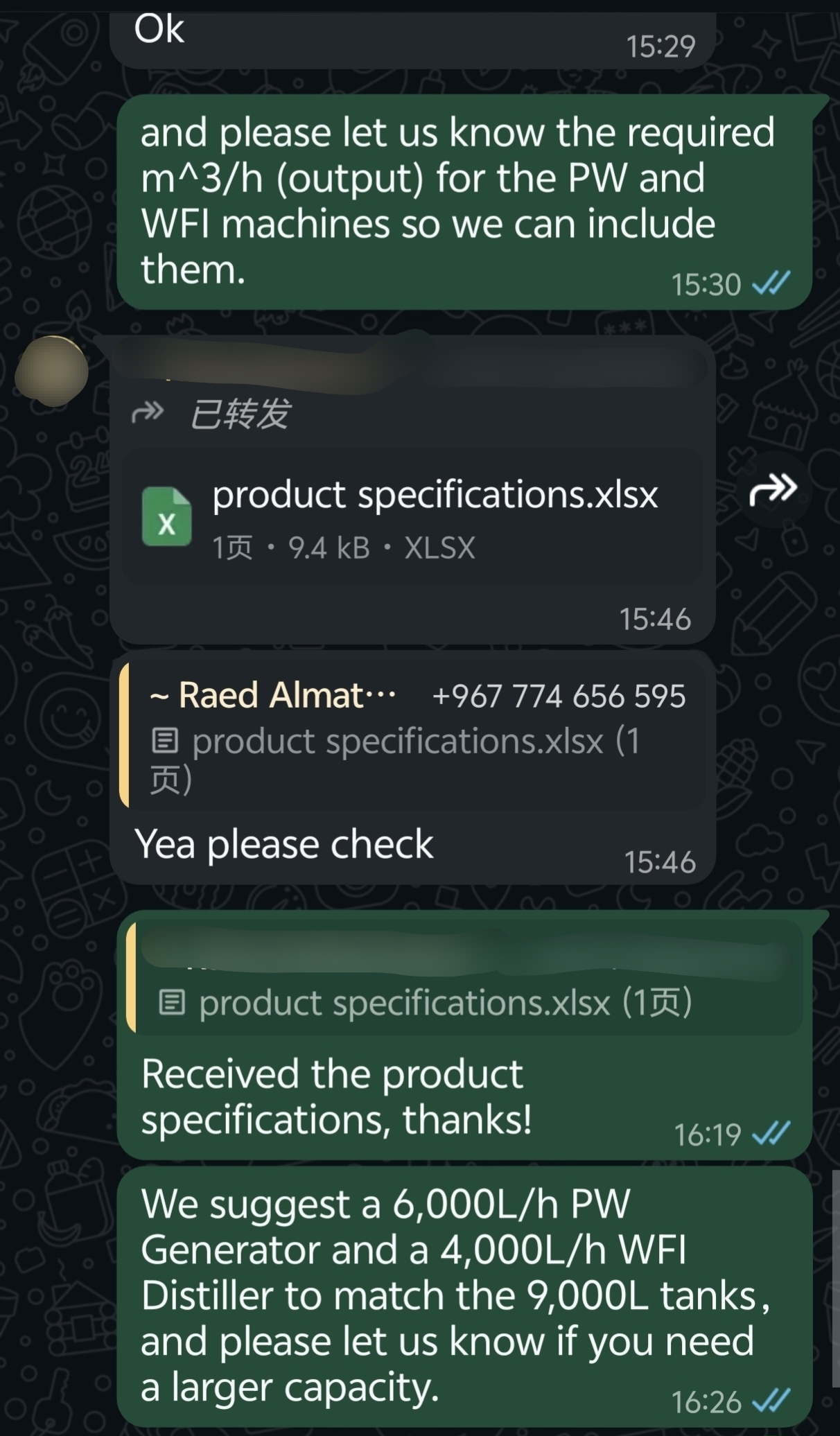
3. The Everheal Engineering Framework: Dynamic Sizing Calculations from Raw Data
When the client shared with our team, Viola, our Senior Project Manager, bypassed standard account handling procedures and directly initiated an urgent, cross-functional engineering alignment.
[Client Data Input: product specifications.xlsx]
                       ↓ (Minute 0)
[Everheal Collaborative Engineering Framework]
Process Engineering ── Automation Team ── Thermal Dynamics
                       ↓ (Minute 20)
[Dynamic Flow Modeling & Empirical Calculations]
                       ↓ (Minute 40)
[The Technical Blueprint: 6,000L/h PW + 4,000L/h WFI + 9,000L Tank]
To deliver reliable, cGMP-compliant recommendations rapidly, Everheal utilizes a proprietary collaborative engineering framework that connects three critical disciplines:
Process Fluid Dynamics: To model real-time water velocity, continuous mass flow rates, and loop consumption curves.
Thermal & Automation Engineering: To ensure the multi-effect distillation columns maintain stable evaporation pressures without cycling penalties.
Logistics & Plant Integration Strategy: To verify that the structural configuration fits neatly into the client's plant layout.
4. Calculating the Golden Configuration
To resolve the client's calculation bottleneck, Everheal’s process engineers extracted the peak operational profiles from the client's data sheet. The core engineering objective was to model the dynamic water volume change over time within the 9,000L tank to find the ideal generation rates for the purified water preparation system (Gpw) and the multi-effect water distilled machine (Gwfi).
The Dynamic Storage Equation
The volume of high-purity water inside the storage vessel at any given moment, V(t) , is governed by the net balance between generation inputs and process consumption outputs:
dV(t) / dt = ∑ Q generation( t) - ∑ Q consumption( t)
Where:
∑ Qgeneration(t) is the continuous volumetric inflow rate from the PW/WFI generation plant.
∑ Qconsumption(t) is the time-varying, combined demand from the formulation suites, cleanroom washers, and large-volume parenteral lines.
By running a discrete time-step simulation over a standard 24-hour manufacturing cycle, our team mapped out the worst-case consumption scenarios. The calculations revealed that a static safety buffer could be maintained using a continuous generation matrix rather than an oversized system.
Defining the 6,000 L/h and 4,000 L/h Configuration
Our engineers calculated that a generation rate of 6,000 L/h for the purified water preparation system provided the ideal mass balance to replenish the 9,000L buffer tank during peak formulation batches.
Simultaneously, for the downstream WFI loops, our team ran an optimization model on the multi-effect distillation columns. The math showed that a 4,000 L/h generation profile for the multi-effect water distilled machine allowed the system to recover from a low-level state back to a 90% storage ceiling within a safe window of time, even during continuous CIP sanitation cycles across the plant.
This specific combination became our "Golden Configuration." It perfectly matched the 9,000L storage capacity, ensuring that both systems operate within their optimal mechanical efficiency zones (80%-85% continuous utilization), which protects long-term system life.
5. Scalable Design: Protecting Long-Term Capital Investment
A common mistake in standard pharmaceutical water generation and storage system designs is focusing exclusively on immediate capacity needs. Biopharmaceutical facilities often scale their manufacturing footprints within 3 to 5 years of initial validation.
While calculating the parameters for the 6,000 L/h PW and 4,000 L/h WFI configuration, Everheal’s design team deliberately structured the technical blueprints with a scalable pharmaceutical water plant layout architecture.
Built-In Future-Proofing
Modular Skid Extensions: The structural 316L stainless steel bases for both the PW generator and the WFI distillation columns were designed with pre-engineered space allocations. If the client expands production in the future, additional reverse osmosis (RO) membrane housings and an extra distillation column effect can be directly bolted onto the existing skids.
Variable Frequency Drive (VFD) Provisioning: The integrated automation control system, built on a Siemens TIA Portal PLC platform, was programmed with pre-configured loop routines capable of managing up to a 50% increase in flow velocities without requiring core software overrides.
Zero Structural Re-Work: This foresight guarantees that the client can increase their utility generation capacity in the future without purchasing new storage vessels or tearing down established cleanroom walls.
6. Unrivaled Engineering Speed and Flawless Integration
By organizing our engineering teams around this structured response framework, Everheal cut down the standard technical review timeline significantly. In exactly 40 minutes from receiving the client’s, our team delivered a comprehensive technical proposal. This document included full mass-balance calculations, structural skid footprint drawings, and complete cGMP utility requirements.
The tangible benefits achieved through this rapid engineering alignment include:
90%+ Reduction in Engineering Cycle Time: The client completed their technical loop evaluation in less than an hour, a process that typically requires weeks of back-and-forth revisions with traditional equipment vendors.
Perfect Utility Sizing: The generation outputs matched the 9,000L storage capacity precisely, eliminating the risk of operational water stagnation and preventing energy waste.
Guaranteed Validation Path: Because the sizing models strictly adhered to ISPE Baseline Guide Vol 4 (Water and Steam Systems) standards, the validation documentation compiled smoothly during the installation qualification (IQ) and operational qualification (OQ) phases.
Executive Validation
The client's Engineering Director highlighted our rapid turnaround during the final project review:
"The speed and technical competence of the Everheal team is truly remarkable. Completing a full, verifiable technical selection for an entire pharmaceutical water generation and storage system in 40 minutes is outstanding. The engineering data aligned perfectly with our internal metrics, and their scalable layout design saved us substantial engineering hours and future capital expense."
7.Partnering with Ningbo Everheal for World-Class Pharmaceutical Utilities
In high-purity biopharmaceutical infrastructure, technical documentation and rapid engineering response are just as critical as high-quality fabrication.
At Ningbo Everheal Pharmaceutical Equipment Co., Ltd., we combine meticulous design capabilities with manufacturing agility. From initial pharmaceutical equipment specification alignment to complex fluid dynamic modeling, we deliver water systems that balance process requirements, regulatory compliance, and cost efficiency. Partner with Everheal to experience professional engineering insight delivered at global speed.
Engineering Sizing Calibration Summary
| Engineering Metric | Client's Initial Concept | Everheal Engineered Solution | Technical & Economic Advantage |
| PW System Capacity | 10,000 L/h (Estimated) | 6,000 L/h (Calculated) | Prevents short-cycling; reduces energy costs |
| WFI System Capacity | 8,000 L/h (Estimated) | 4,000 L/h (Calculated) | Balanced mass-flow; avoids microbial stagnation |
| Storage Tank Synergy | 16,000L Tank (Un-shippable) | 9,000L Container-Optimized | Assures container freight compliance |
| Technical Closeout Time | Est. 10–14 Days | 40 Minutes Total | Streamlines project launch and validation |
| Future Upgrade Path | Complete Replace Required | Modular Skid Extension Built-In | Protects capital investment for future scaling |


