Content Menu
● Why Container Closure Integrity Matters
● Automated Capping vs Hand-Crimping
>> Automated Capping
>> Hand-Crimping
● Side-by-Side Comparison
● How Each Method Affects CCI
>> Automated Capping and CCI
>> Hand-Crimping and CCI
● Regulatory and Quality Expectations
● Practical Risk Evaluation
>> Low-Risk Situations
>> Medium-Risk Situations
>> High-Risk Situations
● Layout and Process Integration
● How to Improve Closure Reliability
>> Recommended Practices
● Which Method Fits Which Operation
● Conclusion
● FAQ
>> 1. What is container closure integrity in vials?
>> 2. Is automated capping always better than hand-crimping?
>> 3. Why is hand-crimping less consistent?
>> 4. How does automated capping improve product quality?
>> 5. Can hand-crimping be used in regulated production?
● References
In sterile pharmaceutical production, vial closure is not a minor finishing step. It is a critical part of product protection, shelf life, and patient safety. When comparing automated capping and hand-crimping, the most important question is not which method is simpler, but which one delivers the most reliable container closure integrity for the intended product and production scale.

Why Container Closure Integrity Matters
Container closure integrity, or CCI, refers to the ability of a vial and its closure system to keep the product protected from contamination and leakage throughout its lifecycle. For injectable drugs, lyophilized products, and other sterile formulations, a weak closure can create serious quality and safety risks.
Several factors influence CCI:
- Seal uniformity.
- Stopper placement.
- Crimp force consistency.
- Compatibility between vial, stopper, and cap.
- Operator handling.
- Environmental conditions during sealing.
Because of these variables, the closure method must be selected with care. A process that works well in a small lab may not be suitable for commercial sterile manufacturing.
Automated Capping vs Hand-Crimping
Although both methods aim to secure the vial closure, they operate very differently in practice. Automated capping uses machine-controlled force and alignment to apply closures with repeatable precision. Hand-crimping depends on manual tools and operator skill.
Automated Capping
Automated capping is widely used in modern pharmaceutical plants because it offers high consistency and efficient production output. The machine controls crimping parameters such as force, position, and alignment, which helps reduce process variation.
Its main strengths include:
- High repeatability.
- Strong process control.
- Better suitability for large production volumes.
- Lower dependence on operator technique.
- Easier integration into validated production lines.
Its limitations include:
- Higher capital investment.
- More complex setup and maintenance.
- Less flexibility when frequent format changes are required.
Hand-Crimping
Hand-crimping is usually applied in laboratory work, pilot-scale batches, early-stage development, and small production runs. It is simple, flexible, and inexpensive compared with automated systems.
Its main strengths include:
- Low initial cost.
- Easy use in small-batch operations.
- Flexible for trial work and non-routine tasks.
- Minimal equipment footprint.
Its limitations include:
- Greater variation from operator to operator.
- Lower throughput.
- Higher risk of inconsistent crimp quality.
- More difficulty in standardizing the process.

Side-by-Side Comparison
| Factor | Automated Capping | Hand-Crimping |
| Consistency | High | Variable |
| Throughput | High | Low |
| Operator dependence | Low | High |
| Validation readiness | Strong | Limited |
| Capital cost | Higher | Lower |
| Best use case | Commercial sterile production | R&D, pilot batches, small-scale operations |
| CCI reliability | More stable when properly validated | Highly dependent on technique |
For manufacturers producing sterile injectables or oncology formulations at scale, automated capping is usually the better choice because it provides more consistent closure quality and stronger process stability.
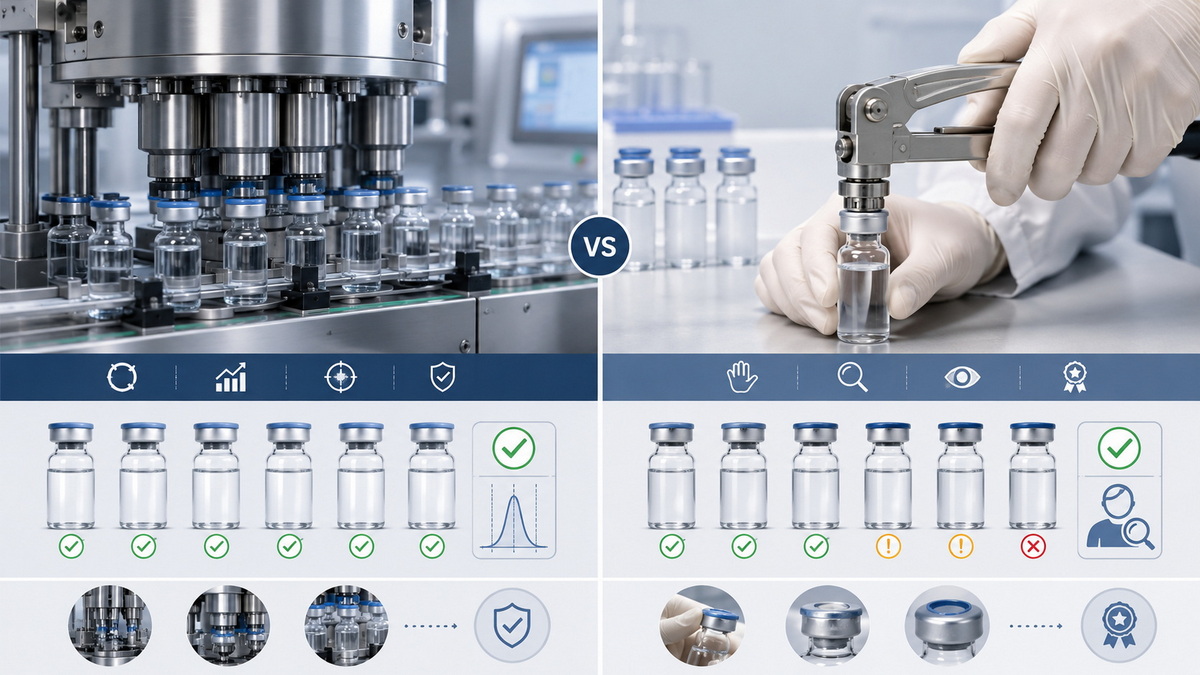
How Each Method Affects CCI
The closure method has a direct effect on how reliably a vial maintains its seal over time. A good-looking crimp is not enough if the seal cannot withstand storage, transportation, or long-term use.
Automated Capping and CCI
Automated systems help maintain consistent closure performance by controlling:
- Cap positioning.
- Crimp depth.
- Crimp force.
- Vial alignment.
- Line synchronization.
This reduces the chance of hidden closure defects. It also makes it easier to establish and maintain a validated process window. For sensitive sterile products, that stability is one of the biggest advantages of automation.
Hand-Crimping and CCI
Hand-crimping can still achieve acceptable results in controlled environments, but the outcome depends heavily on the operator and the tool. Even experienced technicians may produce slight differences in crimp quality, especially during long sessions or repetitive work.
This method may be acceptable when:
- Batch sizes are small.
- Production is still in development.
- The product is not yet fully commercialized.
- The risk level is relatively low.
For high-value sterile products, however, manual variation can become a serious concern.
Regulatory and Quality Expectations
In regulated pharmaceutical manufacturing, the closure system must be suitable for the product, the packaging format, and the production process. Manufacturers are expected to show that the closure method consistently supports product protection and process reliability.
Automated capping is often favored in these environments because it supports:
- Repeatable process parameters.
- Better documentation.
- Lower human intervention.
- Easier integration with quality systems.
Hand-crimping is not automatically unsuitable, but it generally requires stricter procedure control, more training, and frequent verification to achieve similar confidence.
Practical Risk Evaluation
A useful way to choose between the two methods is to evaluate the production risk.
Low-Risk Situations
- Research and development batches.
- Early formulation studies.
- Small pilot lots.
- Short-term sample preparation.
In these cases, hand-crimping may be sufficient.
Medium-Risk Situations
- Pilot manufacturing with limited scale-up.
- Products moving toward commercial launch.
- Lines with moderate production frequency.
In these cases, the choice depends on quality requirements and future volume expectations.
High-Risk Situations
- Sterile commercial manufacturing.
- Large-volume injectables.
- Lyophilized products.
- Oncology drugs.
- Biologics and other sensitive formulations.
In these cases, automated capping is usually the more reliable and scalable option.
Layout and Process Integration
In pharmaceutical production, vial closure should be considered as part of the full manufacturing flow, not as an isolated step. The best sealing method will still underperform if the line layout creates unnecessary handling or workflow instability.
A well-planned sterile line should support:
- Smooth movement from filling to stoppering and capping.
- Minimal manual intervention.
- Stable environmental control around the closure station.
- Clear separation between sterile and non-sterile zones.
- Efficient coordination between upstream and downstream equipment.
This is especially important for facilities that prepare large-volume solutions, lyophilized drugs, or anticancer drug formulations. In such cases, process stability depends on the entire system, not on a single machine.
How to Improve Closure Reliability
The closure method is only one part of the CCI strategy. A strong process depends on design, equipment, and operating discipline working together.
Recommended Practices
1. Standardize vial, stopper, and cap specifications.
2. Validate crimp force and closure parameters.
3. Perform integrity testing with suitable methods.
4. Train operators and maintenance staff carefully.
5. Control the environment around the sealing area.
6. Use automation when production volume or quality risk increases.
7. Review closure performance regularly during routine production.
These steps help reduce variation and improve confidence in long-term seal performance.
Which Method Fits Which Operation
The choice between automated capping and hand-crimping depends on the purpose of production.
If the operation is focused on research, flexibility, and low volume, hand-crimping may be practical. If the operation is focused on commercial output, repeatability, and sterile product quality, automated capping is generally the stronger solution.
In simple terms:
- Hand-crimping offers flexibility.
- Automated capping offers consistency.
For modern pharmaceutical plants, that difference is often decisive.
Conclusion
Container closure integrity is essential for protecting sterile vial products. Automated capping provides better consistency, repeatability, and scalability, while hand-crimping remains useful for small-scale and development work. The right choice depends on product sensitivity, batch size, and long-term production goals.
For manufacturers planning or upgrading sterile production lines, closure technology should be evaluated together with plant layout, workflow design, and process control. A stronger vial closure strategy begins with a well-designed production system.
FAQ
1. What is container closure integrity in vials?
Container closure integrity is the ability of a vial and its closure system to maintain a sterile barrier and prevent contamination or leakage.
2. Is automated capping always better than hand-crimping?
Not always. Automated capping is better for commercial sterile production, while hand-crimping may be suitable for small-scale or developmental work.
3. Why is hand-crimping less consistent?
It depends on manual technique, tool handling, and operator skill, which can cause variation in closure quality.
4. How does automated capping improve product quality?
It helps maintain uniform crimp force, alignment, and seal consistency, which supports stronger closure integrity.
5. Can hand-crimping be used in regulated production?
Yes, but it usually requires stricter training, tighter controls, and more frequent verification to ensure reliable results.
References
1. [Syntegon China – Pure Media and Formulation Systems]
2. [Syntegon China – Drug Product Formulation Systems]
3. [Syntegon China – Pure Media Generation and Distribution]
4. [Journal article on smart formulation system design]
5. [Truking – Pharmaceutical process system solution PDF]


