Different Types of Capsule Filling Machines and Their Industrial Uses
In modern pharmaceutical manufacturing, capsule filling machines are far more than a packaging solution. They are a core part of oral solid dosage production, affecting accuracy, productivity, containment, compliance, and final product quality. Understanding the different types of capsule filling machines and their industrial uses helps manufacturers choose the right equipment for powder, pellets, tablets, liquids, or combination fills.
From a plant design and production line perspective, the best machine is not always the fastest one. The right choice depends on dosage form, batch size, operator safety, cleaning requirements, and long-term scalability. For manufacturers planning a new facility or upgrading an existing line, this decision directly affects efficiency and total cost of ownership.
Why Capsule Filling Equipment Matters in Pharma
Capsules remain one of the most widely used oral dosage forms because they are easy to swallow, flexible in formulation, and suitable for a wide range of active ingredients. Capsule filling equipment determines how consistently each dose is delivered, how much product is lost during operation, and how safely operators can handle the material.
In regulated production environments, the machine must also support repeatability, traceability, and cleaning validation. For high-potency drugs, the containment design becomes even more important. This is why capsule filling technology is often selected not only by output capacity, but also by process safety and compliance requirements.
Main Types of Capsule Filling Machines
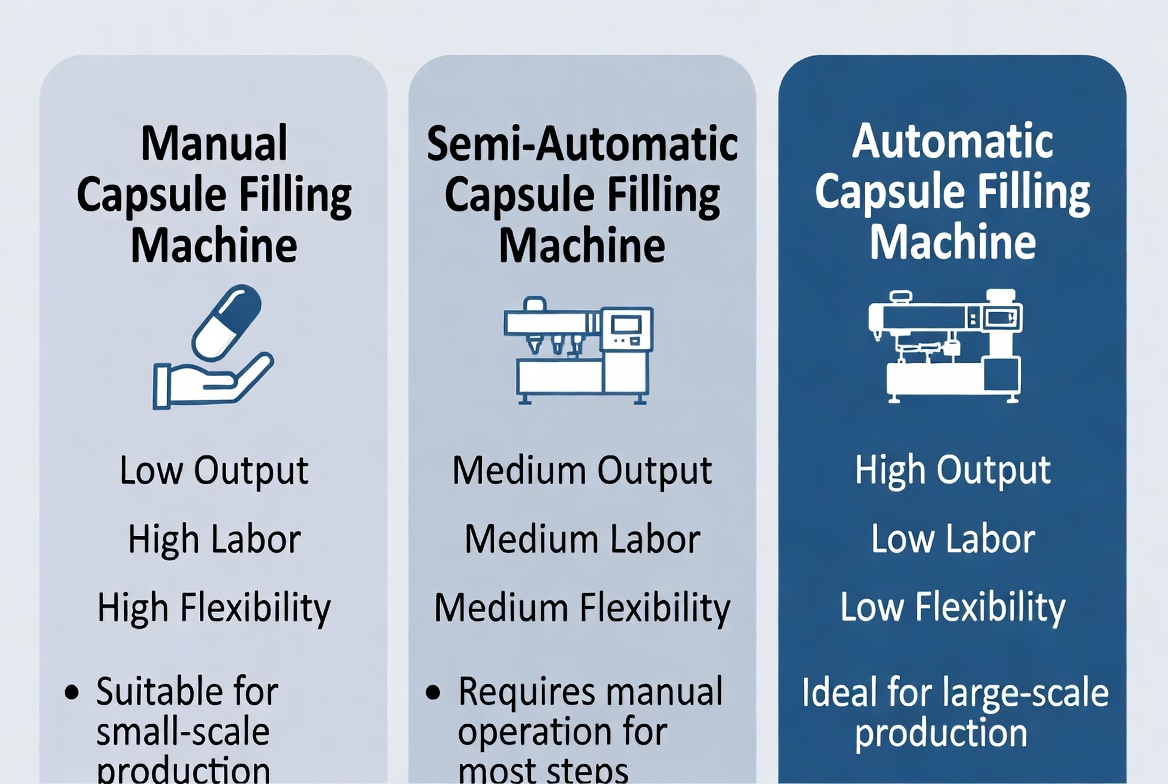
1. Manual Capsule Filling Machines
Manual capsule filling machines are commonly used in laboratories, small-batch production, and product development. They are simple, low-cost, and easy to operate. These machines are best suited for R&D teams, pharmacies, and educational environments.
However, manual systems have clear limitations. They are labor-intensive, slower, and not suitable for large-scale commercial production. They are usually chosen when flexibility and low investment matter more than throughput.
2. Semi-Automatic Capsule Filling Machines
Semi-automatic capsule filling machines combine manual handling with mechanical assistance. They are often used by medium-sized manufacturers or companies transitioning from small-batch production to larger commercial volumes. These machines improve productivity while keeping equipment investment relatively moderate.
They are suitable for powders and, in some designs, pellets or granules. Their biggest advantage is balance: better output than manual systems, but less complexity than fully automatic lines.
3. Automatic Capsule Filling Machines
Automatic capsule filling machines are designed for high-volume pharmaceutical manufacturing. They can complete capsule separation, filling, locking, and sometimes rejection checks with minimal operator intervention. These machines are widely used in commercial oral solid dosage plants.
For large-scale production, automatic systems provide stronger consistency, higher output, and better integration with downstream inspection and packaging equipment. They are the preferred option when manufacturers need stable long-term production capacity.
4. Liquid Capsule Filling Machines
Liquid capsule filling machines are used for formulations that cannot be efficiently filled as dry powder. These systems are suitable for oils, suspensions, and semi-solid materials. In some applications, they are also used for highly potent or low-dose compounds where liquid dosing improves uniformity.
This category is especially important for innovative formulations and specialty pharmaceutical products. It requires careful control of viscosity, sealing, and leak prevention.
5. Capsule Filling Machines for Powder, Pellets, Tablets, and Combinations
Many modern capsule filling platforms can handle multiple fill materials, including powder, pellets, tablets, and mixed formulations. This flexibility is valuable for manufacturers developing differentiated products or multi-release dosage forms.
Combination filling is increasingly important in pharmaceutical and nutraceutical markets because it allows one capsule to deliver multiple ingredients with different release behaviors. For example, a capsule may contain powder for fast release and pellets for extended release.
Capsule Filling Machine Types vs Industrial Uses
| Machine Type | Typical Use | Strengths | Limitations |
| Manual | Lab, R&D, pharmacy compounding | Low cost, simple operation | Low throughput, labor-intensive |
| Semi-automatic | Small to medium production | Better efficiency, moderate investment | Still needs operator involvement |
| Automatic | Large-scale commercial pharma | High speed, consistency, integration | Higher capital investment |
| Liquid filling | Oils, suspensions, semi-solids | Better for non-powder formulations | Requires tight sealing and process control |
| Multi-material filling | Specialty pharma, nutraceuticals | Flexible formulations | More complex setup and validation |
This table helps manufacturers quickly compare the main machine categories based on production needs. In practice, the best option depends on the product portfolio and the plant's future expansion plan.
How to Choose the Right Capsule Filling Machine
Selecting the right machine should start with the product, not the equipment catalog. A manufacturer should evaluate dosage material, target output, capsule size, hygiene needs, and regulatory expectations before making a purchase decision.
Key selection factors include:
- Dosage form: powder, pellets, tablets, liquid, or combinations.
- Batch size: development, pilot, medium-scale, or commercial production.
- Containment level: especially for high-potency or allergenic materials.
- Cleaning and changeover time: important for multiproduct plants.
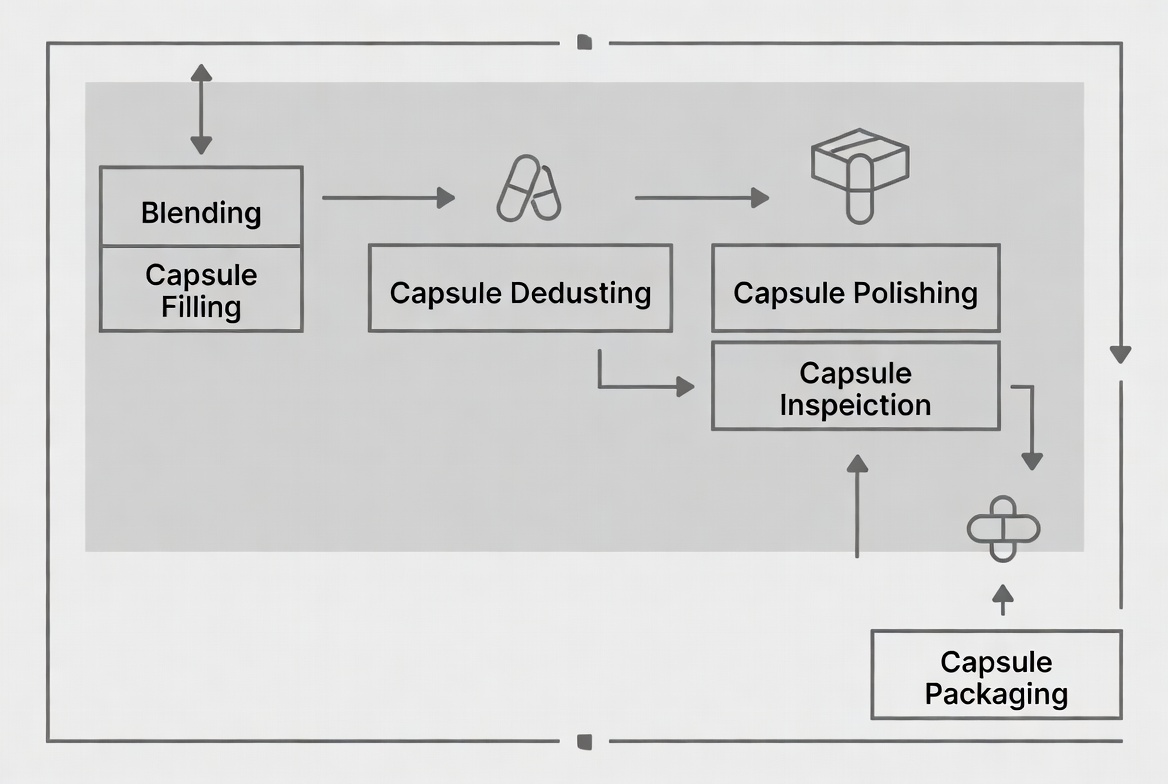
- Integration needs: inspection, polishing, dedusting, and packaging.
- Space and plant layout: machine footprint, workflow, and material flow.
- Long-term scalability: future demand should be considered from day one.
A frequent mistake is buying a machine based only on maximum speed. In reality, a slightly slower machine with better stability, easier cleaning, and stronger process control can deliver higher overall value.
Industrial Applications Across Pharma and Nutraceuticals
Capsule filling machines are used in a broad range of industries. In pharmaceuticals, they support prescription medicines, OTC products, and specialty formulations. In nutraceutical manufacturing, they are used for vitamins, herbal extracts, probiotics, and dietary supplements.
High-containment capsule filling systems are especially relevant for potent active ingredients and oncology-related products. In these cases, operator safety and product isolation become critical design priorities. For manufacturers serving both pharma and health supplement markets, flexible machine platforms can reduce capital duplication and improve facility utilization.
Why Containment and Cleaning Matter
Modern capsule filling projects must address more than output. They also need safe handling, dust control, and cleaning efficiency. This is particularly important for active ingredients that require operator protection or cross-contamination prevention.
Containment design helps limit exposure during filling and transfer. Cleaning strategy helps reduce downtime and maintain product quality between batches. For multiproduct plants, the time saved in cleaning and changeover can be just as valuable as the time gained in production.
A Practical Plant-Planning Perspective
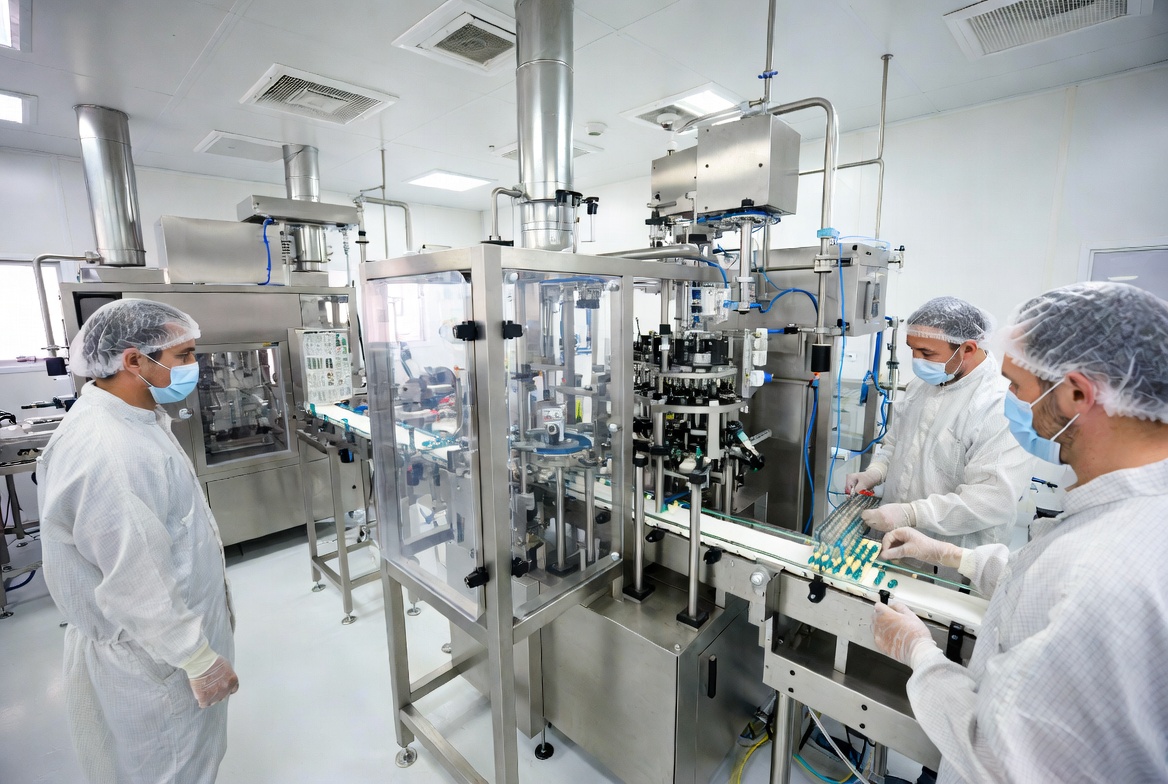
From an engineering standpoint, capsule filling equipment should be designed as part of a broader production system. The upstream and downstream process matters as much as the machine itself. That includes raw material transfer, weighing, blending, dedusting, polishing, inspection, and final packing.
For manufacturers building new facilities, capsule filling lines should be planned with material flow, personnel flow, and room classification in mind. A well-designed layout reduces contamination risk, shortens movement paths, and supports future expansion. This is where an equipment supplier with plant-planning experience can add real value beyond selling a machine.
Real-World Decision Example
A small R&D team developing a new herbal capsule may begin with a manual or semi-automatic machine. Later, if the product enters commercial production, the same company may need automatic filling, inspection, and packaging integration.
This progression shows why machine selection should not be treated as a one-time purchase. It should be part of a phased manufacturing strategy. The best equipment choice today should still make sense when production doubles or when the product portfolio expands.
Latest Industry Insight
The capsule filling market continues to move toward greater automation, better containment, and more flexible multi-format filling. Manufacturers increasingly want machines that can handle different formulations without major downtime or redesign.
Another clear trend is the demand for compact yet integrated lines. Plants are looking for equipment that reduces footprint while improving compliance and throughput. This is especially relevant in regions where space, labor, and regulatory requirements all place pressure on manufacturing efficiency.
Expert Recommendations for Buyers
If you are evaluating a capsule filling project, start with these steps:
1. Define your dosage form and target batch size.
2. Identify the required containment level.
3. Decide whether future products will need liquid or combination filling.
4. Review cleaning validation and changeover requirements.
5. Check whether the machine can integrate with your full line.
6. Ask for sample runs or process verification before final purchase.
A good supplier should not only sell equipment. They should help you match machine capability with real manufacturing needs.
Why Work with a Full-Solution Supplier
For pharmaceutical manufacturers, the best partner is often one that understands the entire plant, not just a single machine. A supplier with experience in purified water systems, sterilization cabinets, and pharmaceutical solution preparation systems can offer a broader view of production architecture.
This matters because capsule filling is only one part of the overall manufacturing ecosystem. When equipment, utilities, and plant layout are coordinated from the beginning, the result is a more efficient, compliant, and scalable facility.
Recommended Call to Action
If you are planning a new capsule filling line or upgrading an existing pharmaceutical plant, request a customized layout and equipment proposal based on your dosage form, capacity target, and compliance requirements. A tailored solution can reduce commissioning risk, improve workflow, and support long-term production growth.
FAQ
1. What is the main difference between manual and automatic capsule filling machines?
Manual machines are best for small batches and R&D, while automatic machines are designed for high-volume commercial production with less operator involvement.
2. Can one capsule filling machine handle different materials?
Yes. Many modern machines can handle powders, pellets, tablets, liquids, or combinations, depending on the machine design.
3. Which capsule filling machine is best for a new pharma plant?
It depends on the target capacity, dosage form, and future expansion plan. For commercial-scale plants, automatic systems are usually the strongest choice.
4. Are liquid capsule filling machines common in pharma?
They are increasingly important for specialty formulations, especially where powders are not ideal or where dose uniformity requires liquid filling.
5. Why is containment important in capsule filling?
Containment protects operators from exposure and reduces cross-contamination risk, especially when handling potent or sensitive materials.
References
1. Syntegon. Capsule filling solutions and product platform overview.
https://www.syntegon.com.cn/solutions/pharma/capsule-filling-machines/
2. ACG. Capsule machinery and capsule processing solutions.
https://www.acg-world.com/zh-CN/everything_capsules
3. CN Patent: A cost-saving capsule filling machine structure.
https://patents.google.com/patent/CN211272423U/zh
4. Journal article on biopharmaceutical workshop process layout optimization.
https://www.2winpub.com/static/uploads/journalArticle/jzgcysj0506015.pdf
5. Market report on manual capsule filling machine trends.
https://www.globalgrowthinsights.com/zh/market-reports/manual-capsule-filling-machine-market-113627
6. Market report on liquid capsule filling and sealing machine trends.
https://m.gelonghui.com/p/765999


