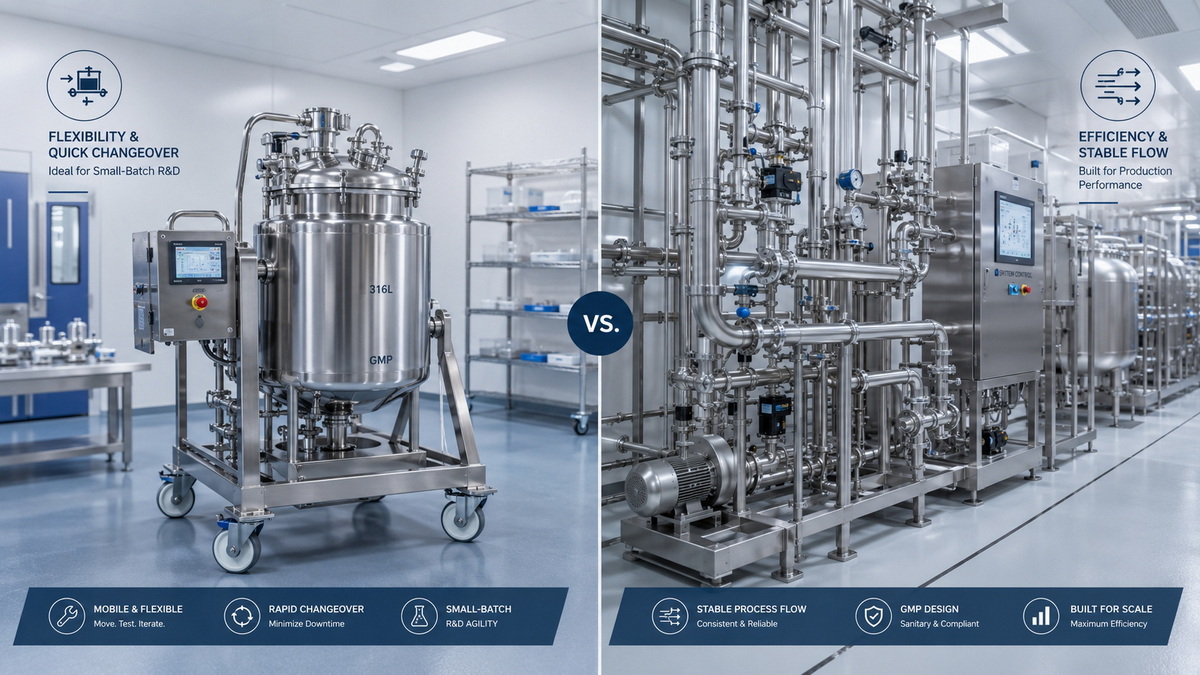
Small-batch pharmaceutical R&D demands a setup that can move fast without compromising GMP discipline. In that context, mobile mixing tanks and fixed piping installations solve the same problem in very different ways: one prioritizes flexibility, the other prioritizes process efficiency and repeatability. [waldner]
Why This Decision Matters in R&D
For formulation teams, the choice between a mobile tank and a fixed piping system affects more than convenience. It influences changeover time, cleaning strategy, contamination risk, validation burden, and how quickly a promising formulation can move to scale-up. [syntegon.com]
In our work with pharmaceutical production planning and clean utility systems, this is rarely just an equipment question. It is a layout question, a compliance question, and a long-term operating-cost question. [everhealgroup]
The Core Trade-Off
A mobile tank is best when the lab needs frequent product changes, multiple trial batches, or parallel experiments. A fixed piping installation is stronger when the same process runs repeatedly and the goal is to reduce handling, shorten transfer paths, and improve throughput. [waldner]
What Mobile Mixing Tanks Offer
Mobile mixing tanks are designed for movement, staged development, and fast reconfiguration. Waldner notes that process tanks can be configured as stationary or mobile, with volumes from 1 to 15,000 liters depending on the project. [syntegon.com]
For small-batch R&D, that mobility creates practical value. A team can bring the vessel to the point of use, change the setup between trials, and reserve fixed infrastructure for utilities instead of dedicating floor space to one line. [waldner]
Best Use Cases
- Multi-product labs with frequent formula changes.
- Pilot plants that support screening, feasibility, and scale-up.
- Facilities where floor space is limited and cleanroom zoning matters.
- Sites that need a lower-cost path before investing in permanent piping. [everhealgroup]
Operational Strengths
Mobile tanks support rapid changeover, which is especially useful in early formulation development. They also reduce the need to commit to a fully hard-piped line before process parameters are stable. [syntegon.com]
In practice, that means less risk when a formulation is still evolving. Teams can test different viscosities, mixing speeds, temperatures, and batch sizes without rebuilding the process every time. [mixing-tank]
Main Limitations
Mobility usually comes with more manual handling. That can increase operator dependency, transfer risk, and the number of steps needed to maintain GMP discipline if the layout is not carefully planned. [syntegon.com]
It can also create a hidden cost: every connection, hose, and transfer point becomes a potential contamination and documentation checkpoint. In small-batch R&D, that is manageable; in high-frequency production, it can become inefficient. [kcc.kropman]
What Fixed Piping Installations Offer
Fixed piping installations are built for repeatability, automation, and process efficiency. When the route between tanks, filters, utilities, and downstream equipment stays constant, the plant can be optimized around flow, cleaning, and batch consistency. [waldner]
This is where fixed piping often wins. Once the process is defined, a permanent layout can reduce transfer time, simplify operator movement, and support a more stable validated state. [syntegon.com]
Best Use Cases
- Repeated manufacture of the same formulation.
- Processes that require tight transfer control.
- Facilities seeking lower operator involvement.
- Plants designed for longer production campaigns. [waldner]
Operational Strengths
A fixed installation makes it easier to engineer CIP/SIP-compatible pathways, sanitary slopes, drainability, and consistent utility routing. Centec describes purified water systems as modular, hygienic, drainable, and designed to support CIP, automatic monitoring, and GMP-compliant operation, which reflects the same logic used in well-designed fixed process infrastructure. [syntegon.com]
That matters because water, cleaning, and formulation are connected. If your clean utility and piping architecture are stable, your process data becomes easier to trust, compare, and audit. [centec]
Main Limitations
The downside is rigidity. Once a fixed piping network is installed, changing product flow, vessel location, or unit operation sequence can be expensive and time-consuming. [waldner]
For R&D environments, that can slow innovation. A line designed too early may lock the team into one process path before the formulation has been proven. [mixing-tank]
Side-by-Side Comparison
| Criterion | Mobile Mixing Tanks | Fixed Piping Installations |
| Flexibility | High | Lower |
| Changeover speed | Fast | Slower |
| Cleaning approach | Often easier to isolate by batch | Strong when CIP/SIP is engineered well |
| Space use | Efficient in variable layouts | Efficient in stable layouts |
| Scale-up readiness | Strong for development stages | Strong for mature processes |
| Automation potential | Moderate to high | High |
| CAPEX timing | Easier to phase | Higher upfront commitment |
In short, mobile tanks win on adaptability, while fixed piping wins on repeatable efficiency. [waldner]
The GMP Perspective
In GMP environments, the best solution is not the most mobile or the most permanent one. It is the one that can be validated, cleaned, monitored, and documented with the least unnecessary complexity. [syntegon.com]
Centec's purified water system example is useful here because it shows the standard expectation for modern pharma utilities: hygienic design, drainability, CIP, automatic monitoring, and sensor-based control of conductivity, TOC, temperature, and pressure. The same design principles should guide your mixing strategy. [syntegon.com]
What Quality Teams Care About
- Product contact surfaces, especially AISI 316L.
- Drainability and dead-leg minimization.
- Cleaning validation pathway.
- Batch traceability and control data.
- Integration with clean utilities and water systems. [waldner]
The Hidden Cost of "Flexible" Layouts
A common mistake in small-batch R&D is assuming flexibility is automatically cheaper. In reality, flexibility can become expensive if it creates repeated manual transfers, extra cleaning steps, or ad hoc layout decisions that never get standardized. [kcc.kropman]
The better metric is not "mobile vs fixed." It is how many process decisions remain open. If the formulation is still changing, mobile infrastructure usually makes sense. If the formulation is stable, fixed piping often delivers lower lifecycle cost and less operator variability. [mixing-tank]
Utility Design Decides the Winner
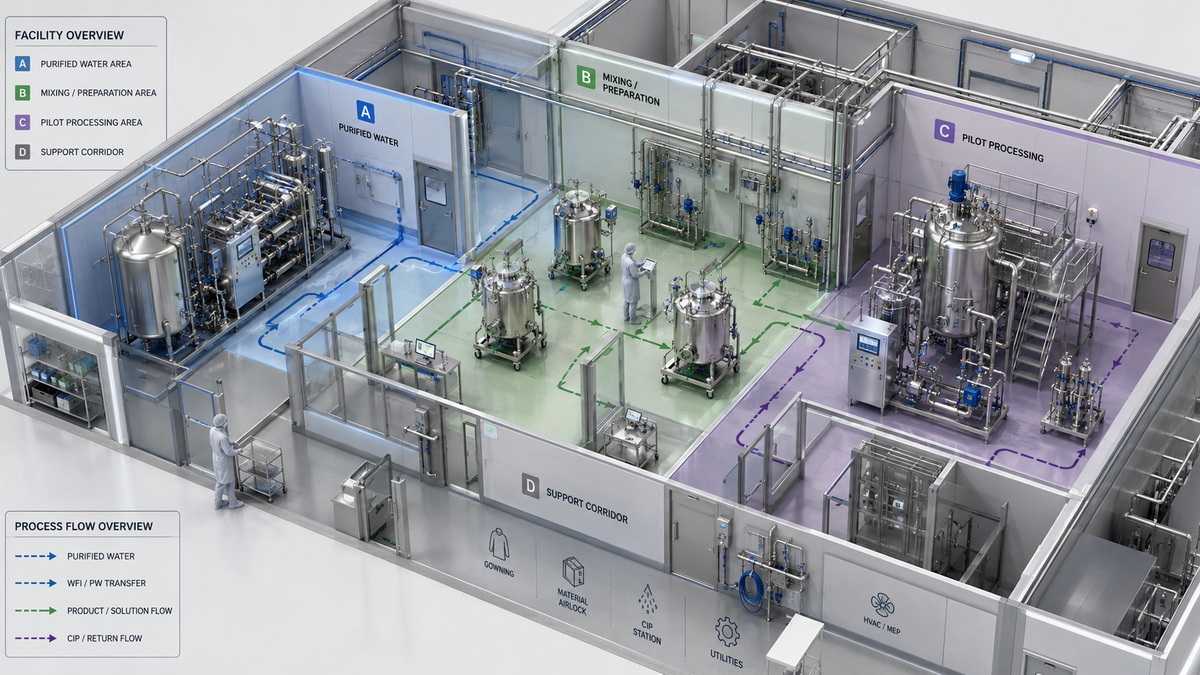
The tank itself is only part of the story. Water quality, cleaning utilities, automation, and room zoning often decide whether a mobile or fixed model succeeds. [syntegon.com]
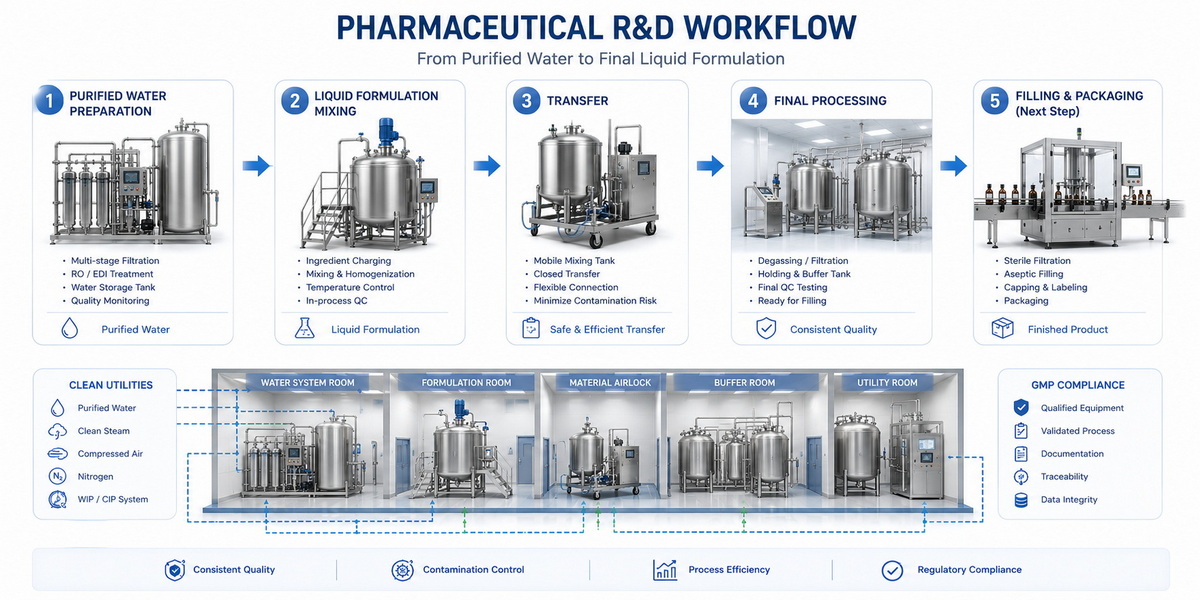
For example, a mobile mixing tank can be very effective in a facility that already has a strong purified water backbone, hygienic connections, and a clear cleaning strategy. Everheal's broader portfolio in purified water preparation systems, sterilization cabinets, and pharmaceutical solution preparation systems shows how utilities and process equipment should be planned together rather than as isolated purchases. [everhealgroup]
From R&D to Scale-Up
The best R&D layouts are designed with the next stage in mind. That means choosing a tank and piping architecture that can evolve from screening to pilot to production without forcing a complete rebuild. [ptknewsroom.wordpress]
A modular approach is often the smartest path. Start with mobile units where formula uncertainty is high, then transition to fixed piping once the process is locked and the business case supports automation. [waldner]
Practical Selection Guide
Use this simple decision path:
1. Choose mobile mixing tanks if you need frequent batch changes, multi-product flexibility, or short-term pilot work.
2. Choose fixed piping installations if your formulation is stable, your batch cycle is repetitive, and uptime matters more than rearrangement.
3. Choose a hybrid model if R&D, pilot, and scale-up all happen in the same facility.
4. Design the utilities first, especially purified water, cleaning, and controls.
5. Plan for validation from day one, not after the layout is already frozen. [centec]
Why Everheal Fits This Topic
For readers evaluating equipment vendors, Everheal's background is relevant because it works across purified water preparation, sterilization, and pharmaceutical solution preparation systems, which are the exact infrastructure layers that support small-batch and scale-up decisions. [everhealgroup]
That broader systems view matters. A tank supplier can deliver hardware, but a pharma project needs a facility solution: utilities, layout, cleanability, compliance, automation, and future expansion. [everhealgroup]
CTA
If your facility is planning a new small-batch R&D area, a pilot suite, or a scale-up-ready formulation line, the smartest next step is a layout review before equipment is ordered. Everheal can help you evaluate whether a mobile, fixed, or hybrid process architecture best supports your product mix, cleaning strategy, and long-term expansion plan. [everhealgroup]
FAQ
1. Are mobile mixing tanks good for pharmaceutical R&D?
Yes. They are especially useful for frequent formula changes, small batches, and pilot work where flexibility matters most. [waldner]
2. When is a fixed piping installation better?
A fixed system is usually better when the process is stable, batches repeat often, and the goal is to improve efficiency and reduce manual handling. [syntegon.com]
3. Which option is easier to validate?
A fixed system can be easier to standardize once it is fully defined, but a mobile system can be easier to validate at small scale if the workflow is simpler and more isolated. [syntegon.com]
4. Do both options support GMP?
Yes, but only if the design supports hygienic surfaces, drainability, cleaning validation, and controlled automation. [centec]
5. What material is most common for pharma process tanks?
AISI 316L is widely used for hygienic pharmaceutical applications because it supports corrosion resistance and cleanability. [syntegon.com]
References
1. [Centec GmbH] — source for purified water system hygiene, drainability, CIP/SIP, automation, and GMP-oriented design.
2. [Waldner – Mixing tank: Process solutions for pharmaceuticals and food] — source for mobile/stationary tank options, made-to-measure design, and volume range.
3. [Everheal – Pharmaceutical Mixing Tank Manufacturer in China] — source for company background and pharma equipment positioning.
4. [Syntegon – High-Purity Media and Formulation Systems] — source for pharma formulation system context.
5. [Syntegon – Drug Product Formulation Systems] — source for pharmaceutical liquid formulation context.
6. [Kropman Contamination Control – Cleaning skids] — source for CIP/COP process logic and mobile component cleaning context.
7. [PTK PM-C Lab Optimized for Small Batch R&D Development] — source for small-batch R&D and scale-up continuity concept.
8. [Cedarstone Industry – Small Industrial Mixing Tanks Explained] — source for small-batch tank use cases, materials, and maintenance considerations.


