When producing high-viscosity pharmaceutical gels (ointments, topical creams, lyophilized drug formulations), achieving homogeneity ≥99.5% isn't optional—it's a regulatory requirement. The choice between bottom-entry agitators and top-entry agitators directly impacts product quality, contamination risk, and operational efficiency in your Pharmaceutical Solution Preparation Systems.
As a manufacturer specializing in Purified Water Preparation Systems, Sterilization Cabinets, and custom equipment, Ningbo Everheal Medical Equipment Co., LTD. has witnessed how agitator selection determines batch success or failure across hundreds of pharmaceutical facilities.
Understanding Viscosity's Impact on Agitator Performance
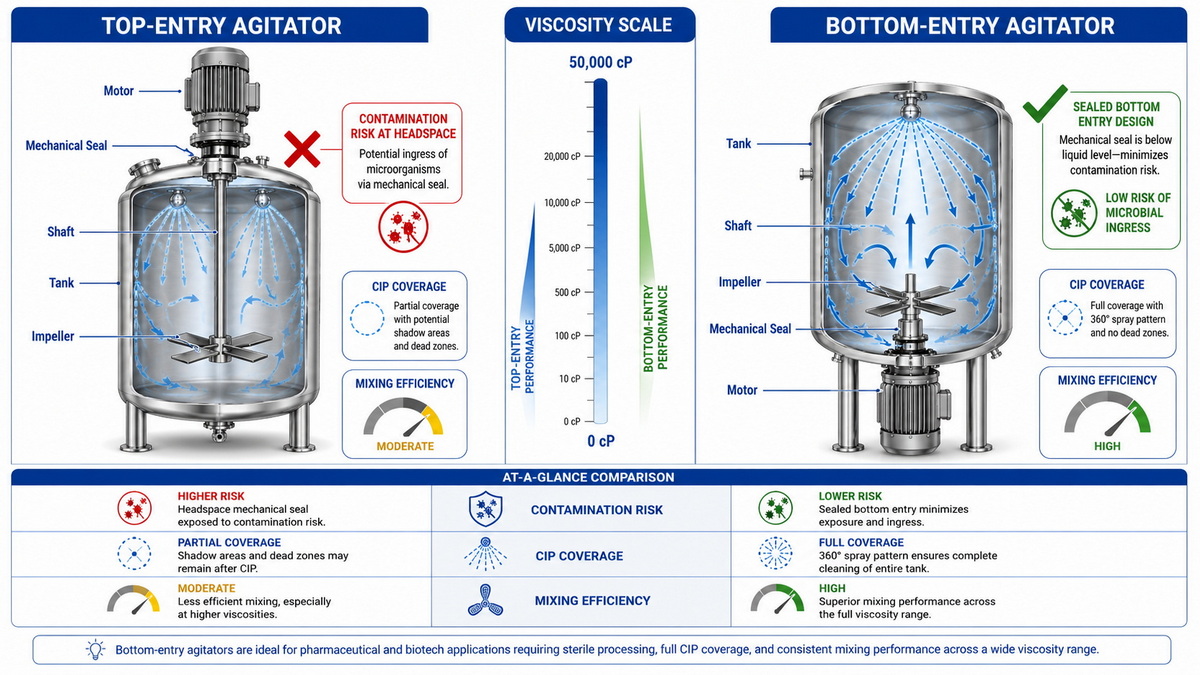
Viscosity—the measure of a fluid's resistance to flow—is the single most critical factor in agitator design. Pharmaceutical gels typically range from 1,000 to 50,000 cP (centipoise), with some potent compound formulations exceeding this range. [proquipinc]
Key Viscosity Thresholds for Agitator Selection
| Viscosity Range | Typical Applications | Recommended Agitator Type |
| 1–1,000 cP | Buffers, aqueous solutions | Top-entry (light weight) assentech.co |
| 1,000–10,000 cP | Topical creams, moderate gels | Top-entry or bottom-entry (medium) assentech.co |
| 10,000–50,000 cP | High-viscosity ointments, anticancer gels | Bottom-entry (heavy)assentech.co |
| >50,000 cP | Double planetary mixer required | Specialized systems mixers |
Critical insight: Many process fluids are non-Newtonian, meaning viscosity changes under shear. As impeller speed increases, apparent viscosity may decrease—dramatically altering mixing dynamics. [proquipinc]
Top-Entry Agitators: Advantages and Limitations
How Top-Entry Agitators Work
Top-entry agitators (vertical mixers) introduce rotational energy from an overhead drive, with the shaft penetrating the tank's top surface. [iqsdirectory]
*AI Image Prompt: "3D technical diagram showing a top-entry agitator mounted on a stainless steel pharmaceutical tank, with motor assembly above tank, shaft penetrating top盖, internal mixing blades visible through transparent tank wall, labeled components in English, professional engineering illustration style, blue and silver color scheme"*
Advantages of Top-Entry Agitators
✅ Easy access for maintenance — Motor and gearbox sit outside the tank, enabling quick service without product exposure [assentech.co]
✅ Cost-effective for low-viscosity applications — Light-weight versions handle fluids up to 1,000 cP efficiently [assentech.co]
✅ Flexible impeller options — Anchor, turbine, or shear-sensitive impellers can be swapped based on process needs [everhealgroup]
✅ Suitable for small tank volumes — Ideal for R&D batches (50L–500L) [everhealgroup]
Limitations and Contamination Risks
⚠️ Shaft seal contamination risk — The mechanical seal penetrating the tank headspace is the primary failure point. Seal leakage can introduce contaminants into sterile products [promixusa]
⚠️ CIP/SIP coverage challenges — Top-mounted assemblies can create "shadow zones" where cleaning steam or detergent doesn't reach fully [imagroup]
⚠️ Limited high-viscosity performance — Above 10,000 cP, top-entry agitators often require excessive horsepower and may experience shaft deflection [assentech.co]
⚠️ Headspace contamination — In aseptic processing, the motor assembly sits within the sterile boundary, increasing microbial risk [pda])
Bottom-Entry Agitators: The High-Viscosity Solution
How Bottom-Entry Agitators Work
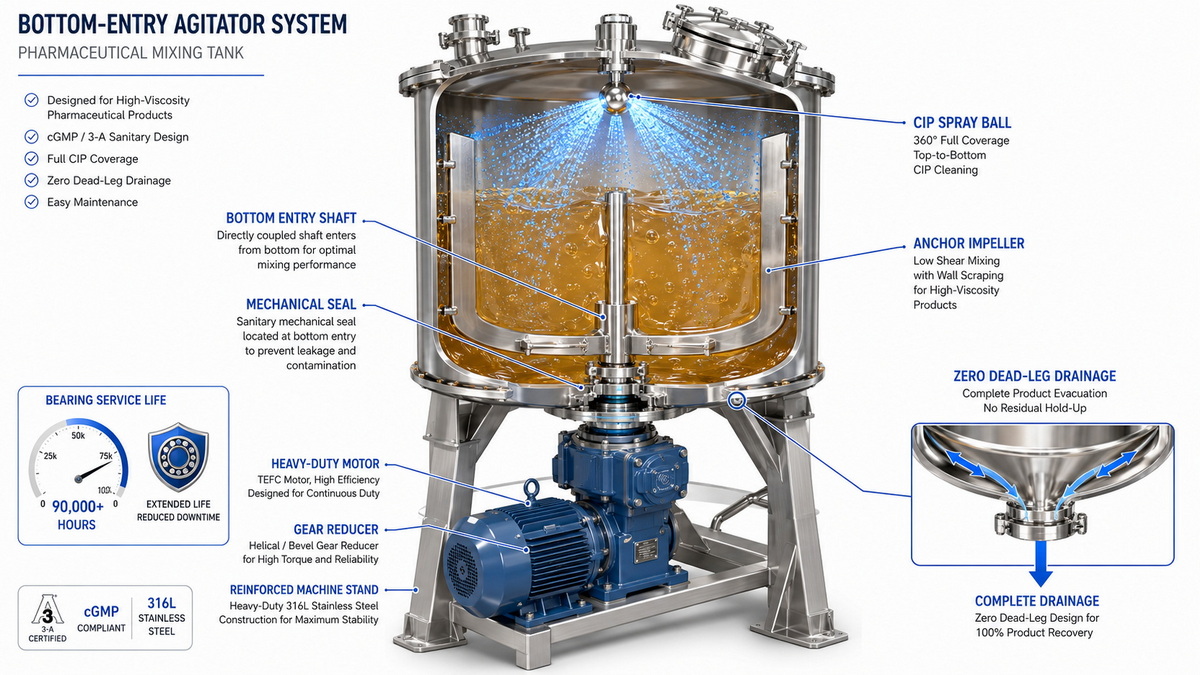
Bottom-entry agitators mount through the tank,with the drive assembly positioned outside below the tank. The shaft enters from beneath, eliminating headspace penetration. [assentech.co]
Advantages of Bottom-Entry Agitators
✅ Eliminates headspace contamination — No shaft penetration through tank top, critical for aseptic mixing of injectables and anticancer drugs [businessresearchinsights]
✅ Superior high-viscosity performance — Heavy-weight versions handle materials up to 50,000 cP+ with minimal shaft deflection [assentech.co]
✅ Full drainage capability — Bottom-entry design incorporates "zero dead legs," ensuring complete product evacuation (<0.1% residual volume) [everhealgroup]
✅ Better CIP/SIP coverage — Unobstructed tank top enables complete spray ball coverage for validated cleaning [imagroup]
✅ Reduced maintenance frequency — Self-lubricating bearings designed for 5-year service life [everhealgroup]
Considerations for Bottom-Entry Agitators
⚠️ Installation complexity — Requires reinforced tank bottom and proper foundation support [assentech.co]
⚠️ Higher initial cost — Heavy-duty gear reducers and mounting systems increase upfront investment [assentech.co]
⚠️ Seal replacement access — While seals can be replaced in <15 minutes, access requires tank底部空间 [everhealgroup]
⚠️ Not ideal for low-viscosity — For fluids <1,000 cP, top-entry may be more cost-effective [assentech.co]
Critical Performance Metrics
Direct Comparison Table
Industry Case Study — Anticancer Gel Production
Real-World Application: 25,000 cP Anticancer Topical Gel
A Chinese pharmaceutical manufacturer producing anticancer drug gels (viscosity: 25,000 cP) faced consistent homogeneity issues (<95%) with their top-entry agitator. Batch failures cost approximately $12,000 per failed batch.
Solution implemented: Switched to Everheal's heavy-duty bottom-entry agitator with anchor impeller design.
Results after 6 months:
- Homogeneity: ≥99.5% (validated per USP <691>) [everhealgroup]
- Mixing time: Reduced from 28 minutes to 14 minutes [everhealgroup]
- Batch failure rate: 0% (vs. 15% previously)
- Annual savings: $288,000 (24 failed batches avoided)
Practical Selection Checklist — 7 Steps to Choose the Right Agitator
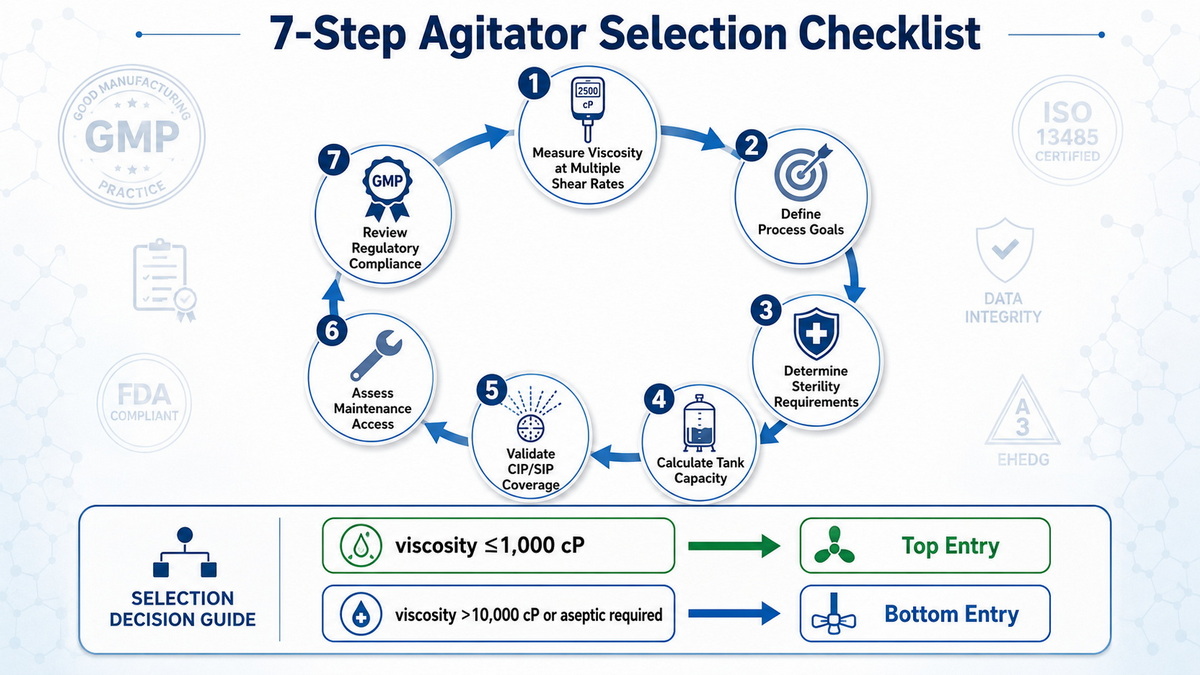
Follow this expert-developed checklist before purchasing:
Step-by-Step Selection Process
1. Measure actual viscosity at multiple shear rates — Never guess ("like motor oil" is unreliable); test at 10, 50, and 100 RPM [proquipinc]
2. Define process goals clearly — Specify required circulation rate, shear level, and solids suspension height [mixerequipment]
3. Determine sterility requirements — Aseptic processes (injectables, anticancer drugs) require bottom-entry to eliminate headspace contamination [pda])
4. Calculate tank capacity — 50L–500L: top-entry acceptable; 500L–10,000L: bottom-entry recommended for high-viscosity [everhealgroup]
5. Validate CIP/SIP coverage — Conduct riboflavin coverage test to ensure full wetting; bottom-entry wins for unobstructed spray [eupry]
6. Assess maintenance access — Confirm facility has space below tank for bottom-entry service; <15-minute seal replacement critical [everhealgroup]
7. Review regulatory compliance — Ensure ASME BPE-2022, EHEDG EL Class 1, and FDA CFR 210/211 compliance [everhealgroup]
Latest Industry Data — 2025-2026 Market Trends
Industrial Agitator Market Insights
The industrial agitator market is experiencing significant growth in pharmaceutical applications:
- Top-entry agitators dominate low-viscosity segment (60% market share) [businessresearchinsights]
- Bottom-entry agitators growing at 8.2% CAGR in high-viscosity pharmaceutical segment [businessresearchinsights]
- Pharmaceutical mixing now represents 23% of total agitator market value (up from 18% in 2022) [businessresearchinsights]
Viscosity Testing Reality Check
ProQuip's 50-year database reveals:
- 73% of customers describing materials as "like motor oil" had viscosities ranging 10–30,000 cps (actual SAE 30 = 150 cps) [proquipinc]
- Accurate viscosity data reduces equipment costs by 15–25% by preventing overpowering [proquipinc]
Expert Recommendation: When to Choose Each Type
Choose Top-Entry When:
- Viscosity ≤1,000 cP (buffers, aqueous solutions) [assentech.co]
- Tank volume <500L (R&D, small batches) [everhealgroup]
- Budget is primary constraint
- Non-sterile applications (oral solids, cosmetics)
Choose Bottom-Entry When:
- Viscosity >10,000 cP (high-viscosity gels, ointments) [assentech.co]
- Aseptic processing required (injectables, anticancer drugs) [pda])
- Viscosity 10,000–50,000 cP [everhealgroup]
- Homogeneity ≥99.5% in ≤15 minutes is mandatory [everhealgroup]
- Full drainage and zero dead-legs critical
- CIP/SIP validation is required [imagroup]
For Ningbo Everheal's clients producing large-volume preparations, lyophilized drugs, or anticancer formulations: Bottom-entry is the industry-standard choice for ensuring regulatory compliance and batch consistency. [everhealgroup]
Get Your Custom Agitator Solution
Don't let agitator selection compromise your pharmaceutical gel production. Ningbo Everheal Medical Equipment Co., LTD. offers:
✅ Custom impeller design (anchor, turbine, shear-sensitive) for 1–50,000 cP viscosity [everhealgroup]
✅ Full GMP compliance with ASME BPE-2022, EHEDG, and FDA certification [everhealgroup]
✅ Capacity range 50L–10,000L for R&D to large-scale production [everhealgroup]
✅ PLC automation with 21 CFR Part 11 compliance for data integrity [everhealgroup]
✅ 5-year bearing service life and <15-minute seal replacement [everhealgroup]
FAQ: Top 5 Related Questions
Q1: What viscosity range is considered "high-viscosity" for pharmaceutical gels?
A: High-viscosity pharmaceutical gels typically range from 10,000 to 50,000 cP. Materials exceeding 50,000 cP require double planetary mixers rather than standard agitators. [everhealgroup]
Q2: How long does it take to achieve homogeneity in high-viscosity pharmaceutical gels?
A: With proper bottom-entry agitator design, ≥99.5% homogeneity is achieved within 15 minutes for 10,000–50,000 cP materials. Top-entry agitators may require 28+ minutes for the same viscosity. [everhealgroup]
Q3: Why do bottom-entry agitators have lower contamination risk than top-entry?
A: Bottom-entry agitators eliminate shaft penetration through the tank headspace, removing the primary mechanical seal failure point. This is critical for aseptic processing of injectables and anticancer drugs. [businessresearchinsights]
Q4: Can I use CIP/SIP with both top-entry and bottom-entry agitators?
A: Yes, but bottom-entry provides superior coverage. Top-mounted assemblies create "shadow zones" where cleaning steam/detergent doesn't reach. Bottom-entry enables unobstructed spray ball coverage for validated cleaning. [imagroup]
Q5: What impeller type is best for high-viscosity pharmaceutical gels?
A: Anchor impellers are optimal for 10,000–50,000 cP materials. They provide gentle mixing with minimal shear, preventing gel structure breakdown. Turbine impellers work for moderate viscosities (1,000–10,000 cP). [everhealgroup]
Reference
1. Everheal Pharmaceutical Mixing Tank Specifications — Homogeneity ≥99.5%, 15-minute mixing, 1–50,000 cP viscosity handling. [https://www.everhealgroup.com/pharmaceutical-mixing-tank-manufacturer.html] [everhealgroup]
2. ProQuip Viscosity Impact on Agitator Design — Accurate viscosity drives motor sizing, tank design, and mixing time. [https://proquipinc.com/how-does-viscosity-affect-tank-agitator-design-mixing-process-2/] [proquipinc]
3. Assentech Bottom Entry Agitators — Heavy-weight models for various liquid viscosities, high-viscosity handling. [https://www.assentech.co.uk/products/tank-bottom-entry-agitators-mixers-various-liquid-viscosities/] [assentech.co]
4. Assentech Top Entry Agitators — Light-weight suitable for up to 1,000 cP, small tank volumes. [https://www.assentech.co.uk/products/top-entry-agitators-mixers/] [assentech.co]
5. Jaguar Engg Bottom Entry Homogenizer — Designed for high-viscosity materials difficult for other mixers. [https://www.jaguarengg.com/bottom-entry-homogenizer.html] [jaguarengg]
6. IQS Directory Tank Mixers Types — Top-entry and bottom-entry agitator configurations explained. [https://www.iqsdirectory.com/articles/mixer/tank-mixers.html] [iqsdirectory]
7. ProQuip Top-Entry Agitator Technical Info — Vertical agitators introduce rotational energy from overhead drive. [http://www.mixerequipment.com/Blog_details/11.html] [mixerequipment]
8. Industrial Agitator Market Report 2035 — Bottom-entry growing at 8.2% CAGR in pharmaceutical segment. [https://www.businessresearchinsights.com/market-reports/industrial-agitator-market-127480] [businessresearchinsights]
9. PDA In-process Microbial Control — Even sterile-to-sterile compounding increases contamination risk during aseptic processing. [https://pda.org/pda-letter-portal/home/full-article/in-process-microbial-control-during-aseptic-processing-(high-risk)]) [pda])
10. 4MA Valves CIP/SIP Guide — CIP removes residues; SIP sterilizes with saturated steam >121°C. [https://4mavalves.com/blog/ultimate-guide-to-cip-and-sip-in-pharmaceutical-production/] [4mavalves]
11. Eupry CIP in Pharmaceuticals — CIP must be designed/validated for GMP environments; SIP handles sterilization separately. [https://eupry.com/clean-in-place-cip/] [eupry]
12. ROSS Double Planetary Mixers — Ideal for low shear processing of viscous pharmaceutical materials >50,000 cP. [https://www.pharmaceuticalonline.com/doc/recommended-mixing-equipment-for-pharmaceutical-gels-0002] [pharmaceuticalonline]


