


Views: 245 Author: Everheal Medical Equipment Publish Time: 2026-07-07 Origin: Everheal


Pure steam is not one-size-fits-all. Pure steam for autoclaves and pure steam for humidification may both come from clean steam generation systems, but their quality requirements, system design logic, and GMP implications are very different.
For pharmaceutical manufacturers, understanding this difference is essential. The right specification affects sterility assurance, product safety, energy efficiency, validation effort, and long-term operating cost.
In pharmaceutical plants, pure steam is used in multiple critical applications. The most demanding is usually sterilization in autoclaves, where steam directly supports the destruction of microorganisms on equipment, components, and sometimes product-contact parts. Humidification, by contrast, is often used to control environmental conditions in cleanrooms, aseptic suites, or process areas.
Because the end uses are different, the steam quality targets are also different. Steam that is acceptable for humidification may not be suitable for sterilization. This is why a clean utility system should never be designed around a single generic "pure steam" definition.
At Ningbo Everheal Medical Equipment Co., LTD., we often see that the best results come when pure steam is planned together with the full factory layout, utility routing, and downstream process requirements. That approach reduces rework and makes validation easier.
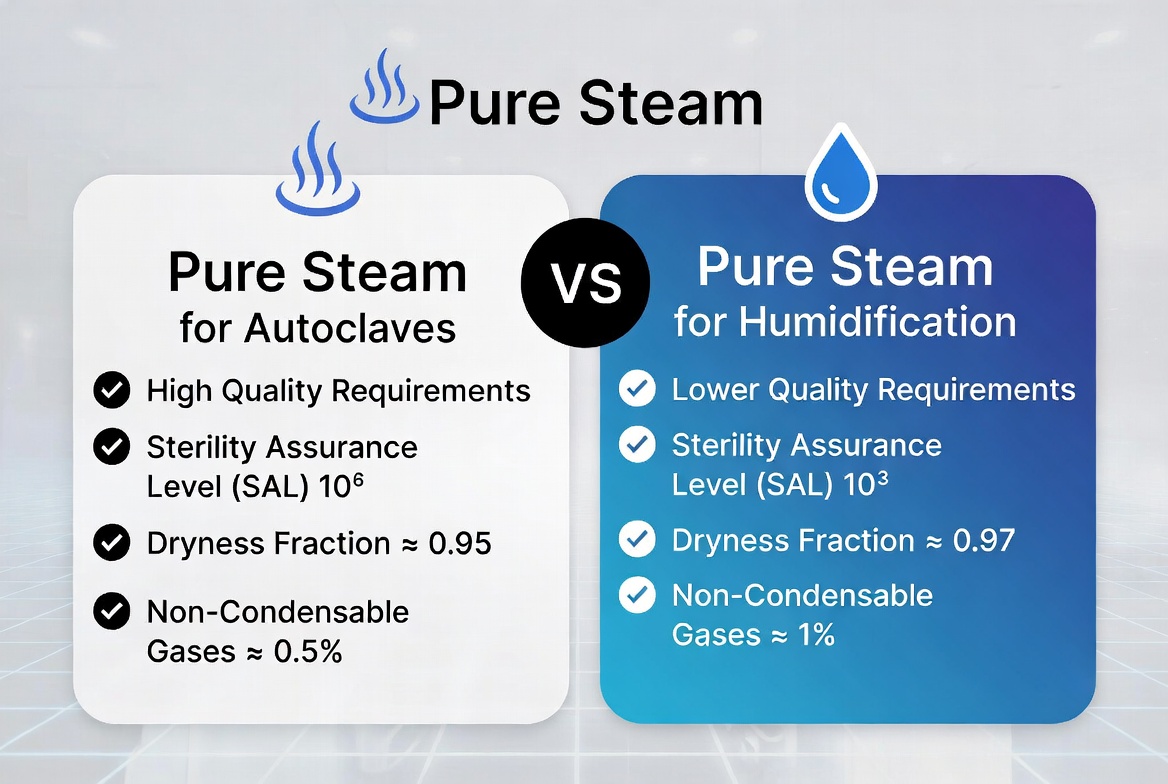
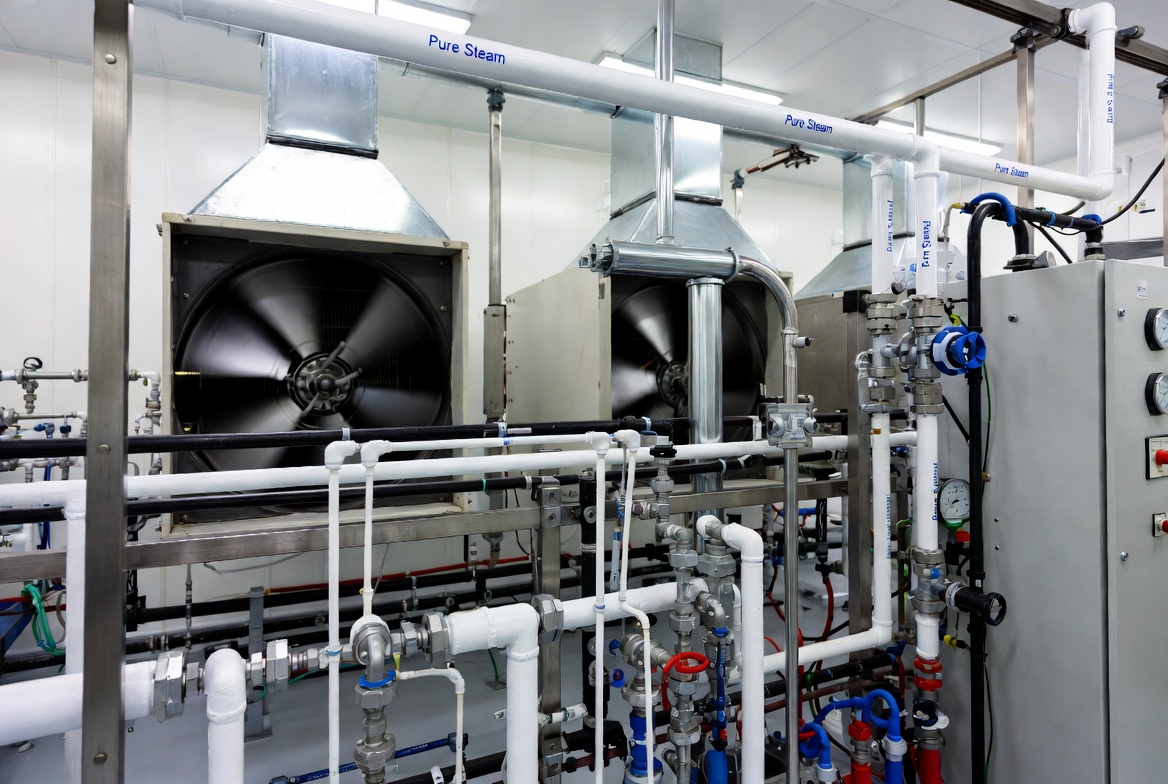
Pure steam is steam produced from purified water or WFI-quality feedwater and designed to meet pharmaceutical cleanliness requirements. It is typically generated in a dedicated pure steam generator and distributed through sanitary piping to points of use.
Unlike industrial steam, pure steam must be controlled for:
- Non-condensable gases
- Dryness fraction
- Chemical contamination
- Endotoxin and carryover risk
- Condensate quality
In practice, the main goal is to ensure that the steam condenses into very clean water without leaving behind impurities that could affect sterilization or cleanroom performance.
Pure steam for autoclaves is the more demanding application. In sterilization, the steam must transfer heat efficiently and penetrate the load consistently. If the steam contains excessive non-condensables or too much moisture, sterilization performance can suffer.
Key requirements usually include:
- High dryness fraction
- Very low non-condensable gases
- Low superheat risk
- Minimal particulate and chemical contamination
- Reliable condensate purity
Autoclaves depend on steam quality for cycle repeatability. Poor-quality steam can create cold spots, extend cycle time, and increase the risk of failed sterilization validation. In regulated facilities, that is not just a technical problem; it is a compliance risk.
A good way to think about it is this: autoclave steam must be performance-grade pure steam. It must support rapid, even, and validated heat transfer every time.

Pure steam for humidification is important, but its quality requirements are often less stringent than for autoclaves. In cleanrooms, humidification steam is mainly used to control relative humidity and prevent static, product stress, or comfort-related issues in controlled environments.
Because steam is usually introduced into air handling systems rather than directly into sterilization chambers, the key concerns are different:
- No visible droplets or excessive wetness
- Low contamination risk
- Stable and controllable generation
- Compatibility with HVAC systems
- Energy efficiency
For humidification, the focus is on maintaining a stable environment, not achieving microbial lethality. That means the steam must still be clean, but it does not always require the same ultra-tight performance parameters as sterilization steam.
| Factor | Pure Steam for Autoclaves | Pure Steam for Humidification |
|---|---|---|
| Primary purpose | Sterilization | Environmental humidity control |
| Main performance need | Heat transfer and penetration | Stable moisture delivery |
| Non-condensable gas limit | Very tight | Important, but often less strict |
| Dryness requirement | High | Moderate to high |
| Validation impact | Directly critical | Usually indirect |
| Compliance risk | Very high | Moderate |
| System design focus | Sterility assurance | HVAC compatibility and stability |
This comparison shows why the same steam generation system may not be optimal for both uses unless it is specifically designed for the most demanding case.
Dryness fraction describes how much of the steam is actually vapor versus entrained water. For autoclaves, excessive moisture can reduce heat transfer efficiency and affect load penetration. For humidification, some moisture content may be less problematic, depending on how the steam is injected and dispersed.
Air and other non-condensable gases are especially harmful in sterilization. They can create insulating layers, delay penetration, and reduce lethality. Humidification systems also benefit from low gas content, but the operational impact is usually less severe than in autoclave cycles.
Autoclave steam must be extremely clean because any residue can affect sterile processing outcomes. For humidification, contamination is still undesirable, but the acceptable risk profile may differ based on the room classification and use case.
Autoclaves require consistent steam supply during each cycle. Humidification requires smooth delivery to maintain room RH setpoints. In both cases, unstable pressure can create performance issues, but the consequences differ.
A pharmaceutical pure steam system should be engineered from the intended use backward. That means the design starts with application requirements, not equipment catalog specifications.
For autoclaves, this usually means:
- Dedicated pure steam generation
- Sanitary piping with proper slope and drainability
- Condensate management
- Online monitoring and routine qualification
- Materials and welding practices aligned with GMP expectations
For humidification, the design may prioritize:
- Integration with HVAC systems
- Controlled steam injection points
- Stable pressure regulation
- Efficient distribution across cleanroom zones
- Lower operating complexity where appropriate
The best systems are not only technically sound; they are also practical to validate and maintain.
From a project planning perspective, the correct question is not "Can one steam source do both jobs?" The better question is "Can one steam source meet the stricter of the two requirements without unnecessary cost or complexity?"
In many facilities, the answer depends on:
- The number of autoclaves
- The classification of the cleanroom
- Whether humidification supports aseptic operations
- Validation strategy
- Redundancy expectations
- Expansion plans for future production lines
For high-value sterile manufacturing, we usually recommend designing for the autoclave requirement first, then verifying whether humidification can be safely supported from the same utility architecture. This avoids underdesign, which is far more expensive to fix later.
Here is a simple validation logic pharmaceutical teams can follow:
1. Define the end use clearly.
Separate sterilization steam points from humidification points.
2. Set quality targets by application.
Autoclaves should receive the strictest specifications.
3. Check distribution losses.
Long pipe runs can affect temperature, dryness, and condensate behavior.
4. Verify condensate quality at point of use.
Do not rely only on generator output data.
5. Confirm performance during qualification.
Test under real operating conditions, not only at idle.
This approach helps reduce surprises during SAT, IQ/OQ, and ongoing GMP audits.
Many projects fail because teams assume "pure steam" automatically means the same thing everywhere. That assumption can lead to underperforming sterilization cycles or overbuilt humidification systems.
Common mistakes include:
- Using one generic specification for all steam applications
- Ignoring condensate quality at the point of use
- Oversizing or undersizing the steam generator
- Failing to separate critical and non-critical utility loops
- Neglecting drainability and pipe slope
- Designing without considering future expansion
These mistakes are avoidable with early engineering coordination.
Pure steam is only one part of a complete pharmaceutical utility strategy. In a modern facility, it should be coordinated with:
- Purified Water Preparation Systems
- WFI and clean utility planning
- Sterilization Cabinet / autoclave integration
- Pharmaceutical Solution Preparation Systems
- Cleanroom HVAC and humidity control
- Factory layout and process flow design
This is where an experienced equipment manufacturer adds value. A well-planned utility network reduces contamination risk, shortens commissioning time, and supports scalable production.
If your facility needs a pure steam system for autoclaves, humidification, or both, the best next step is a custom utility layout review. A tailored design can help you define the right steam quality, reduce validation risk, and build a production line that is ready for GMP operation from day one.
For project consultation, you can position your CTA like this:
Request a custom pure steam system layout and GMP utility solution for your plant.
No. They may be produced by similar equipment, but autoclave steam usually needs stricter control of dryness, non-condensables, and condensate quality.
Yes, in some facilities. However, the system must be designed to satisfy the stricter autoclave requirement and remain stable for humidification use.
They reduce heat transfer and can block steam penetration, which may compromise sterilization performance and cycle validation.
They need clean steam suitable for the facility environment, but the exact specification depends on room classification and operational risk.
Common checks include dryness fraction, non-condensable gases, pressure stability, condensate quality, and point-of-use performance.
1. [United States Pharmacopeia (USP) – General chapters and water/steam-related guidance]
2. [European Pharmacopoeia (Ph. Eur.)]
3. [FDA – Sterilization and aseptic processing guidance]
4. [ISPE – Good Practice Guide: Heating, Ventilation, and Air Conditioning]


