In BFS filling lines, the choice between RABS (Restricted Access Barrier Systems) and isolator technology can define your contamination risk, compliance burden, and long-term operating cost. For manufacturers planning a new aseptic line, the decision is not only technical; it is also strategic, because it affects facility design, operator workflow, and validation scope. EU GMP Annex 1 states that RABS or isolators are beneficial in minimizing microbial contamination from direct human intervention, and any alternative should be justified within the contamination control strategy. [sychem.co]
For pharmaceutical plants producing high-value sterile products, lyophilized drugs, large-volume parenterals, or high-potency formulations, the barrier choice must match the product's risk profile. That is why this comparison matters for BFS filling lines, where sterility assurance, uptime, and manufacturability all depend on the barrier architecture. [health.ec.europa]
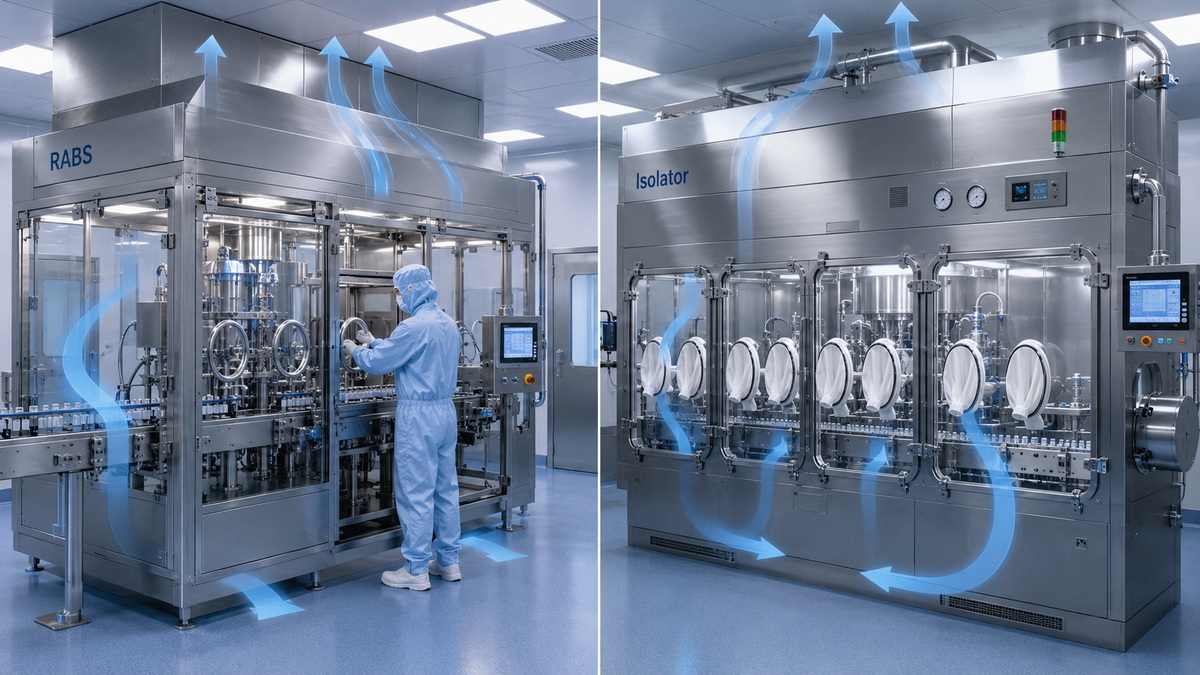
What BFS Filling Lines Need
BFS, or blow-fill-seal, is already a highly integrated aseptic packaging process. It forms the container, fills it, and seals it in a single enclosed sequence, which reduces exposure compared with conventional filling. Even so, the surrounding barrier design still matters because interventions, environmental control, and decontamination strategy can influence contamination risk and line efficiency. [sychem.co]
A BFS line typically needs:
- A controlled aseptic zone.
- Reliable operator separation from the critical process.
- A validated decontamination approach.
- Practical access for maintenance and troubleshooting.
- Stable integration with upstream utilities and downstream handling.
For companies like Ningbo Everheal Medical Equipment Co., LTD., which design complete pharmaceutical production solutions, this means the barrier decision should be considered together with factory layout, utility routing, water systems, and production flow rather than as a standalone equipment choice. [centec]
RABS Explained
RABS are designed to create a physical and aerodynamic barrier between the operator and the critical aseptic area while still allowing some intervention through defined access methods. In practice, they reduce human exposure to the filling zone but do not fully eliminate operator involvement. That makes them attractive for plants that want a strong contamination barrier without the higher complexity of a fully sealed isolator. [health.ec.europa]
RABS are often favored when:
- The process requires periodic manual intervention.
- The manufacturer wants lower complexity than a full isolator.
- The plant already has strong cleanroom capabilities.
- The product risk is moderate rather than extreme.
The main limitation is that RABS still depend more heavily on the surrounding room classification, personnel behavior, and procedural discipline. Under Annex 1, this means RABS must be justified inside a broader contamination control strategy, not treated as a substitute for robust aseptic design. [sychem.co]
Isolator Technology Explained
An isolator is a fully enclosed barrier system designed to separate the critical process from the surrounding environment much more completely than RABS. The isolator interior is typically bio-decontaminated using a validated automated cycle, often with vaporized hydrogen peroxide, and the operator interacts through gloves or validated transfer systems. This architecture is why isolators are often described as the lowest-risk barrier option for aseptic processing. [scribd]
Isolators are especially suitable when:
- The product is highly potent or cytotoxic.
- Sterility assurance is the top priority.
- Human intervention must be minimized.
- Regulatory expectations strongly favor closed processing.
- The company wants stronger containment and cleaner separation.
For BFS filling lines, isolators can support a more resilient contamination control model, especially when the product portfolio includes sensitive sterile dosage forms or when future regulatory upgrades are expected. [sychem.co]
Side-by-Side Comparison
| Factor | RABS | Isolator Technology |
| Human access | Limited, but possible | No direct access to critical zone |
| Contamination control | Strong, but more room-dependent | Stronger, more self-contained |
| Decontamination | Often relies more on room and procedures | Integrated validated bio-decontamination |
| Cleanroom dependence | Higher | Lower |
| Operator intervention | Easier for manual tasks | More restrictive |
| Compliance burden | Moderate to high | Higher upfront, clearer sterility case |
| Best fit | Flexible aseptic operations | High-risk, high-value sterile products |
| BFS application | Good for balanced operations | Better for maximum sterility assurance |
This table reflects a practical truth: RABS usually optimize flexibility, while isolators optimize sterility assurance. For BFS filling lines, the best choice depends on whether your priority is operational agility or contamination risk reduction. [health.ec.europa]
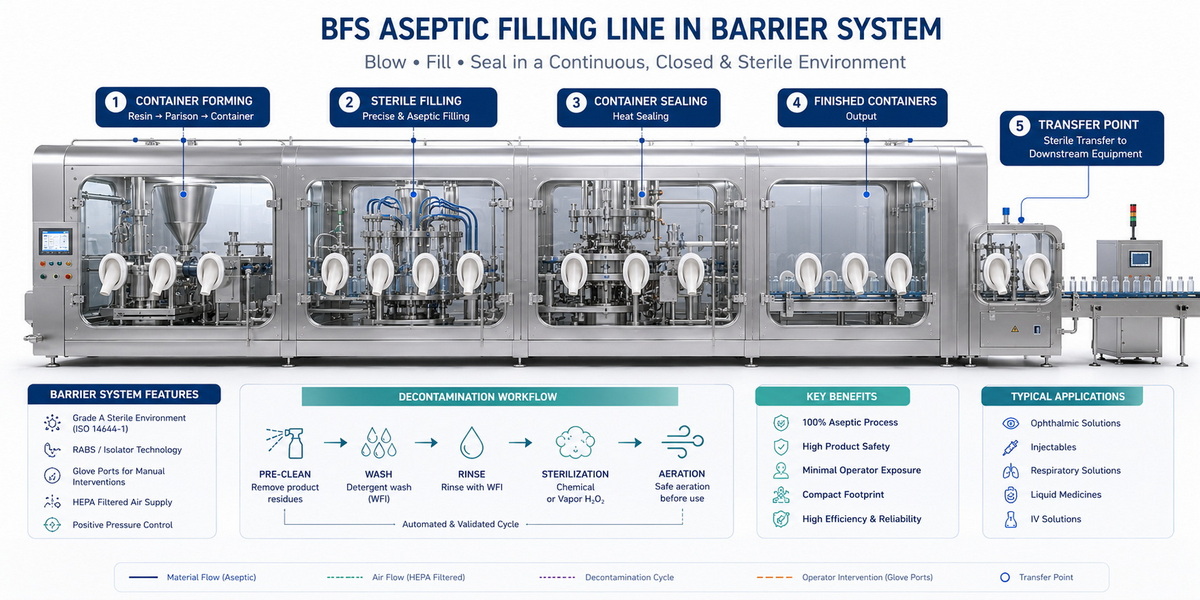
Regulatory View
EU GMP Annex 1 strongly pushes manufacturers toward contamination control strategies that reduce human intervention in critical zones. It specifically states that RABS or isolators are beneficial for assuring conditions and minimizing microbial contamination associated with direct human intervention. In addition, the updated sterile manufacturing framework has increased expectations around barrier systems, monitoring, and validated decontamination. [health.ec.europa]
From a regulatory strategy perspective:
1. Document why the chosen barrier is appropriate.
2. Show how the design supports contamination control.
3. Define intervention management and recovery steps.
4. Validate decontamination, cleaning, and monitoring.
5. Reassess the system when product or capacity changes.
This is especially important for export-oriented plants that must satisfy different markets and inspection philosophies. A BFS line that looks acceptable on paper can still fail an audit if the contamination control logic is weak. [sychem.co]
Cost and Lifecycle
Many buyers compare RABS and isolators only by purchase price, but that is incomplete. The real cost sits in the full lifecycle: cleanroom classification, HVAC load, operator training, validation effort, shutdown frequency, and maintenance access. Isolators often cost more initially, yet they can reduce long-term dependence on highly controlled room environments and can simplify contamination control over time. [sychem.co]
Typical cost tradeoffs include:
- RABS: lower initial complexity, faster adoption, but more reliance on room-grade infrastructure.
- Isolators: higher capital cost, more engineering effort, but stronger sterility assurance and often better strategic scalability.
For BFS projects, lifecycle economics should be modeled alongside expected batch value, line utilization, and product recall risk. A line that protects one high-value product consistently may justify a higher upfront barrier investment very quickly. [sychem.co]
Operational Experience
From a plant engineering standpoint, the biggest difference is not the barrier wall itself, but how the team works inside it. RABS tolerate more manual involvement, which can help during changeovers or troubleshooting, but every intervention increases process risk. Isolators demand better planning, better transfer design, and stronger maintenance discipline, yet they reward the plant with more stable contamination control. [scribd]
A useful way to think about this is:
- RABS = more operational flexibility.
- Isolator = more sterility protection.
- BFS line success = matching the barrier to the product and business model.
For manufacturers entering aseptic BFS for the first time, the best choice is often the one that fits both current operations and future expansion, not just today's budget. [sychem.co]
Recent Industry Insight
A notable trend in sterile manufacturing is the continued move away from open aseptic processing and toward barrier-based designs. Industry discussions around Annex 1 show a clear preference for reducing operator presence in critical zones and improving validated decontamination and automation. That trend matters for BFS filling lines because buyers increasingly evaluate a system not only on output, but also on how well it supports future regulatory expectations. [scribd]
One practical implication is that new BFS projects should be designed with automation and transfer logic in mind from day one. Retrofitting barrier technology later is usually more expensive than planning it into the facility layout, utility strategy, and equipment footprint early. [centec]
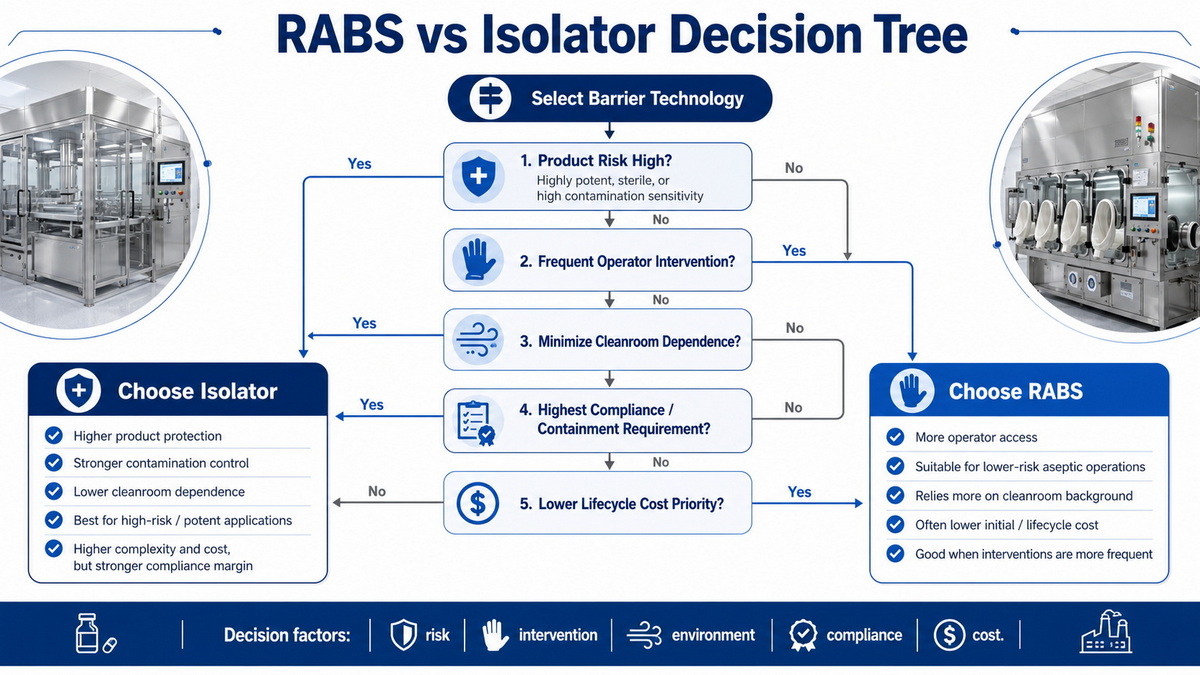
Selection Criteria
Use this framework when choosing between RABS and isolator technology for a BFS line:
1. Define the product risk level.
2. Estimate the intervention frequency.
3. Determine the required sterility assurance level.
4. Check the target market regulations.
5. Model total lifecycle cost.
6. Review available cleanroom infrastructure.
7. Decide whether future expansion is likely.
If your BFS line is aimed at high-potency, high-value, or highly regulated products, isolator technology is usually the safer long-term path. If your plant values manual flexibility and already has a strong aseptic culture, RABS may be the more practical starting point. [health.ec.europa]
Engineering Perspective
For a turnkey equipment supplier, barrier selection should be integrated with the entire plant concept. That includes purified water systems, formulation rooms, sterilization equipment, clean utilities, and production logistics. In other words, the barrier is not just a box around the line; it is part of the overall GMP architecture. [centec]
This is where engineering experience matters. A strong design team will ask:
- Can the layout minimize interventions?
- Is the transfer path logical?
- Are utilities easy to maintain?
- Does the design support cleaning and qualification?
- Will future line expansion remain feasible?
These questions often decide whether a BFS project becomes a stable manufacturing asset or a constant compliance burden. [centec]
Recommended CTA
If you are planning a new BFS filling line, the next step is to align your barrier strategy with your product portfolio, contamination control strategy, and factory layout. A well-designed RABS or isolator solution should be selected together with utilities, cleanroom planning, and validation requirements, not after the line has already been fixed. [health.ec.europa]
CTA: Contact our engineering team to discuss a customized BFS filling line concept, including purified water preparation systems, sterilization cabinets, and pharmaceutical solution preparation systems integrated into a compliant plant layout. [centec]
FAQ
1. Which is better for BFS filling lines, RABS or isolator technology?
It depends on your product risk and compliance strategy. RABS offers more flexibility, while isolators offer stronger sterility assurance and lower human intervention risk. [health.ec.europa]
2. Are isolators always required under EU GMP Annex 1?
No, but Annex 1 strongly favors barrier systems that reduce human intervention, and it expects manufacturers to justify their chosen approach in the contamination control strategy. [health.ec.europa]
3. Is RABS cheaper than isolators?
Usually yes at the beginning, but the full lifecycle cost can change the picture because RABS often require more cleanroom support and operational discipline. [sychem.co]
4. Can BFS lines use either barrier system?
Yes. BFS is compatible with barrier-based approaches, but the right choice depends on the product, intervention pattern, and facility design. [health.ec.europa]
5. Why do regulators prefer barrier systems?
Because barrier systems reduce direct human contact in critical aseptic zones, which lowers contamination risk and improves sterility assurance. [sychem.co]
References
1. European Commission. *EudraLex Volume 4, Annex 1: Manufacture of Sterile Medicinal Products*.
[PDF] [health.ec.europa]
2. Sychem. *EU GMP Annex 1: What It Means for Pharmaceutical Isolators*.
[Article] [sychem.co]
3. PDA / industry presentation materials on isolators and RABS, including Annex 1 barrier system discussions.
[Presentation resource] [pda]
4. European Compliance Academy / barrier systems presentation materials discussing RABS and isolator requirements.
[PDF] [pharma-congress]
5. Centec. *PW Generator for Pharmaceutical Water Systems*, showing integrated pharmaceutical utility design considerations relevant to turnkey facility planning.
[Product page] [centec]


