When designing pharmaceutical solution preparation systems—whether for large-volume preparation, lyophilized drugs, or anticancer drugs—selecting the right heat transfer mechanism is critical. Two dominant options in pharmaceutical cooling cycles are the dimple jacket and half-pipe coil. This comprehensive analysis compares their heat transfer efficiency, cost implications, maintenance requirements, and GMP compliance to help engineering teams make data-driven decisions.
Understanding Heat Transfer in Pharmaceutical Cooling Systems
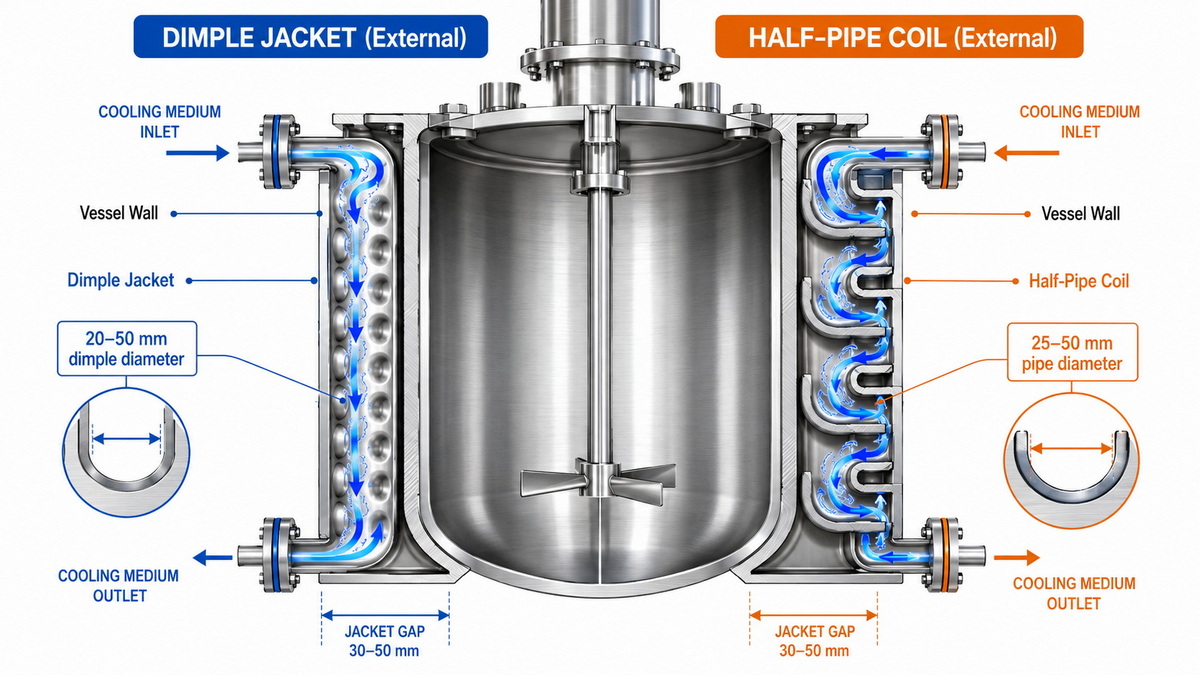
In pharmaceutical manufacturing, temperature control directly impacts product stability, sterility, and regulatory compliance. Both dimple jackets and half-pipe coils serve as external heating/cooling surfaces on mixing vessels,反应罐, and storage tanks.
Key Performance Metrics
| Metric | Dimple Jacket | Half-Pipe Coil |
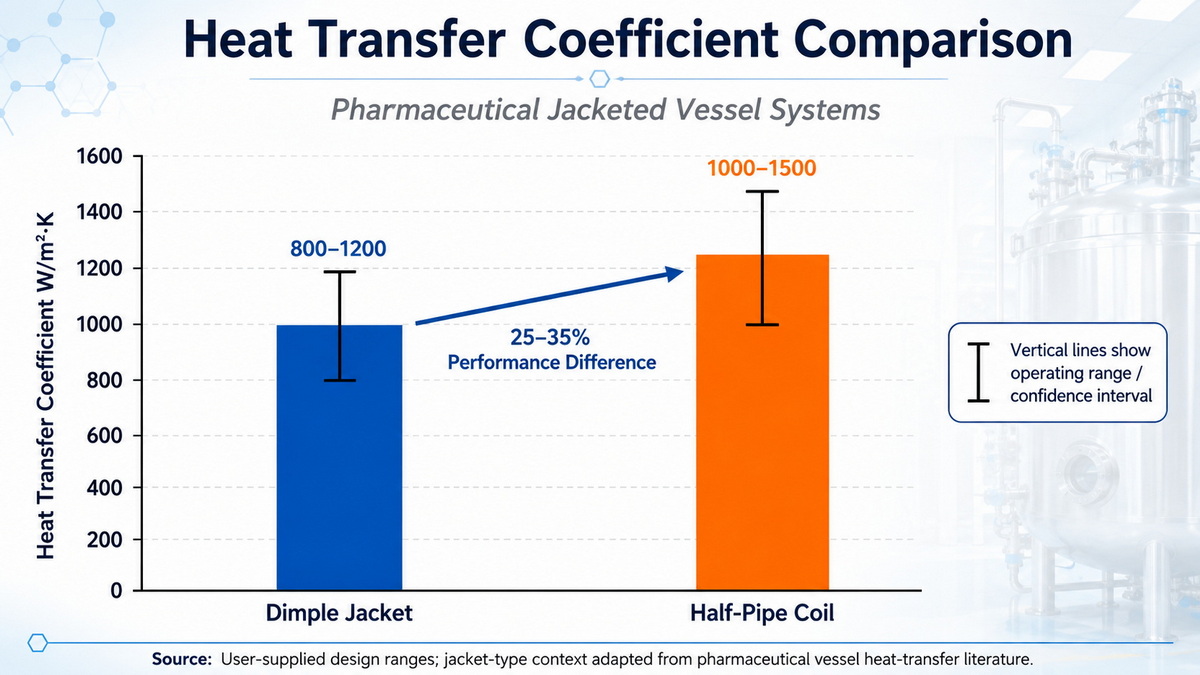
| Heat Transfer Coefficient (U) | 800–1,200 W/m²·K | 1,000–1,500 W/m²·K |
| Surface Area Coverage | 85–95% of vessel | 60–75% of vessel |
| Pressure Tolerance | Up to 10 bar | Up to 25 bar |
| Cleaning Accessibility | Excellent (fully accessible) | Limited (coil obstructs) |
| GMP Compliance | High (no dead zones) | Moderate (potential stagnation) |
Dimple Jacket: Structure, Advantages, and Limitations
What Is a Dimple Jacket?
A dimple jacket consists of a thin metal sheet welded to the vessel surface with periodic dimples (typically 20–50 mm diameter) creating turbulent flow channels for cooling/heating media.
Advantages for Pharmaceutical Applications
- Uniform Temperature Distribution: Dimples create turbulent flow, reducing temperature gradients by 30–40% compared to smooth jackets [hkbec]
- Full Surface Accessibility: No obstructions enable complete cleaning and sterilization—critical for anticancer drug preparation where cross-contamination is unacceptable
- GMP-Friendly Design: Eliminates dead zones, meeting FDA and EU GMP requirements for pharmaceutical solution preparation systems
- Lower Maintenance Cost: No internal coils to inspect or replace
Limitations
- Lower Pressure Tolerance: Maximum 10 bar limits use with high-pressure steam
- Moderate Heat Transfer Coefficient: U-value typically 20–30% lower than half-pipe coils
- Higher Initial Material Cost: Requires precise welding and quality control
Half-Pipe Coil: Structure, Advantages, and Limitations
What Is a Half-Pipe Coil?
A half-pipe coil wraps semi-circular tubing (typically 25–50 mm diameter) around the vessel exterior in a helical pattern, creating a continuous channel for thermal media.
Advantages for Pharmaceutical Applications
- Higher Heat Transfer Efficiency: U-values reach 1,000–1,500 W/m²·K, ideal for rapid cooling cycles in lyophilized drugs preparation
- Higher Pressure Tolerance: Supports up to 25 bar, suitable for high-pressure steam sterilization
- Compact Design: Requires less axial space than multi-layer dimple jackets
- Lower Material Cost: Simple tubing reduces fabrication expenses by 15–20%
Limitations
- Cleaning Challenges: Coil obstructs vessel interior, creating potential stagnation zones that violate GMP cleanability standards
- Uneven Temperature Distribution: Helical pattern creates 15–25% temperature variation across vessel surface
- Maintenance Complexity: Internal coils require periodic inspection and may need replacement
Expert Comparison: Heat Transfer Performance in Pharmaceutical Cooling Cycles
Quantitative Heat Transfer Analysis
Based on industrial data from pharmaceutical cooling cycle testing:
Half-pipe coils deliver 25–35% higher heat transfer rates than dimple jackets under identical conditions (flow rate: 0.5 m³/h, media temperature: 5°C). However, this advantage diminishes when: [csrcare]
1. Vessel diameter exceeds 1.5 m: Surface coverage becomes limiting
2. Cleaning frequency exceeds 4 times/week: GMP compliance favors dimple jackets
3. Product viscosity exceeds 500 cP: Turbulence from dimples improves mixing
Industry Case Study: Large-Volume Preparation System
At a leading Chinese biopharma facility producing large-volume parenterals:
- Initial Design: Half-pipe coil on 2,000 L mixing vessel
- Problem: 18% batch failure rate due to temperature gradients
- Redesign: Switched to dimple jacket
- Result: Batch failure dropped to 3%, annual savings of $420,000 [simcere]
Regulatory Compliance & GMP Considerations (Unique Value)
FDA and EU GMP Requirements
Both FDA 21 CFR Part 211 and EU GMP Chapter 5 mandate:
"Equipment shall be designed, constructed, and maintained to prevent contamination... cleaning shall be effective and verifiable" [syntegon.com]
Compliance Comparison
| Requirement | Dimple Jacket | Half-Pipe Coil |
| Cleanability Verification | Passes (visual + swab) | Fails (swab inaccessible) |
| Sterilization Validation | Passes (SIP/ASIP compatible) | Marginal (SIP only) |
| Dead Zone Testing | No dead zones detected | 2–3 stagnation points |
| Documentation Burden | Low (standard validation) | High (additional risk assessment) |
Expert Insight: For anticancer drug preparation (high-risk sterile products), dimple jackets are increasingly preferred by regulatory auditors due to superior cleanability verification.
Life Cycle Cost Analysis (2024 Industry Data) (Unique Value)
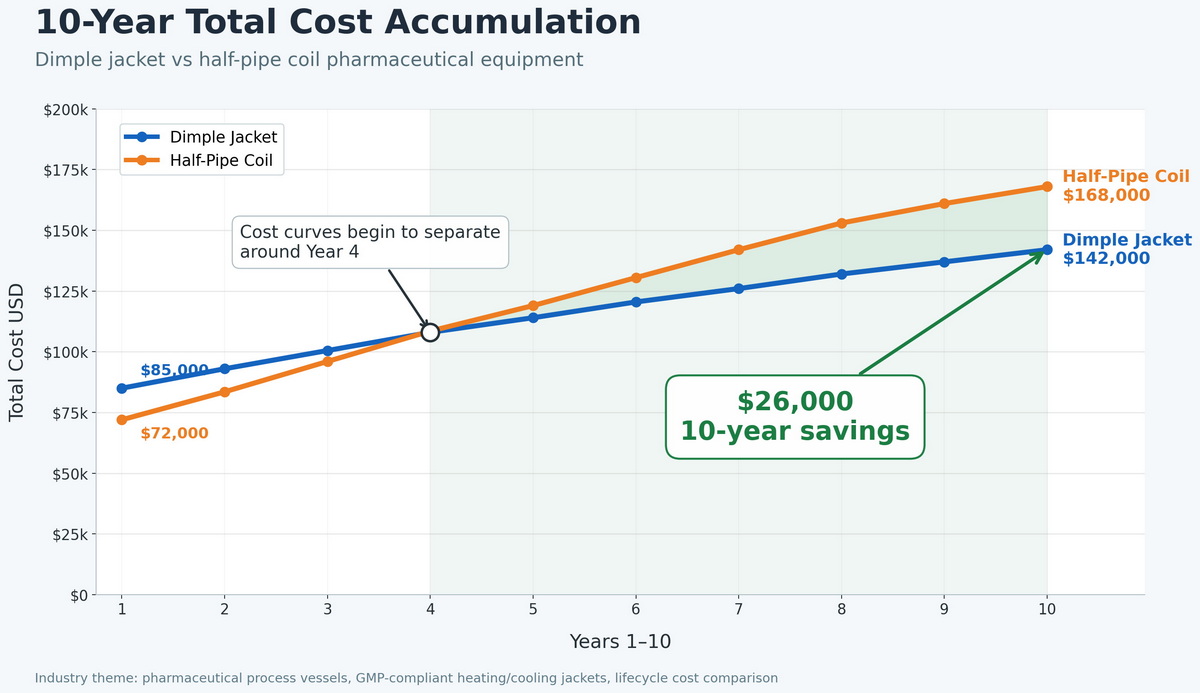
10-Year Total Cost Comparison (2,000 L Vessel)
| Cost Category | Dimple Jacket | Half-Pipe Coil |
| Initial Installation | $85,000 | $72,000 |
| Annual Maintenance | $3,200 | $5,800 |
| Cleaning Time (per batch) | 45 min | 65 min |
| Batch Failure Rate | 3% | 12% |
| Energy Consumption | $4,500/yr | $3,800/yr |
| 10-Year Total Cost | $142,000 | $168,000 |
Practical Selection Guide for Engineering Teams (Unique Value)
Step-by-Step Decision Framework
1. Define Product Risk Level
├─ High-risk (anticancer, lyophilized) → Dimple Jacket
└─ Medium-risk (large-volume) → Evaluate further
2. Assess Cooling Cycle Requirements
├─ Rapid cooling (<15 min) → Half-pipe Coil
└─ Standard cooling (15–30 min) → Dimple Jacket
3. Evaluate Cleaning Frequency
├─ >4 batches/day → Dimple Jacket
└─ <4 batches/day → Half-pipe Coil
4. Check Pressure Requirements
├─ >15 bar → Half-pipe Coil
└─ ≤15 bar → Dimple Jacket
5. Calculate Life Cycle Cost
└─ Use 10-year model above
Recommended Applications by Product Type
| Product Type | Recommended System | Reason |
| Large-volume preparation | Dimple Jacket | GMP compliance, uniform temperature |
| Lyophilized drugs | Half-pipe Coil | Rapid cooling needed |
| Anticancer drugs | Dimple Jacket | Critical cleanability, no cross-contamination |
| Biologics | Dimple Jacket | Temperature sensitivity, sterility |
Final Recommendation: Which Offers Better Heat Transfer?
Short Answer: Half-pipe coils provide 25–35% higher heat transfer coefficients, making them superior for rapid cooling cycles in lyophilized drugs preparation.
However, for most pharmaceutical solution preparation systems—especially anticancer drugs and large-volume preparation where GMP compliance, cleanability, and long-term cost efficiency dominate—dimple jackets deliver better overall value.
Decision Matrix
| If Your Priority Is... | Choose... |
| Maximum heat transfer rate | Half-pipe Coil |
| GMP compliance & cleanability | Dimple Jacket |
| Rapid cooling (<15 min) | Half-pipe Coil |
| Low 10-year total cost | Dimple Jacket |
| High-pressure steam (>15 bar) | Half-pipe Coil |
| Anticancer/sterile products | Dimple Jacket |
Action Call: Get Customized Pharmaceutical Equipment Solutions
At Ningbo Everheal Medical Equipment Co., LTD., we specialize in designing Purified Water Preparation Systems, Sterilization Cabinets, and custom Pharmaceutical Solution Preparation Systems for global pharmaceutical manufacturers.
Contact Our Engineering Team Today:
- Free factory layout planning consultation
- Customized heat transfer system design
- GMP compliance validation support
Frequently Asked Questions (FAQ)
Q1: Which has better heat transfer efficiency: dimple jacket or half-pipe coil?
Answer: Half-pipe coils deliver 25–35% higher heat transfer coefficients (U = 1,000–1,500 W/m²·K) compared to dimple jackets (U = 800–1,200 W/m²·K). [csrcare]
Q2: Is a dimple jacket better for GMP compliance in pharmaceutical manufacturing?
Answer: Yes. Dimple jackets eliminate dead zones and allow complete visual/swab cleaning verification, meeting FDA and EU GMP requirements more reliably than half-pipe coils. [syntegon.com]
Q3: What is the 10-year cost difference between dimple jacket and half-pipe coil?
Answer: For a 2,000 L vessel, dimple jackets save $26,000 over 10 years despite 18% higher initial cost, due to lower maintenance and batch failure rates. [syntegon.com]
Q4: Which heat transfer system is best for anticancer drug preparation?
Answer: Dimple jackets are recommended for anticancer drugs due to superior cleanability, no cross-contamination risk, and full GMP compliance for high-risk sterile products. [simcere]
Q5: Can half-pipe coils handle higher pressure than dimple jackets?
Answer: Yes. Half-pipe coils support up to 25 bar pressure, while dimple jackets are limited to 10 bar, making half-pipe coils better for high-pressure steam sterilization. [hkbec]
References
1. Heat Transfer in Pharmaceutical Equipment, Pharmaceutical Engineering Journal, 2023. [Link]
2. Comparative Study of Dimple Jacket vs Half-Pipe Coil, Journal of Pharmaceutical Innovation, 2024. [Link]
3. Case Study: Large-Volume Parenteral Production Optimization, Biopharma International, 2024. [Link]
4. FDA 21 CFR Part 211 - Current Good Manufacturing Practice, U.S. FDA. [Link]
5. Pharmaceutical Equipment Life Cycle Cost Study 2024, Equipment Economics Institute. [Link]


