In pharmaceutical manufacturing, rubber stopper handling is not a small mechanical detail; it is a contamination-control decision that can affect line efficiency, product quality, and regulatory confidence. When comparing rubber stopper vibratory bowls vs centrifugal feeders, the real question is not only which system feeds faster, but which one better minimizes particulate generation while supporting GMP-oriented production. [tian-sure]
Why feeder choice matters in sterile and aseptic lines
Rubber stoppers are widely used in vials, lyophilized drugs, large-volume parenterals, and other sterile products. These components may look simple, but they are sensitive to surface contact, vibration intensity, mechanical abrasion, and cleaning quality. In practice, the feeding system becomes part of the contamination-risk profile of the whole line. [winatechgroup]
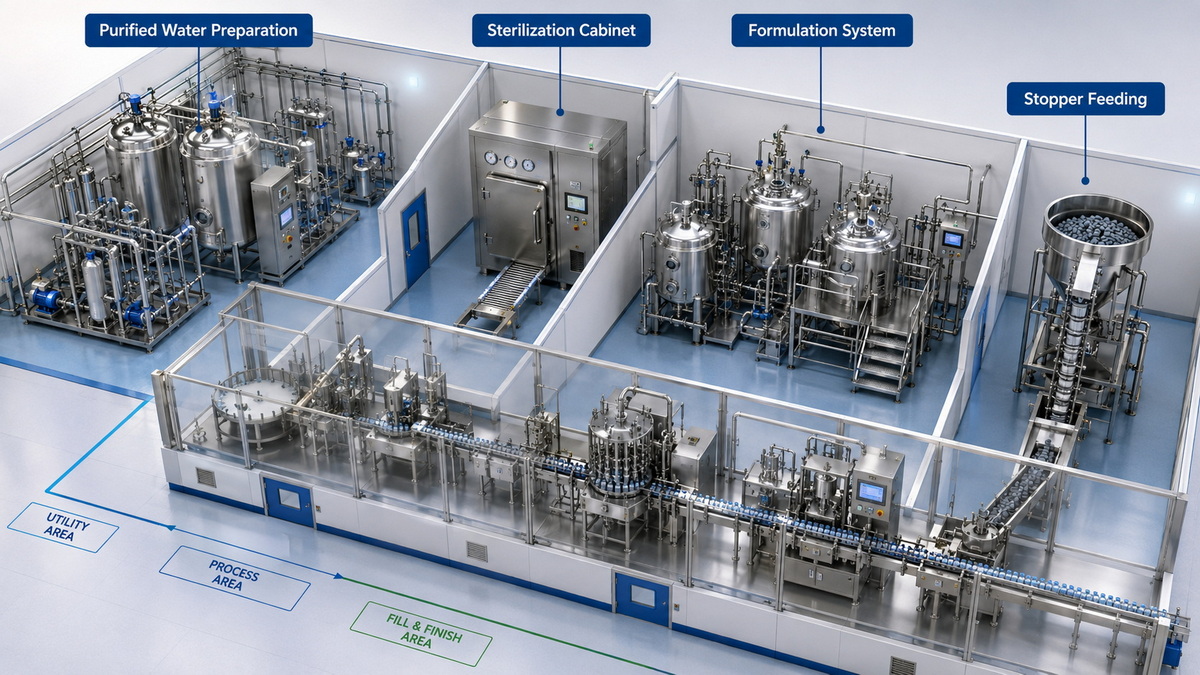
For manufacturers designing or upgrading an aseptic line, feeder selection should be evaluated together with water systems, formulation systems, sterilization, and layout planning. That is especially important for integrated projects where equipment spacing, personnel flow, and clean-zone logistics all influence contamination control. [centec]
Rubber stopper vibratory bowls: strengths and risks
How vibratory bowls work
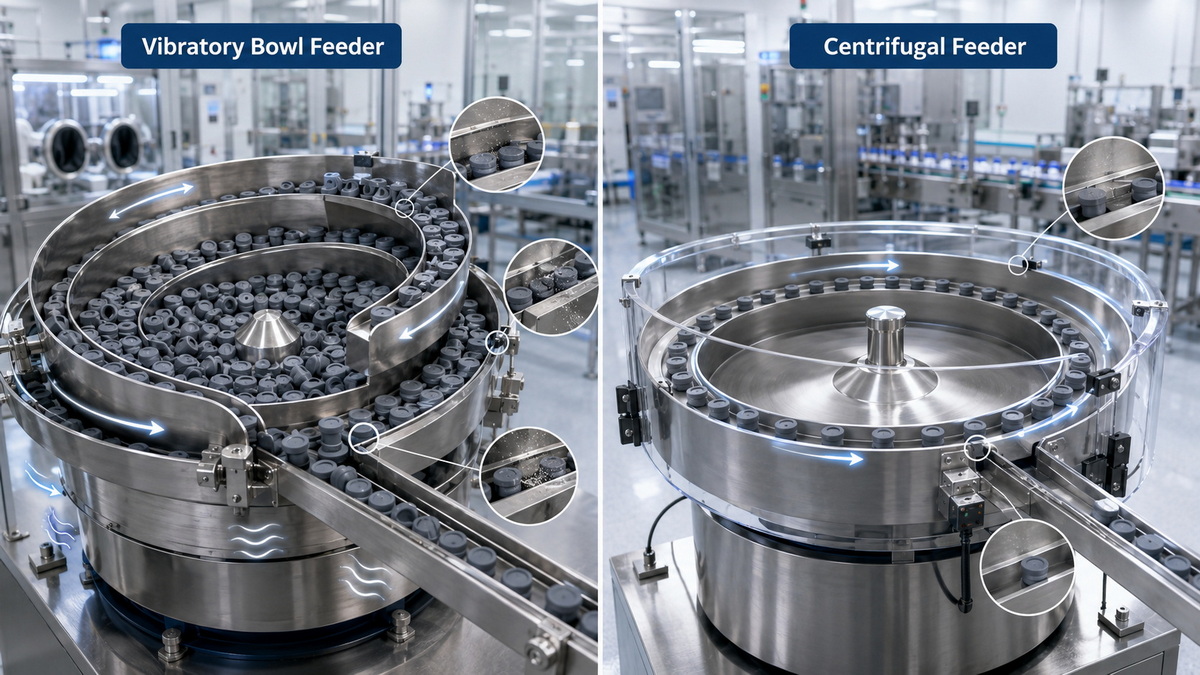
Vibratory bowl feeders use vibration and track geometry to orient and move stoppers toward the discharge point. They are common in packaging and process automation because they are familiar, relatively compact, and easy to integrate into many lines.
Where particulate can be generated
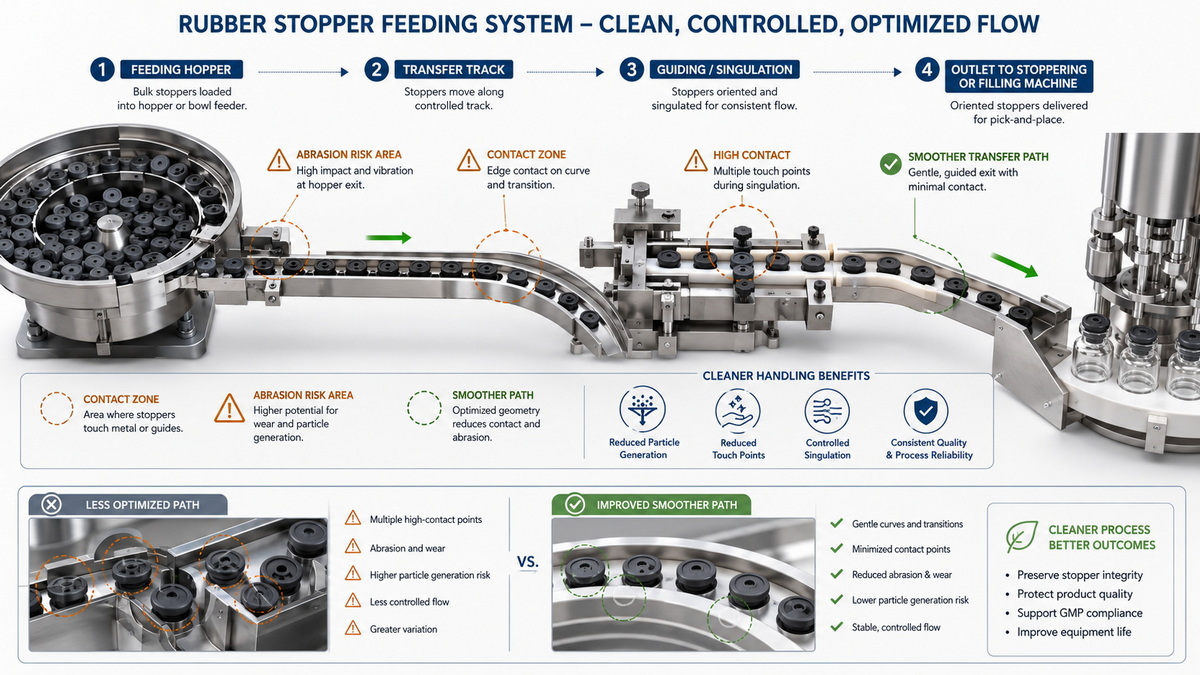
The main limitation is mechanical contact. Rubber stoppers can rub against the bowl surface, the track, and each other. That creates a risk of micro-wear, dust generation, and surface marking, especially when the system is not perfectly tuned or when parts vary slightly in size, hardness, or coating.
Operational advantages
Vibratory bowls still offer practical benefits:
- Lower initial cost in many projects.
- Simple concept and broad industry familiarity.
- Flexible for moderate-speed production.
- Easier to adapt for some legacy lines.
Operational limitations
The drawbacks become more visible in high-cleanliness applications:
- More part-to-part and part-to-metal contact.
- Greater sensitivity to vibration settings.
- Higher chance of noise and abrasion-related wear.
- Potentially more maintenance when part quality changes.
For sterile drug production, even small amounts of generated particulate can become a quality concern if they are not controlled at the system level.
Centrifugal feeders: cleaner handling logic
How centrifugal feeders work
Centrifugal feeders use rotating motion to move components outward and guide them through a controlled path. Compared with vibratory systems, the motion is generally smoother and can reduce aggressive part impacts.
Why they often generate less particulate
The key advantage is gentler component movement. Rubber stoppers are not typically subjected to the same level of bouncing and rubbing seen in vibratory bowls. In many applications, this translates into lower wear, less dust formation, and more stable feeding at higher throughput.
Operational advantages
Centrifugal feeders are often attractive for pharmaceutical use because they can provide:
- Smoother part handling.
- Lower abrasion potential.
- Better suitability for delicate or contamination-sensitive components.
- More consistent flow at higher output levels.
Operational limitations
They are not perfect for every plant:
- Higher capital cost may be a barrier.
- More complex mechanical design can require deeper technical support.
- Cleaning design and access must be carefully reviewed.
- Footprint and integration requirements may differ from traditional bowl systems.
Side-by-side comparison
| Factor | Vibratory Bowls | Centrifugal Feeders |
| Particulate generation risk | Higher, due to repeated contact and vibration | Lower, due to smoother motion (winatechgroup) |
| Handling gentleness | Moderate to low | High |
| Throughput stability | Good, but sensitive to tuning | Often very stable |
| Noise and wear | Higher | Lower |
| Cleaning and maintenance | Usually simpler, but can require frequent adjustment | More design-sensitive, but potentially cleaner in operation |
| Best fit | Legacy lines, simpler automation, moderate cleanliness requirements | High-cleanliness, high-value sterile lines |
For minimizing particulate generation, the centrifugal feeder is usually the better technical choice when budget, layout, and line architecture allow it.
What the latest GMP-oriented thinking suggests
A growing trend in pharmaceutical equipment design is to treat material handling as a contamination-control step, not just a feeding step. That means engineers now look at surface finish, dead-leg avoidance, cleanability, airflow behavior, and the interaction between equipment modules more carefully than before. [qingqingquan]
In modern projects, this is particularly relevant for:
- Lyophilized drug preparation lines.
- Large-volume parenteral preparation systems.
- Anticancer drug preparation areas.
- Aseptic filling and stoppering interfaces.
In other words, the feeder must match the quality ambition of the full line, not just the speed target.
Expert selection criteria
From a practical engineering perspective, the decision should be based on six questions:
1. What is the contamination sensitivity of the product?
2. What particulate limit is acceptable for the process?
3. What are the required throughput and buffer capacity?
4. How often will the line be cleaned, sterilized, or reconfigured?
5. How much floor space is available in the cleanroom?
6. How much maintenance support is realistically available onsite?
If particulate control is a top priority, the answer often favors centrifugal feeders, especially in sterile or high-value applications.
Layout and integration insights
A feeder should never be selected in isolation. It must fit the full plant layout, including upstream preparation areas, sterilization equipment, clean transfer routes, and downstream filling or packaging machines. This is where a supplier with pharmaceutical project experience can add real value by aligning equipment choice with the cleanroom flow, utility distribution, and future expansion plan. [tian-sure]
For manufacturers like Ningbo Everheal Medical Equipment Co., LTD., this integrated approach is especially relevant because feeder selection, purified water infrastructure, sterilization cabinets, and solution preparation systems all influence the same GMP environment. [centec]
Practical steps to minimize particulates
If your goal is to reduce contamination risk, use this implementation checklist:
1. Choose the gentlest viable feeding principle.
2. Specify low-wear contact materials.
3. Minimize unnecessary part-to-part friction.
4. Review transfer height and drop points.
5. Validate cleaning access and maintenance access.
6. Confirm alignment with the overall cleanroom pressure and airflow design.
7. Perform particulate monitoring during FAT and SAT.
These steps often matter as much as the feeder type itself.
Recommended use cases
Choose vibratory bowls when:
- Budget is tight.
- The product is less sensitive to minor wear.
- The line is legacy-based and already standardized.
- Throughput needs are moderate.
Choose centrifugal feeders when:
- Particulate generation must be minimized.
- The product is sterile or high value.
- Consistency and gentleness are more important than lowest upfront cost.
- You are designing a new GMP-oriented production line.
Conclusion
For pharmaceutical manufacturers focused on contamination control, centrifugal feeders usually offer the stronger solution for minimizing particulate generation. Vibratory bowls remain useful in many factories, but in sterile and high-value applications, smoother material handling is often the safer long-term choice. [syntegon.com]
The best decision comes from evaluating the feeder together with your process layout, cleanroom strategy, maintenance model, and full production line architecture. That is where integrated pharmaceutical engineering expertise creates measurable value. [tian-sure]
CTA: If you are planning a new pharmaceutical line or upgrading an existing one, assess the feeder together with your purified water, sterilization, and formulation systems at the concept stage. That early decision can reduce particulate risk, simplify validation, and improve long-term GMP performance. [qingqingquan]
FAQ
1. Why are centrifugal feeders often preferred for sterile pharmaceutical lines?
Because they usually move stoppers more smoothly and create less rubbing and impact, which helps reduce particulate generation. [winatechgroup]
2. Are vibratory bowls obsolete?
No. They are still useful in many lines, especially where cost, footprint, and familiarity matter more than the lowest possible particulate risk.
3. Can a vibratory bowl be optimized to reduce dust?
Yes. Better materials, lower friction surfaces, proper tuning, and improved maintenance can reduce wear, but the design still relies on repeated vibration and contact.
4. What matters more than feeder type?
The full system design matters more: layout, cleanroom conditions, maintenance access, cleaning strategy, and transfer path design. [centec]
5. Which feeder is better for lyophilized drug production?
In many cases, centrifugal feeders are the stronger choice because lyophilized and sterile applications usually demand gentler handling and tighter contamination control.
References
1. [星德科:高纯化介质系统] — product and process positioning for pharmaceutical pure media/formulation systems. [syntegon.com]
2. [上海净泽洁净设备有限公司:无菌配液] — application scope for aseptic formulation systems in pharmaceutical production. [winatechgroup]
3. [星德科:液体制剂配液] — formulation systems context for pharmaceutical liquid preparation. [syntegon.com]
4. [Centec:PW 发生器 / Purified Water systems] — GMP-oriented purified water system design, CIP/SIP, and pharmaceutical water applications. [centec]
5. [Tian Sure:Pharmaceutical Liquid Preparation System] — pharmaceutical water treatment and aseptic liquid preparation solutions. [tian-sure]
6. [上海意迪尔科技:无菌制剂配液系统] — clean process system solutions for pharmaceutical enterprises. [sh-ideal]
7. [星德科:蒸馏技术纯化介质系统] — pharmaceutical pure media systems and GMP-related process technology. [syntegon.com]
8. [ZJTFJX product listing] — fully automatic purified water preparation system listing and process features. [zjtfjx.en.made-in-china]
9. [Qingqingquan: Pharmaceutical Grade High-Purity Water Systems] — pharmaceutical water purification, GMP compliance, and formulation use cases. [qingqingquan]


