In pharmaceutical manufacturing, powder dissolution is not just a mixing problem; it is a process-control problem that directly affects batch uniformity, cycle time, product quality, and downstream sterility assurance. For difficult-to-mix powders, the choice between vortex breakers and high-shear impellers can determine whether your formulation dissolves smoothly or becomes a recurring source of lumps, foaming, dead zones, and rework. [syntegon.com]
At Ningbo Everheal Medical Equipment Co., LTD., where large-scale pharmaceutical solution preparation systems, purified water preparation systems, sterilization cabinets, and factory layout planning are part of the broader production ecosystem, this decision matters at the system level, not only at the tank level. The right agitation strategy must fit the material, vessel geometry, cleanability requirements, and validation expectations of a GMP environment. [cphi]
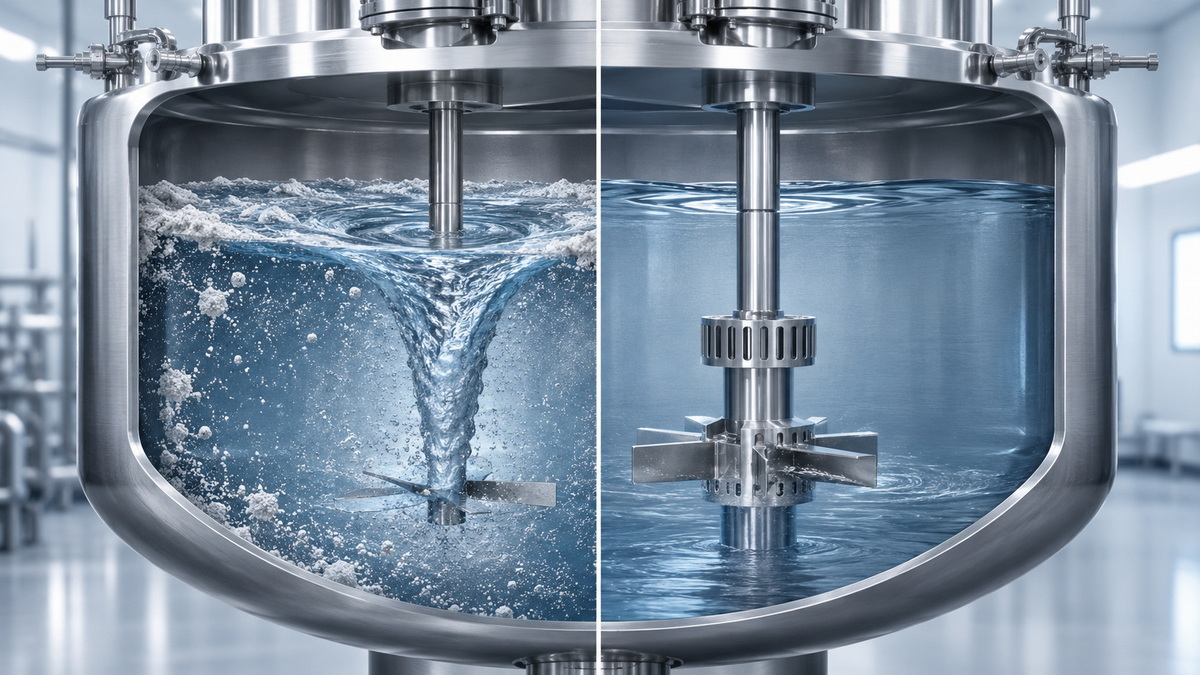
Why difficult powders behave badly
Difficult-to-mix powders usually fail for one or more of these reasons: they float, wet too slowly, agglomerate, trap air, build static charge, or form "fish eyes" that resist breakup. Industry discussions on powder homogeneity repeatedly point to particle size, density differences, flowability, static charge, and blend architecture as major drivers of poor mixing behavior. [ask.pharmaguideline]
In pharmaceutical solution preparation, these issues become more visible when handling large-volume preparations, lyophilized drug reconstitution, or oncology formulations, where incomplete wetting can create visible solids, inconsistent concentration, or longer hold times. Dissolution testing research also shows that deagglomeration, particle size, and membrane coverage strongly influence observed dissolution behavior. [pubmed.ncbi.nlm.nih]
A practical way to think about the problem is this:
- If the powder is already willing to disperse, you may only need to guide flow and suppress vortexing.
- If the powder resists wetting or forms persistent agglomerates, you need more aggressive shear and dispersion energy.
- If the process must remain gentle to avoid aeration, foaming, or product damage, the mixer must be selected with more caution. [pmc.ncbi.nlm.nih]
What a vortex breaker does
A vortex breaker is a flow-control device, usually mounted inside a tank, designed to disrupt the central whirlpool that forms during agitation. Its main purpose is not to "mix harder," but to prevent air entrainment, improve surface drawdown, and reduce the formation of a deep vortex that can trap powder on the liquid surface. This is especially useful in tanks where liquid level, impeller speed, and fill volume make vortexing more likely. [syntegon.com]
In pharmaceutical tanks, vortex breakers are often valuable when the process goal is to maintain stable top-surface behavior during mild to moderate agitation. They can help reduce splashing, foam formation, and the risk of localized air incorporation, which is important in water-for-injection-related systems and sensitive solution prep operations. [syntegon.com]
However, a vortex breaker alone does not generate meaningful particle breakup energy. It can improve bulk circulation and make the vessel more stable, but it is not a substitute for a high-energy dispersion device when the powder is hydrophobic, cohesive, or highly prone to agglomeration. [idexindia]
What a high-shear impeller does
A high-shear impeller is designed to create intense local velocity gradients that break up agglomerates, disperse solids faster, and accelerate wetting. Compared with low-shear agitation, high-shear systems use more energy at the point of contact, which is why they are frequently chosen for challenging pharmaceutical formulations and demanding solution preparation tasks. [sciencedirect]
The biggest advantage is speed. High-shear impellers can reduce the time required to deagglomerate difficult powders, improve uniformity, and help formulations reach a consistent dissolution state more quickly. Studies on high-shear mixing and granulation show that shear conditions strongly influence particle behavior, wet mass consistency, and even dissolution performance. [pmc.ncbi.nlm.nih]
The trade-off is that high-shear mixing can introduce heat, foam, aeration, mechanical stress, or excessive particle size reduction if the process is not controlled carefully. In some cases, too much shear can worsen performance by densifying material, changing wetting behavior, or making scale-up less predictable. [sciencedirect]
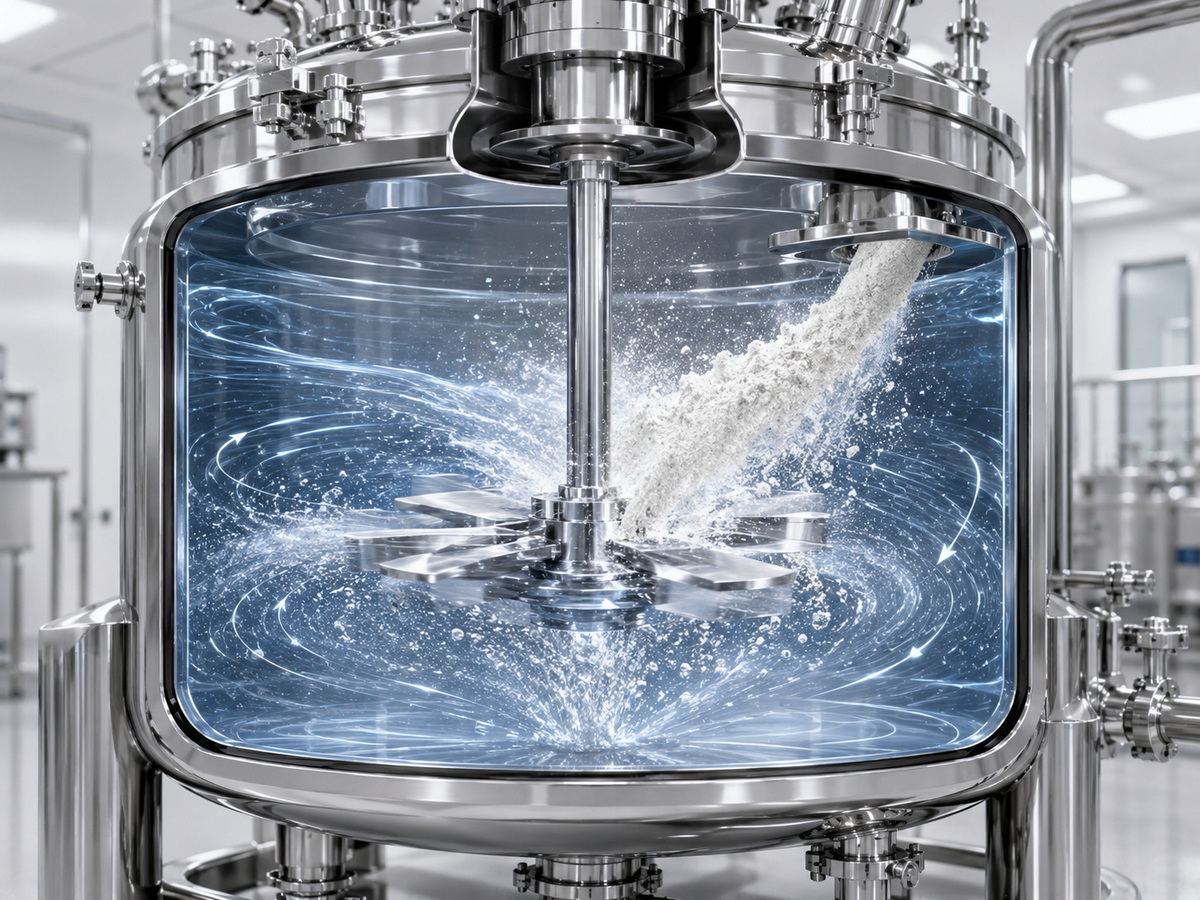
Side-by-side comparison
| Factor | Vortex Breaker | High-Shear Impeller |
| Primary function | Suppress vortexing and air entrainment | Create strong dispersion and deagglomeration |
| Best for | Stable bulk circulation, reduced splashing, lower foam | Difficult-to-wet powders, clumped solids, fast dissolution |
| Energy input | Low to moderate | High |
| Dissolution impact | Indirect | Direct |
| Risk profile | Limited shear, lower product stress | Heat, foam, over-shearing, scale-up complexity |
| GMP relevance | Useful for stable tank behavior | Critical for challenging formulation performance |
| Typical outcome | Better surface control | Faster and more complete powder breakup |
For many production lines, the real answer is not "either/or." A well-designed vessel can use vortex control to stabilize the tank while relying on high-shear impeller action to achieve the actual dissolution target. [idexindia]
Which one improves dissolution rates
If your main goal is faster dissolution, the high-shear impeller usually has the advantage because it directly attacks agglomerates and boundary-layer resistance. Dissolution research has shown that faster mixing and better dispersion can improve dissolution by breaking agglomerates and reducing effective particle size. [pubmed.ncbi.nlm.nih]
A vortex breaker can still help by preventing the process from losing efficiency to air entrainment or powder floating at the surface. In other words, it improves the conditions for mixing, but it does not deliver the same dissolution acceleration as a high-shear element. [syntegon.com]
For difficult pharmaceutical powders, the most common rule is:
1. Use a vortex breaker when the issue is mainly surface instability, splashing, or entrained air.
2. Use a high-shear impeller when the issue is wetting, dispersion, clump breakup, or dissolution speed.
3. Use both when the process must be stable and fast at the same time. [pmc.ncbi.nlm.nih]
Process selection framework
Choosing the right agitation strategy should start with material characterization, not equipment preference. Before you select a mixer, evaluate the powder's wettability, bulk density, particle size distribution, static sensitivity, and tendency to form lumps or float. Industry guidance on powder blending consistently highlights these variables as major mixing constraints. [ask.pharmaguideline]
A practical selection framework looks like this:
- Use vortex control first when the formulation is already soluble but the tank exhibits unstable flow.
- Use high shear first when the powder forms persistent agglomerates or is slow to disperse.
- Use staged addition when the powder loads too fast and creates local overloads.
- Use controlled liquid fill and impeller speed ramping to avoid a surface vortex and improve wetting.
- Validate with dissolution and uniformity tests before scale-up. Dissolution methods are specifically used to assess dispersion behavior and discriminatory performance. [pubmed.ncbi.nlm.nih]
New industry insight: why scale-up changes the answer
One of the most overlooked issues in pharmaceutical mixing is that a solution that behaves well at pilot scale may fail at production scale. Vessel diameter, impeller-to-tank ratio, fill height, baffle arrangement, and feed point all change the hydrodynamics. That means a vortex breaker that appears unnecessary in a small tank may become valuable in a large production vessel, while a high-shear impeller that works at lab scale may need re-optimization to avoid heat buildup at scale. [sciencedirect]
This is especially important for companies building complete production lines. In a large-volume preparation system, the mixing device cannot be separated from the overall process design. Water quality, transfer piping, CIP/SIP strategy, and cleanroom layout all influence whether dissolution happens predictably and repeatably. [cphi]
From a systems-engineering perspective, the best plants are not the ones with the most aggressive mixer. They are the ones with the most controllable and validated mixing environment.
Practical operating steps
To improve dissolution rates for difficult powders, follow a disciplined operating sequence:
1. Pre-wet the powder if the formulation allows it.
2. Start at low impeller speed to establish circulation without vortex collapse.
3. Add powder gradually rather than dumping it in a single charge.
4. Increase shear in stages only after the surface is stable.
5. Watch for foam, clumps, and wall adhesion during the first minutes.
6. Confirm endpoint by test, not by appearance alone. Dissolution behavior should be verified using appropriate testing methods. [pubmed.ncbi.nlm.nih]
For GMP facilities, these steps should be embedded in SOPs and linked to batch records. That makes the process more reproducible and easier to defend during qualification and validation. [syntegon.com]
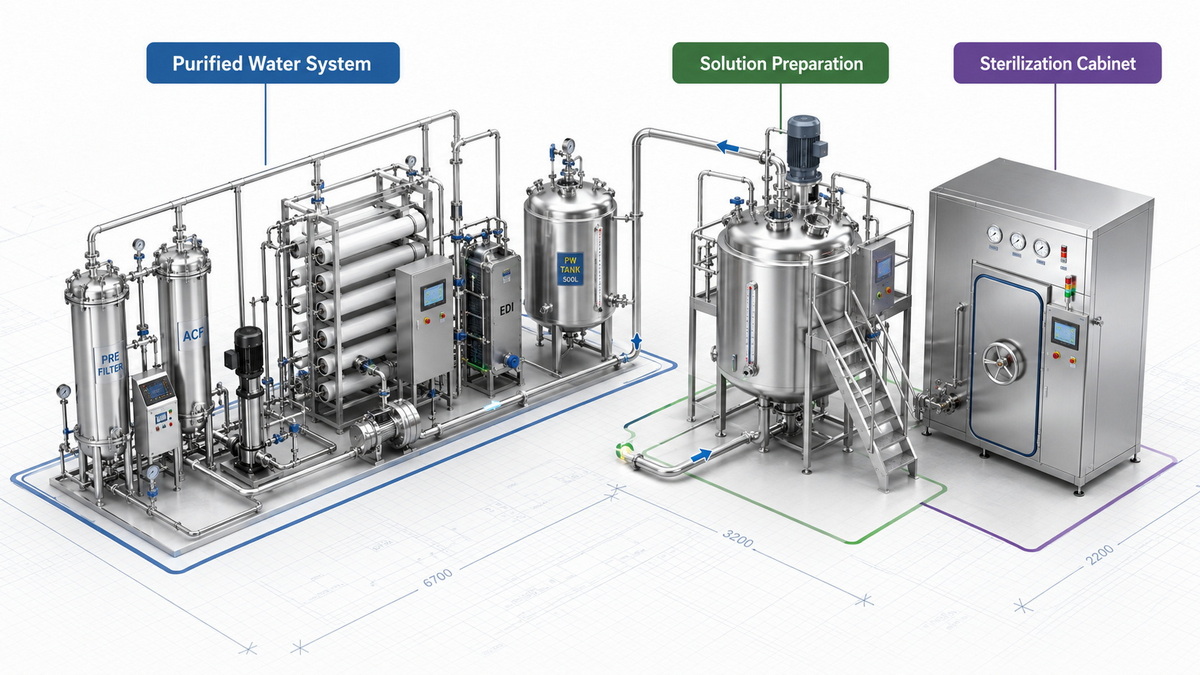
Expert view from equipment design
From an equipment-design standpoint, the strongest mixing performance usually comes from balancing three things: flow control, shear intensity, and cleanability. A high-shear impeller may solve the formulation challenge, but if it creates maintenance or cleaning difficulties, the process may not be suitable for a regulated plant. Vortex breakers are comparatively simple and robust, but they should be treated as a supporting feature rather than the main mixing engine. [idexindia]
For pharmaceutical manufacturers, the ideal design often includes:
- Stable vessel geometry.
- Proper impeller selection.
- Controlled powder feed.
- Vortex suppression where needed.
- Sanitary design and easy CIP/SIP integration.
- Sufficient utility support, including purified water and validated cleaning infrastructure. [cphi]
This is where a turnkey engineering partner becomes valuable. The mixer performs best when it is designed as part of the whole production ecosystem, not as an isolated machine.
When to choose each
Use a vortex breaker when you need better tank stability, less splashing, and reduced air entrainment during moderate agitation. Use a high-shear impeller when your real bottleneck is rapid deagglomeration and dissolution of difficult powders. Use a combined approach when you need both predictable hydraulics and strong dispersion performance. [syntegon.com]
For pharmaceutical solution preparation systems, the right answer should always be supported by process data, not habit. Dissolution testing, homogeneity checks, and scale-up verification are essential before the process is locked into production. [pubmed.ncbi.nlm.nih]
Conclusion
The best choice between vortex breakers and high-shear impellers depends on the root cause of the mixing problem. If the issue is flow instability, choose vortex control. If the issue is powder breakup and dissolution speed, choose high shear. In real pharmaceutical production, the most reliable systems often use both in a carefully engineered, GMP-friendly process design. [pmc.ncbi.nlm.nih]
For manufacturers planning a new powder dissolution or solution preparation line, the strongest competitive advantage comes from integrating mixer selection with vessel design, clean utility systems, and validated process flow from day one. [syntegon.com]
CTA
If you are designing or upgrading a pharmaceutical solution preparation system, the next step is to map your powder characteristics, batch volume, and cleanroom constraints to the right agitation strategy. A system-level layout review can prevent costly rework and improve batch consistency before installation begins. [syntegon.com]
FAQ
1. Is a vortex breaker enough to dissolve difficult powders?
Usually not. It helps stabilize flow and reduce air entrainment, but it does not provide the shear needed to break tough agglomerates. [syntegon.com]
2. When should I choose a high-shear impeller instead?
Choose high shear when the powder is slow to wet, forms clumps, or needs faster dispersion and more uniform dissolution. [idexindia]
3. Can high shear damage sensitive formulations?
Yes. Excess shear can create heat, foaming, or unwanted densification, so the process must be validated and controlled. [sciencedirect]
4. Do vortex breakers improve GMP compliance?
Indirectly, yes. They can reduce splashing and air entrainment, which supports more stable and reproducible tank behavior in regulated environments. [syntegon.com]
5. How should I validate the mixing process?
Use dissolution testing, content uniformity checks, and scale-up verification to confirm the process performs consistently at production scale. [pubmed.ncbi.nlm.nih]
References
1. Syntegon China. "制药- 解决方案- 配液系统."
[https://www.syntegon.com.cn/solution-finder/pharma/pharmaceutical-formulation/] [syntegon.com]
2. Syntegon China. "解决方案- 制药- 液体制剂- 工艺和生物工艺- 配液."
[https://www.syntegon.com.cn/solutions/pharma/drug-product-formulation-systems/] [syntegon.com]
3. PubMed. "High shear mixing granulation of ibuprofen and β-cyclodextrin."
[https://pmc.ncbi.nlm.nih.gov/articles/PMC2750670/] [pmc.ncbi.nlm.nih]
4. PubMed. "The measurement of mixture homogeneity and dissolution…"
[https://pubmed.ncbi.nlm.nih.gov/7870671/] [pubmed.ncbi.nlm.nih]
5. PubMed. "Dissolution techniques for in vitro testing of dry powders…"
[https://pubmed.ncbi.nlm.nih.gov/22528980/] [pubmed.ncbi.nlm.nih]
6. IDEX India. "How Can High Shear Mixers Enhance Product Quality in Pharmaceuticals?"
[https://www.idexindia.in/how-can-high-shear-mixers-enhance-product-quality-in-pharmaceuticals/] [idexindia]
7. Pharmaguideline. "Improve homogeneity during powder blending…"
[https://ask.pharmaguideline.com/t/improve-homogeneity-during-powder-blending-is-there-an-expert/9344] [ask.pharmaguideline]
8. CPHI制药在线. "2025制药用水设备专场."
[https://www.cphi.cn/zt/product/waterequipment] [cphi]


