Critical Maintenance Choice for Pharmaceutical Plants: Chemical Descaling or Thermal Shock Prevention?
As an engineer with over 15 years of experience in pharmaceutical equipment manufacturing in Ningbo, China, I have witnessed the installation and maintenance of hundreds of Purified Water Preparation Systems and pure steam generators at pharmaceutical plants through my work at Ningbo Everheal Medical Equipment Co., LTD. Today, I will deeply compare Chemical Descaling and Thermal Shock—two maintenance strategies for clean steam generator heat exchangers—to help pharmaceutical plant engineers make informed decisions. [dercsalotech]
What Is a Clean Steam Generator Heat Exchanger? Why Is Maintenance Critical?
Clean steam generators are core equipment in the pharmaceutical industry, producing sterile, pyrogen-free, endotoxin-free steam for equipment sterilization and cleanroom humidification. The heat exchanger, as its "heart," is responsible for heat transfer. Once fouled or damaged: [electrosteam]
| Impact Dimension | Specific Manifestation |
| Energy Efficiency Loss | 1/32-inch scale layer causes 2% fuel loss; 8,000 hours of operation consumes $72,000 more in fuel goodway |
| Heat Transfer Decline | Scale acts as an insulator, hindering heat transfer between metal and water goodway |
| Increased Pump Wear | Flow channels narrow, pumps work harder, increasing energy consumption and maintenance frequency goodway |
| Compliance Risk | Violation of FDA regulations and global cGMP standards, affecting product quality csidesigns |
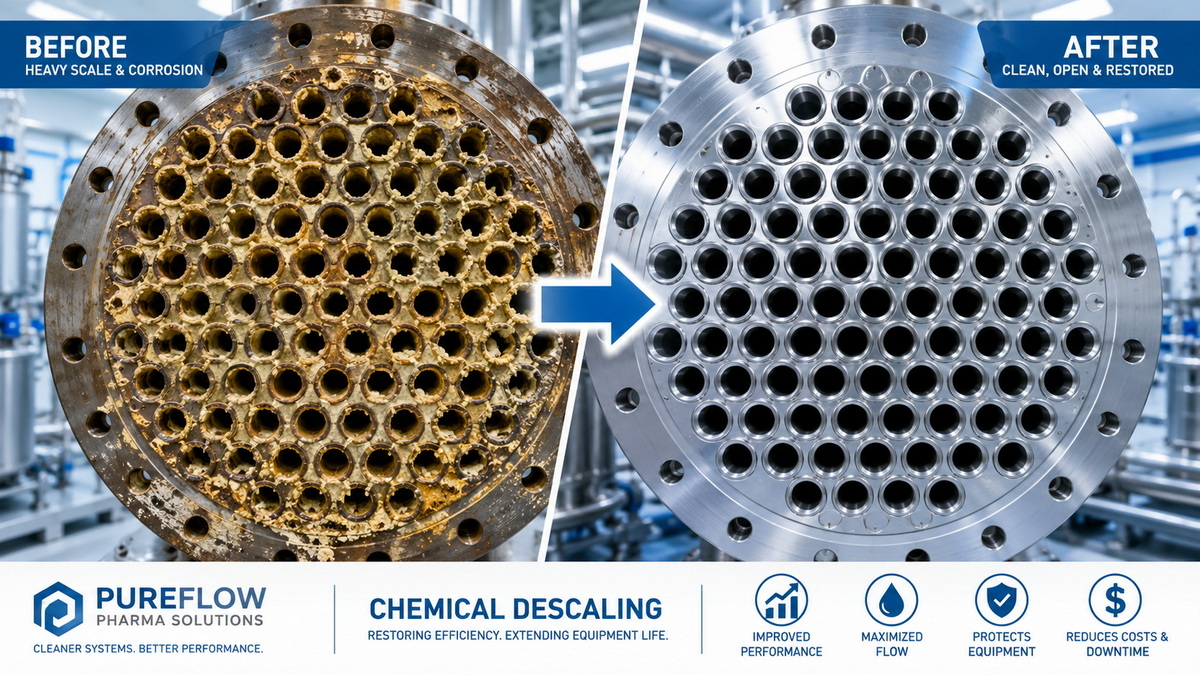
Chemical Descaling Explained
How Chemical Descaling Works
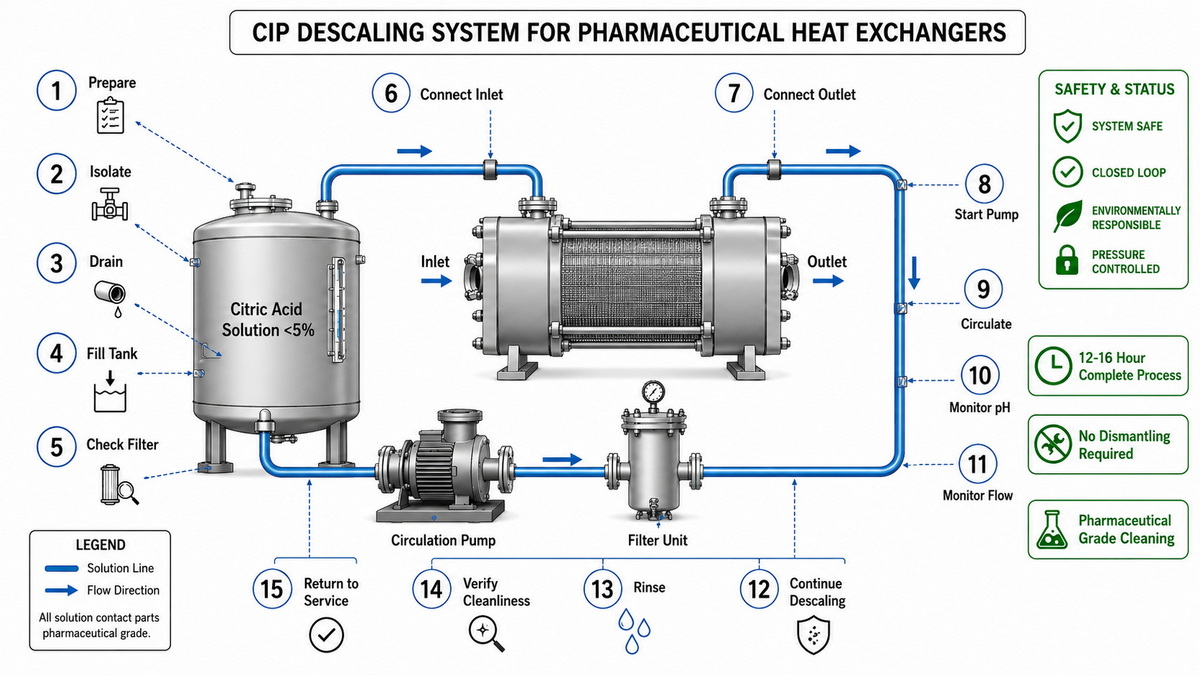
Chemical descaling dissolves hard scale and mineral deposits by circulating chemical solution through tubes. The most commonly used chemical is diluted citric acid, with concentration below 5%. [goodway]
Standard Operating Procedure (15-Step C.I.P. Cleaning Process) [scribd]
1. Drain the heat exchanger of water, oil, and other residues
2. Connect hoses, connecting the solution tank and drive pump to inlet and outlet ports
3. Fill the solution tank with fresh water; heat if necessary
4. Circulate fresh water for 2 hours throughout Plates (acid side)
5. Rinse water from the acid side
6. Pour LSR (6 drums into solution tank)
7. Pour 2 drums of water (3:1 dilution)
8. Circulate LSR solution for 12 hours
9. Rinse LSR residues
10. Pour 1 drum of Simple Green Crystal
11. Pour 4 drums of water (1:4 dilution)
12. Circulate Crystal solution for 2 hours
13. Rinse Crystal residues
14. Rinse Plates with fresh water
15. Disconnect hoses and resume operation
Advantages of Chemical Descaling
- ✅ Effective for hard scale: Particularly suitable for mineral deposits and hard calcium scale [linkedin]
- ✅ Online operation: Most use CIP (Clean-in-Place) systems, requiring no disassembly [scribd]
- ✅ Eco-friendly options: ScaleBreak-MP uses citric acid base, biodegradable, no hydrochloric acid [goodway]
- ✅ Cost-controlled: Significantly lower than equipment replacement costs [goodway]
Limitations of Chemical Descaling
- ❌ Corrosion risk: Acidic solutions may attack metal surfaces, causing corrosion [reddit]
- ❌ Neutralization required: Must use neutralizing and passivation solutions to treat residual chemicals [serckglobal]
- ❌ Time-consuming: Complete process requires 12-16 hours [scribd]
- ❌ Not suitable for all materials: Certain stainless steel equipment requires specialized chemicals (e.g., ScaleBreak-SS) [goodway]
Thermal Shock Explained
What Is Thermal Shock?
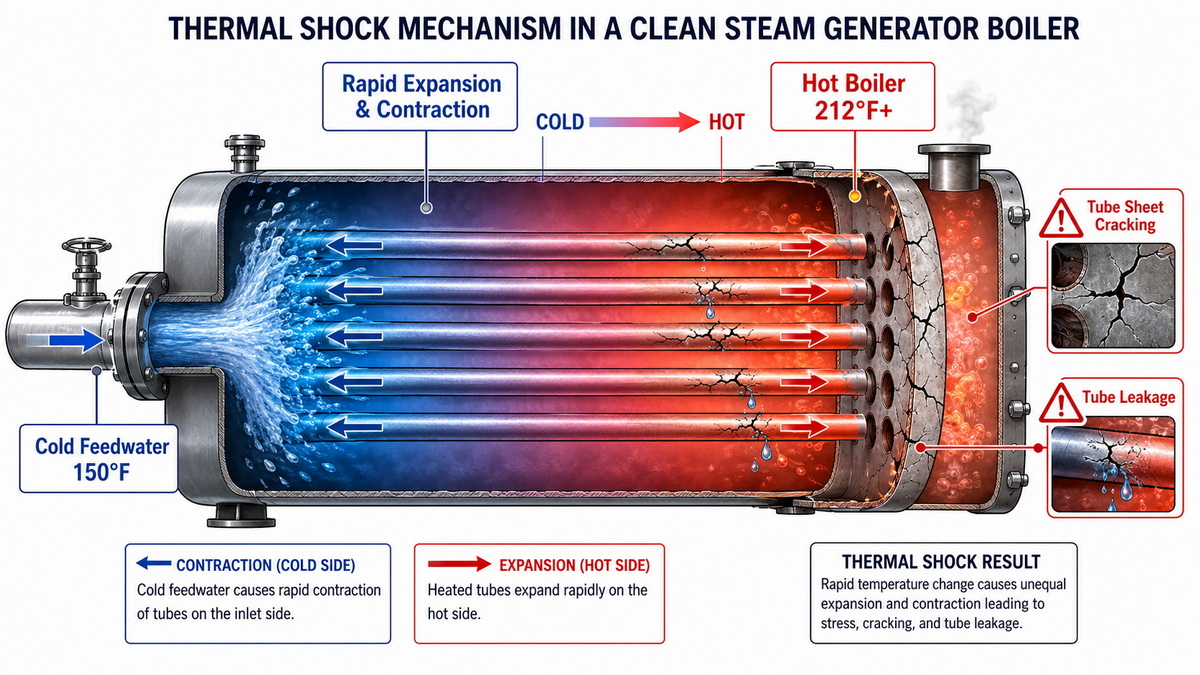
Thermal shock occurs when cold water enters a hot boiler. When a boiler operates at or near full power, it is full of boiling water. The sudden introduction of cold water reacts strongly with hot water. [miuraboiler]
Thermal Shock Damage Mechanism [claritywatertech]
Specific manifestations:
- Tubes leakage: Uneven expansion and contraction of tubes due to hot/cold alternation [claritywatertech]
- Tube sheets cracking: Especially in cast iron boilers [claritywatertech]
- Pressure vessel failure: May lead to catastrophic explosion [claritywatertech]
Three Major Negative Impacts of Thermal Shock [claritywatertech]
1. Increased fuel costs: Heating cold water requires more fuel
2. Accelerated corrosion: Dissolved gases (oxygen, carbon dioxide) remain in cold water, causing oxygen pitting
3. Thermal shock risk: May cause sudden pressure vessel failure
Golden Rules for Preventing Thermal Shock [miuraboiler]
| Prevention Measure | Specific Standard |
| Feedwater temperature | Maintain ≥200°F (about 93°C) claritywatertech |
| Deaerator temperature | 212°F + (2 × Tank Pressure); e.g., 6psi requires 224°F+ claritywatertech |
| Cold boiler startup | Low fire for 30 minutes until reaching operating temperature claritywatertech |
| Minimize cycling | Reduce daily operation cycle frequency miuraboiler |
| Boiler size matching | Avoid oversized boilers causing unnecessary cycling miuraboiler |
Core Comparison: Chemical Descaling Vs Thermal Shock Prevention
| Comparison Dimension | Chemical Descaling | Thermal Shock Prevention |
| Nature | Active cleaning measure (remedial) | Passive preventive measure (preventive) |
| Objective | Remove existing scale layers | Avoid damage from temperature |
| Execution Frequency | Every 12-24 months (turnaround) dercsalotech | Continuous operating |
| Cost Type | One-time cleaning cost | Long-term operational optimization cost |
| Risk | Corrosion, chemical residue | Equipment cracking, explosion |
| Application Stage | After scale layer forms | Throughout equipment operation |
| Technical Requirement | Chemical knowledge, CIP system | Temperature control, operating |
Expert Insight: Best Maintenance Strategy for Pharmaceutical Industry (2025 Update)
Based on my project experience at Ningbo Everheal, here is an integrated maintenance strategy:
1. Prevention First: Establish Thermal Shock Protection System
- Install feedwater preheating system: Ensure inlet water temperature ≥200°F
- Automated temperature monitoring: Use PLC to control ramp rates, avoid sudden slugs [enerquip]
- Regular condensate analysis: Monitor dissolved oxygen and carbon dioxide levels [claritywatertech]
2. Regular Cleaning: Chemical Descaling Timing Judgment
According to DERC Salotech research, heat exchanger cleaning intervals vary greatly:
- Heavy fouling environments: Cleaning required every 12-24 months [dercsalotech]
- Optimized design environments: 5-10 years without cleaning [dercsalotech]
Indicators for determining chemical descaling necessity:
- Heat transfer efficiency decline >5%
- Pump pressure drop increase >10%
- Abnormal fuel consumption increase
3. Emerging Technologies: Nanocoatings and Self-Cleaning Surfaces [igminresearch]
- Nanotechnology coatings: Hydrophobic/hydrophilic coatings significantly improve fouling resistance
- Self-cleaning surfaces: Based on photocatalysis or microfluidics, automatically decompose pollutants
What Is a Clean Steam Generator Heat Exchanger? Why Is Maintenance Critical?
Clean steam generators are core equipment in the pharmaceutical industry, producing sterile, pyrogen-free, endotoxin-free steam for equipment sterilization and cleanroom humidification. The heat exchanger, as its "heart," is responsible for heat transfer. Once fouled or damaged: [electrosteam]
| Impact Dimension | Specific Manifestation |
| Energy Efficiency Loss | 1/32-inch scale layer causes 2% fuel loss; 8,000 hours of operation consumes $72,000 more in fuel goodway |
| Heat Transfer Decline | Scale acts as an insulator, hindering heat transfer between metal and water goodway |
| Increased Pump Wear | Flow channels narrow, pumps work harder, increasing energy consumption and maintenance frequency goodway |
| Compliance Risk | Violation of FDA regulations and global cGMP standards, affecting product quality csidesigns |
Chemical Descaling Explained
How Chemical Descaling Works
Chemical descaling dissolves hard scale and mineral deposits by circulating chemical solution through tubes. The most commonly used chemical is diluted citric acid, with concentration below 5%. [goodway]
Standard Operating Procedure (15-Step C.I.P. Cleaning Process) [scribd]
1. Drain the heat exchanger of water, oil, and other residues
2. Connect hoses, connecting the solution tank and drive pump to inlet and outlet ports
3. Fill the solution tank with fresh water; heat if necessary
4. Circulate fresh water for 2 hours throughout Plates (acid side)
5. Rinse water from the acid side
6. Pour LSR (6 drums into solution tank)
7. Pour 2 drums of water (3:1 dilution)
8. Circulate LSR solution for 12 hours
9. Rinse LSR residues
10. Pour 1 drum of Simple Green Crystal
11. Pour 4 drums of water (1:4 dilution)
12. Circulate Crystal solution for 2 hours
13. Rinse Crystal residues
14. Rinse Plates with fresh water
15. Disconnect hoses and resume operation
Advantages of Chemical Descaling
- ✅ Effective for hard scale: Particularly suitable for mineral deposits and hard calcium scale [linkedin]
- ✅ Online operation: Most use CIP (Clean-in-Place) systems, requiring no disassembly [scribd]
- ✅ Eco-friendly options: ScaleBreak-MP uses citric acid base, biodegradable, no hydrochloric acid [goodway]
- ✅ Cost-controlled: Significantly lower than equipment replacement costs [goodway]
Limitations of Chemical Descaling
- ❌ Corrosion risk: Acidic solutions may attack metal surfaces, causing corrosion [reddit]
- ❌ Neutralization required: Must use neutralizing and passivation solutions to treat residual chemicals [serckglobal]
- ❌ Time-consuming: Complete process requires 12-16 hours [scribd]
- ❌ Not suitable for all materials: Certain stainless steel equipment requires specialized chemicals (e.g., ScaleBreak-SS) [goodway]
Thermal Shock Explained
What Is Thermal Shock?
Thermal shock occurs when cold water enters a hot boiler. When a boiler operates at or near full power, it is full of boiling water. The sudden introduction of cold water reacts strongly with hot water. [miuraboiler]
Thermal Shock Damage Mechanism [miuraboiler]
Specific manifestations:
- Tubes leakage: Uneven expansion and contraction of tubes due to hot/cold alternation [claritywatertech]
- Tube sheets cracking: Especially in cast iron boilers [claritywatertech]
- Pressure vessel failure: May lead to catastrophic explosion [claritywatertech]
Three Major Negative Impacts of Thermal Shock [claritywatertech]
1. Increased fuel costs: Heating cold water requires more fuel
2. Accelerated corrosion: Dissolved gases (oxygen, carbon dioxide) remain in cold water, causing oxygen pitting
3. Thermal shock risk: May cause sudden pressure vessel failure
Golden Rules for Preventing Thermal Shock [miuraboiler]
| Prevention Measure | Specific Standard |
| Feedwater temperature | Maintain ≥200°F (about 93°C) claritywatertech |
| Deaerator temperature | 212°F + (2 × Tank Pressure); e.g., 6psi requires 224°F+ claritywatertech |
| Cold boiler startup | Low fire for 30 minutes until reaching operating temperature claritywatertech |
| Minimize cycling | Reduce daily operation cycle frequency miuraboiler |
| Boiler size matching | Avoid oversized boilers causing unnecessary cycling miuraboiler |
Core Comparison: Chemical Descaling Vs Thermal Shock Prevention
| Comparison Dimension | Chemical Descaling | Thermal Shock Prevention |
| Nature | Active cleaning measure (remedial) | Passive preventive measure (preventive) |
| Objective | Remove existing scale layers | Avoid damage from temperature |
| Execution Frequency | Every 12-24 months (turnaround) dercsalotech | Continuous operating |
| Cost Type | One-time cleaning cost | Long-term operational optimization cost |
| Risk | Corrosion, chemical residue | Equipment cracking, explosion |
| Application Stage | After scale layer forms | Throughout equipment operation |
| Technical Requirement | Chemical knowledge, CIP system | Temperature control, operating |
Expert Insight: Best Maintenance Strategy for Pharmaceutical Industry (2025 Update)
Based on my project experience at Ningbo Everheal, here is an integrated maintenance strategy:
1. Prevention First: Establish Thermal Shock Protection System
- Install feedwater preheating system: Ensure inlet water temperature ≥200°F
- Automated temperature monitoring: Use PLC to control ramp rates, avoid sudden slugs [enerquip]
- Regular condensate analysis: Monitor dissolved oxygen and carbon dioxide levels [claritywatertech]
2. Regular Cleaning: Chemical Descaling Timing Judgment
According to DERC Salotech research, heat exchanger cleaning intervals vary greatly:
- Heavy fouling environments: Cleaning required every 12-24 months [dercsalotech]
- Optimized design environments: 5-10 years without cleaning [dercsalotech]
Indicators for determining chemical descaling necessity:
- Heat transfer efficiency decline >5%
- Pump pressure drop increase >10%
- Abnormal fuel consumption increase
3. Emerging Technologies: Nanocoatings and Self-Cleaning Surfaces [igminresearch]
- Nanotechnology coatings: Hydrophobic/hydrophilic coatings significantly improve fouling resistance
- Self-cleaning surfaces: Based on photocatalysis or microfluidics, automatically decompose pollutants
Ningbo Everheal's Customized Solutions
As a Chinese manufacturer specializing in Purified Water Preparation Systems and Pure Steam Generators, Ningbo Everheal Medical Equipment Co., LTD. provides:
- ✅ Customized factory layout planning: Optimized production line construction for pharmaceutical plants worldwide
- ✅ Thermal shock protection design: Boiler size matching + feedwater preheating system integration
- ✅ CIP cleaning interfaces: Pre-installed hoses and pump ports for chemical descaling
- ✅ 15 years of engineering experience: Hundreds of successful pharmaceutical plant cases [everhealgroup]
Call to Action (CTA)
Is your pharmaceutical plant heat exchanger facing fouling or thermal shock risks?
Contact Ningbo Everheal Now:
- Website: [everhealgroup.com]
- Phone: +86 188 5843 2776
- Email: info@everhealgroup.com [everhealgroup]
Get a Free Factory Layout Assessment — Let us help you design a customized pharmaceutical production line that combines thermal shock protection and chemical cleaning convenience!
FAQ: Common Questions
Q1: How often should chemical descaling be performed?
A: cleaning intervals vary by fouling severity. Heavy fouling environments require cleaning every 12-24 months; optimized design environments can reach 5-10 years. Judgment indicators include heat transfer efficiency decline >5% or abnormal fuel consumption increase. [dercsalotech]
Q2: What permanent damage can thermal shock cause?
A: Thermal shock can cause tubes leakage, tube sheets cracking, and even pressure vessel failure and explosion. Damage is typically immediate and irreversible. [miuraboiler]
Q3: Is citric acid descaling safe for stainless steel?
A: Diluted citric acid (concentration <5%) is safe for most stainless steel, but specialized chemicals like ScaleBreak-SS are recommended. [goodway]
Q4: What is the minimum feedwater temperature?
A: General standard is 200°F (93°C) or higher. For deaerators, temperature is 212°F + (2 × Tank Pressure). [claritywatertech]
Q5: Does Ningbo Everheal provide heat exchanger maintenance services?
A: Yes, we provide customized factory layout planning, production line construction solutions, and pre-installed CIP cleaning interfaces with thermal shock protection design. [everhealgroup]
Reference:
1. DERC Salotech. "Why do some heat exchangers require cleaning every turnaround while others last years?" https://dercsalotech.nl/kennisbank/why-do-some-heat-exchangers-require-cleaning-every-turnaround-while-others-last-years/ [dercsalotech]
2. Ningbo Everheal Medical Equipment Co., LTD. "everheal Group Official Website" https://www.everhealgroup.com [everhealgroup]
3. CSI Designs. "Heat Exchangers for Pharmaceutical Manufacturing" https://www.csidesigns.com/blog/articles/heat-exchanges-in-pharma [csidesigns]
4. CSI Designs. "Cleaning and Maintaining Your Heat Exchanger: Complete Guide" https://www.csidesigns.com/blog/articles/cleaning-and-maintaining-your-heat-exchanger [csidesigns]
5. Goodway. "Heat Exchanger and Boiler Maintenance: Chemical Descaling" https://www.goodway.com/hvac-blog/2018/11/heat-exchanger-maintenance-chemical-descaling/ [goodway]
6. ElectroSteam. "Clean Steam Generators for Pharma" https://www.electrosteam.com/applications/sterilization-of-pharmaceutical-products-equipment/ [electrosteam]
7. Clarity Water Technologies. "Don't Let Thermal Shock Harm Your Steam Boiler!" https://claritywatertech.com/dont-let-thermal-shock-harm-your-steam-boiler/ [claritywatertech]
8. Miura America. "What is Thermal Shock and How Do You Prevent It?" https://miuraboiler.com/what-is-thermal-shock-and-how-do-you-prevent-it/ [miuraboiler]
9. Enerquip. "What Is Thermal Shock Vs. Thermal Fatigue (and How to Prevent Both)?" https://www.enerquip.com/what-is-thermal-shock-vs-thermal-fatigue-and-how-to-prevent-both/ [enerquip]
10. Igmin Research. "Contamination in Heat Exchangers: Types, Energy Effects and Cleaning Methods" https://www.igminresearch.com/articles/html/igmin209 [igminresearch]


