| Availability: | |
|---|---|
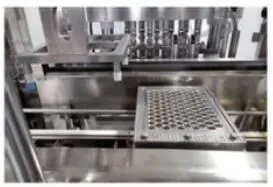
Suitable for various brands of ready-to-use (RTU) nest-style prefilled syringe packaging materials. The surface of the Prefilled Syringe Filling Production Line is made of SUS304 stainless steel, with contact parts using SUS316L stainless steel and medical-grade silicone rubber, meeting GMP specifications. The ceramic plunger pump ensures precise filling, with resistance to acid, alkali, wear, and high temperatures, achieving high filling accuracy. The sorting and transportation of rubber stoppers are accomplished through a vibrating tray, using a clean SUS316L stainless steel tray with no dead corners, and the top tray is detachable and supports sterilization.
The equipment features internationally renowned electrical components, employing interference-free modular control with synchronous actions controlled by servo motors for accuracy and reliability. The PLC programming controller controls motor operation, and the human-machine interface monitors and displays the working status of each station in real-time, providing automatic alarms and fault location displays. Multiple filling doses and methods are available, supporting the storage of various formula parameters.
The filling needle rises with the liquid level to prevent drug splashing. The equipment boasts high automation, requiring minimal personnel, as few as 2 people. It can be optionally equipped with an A-grade laminar flow hood for high cleanliness production.
| Applicable Materials | Liquid |
| Applicable Specifications | 1ml/1-3ml/5ml/10ml |
| Filling Range | 0.1-10ml (Requires change of plunger pump) |
| Number of Filling Needles | 10 |
| Filling Accuracy | ≤±1.5% |
| Production Capacity | 9000-10000 units/hour |
| Total Power | 15KW |
| Voltage | 380V50Hz |
| Compressed Air | 0.6-0.7Mpa |
| Dimensions | L4469×W1438×H1878mm |
| Total Weight | 2000KG |
|
Why Choose Us
Pharmaceutical Grade Stainless Steel Construction:
Manufactured using high quality pharmaceutical grade stainless steel materials to ensure product hygiene and durability. It meets the requirements of sensitive environments such as pharmaceutical manufacturing.
Strict Manufacturing Processes and Quality Control:
We follow strict manufacturing processes and quality checks. Every device undergoes thorough testing and inspection before it's shipped to ensure it meets the pharmaceutical industry's strict standards.
Deployment of Experienced Engineers to Customer Facilities:
We dispatch experienced engineers to our customers' facilities. During the installation process, they supervise the equipment installation, ensuring that every component is correctly and accurately configured. Additionally, they provide detailed operating instructions to ensure customers can fully utilize the equipment's capabilities for efficient production.
Over 10 Years of Project Experience:
With over 10 years of successful project experience providing water purification solutions to the pharmaceutical industry,Our expertise and experience serve as strong support for the success of your projects.
|
Payment Terms
Hot Tags: Prefilled Syringe Filling Production Line, Syringe Filling Line, Syringe Production Line, Automatic Syringe Filling Machine, Syringe Filling System, Semi Automatic Syringe Filling Machine, Syringe Making Machine, Aseptic Filling Line, Syringe Machine, Automatic Filling And Sealing Machine, China, Customized, OEM, Low price, manufacturing company, manufacturers, factory, suppliers, quotation, for sale
Electropolished 316L vs standard stainless steel in pharmaceutical purified water storage tanks: learn how surface finish, Ra values, and hygienic design influence biofilm formation, cleaning, and GMP compliance in PW systems serving BFS, FFS, and aseptic filling lines.
Learn when to choose peristaltic vs piston pumps in pharmaceutical filling machines. Compare contamination risk, cleaning validation, and multi-product efficiency, with expert insights from an integrated BFS, FFS, and aseptic line manufacturer.
In large‑scale pharma liquid packing, batch mixing is giving way to continuous in-line blending. Learn how each approach impacts homogeneity, quality risk, and OEE on filling, FFS, and BFS lines, with practical guidance from an equipment and process perspective.
“Compare closed-loop chemical dispensing vs open-tank mixing in pharmaceutical cleanrooms. Learn how to cut VOC emissions, protect operators and integrate zero‑VOC strategies into BFS, FFS and sterile filling lines with expert guidance from Ningbo Everheal Medical Equipment.”
Discover how jacketed mixing tanks compare with external heat exchangers for precision temperature control in exothermic chemical reactions. Learn selection criteria, safety implications, and integration tips for pharmaceutical and specialty chemical plants, including BFS and FFS lines.
Comprehensive comparison of 316L stainless steel vs Hastelloy mixing tanks for pharmaceutical intermediate production. Expert analysis of corrosion resistance in acidic environments, cost-benefit evaluation, material selection criteria, and lifecycle performance. Industry insights from pharmaceutical equipment manufacturers specializing in production line design.
Discover how automated liquid dispensing outperforms manual weight‑batching in potent API handling. Learn how closed BFS and FFS systems cut human error, protect operators, and strengthen regulatory compliance for modern HPAPI manufacturing lines.
Discover how magnetic agitators and mechanical shaft mixers impact shear stress, protein stability, and aseptic integrity in pharmaceutical manufacturing. Learn when each technology is best suited and how integrated FFS/BFS lines protect delicate biologic formulations.
Learn how dry heat sterilization cabinets compare with moist heat autoclaves for depyrogenation of pharmaceutical glassware. Understand mechanisms, validation, layouts, and when to choose each method to design safer, more efficient injectable production lines.
Sustainable air filtration for high‑dust pharma labs: compare washable pre‑filters and disposable synthetic media, see how hybrid strategies cut waste and energy use, and learn practical GMP‑aligned steps for cleaner, greener sterile manufacturing.
Choosing between rotary and linear filling and capping machines is no longer just a mechanical preference; it is a strategic decision that shapes your *speed, precision, and compliance* in small‑batch ophthalmic lines. For producers working with sterile eye drops, single-dose BFS ampoules, and small
This in‑depth guide compares glass bottles and flexible IV bags for sterile infusion products, analyzing filling line efficiency, sterilization stability, microplastic risks, and BFS/FFS technologies to help pharmaceutical manufacturers design future‑ready IV production facilities.
Discover how BFS (Blow-Fill-Seal) and FFS (Form-Fill-Seal) technologies compare in contamination risk for thermosensitive biologics. Learn key aseptic differences, real-world use cases, and expert tips for designing safer, more efficient fill-finish lines.
Discover how direct-heating and indirect-heating clean steam generators impact large-scale autoclave sterilization. Learn key design criteria, steam quality requirements, regulatory expectations, and practical selection tips for pharmaceutical plants planning new or upgraded sterile utilities.
Compare vapor compression distillation vs. multi‑effect distillers for high‑volume IV solution plants. Explore lifecycle costs, energy use, footprint, and reliability, with expert guidance from an integrated pharmaceutical equipment and plant layout provider.
Discover whether single-stage RO or two-stage RO + EDI is the better choice for high-silica pharmaceutical feedwater. Compare performance, lifecycle cost, and GMP compliance, and learn how Everheal designs reliable purified water systems for modern pharma plants.
Pure steam generators vs. clean steam generators for SIP cycles: understand quality differences, GMP expectations, lifecycle costs, and when each standard fits your pharma or biotech plant. Includes expert framework and turnkey insights from a Chinese pure steam generator manufacturer.
For energy‑constrained pharma facilities, learn how to choose between multi‑effect distillation and membrane‑based ambient WFI. Compare energy, risk, layout, and lifecycle costs, and see how Everheal designs GMP‑compliant, sustainable WFI systems.
This comprehensive guide analyzes leading pharmaceutical production line manufacturers serving Tajikistan from a buyer’s perspective. It explains key evaluation criteria, compares global and Chinese suppliers, and shows how Ningbo Everheal supports compliant, scalable factory projects.
Discover how Kyrgyz pharmaceutical manufacturers can select the right production line suppliers. This guide compares leading global and Chinese providers, highlights real‑world criteria, and shows how Ningbo Everheal supports turnkey, compliant, and cost‑effective factory projects.