


Views: 265 Author: Everheal Medical Equipment Publish Time: 2026-07-16 Origin: Everheal


Content Menu
● What a Capsule Filling Machine Does
● Main Types of Capsule Filling Machines
● How an Automatic Capsule Filling Machine Works
● Choosing the Right Machine Type
● Factors That Affect Performance
● Common Problems in Production
● Practical Ways to Improve Stability
● Capsule Filling in Modern Pharmaceutical Production
● FAQ
>> 1. What is the working principle of a capsule filling machine?
>> 2. What are the main types of capsule filling machines?
>> 3. Which filling principle is most common?
>> 4. Why does capsule fill weight vary?
>> 5. How do I choose the right capsule filling machine?
Capsule filling is one of the most widely used dosage-form processes in the pharmaceutical industry. A capsule filling machine turns empty shells into finished products by placing the right amount of material into each capsule and ensuring proper closure.
Although the task sounds simple, the process requires high precision. The machine must align capsules correctly, separate the capsule body from the cap, meter the exact dose, close the capsule securely, and remove any defective units. For that reason, capsule filling machines are designed as multi-station systems with tightly synchronized operations.

A capsule filling machine is used to fill hard capsules with powdered ingredients, granules, pellets, or in some cases liquid-based materials. Its main purpose is to achieve consistent fill weight, stable locking quality, and reliable production output.
In practice, the machine must complete five essential tasks:
- Feed empty capsules into the system.
- Orient capsules into the correct position.
- Separate the capsule cap from the body.
- Fill the body with the required dose.
- Close and discharge the finished capsules.
Each step must be accurate. Even small errors in capsule orientation, powder flow, or closing pressure can affect product quality and production efficiency.
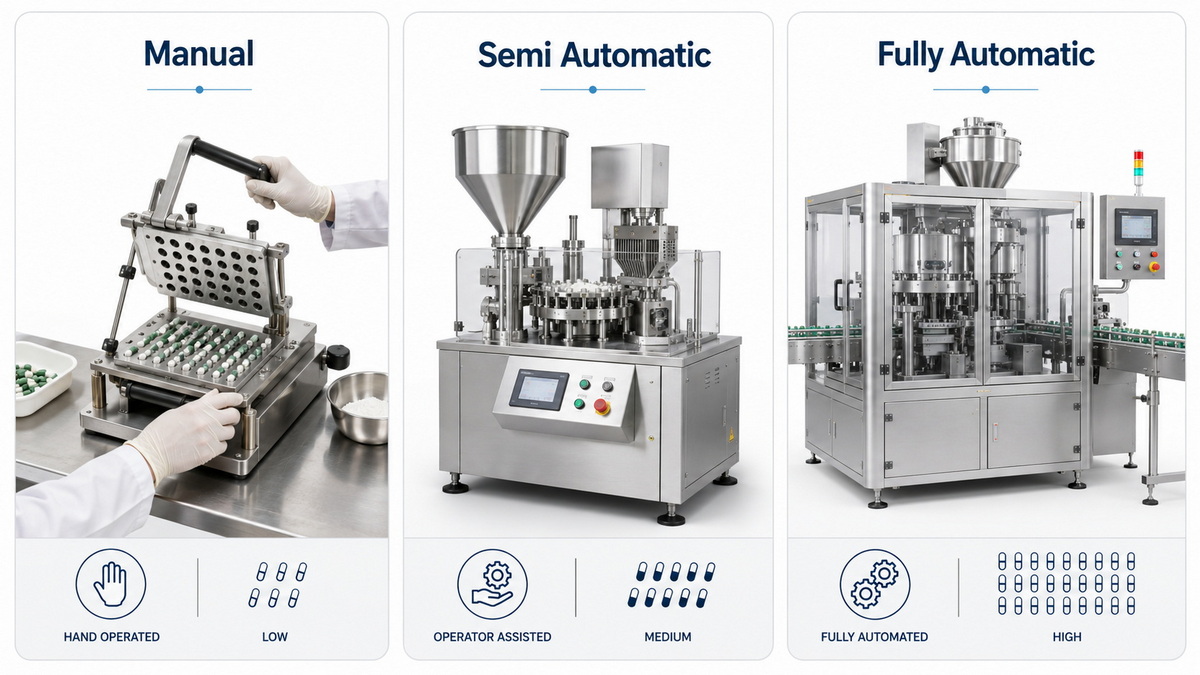
Capsule filling machines are generally divided into three categories: manual, semi-automatic, and fully automatic. Each type serves a different production scenario.
| Machine Type | Working Style | Best For | Main Advantage |
|---|---|---|---|
| Manual Capsule Filling Machine | Operated mostly by hand | Small batches, laboratories, startups | Low investment and simple operation |
| Semi-Automatic Capsule Filling Machine | Combination of manual handling and machine-assisted filling | Pilot production and medium-scale output | Better efficiency than manual machines |
| Fully Automatic Capsule Filling Machine | Automated feeding, filling, closing, and discharge | Large-scale pharmaceutical production | High speed and strong consistency |
Manual machines are usually used in small-scale settings where output requirements are limited. Semi-automatic machines are suitable when production needs are growing but full automation is not yet necessary. Fully automatic machines are preferred for commercial production because they offer higher throughput, better repeatability, and less operator dependence.
A fully automatic capsule filling machine follows a structured sequence. Although machine designs vary, the basic operating logic is similar.
Empty capsules are loaded into the hopper. From there, the machine transfers them into the feeding track and arranges them for the next stage. The system must deliver capsules in a stable and orderly way so that downstream steps can run smoothly.
The machine aligns each capsule so that the cap and body are properly positioned. Orientation is essential because misaligned capsules can cause separation failure or mechanical damage.
Once aligned, the capsule body is separated from the cap. Some machines use vacuum or air-assisted methods, while others rely on mechanical movement and guiding parts. The separation stage must be precise to avoid shell deformation or incomplete opening.
After separation, the machine fills the capsule body with the target material. The filling mechanism depends on the design of the equipment and the nature of the product. The machine must control the amount of material carefully to ensure accurate dose delivery.
In some systems, the filled material is lightly compacted or settled before closure. This helps stabilize the dose and improve fill uniformity, especially for powders with variable flow behavior.
The cap is returned to the body and locked in place. Proper closing is critical because poor locking can lead to leakage, opening during handling, or rejection in later inspection steps.
Finished capsules are discharged automatically. Any defective capsules are removed by the rejection system. This final stage helps maintain product quality and prevents problematic capsules from moving to the next process.
Different machines use different filling principles depending on the formulation and production requirement. The most common systems are tamping pin, dosator, auger, and vibratory filling.
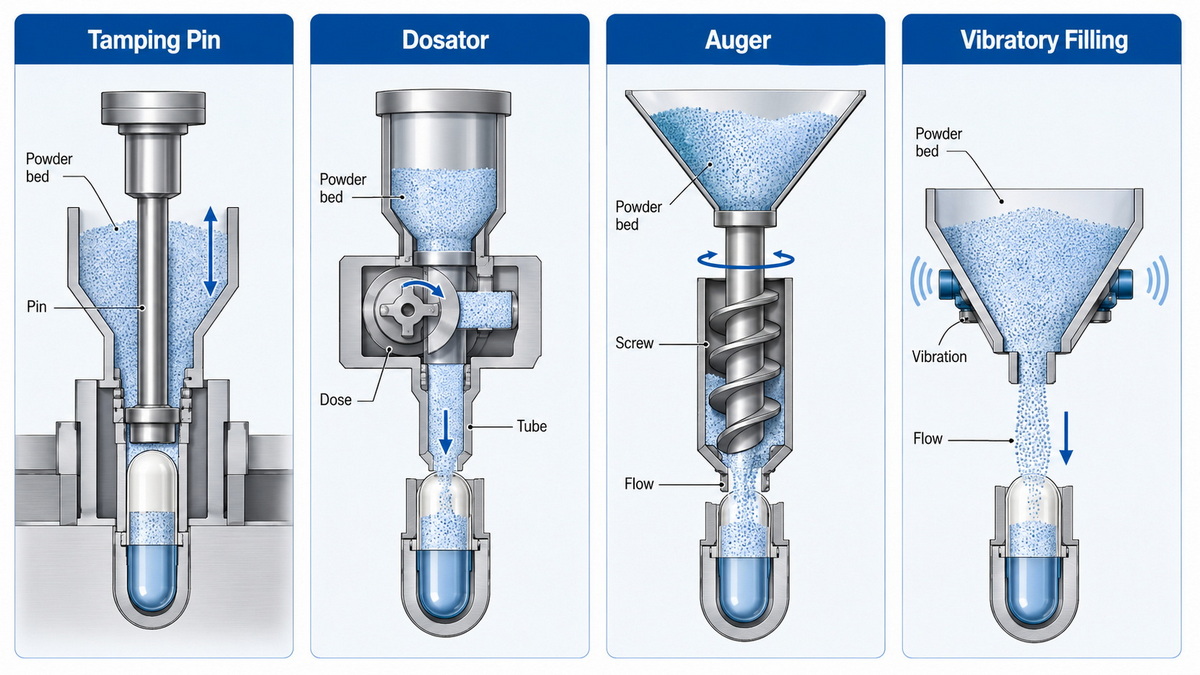
The tamping pin system compresses powder into plugs inside dosing holes. These plugs are then transferred into the capsule body. This method is commonly used when the powder has reasonably good flow and compressibility.
Advantages
- Good dose consistency.
- Suitable for many powder formulations.
- Reliable for medium to high production speeds.
Limitations
- Less suitable for very cohesive powders.
- Sensitive to powder behavior changes.
The dosator principle uses a dosing tube to collect powder and form a compact plug. That plug is then placed into the capsule. This method is often used for fine powders that need controlled compaction.
Advantages
- Accurate dosing.
- Suitable for certain low-density powders.
- Good control over plug formation.
Limitations
- Performance depends on powder characteristics.
- Sensitive to environmental changes such as humidity.
In auger filling, a rotating screw moves powder into the dosing area in controlled amounts. This principle is widely used where continuous metering is needed.
Advantages
- Flexible filling control.
- Efficient for continuous operation.
- Suitable for a range of powder types.
Limitations
- Depends strongly on flow behavior.
- May need careful tuning for stable results.
Vibratory filling uses vibration to help powder move into the capsule body more smoothly. It is useful for products that benefit from gentle handling.
Advantages
- Less mechanical stress on material.
- Helpful for some difficult-flow powders.
- Simple and stable filling approach.
Limitations
- Not suitable for every formulation.
- May require careful process adjustment.
The best machine is not always the fastest one. The right choice depends on product properties, batch size, output target, and process control needs.
Here are the main selection factors to consider:
- Powder flowability.
- Capsule size range.
- Required production capacity.
- Desired fill accuracy.
- Cleaning and changeover time.
- Stability of the formulation.
- Level of automation needed.
For small batches or development work, a manual or semi-automatic machine may be enough. For commercial manufacturing, a fully automatic system is usually more practical because it offers better consistency and lower labor dependence.
Even a high-quality machine can perform poorly if the process is not properly controlled. Several real-world factors influence production results.
Powder flow, density, compressibility, and moisture sensitivity all affect filling performance. A material that flows well in the lab may behave differently during continuous production.
Temperature and humidity can influence capsule shell behavior and powder flow. Excess moisture may cause sticking, clogging, or poor capsule locking.
Capsule shells must be consistent in size, shape, and moisture content. Poor capsule quality can lead to filling issues and rejection.
Incorrect settings, worn parts, or poor cleaning can reduce accuracy and increase defect rates. Regular inspection and proper adjustment are essential.
Several typical issues can appear during capsule filling. These problems are usually linked to material behavior, machine setup, or environmental conditions.
- Misoriented capsules.
- Incomplete capsule separation.
- Uneven fill weight.
- Powder leakage.
- Loose capsule locking.
- Excessive rejection rate.
When these problems occur, the first step is to check the powder characteristics, capsule quality, and machine settings before making major mechanical changes.
Stable capsule filling depends on both machine performance and process discipline. Manufacturers can improve output reliability by applying a few practical measures.
1. Control room temperature and humidity.
2. Test powder flow before full production.
3. Inspect capsule shells regularly.
4. Clean contact parts on a fixed schedule.
5. Monitor fill weight trends during production.
6. Check rejection patterns for recurring faults.
7. Match the filling principle to the product formulation.
These measures help reduce variation, improve batch consistency, and support smoother production runs.
Today's pharmaceutical production lines are becoming more integrated, more intelligent, and more process-driven. Capsule filling machines are no longer viewed as isolated equipment. They are part of a broader manufacturing system that includes clean utilities, preparation areas, production flow design, and downstream packaging.
This means equipment selection should be connected to the whole factory plan. A well-matched capsule filling system can improve not only output but also workflow efficiency, hygiene control, and long-term operational stability.
Capsule filling machines work by combining accurate capsule handling, controlled dosing, secure closing, and automatic rejection of defective units. Different machine types and filling principles are suited to different products and production scales, so the best choice depends on the characteristics of the formulation and the needs of the plant.
For manufacturers, understanding how these machines work is the first step toward better production planning, more stable output, and more efficient equipment selection.
A capsule filling machine works by feeding empty capsules, separating the cap from the body, filling the body with material, closing the capsule, and discharging the finished product.
The main types are manual, semi-automatic, and fully automatic capsule filling machines.
The most common filling principles are tamping pin, dosator, auger, and vibratory filling.
Fill weight can vary because of powder flow problems, humidity changes, capsule quality issues, or incorrect machine settings.
The right machine depends on production scale, powder properties, capsule size, required speed, and cleaning requirements.
1. Rich Packing. Capsule Filling Machine Working Principle: The Complete Buyer Guide Checks & Troubleshooting.
https://www.richpacking020.com/capsule-filling-machine-working-principle-the-complete-buyer-guide-checks-troubleshooting_n355
2. Adinath Machines. Types of Capsule Filling Machines – Design, Process, and Working Principle.
https://www.adinathmachines.com/blog/types-of-capsule-filling-machines-design-process-and-working-principle/
3. Huaon Industry Research. 2026年中国制药装备行业发展现状及趋势分析,智能化、数字化成为明确的发展趋势.
https://www.huaon.com/channel/trend/1176101.html
4. PharmaMachinerys. Capsule Filling Machine Working Principle Explained.
https://pharmamachinerys.com/blog/capsule-filling-machine-working-principle/
5. CBD Machinery. Types of Capsule Filling Machines.
https://www.cbdmachinery.com/types-of-capsule-filling-machines/
6. Basic Medical Key. Dry Fill Formulation and Filling Technology.
https://basicmedicalkey.com/dry-fill-formulation-and-filling-technology/


