In modern production, the choice between a liquid bottle filling machine and a pharmaceutical liquid filling system is not just a packaging decision. It is a strategic decision that affects product quality, compliance, throughput, contamination risk, and plant layout. [sountecplast]
For pharmaceutical manufacturers, the right solution depends on the product type, viscosity, sterility level, bottle format, and regulatory expectations. In practice, the best filling line is the one that fits the medicine, the process, and the factory—not the other way around. [giiresearch]
Why This Comparison Matters
A liquid bottle filling machine is usually discussed in the packaging world, while a pharmaceutical liquid filling system is designed for higher hygiene, tighter process control, and stricter compliance. That difference matters because a line that works well for beverages or general liquids may not be suitable for oral syrups, injectables, or other sensitive pharmaceutical products. [fortunebusinessinsights]
From an engineering perspective, the gap is not only about speed. It also includes dosing accuracy, cleanability, aseptic protection, traceability, and integration with upstream and downstream systems such as preparation tanks, CIP/SIP, capping, inspection, and labeling. [openpr]
What Is a Liquid Bottle Filling Machine?
A liquid bottle filling machine is equipment used to fill liquid products into bottles with a defined volume or weight. It is widely used in food, beverage, cosmetics, household chemicals, and some non-sterile industrial applications. [mordorintelligence]
These machines may use gravity filling, overflow filling, piston filling, vacuum filling, or volumetric methods depending on product characteristics. In many markets, automation and modular design are now the dominant trends because they improve output, reduce labor dependence, and support faster changeovers. [sountecplast]
Typical strengths
- Fast and efficient bottle handling.
- Flexible for multiple bottle sizes.
- Suitable for a wide range of liquid viscosities.
- Easier to deploy for general packaging lines.
Typical limitations
- Hygiene level may be insufficient for pharmaceutical-grade applications.
- Not always designed for sterile or aseptic environments.
- May require additional systems for traceability and process validation.
What Is a Pharmaceutical Liquid Filling System?
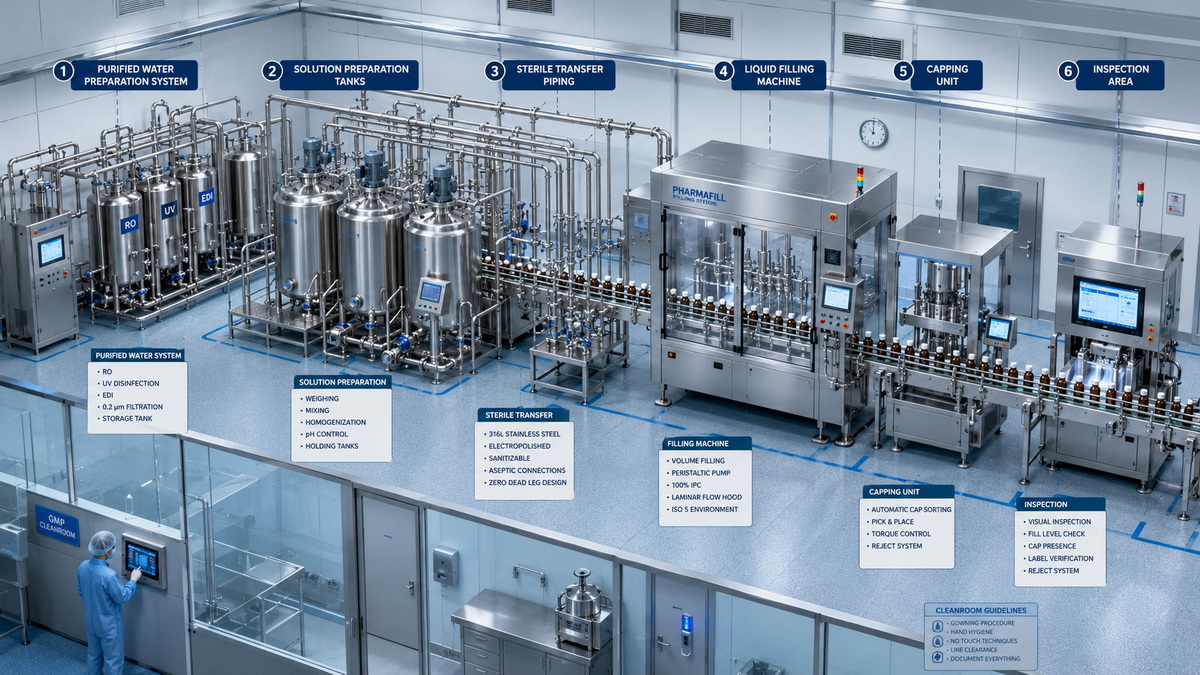
A pharmaceutical liquid filling system is a more complete production solution. It is usually designed to work with the full upstream and downstream process, including liquid preparation, filtration, transfer, filling, capping, inspection, and sometimes cleanroom integration. [indexbox]
For pharma plants, the filling system must support controlled environments and consistent dosing. This is especially important for products such as oral liquids, suspensions, sterile liquids, and high-value formulations that require repeatable accuracy and low contamination risk. [databridgemarketresearch]
Typical strengths
- Better control of hygiene and contamination risk.
- More suitable for regulated pharmaceutical environments.
- Easier to integrate with preparation systems and clean utilities.
- Better alignment with validation and compliance needs.
Typical limitations
- Higher investment cost.
- More complex engineering and qualification.
- Requires stronger planning for factory layout and utility design.
Side-by-Side Comparison
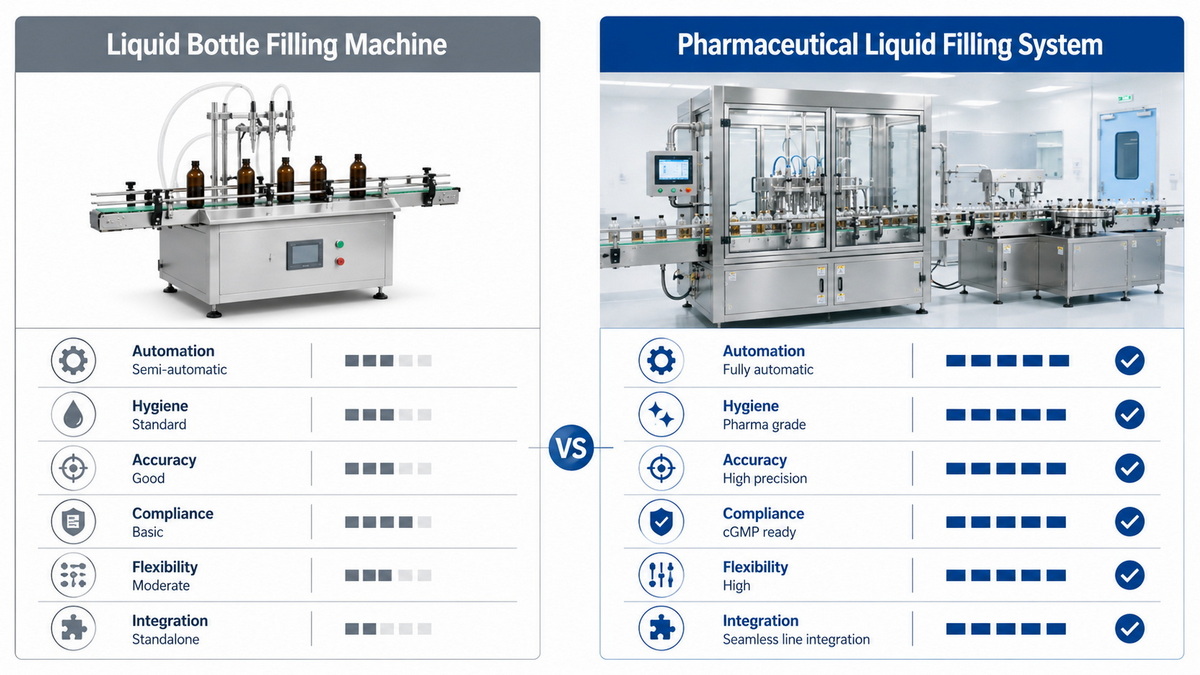
| Item | Liquid Bottle Filling Machine | Pharmaceutical Liquid Filling System |
| Main purpose | General liquid packaging (General liquid packaging) | Regulated pharma production (Regulated pharma production) |
| Hygiene level | Standard to medium (Standard to medium) | High to aseptic-grade (High to aseptic-grade) |
| Accuracy requirement | Moderate to high (Moderate to high) | High to very high (High to very high) |
| Integration scope | Standalone or semi-line (Standalone or semi-line) | Full process line integration (Full process line integration) |
| Validation need | Limited in many industries (Limited in many industries) | Strong qualification and documentation (Strong qualification and documentation) |
| Best suited for | Beverages, cosmetics, chemicals (Beverages, cosmetics, chemicals) | Oral liquids, sterile liquids, pharma preparations (Oral liquids, sterile liquids, pharma preparations) |
Key Selection Factors
Choosing the right equipment starts with the product itself. Viscosity, foaming tendency, particulate content, temperature sensitivity, and sterility requirements all influence machine selection. [indexbox]
You should also evaluate output targets, bottle format range, changeover frequency, and available cleanroom space. In 2026, market demand is clearly shifting toward fully automated, precision-focused, and flexible multi-format filling lines. [giiresearch]
1. Product characteristics
- Is the liquid thin, viscous, foamy, or sensitive to oxidation?
- Does it contain suspended particles?
- Does it require sterile or non-sterile handling?
2. Compliance requirements
- Does the process need hygienic design?
- Is traceability required?
- Are validation and documentation mandatory?
3. Production strategy
- Will you run one SKU or many?
- Do you need quick changeovers?
- Is the line intended for high-speed mass production or smaller batch manufacturing?
Why Pharma Buyers Need More Than a Filler
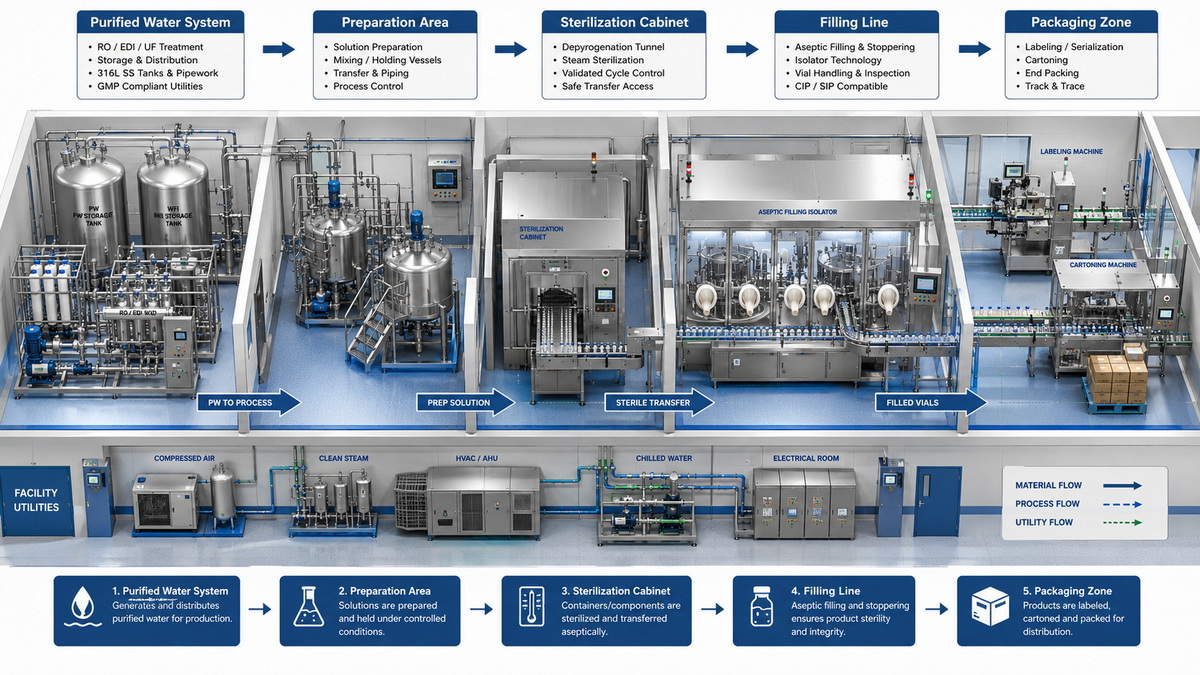
In pharmaceutical manufacturing, a filler is only one part of the total system. A complete liquid production line often includes purified water preparation, solution preparation tanks, transfer piping, sterilization equipment, filling, and packaging. That is why many plants fail to achieve stable output when they buy equipment in isolation without planning the full line. [giiresearch]
For example, if a facility produces oral liquids or high-value formulations, upstream preparation consistency is just as important as filling accuracy. A well-designed Pharmaceutical Solution Preparation System can reduce batch variation before filling even begins. This is especially relevant for large-volume preparations, lyophilized drug preparation, and anticancer drug preparation lines. [databridgemarketresearch]
Industry Trends Shaping 2026
The liquid filling market is moving toward automation, precision control, and hygienic design. Multiple market reports show continued growth in liquid filling machine demand, with strong momentum behind automatic systems and servo-based filling platforms. [mordorintelligence]
Three trends matter most for pharma decision-makers:
- Automation is becoming standard, not optional.
- Flexible multi-format lines are more valuable as SKU diversity grows.
- Aseptic and hygienic filling is becoming a core purchasing criterion. [fortunebusinessinsights]
This means future-ready plants should plan not only for present output, but also for expandability, modular upgrades, and integration with clean utilities and process systems.
Practical Planning Steps for a New Line
When helping a pharmaceutical plant design a liquid filling project, we recommend a structured approach. This reduces rework, shortens installation risk, and improves long-term operating efficiency.
1. Define the product category and process route.
2. Confirm bottle type, closure type, and target capacity.
3. Identify cleanliness, sterility, and compliance requirements.
4. Map the full process flow from preparation to final packaging.
5. Plan utilities, cleanroom zones, and maintenance access early.
6. Select equipment based on product behavior, not only on speed.
7. Build room for future expansion and line upgrades.
This is where factory layout planning becomes critical. A compact but poorly arranged line can create bottlenecks, while a properly planned layout improves material flow, hygiene control, and operator efficiency.
Expert Insight: What Buyers Often Miss
One common mistake is comparing machines only by bottle-per-minute output. In pharma, that is not enough. If the machine cannot maintain dosing stability, support cleaning, and fit the plant's hygiene strategy, the real cost of ownership becomes much higher. [fortunebusinessinsights]
Another overlooked point is the relationship between the filling line and the upstream preparation system. A stable liquid formulation reduces filling variation, improves consistency, and protects final product quality. For pharmaceutical manufacturers, this means the preparation system and filling system should be designed together as one integrated solution.
Suggested CTA
If your plant is planning a liquid filling line, pharmaceutical solution preparation system, purified water system, or sterilization equipment project, the best next step is to request a tailored layout and process evaluation. A customized engineering proposal can help you reduce risk, improve compliance, and build a line that is ready for future production growth.
Call to action: Contact Ningbo Everheal Medical Equipment Co., LTD. for a customized pharmaceutical line planning and equipment solution.
FAQ
1. What is the main difference between a liquid bottle filling machine and a pharmaceutical liquid filling system?
A liquid bottle filling machine is usually focused on packaging, while a pharmaceutical liquid filling system is designed for regulated production, hygiene, and process integration. [giiresearch]
2. Can one machine handle both pharma and non-pharma liquids?
Sometimes yes, but only if the machine and process design meet the required hygiene, cleaning, and validation standards for the intended product. [databridgemarketresearch]
3. Why is automation important in liquid filling lines?
Automation improves filling consistency, reduces labor dependence, supports higher throughput, and helps lower contamination risk. [sountecplast]
4. What products need a pharmaceutical liquid filling system?
Oral liquids, suspensions, sterile liquids, and other high-value formulations generally need a more controlled and compliant filling environment. [databridgemarketresearch]
5. Why should filling equipment and preparation systems be planned together?
Because the stability of the prepared liquid affects filling accuracy, product quality, and overall line performance. Integrated planning also improves plant layout and operational flow.
References
1. Mordor Intelligence. "Liquid Filling Machines Market Size, Trends, Scope." [https://www.mordorintelligence.com/industry-reports/liquid-filling-machines-market]
2. GII Research. "Automatic Liquid Filling Machine - Market Share Analysis, Industry Trends & Statistics, Growth Forecasts (2026 - 2031)." [https://www.giiresearch.com/report/moi2043836-automatic-liquid-filling-machine-market-share.html]
3. GII Research. "Automatic Liquid Filling Global Market Report 2026." [https://www.giiresearch.com/report/tbrc1931865-automatic-liquid-filling-global-market-report.html]
4. Fortune Business Insights. "Liquid Filling Machines Market Size, Share | Growth ." [https://www.fortunebusinessinsights.com/liquid-filling-machines-market-109925]
5. IndexBox. "Liquid Filling Machines Market Analysis 2026-2035." [https://www.indexbox.io/blog/liquid-filling-machines-market-forecast-points-higher-toward-2035-on-surging-demand-for-precision-p...]
6. Databridge Market Research. "Global Liquid Filling Machines Market." [https://www.databridgemarketresearch.com/de/press-release/global-liquid-filling-machines-market]
7. Sountec Plast. "2026 Bottle Filling Machine Market Trends & Buying Guide." [https://www.sountecplast.com/blogs/bottle-filling-machine-market-in-2026-key-trends-growth-and-what-it-means-for-your-business.h]
8. OpenPR. "Multi-Head Filling Machines - Top Global Industry Trends in 2026." [https://www.openpr.com/news/4283876/multi-head-filling-machines-top-global-industry-trends-in-2026]


