


Views: 243 Author: Everheal Medical Equipment Publish Time: 2026-07-12 Origin: Everheal


When a pharmaceutical plant works with high-hardness feedwater, the distillation strategy you choose directly affects reliability, maintenance cost, water quality stability, and long-term production risk. In most real-world projects, the right choice between single-stage distillation and multi-stage distillation depends on feedwater hardness, scaling control, energy efficiency, and the required level of purification for downstream pharma processes.
For manufacturers of purified water preparation systems, sterilization equipment, and pharmaceutical solution preparation systems, this is not a theoretical debate. It is a practical engineering decision that influences the entire utility architecture of a GMP-oriented facility.

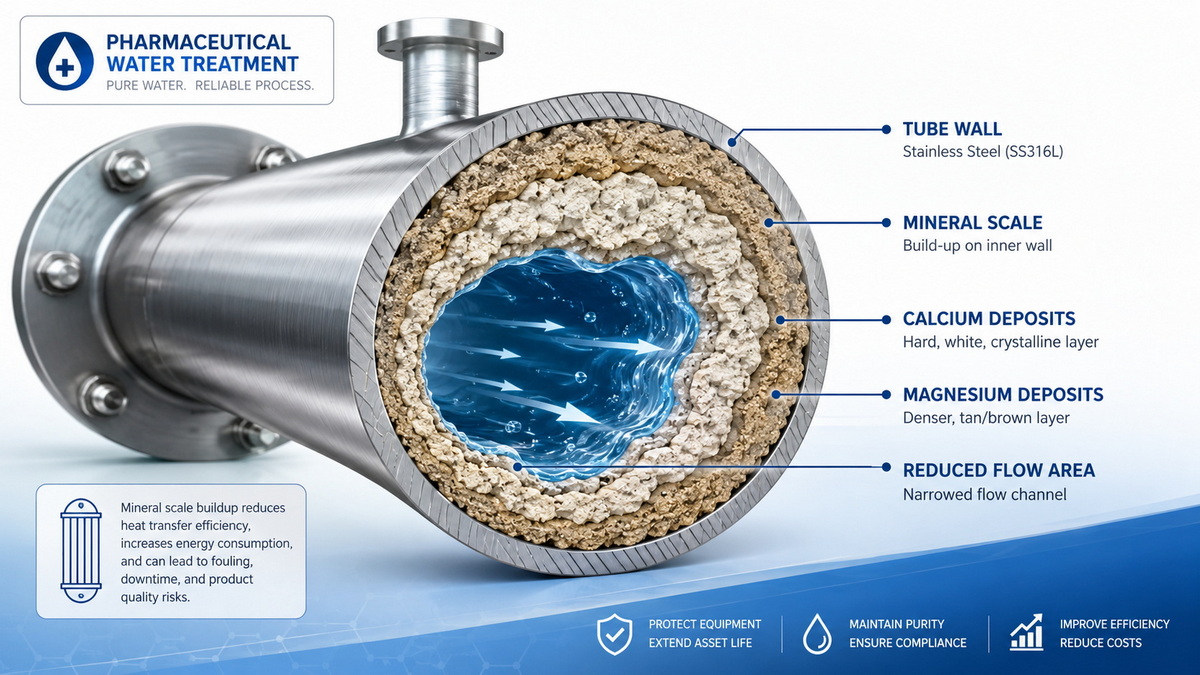
High-hardness feedwater contains elevated levels of calcium and magnesium salts. These minerals are the main cause of scale formation inside heaters, evaporators, heat exchangers, and distribution lines. Once scale begins to form, heat transfer drops, energy use rises, and cleaning frequency increases.
In pharmaceutical environments, this matters even more because unstable water quality can affect cleaning validation, process consistency, and equipment uptime. A distillation system must therefore do more than produce clean water. It must also remain stable under difficult raw-water conditions.
Single-stage distillation uses one evaporation and condensation step to separate purified water from contaminants. The process is simpler, with fewer components, shorter start-up time, and typically lower initial investment.
In practice, single-stage systems can work well when feedwater quality is already reasonably controlled. They are often favored in smaller facilities, pilot plants, or applications where water demand is modest and incoming water treatment is strong.
- Simpler design and operation.
- Lower capital cost.
- Easier maintenance and operator training.
- Smaller equipment footprint.
- Higher risk of scaling.
- Less tolerant of fluctuating feedwater quality.
- More frequent cleaning requirements.
- Greater sensitivity to pre-treatment performance.
Multi-stage distillation passes water through several evaporation stages. Each stage reuses thermal energy more efficiently, which can improve performance and reduce operating waste. More importantly for hard water environments, the staged design provides better process control and more robust separation behavior.
For pharmaceutical plants dealing with challenging feedwater, multi-stage systems are often preferred because they offer better resilience. They are especially valuable where production must run continuously and downtime is expensive.
- Better resistance to scaling stress.
- Improved thermal efficiency.
- More stable output in demanding conditions.
- Better fit for larger-capacity pharmaceutical plants.
- Higher initial investment.
- More complex design and control logic.
- Larger engineering and validation effort.
- More sophisticated maintenance planning.
The table below shows the most important differences for high-hardness feedwater environments.
| Factor | Single-Stage Distillation | Multi-Stage Distillation |
|---|---|---|
| Feedwater hardness tolerance | Lower | Higher |
| Scale resistance | Moderate to low | Better |
| Energy efficiency | Lower | Higher |
| Capital cost | Lower | Higher |
| Maintenance burden | Simpler but more frequent cleaning | More complex but often more stable |
| Suitability for continuous pharma production | Limited in harsh conditions | Strong |
| Best fit | Small systems, controlled water quality | Large plants, difficult raw water, high uptime needs |
For high-hardness feedwater environments, multi-stage distillation generally performs better over the full life cycle. The main reason is not just water quality. It is operational resilience.
A system that handles hard water well will reduce scaling events, preserve thermal performance, and protect production continuity. In many pharmaceutical facilities, that stability is worth more than a lower purchase price.
Single-stage distillation may still be acceptable if upstream softening, filtration, and chemical control are excellent. But if raw water hardness is consistently high, the hidden costs of cleaning, downtime, and efficiency loss can quickly outweigh the savings from simpler equipment.
Pretreatment often decides whether a distillation system succeeds or struggles. For hard water applications, a robust pretreatment train may include:
1. Softening to reduce calcium and magnesium.
2. Filtration to remove suspended solids.
3. Activated carbon where chlorine or organics must be controlled.
4. Reverse osmosis or other desalting steps to reduce overall load.
5. Conductivity and hardness monitoring for tighter process control.
In many pharma projects, pretreatment is not optional. It is the first layer of protection for both single-stage and multi-stage systems.
Across pharmaceutical utilities, the industry trend is toward systems that can sustain stable output under variable raw-water conditions while minimizing manual intervention. Modular skid design, automated monitoring, hygienic construction, and data-driven maintenance are now common expectations in modern facilities.
That trend favors multi-stage distillation in difficult water environments because it aligns better with reliability-focused plant design. It also supports broader facility planning, especially when distilled water is part of an integrated utility network serving cleaning, formulation, and sterilization operations.
Choose single-stage distillation when:
- Water demand is limited.
- Feedwater hardness is already well controlled.
- Capital budget is tight.
- The facility can tolerate more frequent maintenance.
Choose multi-stage distillation when:
- Feedwater hardness is consistently high.
- Water demand is medium to large.
- Production downtime is costly.
- Long-term operating efficiency matters more than the initial price.
From a plant design perspective, the best water system is not the one with the most complex structure. It is the one that matches the real operating conditions of the facility.
For a pharmaceutical manufacturer, this means evaluating:
- Raw water quality.
- Daily water demand.
- Required purity level.
- Utility redundancy needs.
- Cleaning and maintenance resources.
- Expansion plans for future production lines.
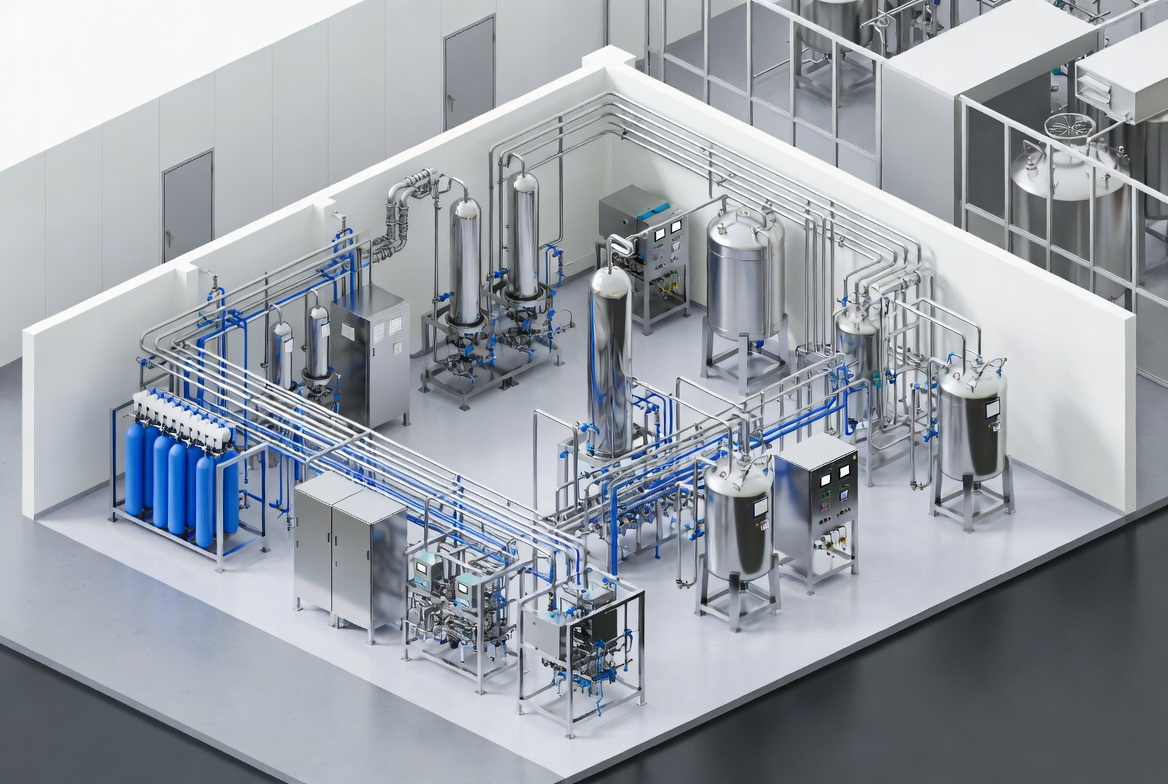
In projects involving purified water preparation systems, sterile process utilities, and pharmaceutical formulation lines, water architecture should be designed as part of the whole factory plan, not as an isolated purchase.
| Application context | Better option | Reason |
|---|---|---|
| Small production site with controlled inlet water | Single-stage | Lower cost and simpler operation |
| Large GMP plant with unstable hard water | Multi-stage | Better resilience and efficiency |
| Plant with high uptime requirements | Multi-stage | Reduced interruption risk |
| Budget-limited pilot facility | Single-stage | Easier to deploy |
| Facility planning for future expansion | Multi-stage | Better scalability |
Many buyers focus only on equipment price. That is often the wrong starting point.
Common mistakes include:
- Ignoring actual feedwater hardness data.
- Underestimating scaling risk.
- Choosing a system without considering future output growth.
- Failing to integrate pretreatment into the design.
- Overlooking cleaning access and maintenance workflow.
A better approach is to evaluate total lifecycle performance, not only initial procurement cost.
For high-hardness feedwater environments, multi-stage distillation is usually the stronger choice because it offers better operational stability, better scale resistance, and better long-term performance. Single-stage distillation can still work in controlled conditions, but it is generally more suitable for smaller or less demanding applications.
For pharmaceutical manufacturers, the right decision should be based on raw-water analysis, production scale, maintenance capacity, and the full lifecycle cost of ownership. When the goal is reliable water supply for demanding production lines, the best system is the one that protects both water quality and plant continuity.
Single-stage distillation uses one evaporation-condensation step, while multi-stage distillation uses several stages to improve efficiency and stability.
High hardness causes mineral scale, which reduces heat transfer efficiency, increases maintenance, and can shorten equipment life.
Yes, but mainly for smaller facilities or sites with well-controlled feedwater. It is less suitable for harsh water conditions.
It is more resilient in difficult feedwater conditions and usually performs better in large, continuous pharmaceutical operations.
Pretreatment is critical. Softening, filtration, and desalting can greatly reduce scaling risk and improve overall system stability.
1. [Centec GmbH — PW generator product page]
2. [Syntegon — Pure media and formulation systems]
3. [Syntegon — Drug product formulation systems]
4. [Molewater — Purified water system (PW)]
5. [Nanjing Tianshui Machinery — Pharmaceutical pure water equipment]


