In biologic drug manufacturing, every milliliter matters. When products are high-value, fragile, and often produced in limited batches, filling accuracy is not just a technical metric—it directly affects yield, compliance, patient safety, and profit margin. That is why many manufacturers compare mass flow meters and vacuum filling when designing or upgrading a sterile filling line. [syntegon.com]
For pharmaceutical plants handling expensive biologics, the real question is not only "which system is accurate?" but "which system is most reliable under GMP conditions, compatible with process design, and scalable for future production?" This article compares both methods from engineering, operational, and business perspectives, with a focus on how to achieve ±0.5% accuracy in modern biologic filling applications. [winatechgroup]
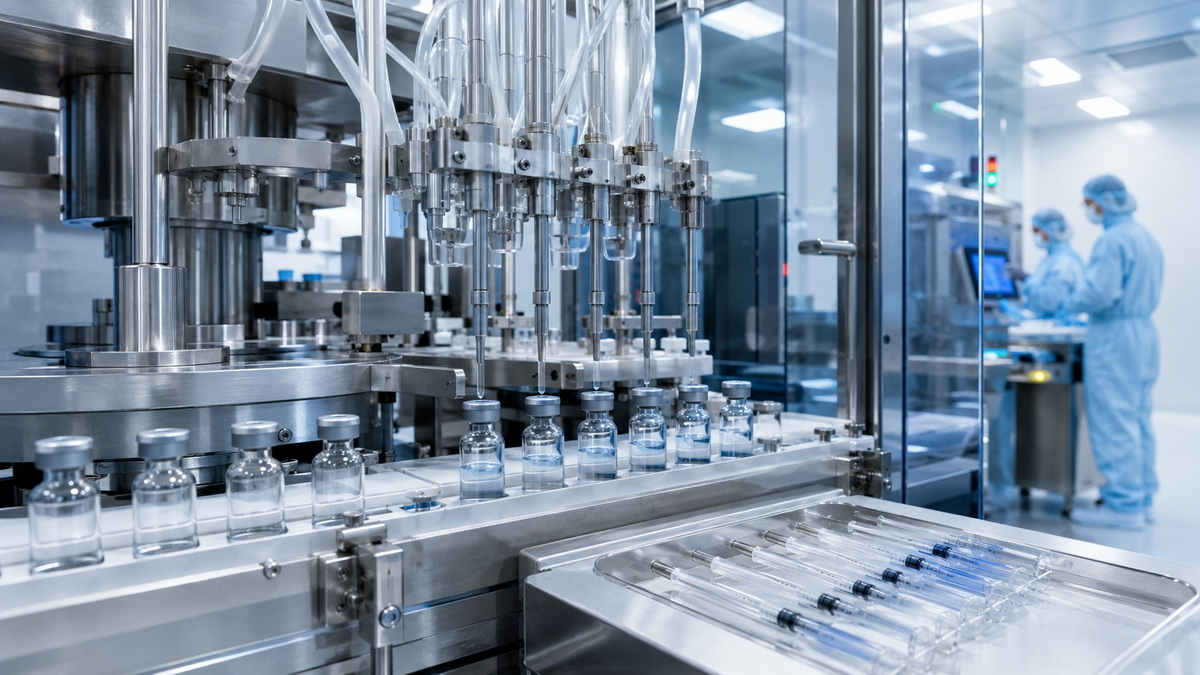
Why Accuracy Matters in Biologic Drug Filling
Biologic drugs are costly to develop and produce. They are also sensitive to contamination, shear, temperature fluctuation, and fill-volume variation. Even a small overfill can translate into significant product loss across thousands of vials or syringes.
For manufacturers, fill accuracy affects:
- Cost of goods sold, because overfill increases waste.
- Regulatory confidence, because consistent fill volume supports batch reproducibility.
- Therapeutic consistency, because underfill may affect dose delivery.
- Production efficiency, because unstable filling leads to rejects and rework.
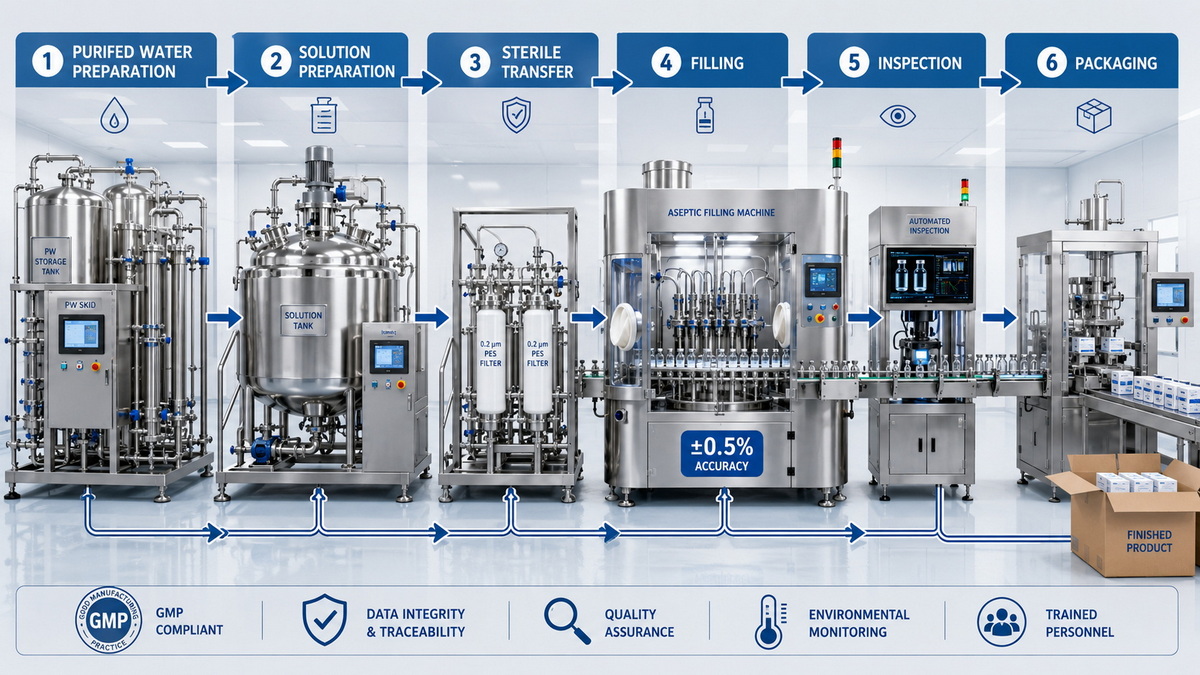
In practice, the filling system must work as part of a broader pharmaceutical production chain that may include purified water systems, sterile preparation tanks, CIP/SIP capability, and cleanroom-controlled layout planning. [syntegon.com]
What Is Mass Flow Meter Filling?
Mass flow meter filling measures the actual mass of liquid passing through the system. In pharmaceutical applications, this is typically done using advanced flow measurement technology integrated into the filling line control system.
How it works
The system monitors liquid flow in real time and stops the fill once the target mass or volume-equivalent threshold is reached. Because measurement is based on mass rather than only time or pressure, it can improve consistency when liquid properties change slightly.
Main strengths
- High filling precision.
- Better control for viscosity variations.
- Strong suitability for automated, data-driven production.
- Easier integration with digital monitoring and batch records.
Main limitations
- Higher capital cost.
- Requires careful calibration and maintenance.
- Performance depends on product behavior, temperature, and line design.
For expensive biologic drugs, mass flow meters are often preferred when manufacturers want strong process control and traceability. [syntegon.com]
What Is Vacuum Filling?
Vacuum filling uses pressure differential to draw liquid into containers. The system creates a vacuum environment that helps pull product into the vessel until a predetermined level or condition is reached.
How it works
Instead of measuring mass directly, the filling action relies on vacuum force and container behavior to deliver product into the final package. It is commonly used in specific liquid packaging applications where speed and simplicity matter.
Main strengths
- Simple operating principle.
- Can be effective in certain low-viscosity applications.
- Often easier to understand and maintain.
- May offer good throughput in some line configurations.
Main limitations
- Less precise for highly valuable product.
- Can be affected by foam, bubbles, container differences, and liquid behavior.
- May be less ideal for modern sterile biologic filling where tighter control is required.
For biologics, vacuum filling can be useful in some workflows, but it often faces more challenges when the target is sub-percent accuracy and minimal product loss.
Mass Flow Meters vs Vacuum Filling
The table below provides a practical comparison for pharmaceutical decision-makers.
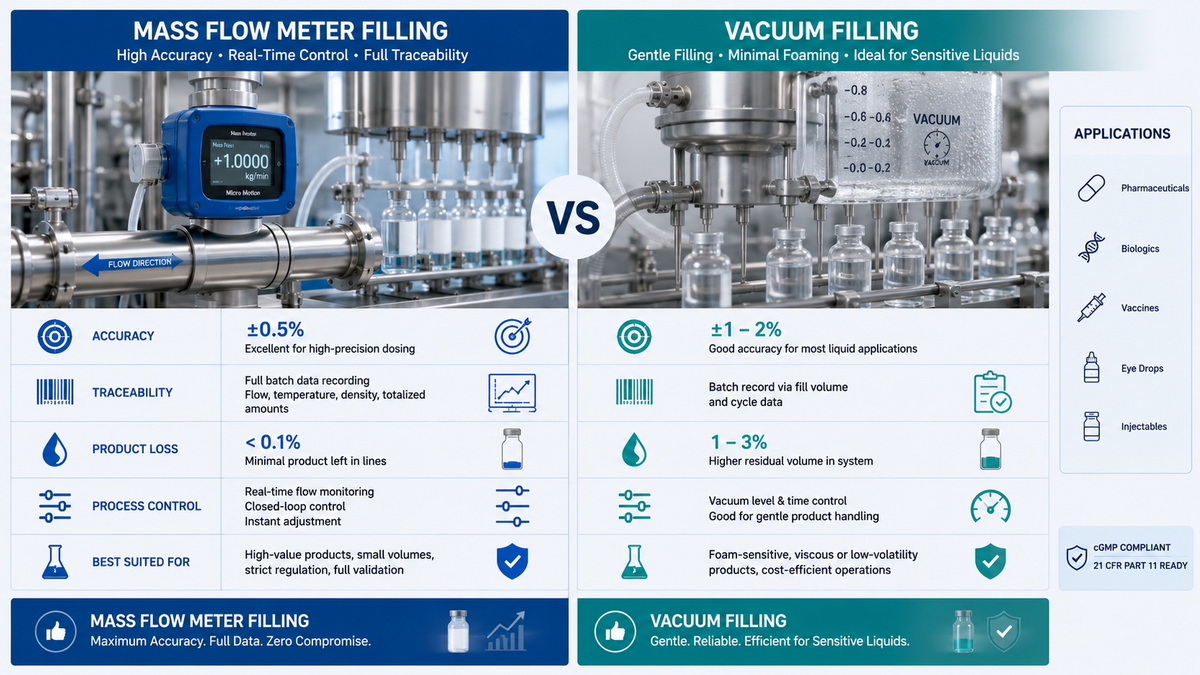
| Factor | Mass Flow Meters | Vacuum Filling |
| Accuracy | Strong potential for ±0.5% or better with proper calibration | Usually less precise for high-value biologics |
| Product loss | Lower overfill risk | Higher risk of overfill or variability |
| Product sensitivity | Better for controlled filling | Can be influenced by foam, bubbles, and flow changes |
| GMP traceability | Strong data capture and control | More limited in measurement depth |
| Equipment complexity | Higher | Lower |
| Maintenance | Requires calibration and validation | Usually simpler mechanically |
| Best use case | Expensive biologics, sterile injectables, high-value products | Lower-complexity liquid packaging or specific legacy lines |
In short, mass flow meters are usually the stronger choice when accuracy, traceability, and regulatory control are priorities. Vacuum filling may still have a place, but it is generally less competitive for premium biologic products.
How to Achieve ±0.5% Accuracy
Reaching ±0.5% accuracy is not only about choosing the right filling technology. It depends on the full system design.
1. Stabilize the product supply
Use a well-designed preparation and transfer system that maintains consistent pressure, temperature, and mixing. For biologics, product variability must be minimized before the liquid reaches the filling head. [winatechgroup]
2. Control the environment
Cleanroom conditions, temperature stability, and vibration control all influence fill performance. A poorly planned plant layout can create unnecessary process instability.
3. Calibrate regularly
Even the best measurement system will drift over time. Routine calibration and qualification are necessary to maintain performance.
4. Reduce air and foam
Air bubbles can distort fill readings and damage accuracy. Degassing and proper line design help prevent this.
5. Validate the entire line
The filling machine alone cannot guarantee accuracy. The tanks, piping, sensors, software, and container handling system must all perform consistently together.
6. Build for GMP compliance
Validation documentation, electronic records, alarm management, and traceability should be considered from the beginning, not added later.
Expert View: Where Mass Flow Meters Win
From a process-engineering perspective, mass flow meters are especially strong in situations where:
- The drug substance is expensive.
- Batch sizes are small to medium.
- Dose precision is critical.
- The company needs strong digital traceability.
- The line must support future automation upgrades.
This is why many modern sterile drug preparation and filling projects increasingly favor measurement-driven systems rather than purely mechanical or vacuum-based approaches. In high-value biologics, the cost of one inaccurate fill can exceed the cost of better equipment over time. [syntegon.com]
When Vacuum Filling Still Makes Sense
Vacuum filling is not obsolete. It can still be practical when:
- The product is less expensive.
- The container and liquid behavior are highly predictable.
- Throughput matters more than ultra-tight dosing control.
- The plant already operates a mature vacuum-based setup.
In other words, vacuum filling is often a fit-for-purpose option, not the best option for every biologic application.
A Better Plant-Level Perspective
For companies like Ningbo Everheal Medical Equipment Co., LTD., the decision should be viewed at the system level, not only the machine level. A high-performance biologic filling line depends on upstream water preparation, sterile solution preparation, CIP/SIP capability, and smart plant layout planning.
That broader approach matters because a precise filling system cannot compensate for poor upstream fluid preparation or an inefficient factory layout. This is especially relevant for facilities producing large-volume infusions, lyophilized drugs, and anticancer preparations, where contamination control and process stability are essential. [syntegon.com]
Implementation Checklist for Manufacturers
Before selecting a filling method, ask these questions:
1. What is the target accuracy?
2. How expensive is each fill loss?
3. Is the product sensitive to foam, bubbles, or shear?
4. Do we need advanced batch traceability?
5. Will this line need scaling in the next 3–5 years?
6. How much validation support does the vendor provide?
7. Does the plant layout support clean operation and smooth material flow?
If the answer to most of these points is "yes" for precision and compliance, mass flow meters are usually the stronger strategic choice.
CTA Section
If your facility is planning a biologic filling upgrade, the best next step is to evaluate the whole process chain—not only the filling head. A well-designed solution should align accuracy, compliance, cleanroom layout, and future scalability.
Need a customized pharmaceutical line solution? Work with an engineering partner that can design purified water preparation systems, sterilization cabinets, and pharmaceutical solution preparation systems as one integrated production platform.
FAQ
1. Is mass flow meter filling always better than vacuum filling?
Not always. Mass flow meters are usually better for high-value biologics and tight accuracy goals, while vacuum filling may still work for less demanding applications.
2. Can vacuum filling achieve ±0.5% accuracy?
It may be possible in some controlled cases, but it is generally more difficult to maintain consistently for expensive biologic drugs.
3. Why do biologic drugs need such precise filling?
Because they are expensive, sensitive, and often produced in small batches, so even small overfill losses can significantly affect profitability.
4. What affects filling accuracy the most?
Product viscosity, air bubbles, temperature stability, calibration quality, container consistency, and line design all play major roles.
5. Should the filling system be chosen alone or with the whole plant design?
With the whole plant design. The best results come from integrating water preparation, solution preparation, sterilization, cleanroom layout, and filling technology.
References
1. Winatech Group, "生物制药配液系统" — discusses formulation systems, CIP/SIP, heating/cooling, and mixing in biologic and pharmaceutical production: [http://www.winatechgroup.com/product/showproduct.php?id=17] [winatechgroup]
2. Syntegon China, "制药- 解决方案- 高纯化介质系统" — overview of pharmaceutical process and formulation solutions: [https://www.syntegon.com.cn/solution-finder/pharma/pure-media-and-formulation-systems/] [syntegon.com]
3. Syntegon China, "制药- 液体制剂- 工艺和生物工艺- 配液" — pharmaceutical liquid formulation and process solutions: [https://www.syntegon.com.cn/solutions/pharma/drug-product-formulation-systems/] [syntegon.com]


