


Views: 222 Author: Everheal Medical Equipment Publish Time: 2026-06-13 Origin: Everheal


In sterile pharmaceutical manufacturing, lubricant leakage is not a minor maintenance issue. It is a contamination risk, a compliance risk, and a batch-loss risk. For sterile mixing tanks used in compounding, large-volume preparation, and aseptic processing, the choice between double-mechanical seals and magnetic drives directly affects product integrity, downtime, and total cost of ownership. [fluiten]
Sterile mixing tanks are used in environments where even a small leak can compromise the entire contamination control strategy. In aseptic processing, regulators expect facilities to identify and control risks from equipment, personnel, materials, and utilities through a documented contamination control strategy. That means seal selection is not just a mechanical decision; it is a quality-system decision. [ecolab]
From a plant-design perspective, the seal must support cleanability, sterilizability, and reliable containment. In practice, this means the equipment should be compatible with CIP/SIP, minimize crevices, and avoid introducing foreign material into the product zone. For companies building purified water systems, sterilization cabinets, and pharmaceutical solution preparation systems, this is especially important because the mixing tank often sits at the center of the sterile process line. [ivi]
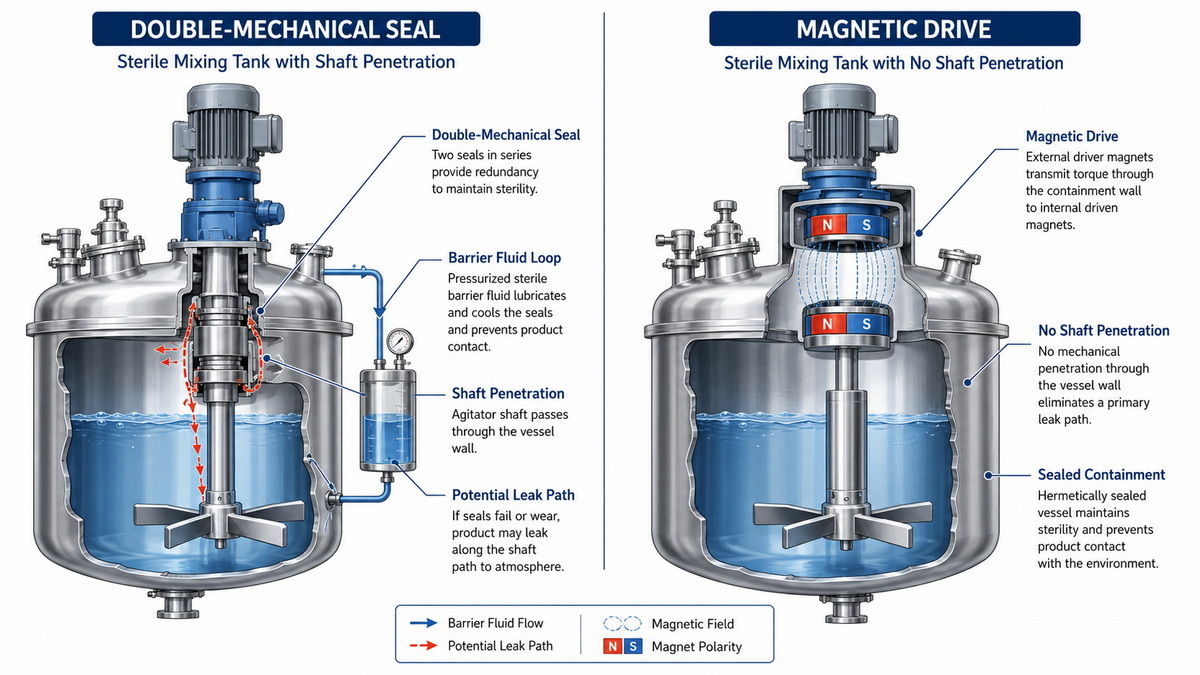
Double-mechanical seals use two sealing faces with a barrier fluid between them. The barrier fluid helps cool the seal faces, lubricate the surfaces, and provide an extra containment layer if one seal face begins to wear. In sterile service, this design is often chosen when the process requires a robust rotating shaft and the tank must operate under demanding conditions. [flexachem]
The main advantage is familiarity. Many plants already know how to install, inspect, and maintain them. They can also be engineered for a wide range of viscosities, temperatures, and pressures, which makes them useful in large-volume preparation and some anticancer drug formulations where process conditions can be harsh. However, they still depend on a physical shaft penetration through the tank wall, which means there is always some residual leak risk if the seal fails or the barrier system is compromised. [ekato]
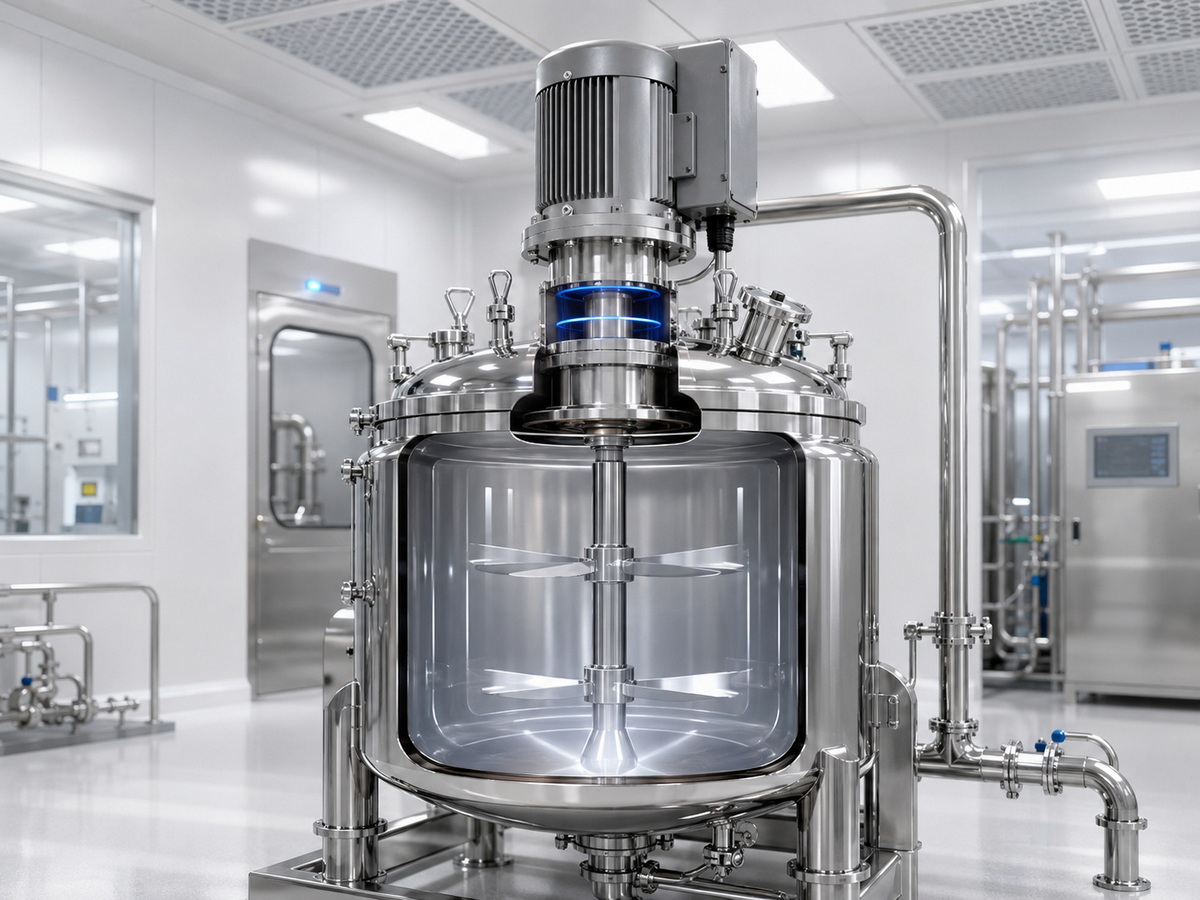
Magnetic drive mixers transmit torque through magnetic coupling rather than through a penetrating shaft, so they eliminate the mechanical seal entirely. That is the key reason they are attractive in aseptic and sterile applications: no shaft penetration means no traditional seal leak path. For process owners focused on zero-leak containment, this is a powerful design advantage. [promixusa]
Magnetic drive systems are especially appealing in sterile mixing tanks where contamination prevention is paramount. They reduce one of the most failure-prone components in rotating equipment and can simplify the contamination control strategy by removing seal-face wear, barrier fluid management, and related maintenance tasks. The tradeoff is that magnetic designs may have different torque limits, heat characteristics, and upfront cost profiles, so they must be matched carefully to the application. [alfalaval]
The right choice depends on process risk, operating conditions, and maintenance strategy. The table below shows the practical differences most pharma engineers care about.
| Criteria | Double-Mechanical Seals | Magnetic Drives |
|---|---|---|
| Leak path | Uses a shaft penetration, so leak risk exists if seal or barrier system degrades (fluiten) | No mechanical shaft penetration, so no traditional seal leak path (promixusa) |
| Contamination risk | Lower than single seals, but still dependent on seal health and barrier fluid control (fluiten) | Very low seal-related contamination risk because the seal is eliminated (promixusa) |
| Maintenance | Requires inspection, barrier fluid management, and periodic seal replacement (fluiten) | Typically simpler sealing-related maintenance, though coupling and alignment still matter (promixusa) |
| Sterile-process fit | Strong fit when engineered correctly and validated for CIP/SIP (fluiten) | Excellent fit for aseptic and high-containment applications (promixusa) |
| Upfront cost | Often lower than magnetic systems | Often higher initially, but may reduce lifecycle contamination costs |
| Best use case | High-duty mixing where mechanical familiarity and torque demands matter | Highest-containment sterile tanks where leak elimination is critical |
Current sterile-manufacturing guidance emphasizes that sterility assurance must be built into the process, not tested into the finished product. EU GMP Annex 1 and FDA sterile drug guidance both stress contamination control, process validation, cleaning and disinfection, and robust risk management. In that context, a leaking seal is not simply a maintenance defect; it is evidence that the control strategy may be inadequate. [golighthouse]
For sterile mixing tanks, the expectation is that equipment design should support prevention, detection, and mitigation. That includes validating cleaning and sterilization, documenting maintenance procedures, and ensuring all critical surfaces remain controllable under normal and worst-case operating conditions. In other words, the best sealing system is the one that fits your actual contamination risk profile, not the one with the most marketing claims. [fluiten]
Across sterile manufacturing, contamination events are increasingly expensive because they can trigger batch rejection, investigation, downtime, and remediation. That is one reason seal-free designs are gaining interest in biotech and pharma mixing systems. In facilities running high-value products such as lyophilized drugs or oncology solutions, the cost of one leak can outweigh years of incremental equipment savings. [jstopmixer]
For manufacturers planning new lines, this changes the decision logic. The real comparison is not only purchase price versus purchase price. It is purchase price versus total contamination risk cost, including labor, maintenance, downtime, and batch loss.
A practical selection process can be built around four questions:
1. How sensitive is the product to contamination?
2. What are the mixing torque and speed requirements?
3. How much maintenance disruption can the plant tolerate?
4. Does the line need maximum containment or maximum mechanical flexibility?
If the tank serves a critical sterile formulation area, magnetic drive systems usually deserve serious consideration. If the process demands very high torque, heavy-duty agitation, or a plant already standardized on seal maintenance programs, double-mechanical seals may still be the better engineering choice. The most effective solution is often the one aligned with facility layout, utilities, and validated cleaning strategy. [pda]
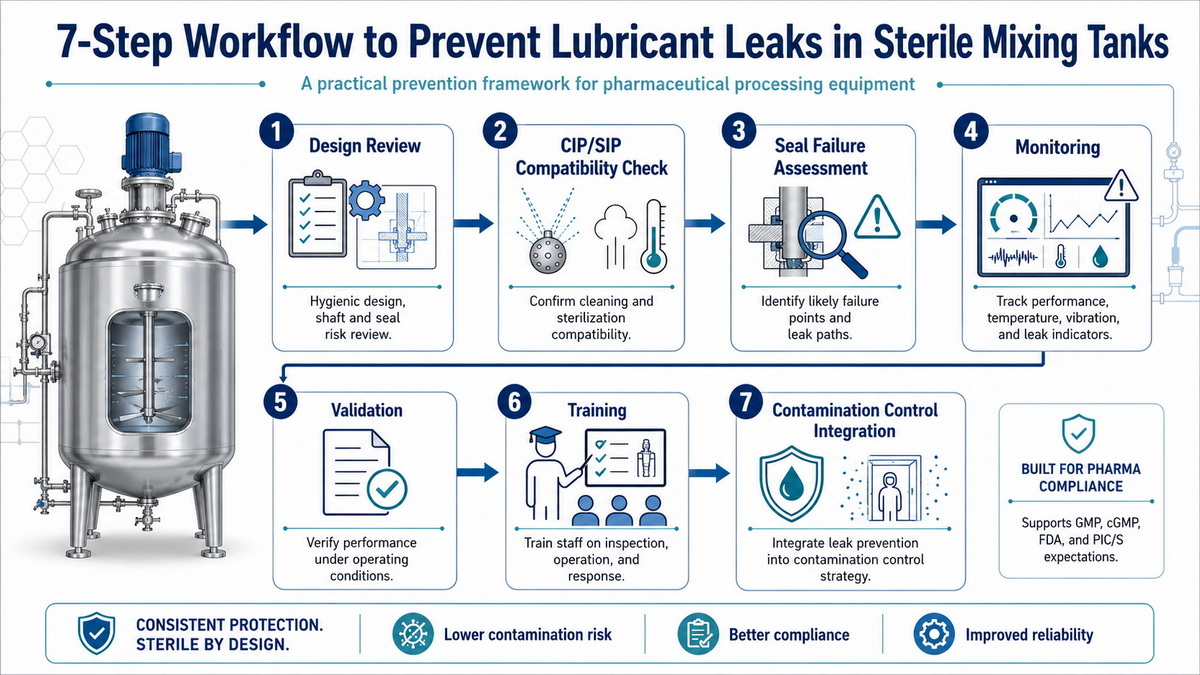
For engineering teams, the leak-prevention strategy should start before procurement. A cleanroom-ready mixer installation should include the following steps:
1. Define product risk and contamination criticality.
2. Confirm CIP/SIP compatibility for every wetted component.
3. Review seal or coupling failure modes.
4. Specify maintenance intervals and monitoring points.
5. Validate the design under actual operating conditions.
6. Train operators and maintenance staff on early leak detection.
7. Integrate the mixer into the site contamination control strategy. [fda]
This is where a turnkey equipment partner adds real value. For a manufacturer like Ningbo Everheal Medical Equipment Co., LTD., the best projects are not only equipment deliveries. They are complete plant-layout and process-integration solutions that reduce risk from the first design drawing onward.
From an equipment-selection perspective, the biggest mistake is treating the mixer as a standalone machine. In sterile drug production, the mixer is part of a larger ecosystem that includes purified water, sterilization equipment, utility systems, and layout discipline. If the surrounding line is weak, even a premium seal or magnetic drive will not fully protect the process.
My recommendation is simple: use magnetic drives when sterility assurance and leak elimination are the dominant priorities, and use double-mechanical seals when the application needs mechanical robustness and the site has strong maintenance discipline. In both cases, the final decision should be validated against process risk, not habit.
If your facility is planning a new sterile mixing line, the best next step is to align equipment selection, layout planning, and contamination control strategy before procurement begins. A properly designed system can reduce leak risk, simplify validation, and protect every batch.
Magnetic drives are generally safer from a leak-containment perspective because they eliminate the shaft penetration and the mechanical seal. [aseptconn]
Yes, they can be acceptable if they are properly designed, maintained, and validated for CIP/SIP and contamination control. [ivi]
No. They are best for applications where seal elimination is important, but not every process needs them. [wmprocess]
Common causes include seal wear, barrier fluid issues, poor alignment, thermal stress, and maintenance lapses. [flexaseal]
Choose based on product sensitivity, torque needs, maintenance capability, and the facility's contamination control strategy. [ecolab]
1. FDA, Sterile Drug Products Produced by Aseptic Processing — Current Good Manufacturing Practice: [https://www.fda.gov/regulatory-information/search-fda-guidance-documents/sterile-drug-products-produced-aseptic-processing-curre] [fda]
2. FDA guidance excerpt on sterility assurance and validation: [https://www.fda.gov/media/71026/download] [fda]
3. Ecolab, EU ANNEX-1 and the Impact of Contamination Control Strategy: [https://www.ecolab.com/articles/2023/01/eu-annex-1-regulations-and-control-contamination-strategy] [ecolab]
4. PDA, EU GMP Annex 1. Implementation of Contamination Control Strategy: [https://www.pda.org/pda-letter-portal/home/full-article/eu-gmp-annex-1.-implementation-of-contamination-control-strategy] [pda]
5. Fluiten, Mechanical seals for the pharmaceutical industry: [https://fluiten.com/tenute-meccaniche-per-industrie-farmaceutiche/] [fluiten]
6. Ekato, Double-Acting Mechanical Seals: [https://www.ekato.com/products/mechanical-seals-supply-systems/double-acting-mechanical-seals/] [ekato]
7. Promix, Magnetic Drive Mixers: [https://promixusa.com/product/magnetic-drive-mixers/] [promixusa]
8. Millipore/Aseptconn, Magnetic mixers in aseptic processes: [https://www.aseptconn.ch/en/millipore-novaseptic-magnetic-mixers] [aseptconn]


