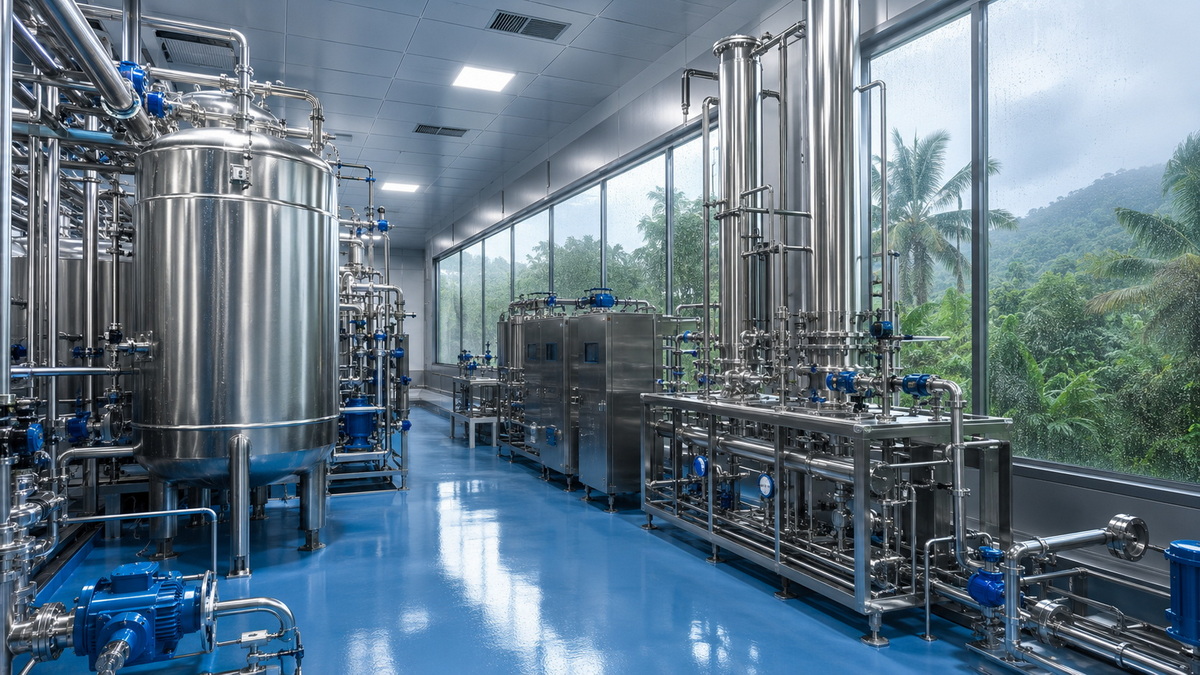
In tropical climates, feedwater quality rarely stays stable. Seasonal rain, flooding, higher microbial pressure, and fluctuating conductivity can change the risk profile of a pharmaceutical water system fast, which makes the choice between a Multi-Effect Distiller (MED) and a Vapor Compression (VC) system especially important. WHO guidance emphasizes considering seasonal feed-water variation, while pharmaceutical WFI systems must also control temperature and microbial growth risk. [who]
Why Tropical Climates Change the Decision
Tropical plants often face two problems at the same time: variable source water and a warmer operating environment. That combination can increase scaling, biofilm risk, pretreatment load, and maintenance pressure, especially when the feedwater chemistry shifts across wet and dry seasons. For pharmaceutical manufacturers, the real question is not simply "Which system is better?" but "Which system stays more stable when feedwater conditions move outside the ideal range?". [who]
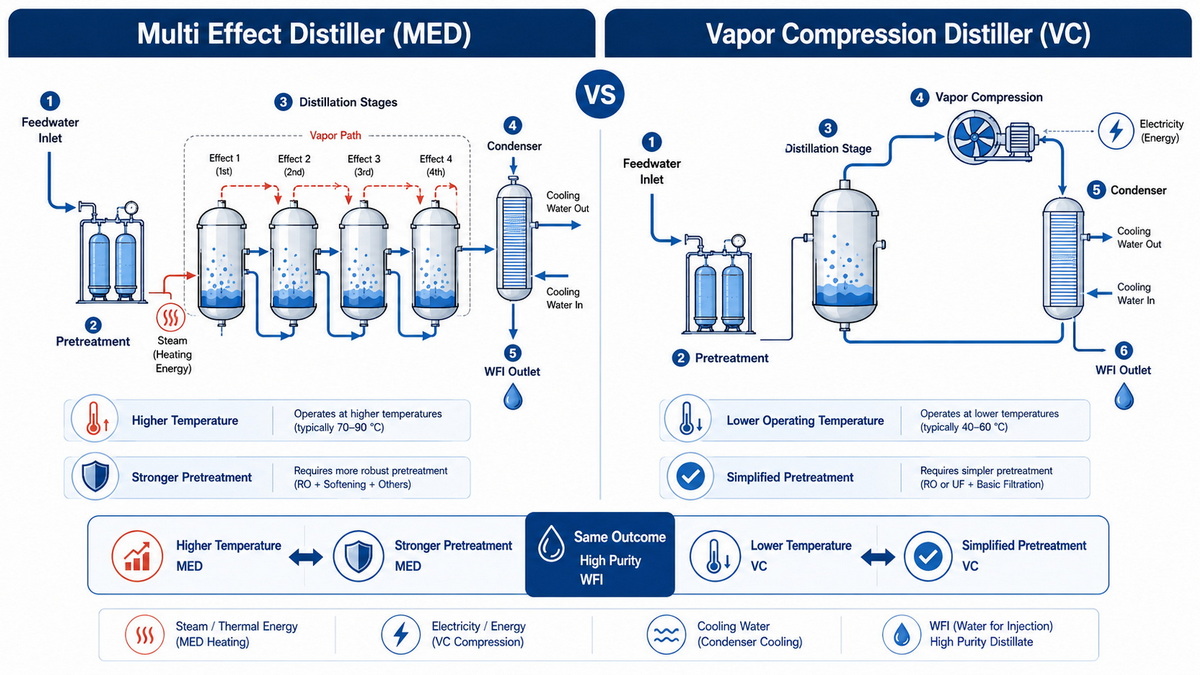
From an engineering standpoint, that is where the MED vs VC comparison becomes practical. MED usually depends more heavily on strong pretreatment, while VC is often more forgiving because it operates at lower temperatures and can tolerate simplified pretreatment in many installations. [aqua-chem]
What Each Technology Does
Multi-Effect Distiller
A Multi-Effect Distiller uses a series of effects, where steam from one stage drives the next stage, improving thermal efficiency. This design is proven, widely used in pharmaceutical WFI production, and often favored in facilities that already have reliable clean steam or robust thermal infrastructure. MED is attractive when a plant wants stable, high-volume output and has the upstream water treatment capacity to support it. [aqua-chem]
Vapor Compression
Vapor Compression distillation compresses vapor so it can be reused as the heat source, reducing the need for external steam and often lowering energy demand. VC systems are typically described as operating at lower temperatures than MED, which can reduce scaling and corrosion stress. In practical terms, that lower thermal stress can be a meaningful advantage when raw water quality changes from season to season. [aqua-chem]
Side-by-Side Comparison
| Factor | Multi-Effect Distiller | Vapor Compression |
| Thermal profile | Higher temperatures in the first effect, then cascading reuse of heat (aqua-chem) | Lower operating temperatures than MED (aqua-chem) |
| Pretreatment demand | Usually stronger pretreatment needed, often RO or two-pass RO for harsher feedwater (aqua-chem) | Can often work with simplified pretreatment such as softened and dechlorinated feedwater (meco) |
| Scaling sensitivity | More exposed to precipitation when feedwater constituents reach saturation at higher temperatures (aqua-chem) | Generally less susceptible to scaling and corrosion due to lower temperatures (meco) |
| Cooling requirement | May need supplemental cooling, especially for ambient product water (aqua-chem) | Often needs no cooling water to condense pure steam (youtube) |
| Energy profile | Efficient in thermal plants with available steam, but still tied to steam generation economics (aqua-chem) | Often more energy efficient and can produce hot or ambient WFI flexibly (aqua-chem) |
| Tropical suitability | Works well only when pretreatment and utility control are strong | Often more resilient when raw water quality fluctuates |
In short, MED is stronger when the utility package is strong, while VC tends to be stronger when the incoming water is less predictable. [aqua-chem]
Feedwater Risk Factors That Matter Most
Three feedwater variables usually create the biggest headaches in tropical regions: hardness, silica, and chloride. Hardness increases scaling risk in both systems, while silica and chloride are especially problematic for MED because of its higher operating temperatures and pretreatment needs. WHO guidance also makes seasonal feed-water variation a specific design concern, which is highly relevant in monsoon-driven markets. [aqua-chem]
A useful plant-side checklist is this:
1. Measure feedwater all year, not only at commissioning.
2. Track wet-season vs dry-season swings.
3. Define pretreatment based on the worst expected feedwater, not the average.
4. Review sanitization and hot-hold temperature strategy for microbial control.
5. Validate the system under realistic seasonal load scenarios. [who]
Which System Handles Fluctuating Water Better
If the plant is in a tropical region with frequent raw-water variation, VC usually offers the more forgiving operating window. Lower temperature operation reduces the tendency for precipitation and makes the system less vulnerable to feedwater changes that would otherwise drive scaling or corrosion. That does not mean MED is a poor choice; it means MED is a better fit only when pretreatment, utilities, and maintenance discipline are already strong. [aqua-chem]
MED can still perform very well in large pharmaceutical operations, especially when the site has reliable RO, softening, and continuous process control. But when feedwater quality is unstable, the cost of keeping MED protected often rises faster than expected because the system itself is less forgiving of variation. [pharma-equipment-gallery]
Energy, Utilities, and Operating Cost
Energy economics matter more than many buyers expect. MED is thermally efficient in the right utility environment, but it depends on steam economics and can require more extensive cooling support. VC often has lower overall operating cost because it reuses vapor compression more directly and can avoid cooling water demand in many configurations. [aqua-chem]
For tropical plants, that utility difference can become a strategic decision. If electricity is stable and steam is expensive or difficult to manage, VC may be the better fit. If the site already has abundant clean steam and a well-controlled thermal utility network, MED can still be cost-effective. [krohne]
Design Strategy for Tropical Plants
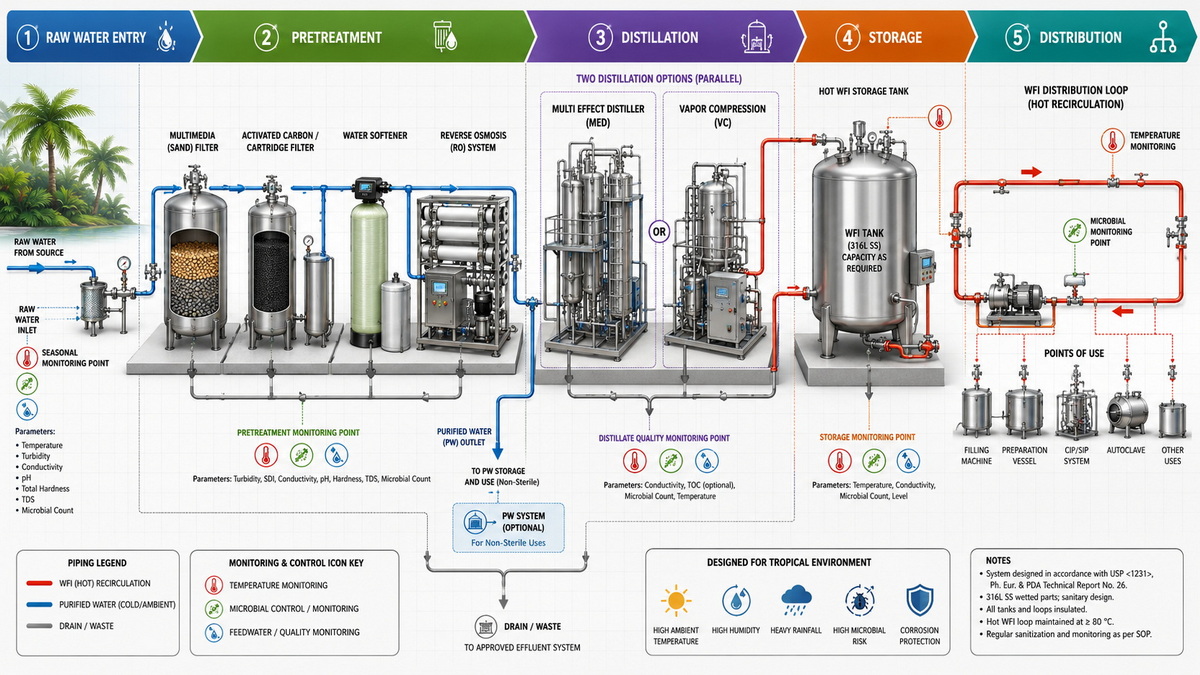
From an EPC and layout-planning perspective, the best distillation system is the one designed as part of the whole water loop, not as a standalone machine. WHO guidance specifically points to feed-water quality, seasonal variation, user demand, and purification sequence as core design inputs. That means plant layout, utility routing, drain design, room cooling, and sanitization access should all be planned together. [who]
For manufacturers like Everheal, this is where project value goes beyond equipment supply. A well-designed pharmaceutical water line should integrate pretreatment, distillation, storage, distribution, and monitoring into one coordinated system, especially in markets with hot and humid conditions. [linkedin]
Practical Selection Framework
Use this simple decision framework:
- Choose VC when feedwater quality varies widely, thermal stress must be minimized, or simplified pretreatment is valuable. [aqua-chem]
- Choose MED when the plant has strong pretreatment, stable utilities, and a clear preference for a traditional multi-stage thermal system. [pharma-equipment-gallery]
- Choose neither without first mapping seasonal feedwater behavior, capacity needs, and sanitation strategy. [who]
This is the most defensible way to speak to procurement teams, validation teams, and plant engineering teams at the same time.
Everheal Project Insight
In projects for pharmaceutical production lines, the most successful water systems are usually those designed around the site's real climate, not a generic specification sheet. In tropical regions, a water system should be treated as a dynamic utility asset, not a static machine. That is why a supplier with layout-planning capability, equipment integration experience, and water-system engineering know-how can add measurable value during concept design and factory expansion. [who]
For Chinese pharmaceutical equipment manufacturers serving global buyers, this is also a strong positioning angle. Buyers want not only compliant distillation equipment, but also a partner who can help them reduce validation risk, protect uptime, and simplify the long-term operating model. [linkedin]
Conclusion and CTA
For tropical plants with fluctuating feedwater quality, Vapor Compression is usually the more resilient choice, while Multi-Effect Distillation remains highly effective when pretreatment and utilities are tightly controlled. The best decision should be based on seasonal feedwater data, sanitation requirements, utility economics, and the plant's long-term validation strategy. [aqua-chem]
CTA: If your facility is planning a new WFI or purified water line, start with a seasonal feedwater assessment and a full utility review before selecting MED or VC. That single step can prevent costly redesigns, oversizing, and validation delays.
FAQ
1. Is VC always better than MED in tropical climates?
Not always. VC is often more tolerant of fluctuating feedwater, but MED can perform very well when pretreatment and utilities are strong. [aqua-chem]
2. Does MED always require reverse osmosis?
Not always in every case, but MED generally needs stronger pretreatment than VC, and RO or two-pass RO is commonly recommended for more demanding feedwater. [aqua-chem]
3. Why does seasonal water quality matter so much?
Because pharmaceutical water systems must be designed around real feedwater variation, not just average conditions, and WHO guidance specifically highlights seasonal effects. [who]
4. Which system is easier to operate?
VC is often easier to manage in unstable feedwater environments because it typically runs at lower temperature and can use simpler pretreatment. [aqua-chem]
5. Can either system produce WFI for injectable manufacturing?
Yes. Both technologies are used in pharmaceutical WFI generation when properly designed, qualified, and validated for compendial use. [fda]
Reference:
1. Aqua-Chem, "Vapor Compression Distillation vs Multiple Effect Distillation" — [https://aqua-chem.com/wp-content/uploads/2020/09/White-Paper-VC-vs-MED.pdf] [aqua-chem]
2. WHO GMP Water for Pharmaceutical Use guidance — [https://www.who.int/docs/default-source/medicines/norms-and-standards/guidelines/production/trs970-annex2-gmp-wate-pharmaceutica...] [who]
3. WHO update note on pharmaceutical water guideline — [https://www.gmp-compliance.org/gmp-news/who-issues-update-of-pharmaceutical-water-guideline] [gmp-compliance]
4. FDA High Purity Water System inspection guide — [https://www.fda.gov/inspections-compliance-enforcement-and-criminal-investigations/inspection-guides/high-purity-water-system-79] [fda]
5. MECO, "An End User's Guide to Water for Injection" — [https://www.meco.com/an-end-users-guide-to-water-for-injection/] [meco]
6. Everheal company profile — [https://www.linkedin.com/company/everheal-medical] [linkedin]
7. Everheal Multi Effect Distilled Water Machine Manufacturer page — [https://www.everhealgroup.com/multi-effect-distilled-water-machine-manufacturer.html] [everhealgroup]
8. Everheal Multi Function Distillation Water Machine Supplier page — [https://www.everhealgroup.com/multi-function-distillation-water-machine-supplier.html] [everhealgroup]
9. Bram-Cor / pharma equipment gallery MED system page — [https://pharma-equipment-gallery.com/water-injection-multiple-effect-distillers] [pharma-equipment-gallery]
10. Bram-Cor vapor compression distiller video transcript — [https://www.youtube.com/watch?v=82j8snkb-sc] [youtube]


