Capsule filling is one of the most important steps in pharmaceutical and nutraceutical manufacturing because it directly affects dose accuracy, product consistency, production efficiency, and patient experience. From my perspective as a manufacturing and process-planning professional, the best capsule filling solution is never just "the fastest machine"; it is the one that matches the formulation, output target, compliance needs, and factory layout. [slideshare]
For manufacturers planning a new plant or upgrading an existing line, understanding the different types of capsule filling methods is essential before selecting equipment, designing the workshop, or calculating capacity. [urbanpackline]
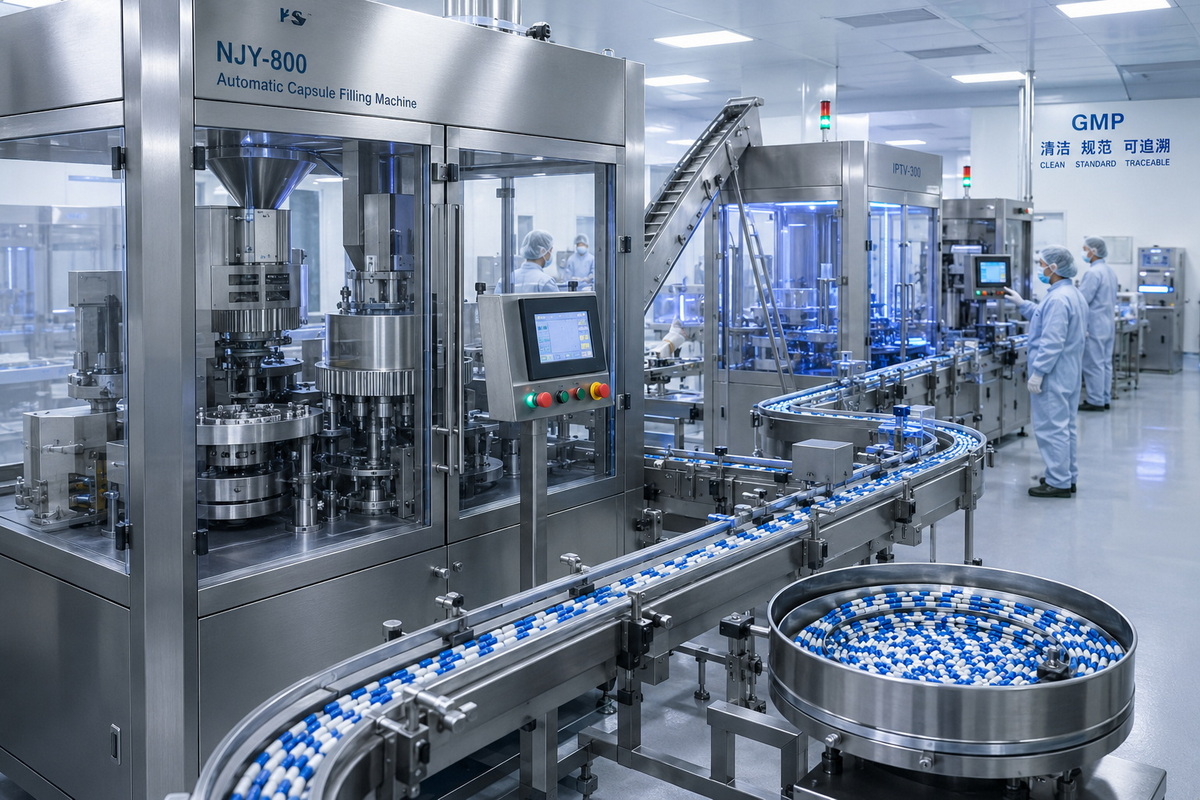
Why capsule filling method matters
Capsules remain widely used because they are easy to swallow, flexible in formulation, and suitable for powders, pellets, granules, liquids, and semi-solid fills. The filling method you choose affects not only throughput, but also fill-weight variation, dust control, operator workload, and cleaning complexity. [ijarsct.co]
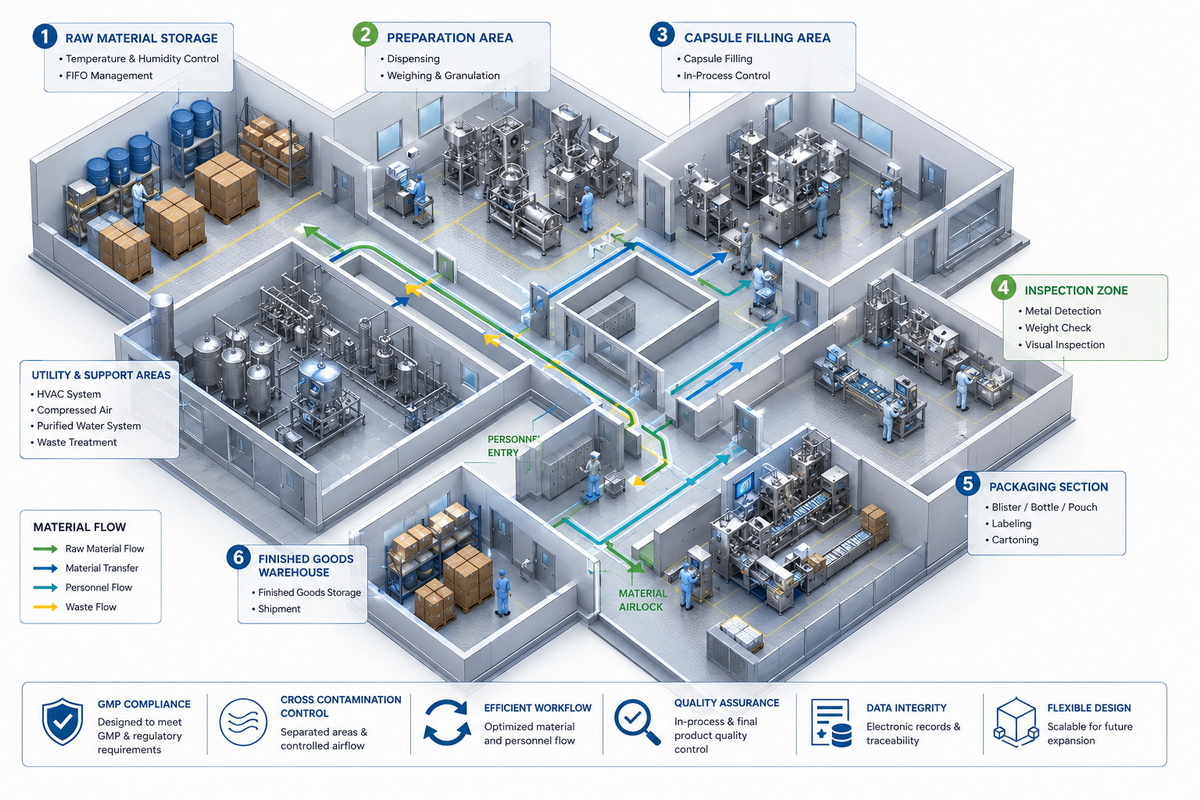
In real factory planning, the capsule filling process is also connected to upstream and downstream systems such as powder preparation, blending, transfer, inspection, polishing, and packaging. That is why a capsule line should be designed as a complete system, not as a single machine purchase. This is especially relevant for manufacturers that are building integrated pharmaceutical production lines. [everhealgroup]
Main types of capsule filling
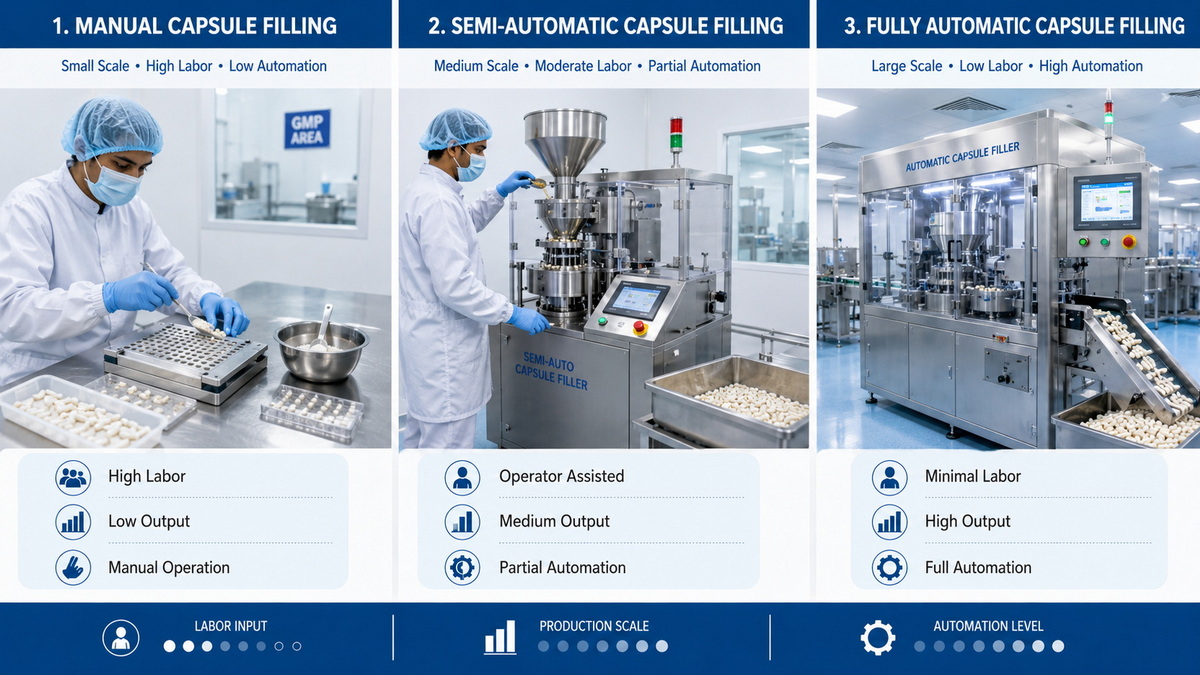
1. Manual capsule filling
Manual capsule filling is the simplest method and is usually used in pharmacies, laboratories, R&D settings, or very small-batch production. It requires the operator to separate capsule bodies and caps, fill the powder manually, and close the capsule. [urbanpackline]
Best suited for:
- Research and development.
- Small personalized batches.
- Early-stage product testing.
- Compounding pharmacies.
Advantages:
- Low initial investment.
- Simple to operate.
- Useful for formulation trials.
Limitations:
- Slow output.
- Higher risk of inconsistency.
- Greater operator dependence.
- Less suitable for GMP-scale industrial production.
In practice, manual filling is a starting point, not a long-term solution for a commercial pharmaceutical factory. [urbanpackline]
2. Semi-automatic capsule filling
Semi-automatic filling offers a balance between flexibility and productivity. Operators still play a role in loading or monitoring, but the equipment handles the key filling and locking steps with much better accuracy than manual work. [lodhapharma]
Best suited for:
- Small and medium production.
- Pilot lines.
- Multi-product workshops.
- Manufacturers with moderate output requirements.
Advantages:
- Better dose consistency than manual filling.
- Lower cost than a fully automatic line.
- Easier to implement in compact workshops.
Limitations:
- Still requires labor input.
- Lower speed than high-speed automatic systems.
- May be less efficient for large-volume products.
For many growing pharma companies, semi-automatic systems are a smart bridge between R&D and full-scale manufacturing. [scribd]
3. Fully automatic capsule filling
Fully automatic capsule filling machines are designed for industrial production where speed, precision, and repeatability matter most. They automate capsule orientation, separation, dosing, filling, locking, and discharge with minimal manual intervention. [lodhapharma]
Best suited for:
- Large-scale pharmaceutical production.
- Nutraceutical manufacturing.
- High-volume commercial products.
- Plants that need stable output and consistent quality.
Advantages:
- High output.
- Strong repeatability.
- Reduced human error.
- Better fit for GMP-oriented production management.
Limitations:
- Higher capital cost.
- More complex maintenance.
- Requires skilled operation and validation support.
This is the category where engineering design, validation planning, and factory layout become most important, because machine performance depends on the whole production environment. [linkedin]
4. Liquid and semi-solid capsule filling
Some products require liquids, suspensions, or semi-solid materials instead of powders. These formulations need specialized equipment and tighter sealing controls to reduce leakage risk and protect product stability. [lomfiller]
Best suited for:
- Oils.
- Certain vitamins and supplements.
- Specialty pharmaceutical formulations.
- Non-powder dosage forms.
Advantages:
- Expands formulation flexibility.
- Supports premium and differentiated products.
- Can improve patient acceptance in some applications.
Limitations:
- More demanding sealing requirements.
- Greater need for process control.
- Equipment selection is more specialized.
This category is increasingly relevant as manufacturers look for higher-value product formats and more differentiated oral delivery systems. [lomfiller]
Capsule filling methods at a glance
| Method | Typical scale | Common applications | Strengths | Main drawbacks |
| Manual | Very small | R&D, compounding, trial batches | Low cost, simple setup | Slow, inconsistent, labor-intensive |
| Semi-automatic | Small to medium | Pilot production, specialty batches | Better accuracy, moderate investment | Still labor-dependent |
| Fully automatic | Medium to large | Industrial pharma, nutraceuticals | High speed, consistent output | Higher CAPEX, more complex maintenance |
| Liquid / semi-solid | Specialty production | Oils, suspensions, premium formulations | Formulation flexibility | Needs specialized sealing and control |
How to choose the right capsule filling system
The right choice depends on five practical factors: target output, formulation type, available floor space, compliance requirements, and budget. A machine that looks efficient on paper can become inefficient if the workshop layout, dust control, or upstream powder handling is not designed correctly. [everhealgroup]
Use this simple selection logic:
1. Start with formulation type.
2. Define hourly and daily output targets.
3. Check whether the product is powder, pellet, liquid, or semi-solid.
4. Match the machine with your available utilities and cleanroom strategy.
5. Plan the line around future expansion, not only current demand.
For factory owners, this is where a complete plant layout plan becomes more valuable than a single equipment quote. [everhealgroup]
What makes capsule production more reliable
In a real production environment, capsule filling quality depends on more than machine speed. Powder flowability, particle size distribution, moisture behavior, and compression behavior can all influence fill uniformity. That is why upstream preparation and controlled material transfer are critical. [ijarsct.co]
A reliable line should include:
- Controlled material dispensing.
- Stable blending or premixing.
- Proper dust extraction.
- In-process weight checks.
- Capsule polishing and inspection.
- Clean and efficient downstream packing.
For manufacturers building integrated pharma facilities, these systems should be planned together to reduce cross-contamination risk and improve workflow efficiency. [everhealgroup]
Industry insight for 2026 planning
One of the biggest trends in capsule manufacturing is the move toward higher automation and tighter process control. Manufacturers are not only looking for speed; they also want better traceability, less manual handling, and a cleaner production flow. This trend is visible in the market's growing interest in complete production lines and application-specific equipment. [linkedin]
Another important shift is the rise of specialized capsule formats, including liquid-filled and high-value formulations. That means future-ready factories should leave room for flexible line design, modular expansion, and utility planning from the beginning. [lomfiller]
Practical plant-planning advice from an equipment perspective
If I were advising a pharmaceutical client, I would recommend building the capsule line around the following priorities:
- Material flow first: avoid unnecessary turns and backtracking.
- Contamination control: separate raw material, filling, and packaging zones.
- Utility readiness: plan for compressed air, HVAC, dust extraction, and power loads.
- Validation support: keep equipment documentation and qualification in mind early.
- Scalability: make sure the layout can support future capacity growth.
This approach aligns well with manufacturers like Everheal, which position themselves around complete production equipment and line design solutions for pharmaceutical and food industries. [everhealgroup]
Why this matters for pharma decision-makers
Choosing the right capsule filling technology is not just a procurement decision. It is a manufacturing strategy decision that affects cost, compliance, productivity, and product quality for years. [ijarsct.co]
For startups, the wrong choice can create unnecessary capital burden. For established manufacturers, the wrong choice can create bottlenecks, quality variation, and layout inefficiency. That is why expert planning should connect product strategy, plant design, and equipment selection from the very beginning. [linkedin]
Conclusion
Different types of capsule filling methods serve different production goals. Manual filling works for very small batches, semi-automatic systems suit growing production, fully automatic machines support industrial output, and liquid or semi-solid systems unlock specialty formulations. [lodhapharma]
For manufacturers that want to build or upgrade a capsule production line, the best results come from combining equipment selection with professional factory layout planning, utility design, and process integration. This is where a capable engineering partner can create long-term operational value. [everhealgroup]
Call to action: If your team is planning a capsule production line, request a customized layout and equipment proposal that matches your target output, formulation type, and GMP workflow. [everhealgroup]
FAQ
1. What is the most common type of capsule filling in pharma?
Fully automatic capsule filling is the most common choice for large-scale pharmaceutical production because it provides speed, consistency, and better process control. [urbanpackline]
2. Is manual capsule filling still useful?
Yes. Manual filling is still useful for R&D, compounding pharmacies, and very small batches where flexibility matters more than speed. [ijarsct.co]
3. What products can be filled into capsules?
Capsules can be filled with powders, granules, pellets, liquids, suspensions, and semi-solid materials depending on the machine and formulation. [lomfiller]
4. How do I choose between semi-automatic and automatic machines?
Choose semi-automatic systems for smaller output, lower investment, and flexible production; choose automatic systems when you need high throughput, repeatability, and industrial-scale efficiency. [lodhapharma]
5. Why is factory layout important for capsule filling?
Because capsule filling performance depends on the full production flow, including material handling, dust control, utilities, and downstream packaging. A poor layout can reduce efficiency even if the machine itself is high quality. [linkedin]
References
1. Lodha International LLP. "Types of Capsule Filling and Applications." [https://www.lodhapharma.com/different-types-of-capsule-filling-and-their-applications.php] [lodhapharma]
2. EVERHEAL official website. [https://www.everhealgroup.com] [everhealgroup]
3. Everheal LinkedIn profile. [https://www.linkedin.com/company/everheal-medical] [linkedin]
4. EVERHEAL products page. [https://www.everhealgroup.com/products.html] [everhealgroup]
5. Urban Machinery. "What are the different types of capsule filling?" [https://www.urbanpackline.com/what-are-the-different-types-of-capsule-filling.html] [urbanpackline]
6. Slideshare. "Capsule filling." [https://www.slideshare.net/slideshow/capsule-filling/198789175] [slideshare]
7. Scribd presentation on capsule filling machines. [https://www.scribd.com/presentation/917985114/Capsule-Filling-Machine-Presentation] [scribd]
8. Lomfiller. "6 Types of Capsule Filling Machines You Need to Know Today." [https://lomfiller.com/types-of-capsule-filling-machines/] [lomfiller]
9. IJARSCT paper on capsule filling machines. [https://ijarsct.co.in/Paper14218.pdf] [ijarsct.co]


