Pharmaceutical manufacturers today must produce consistently low-conductivity purified water under strict global regulations (EU GMP, USP, Chinese Pharmacopoeia, etc.). At the same time, engineering teams are under pressure to reduce energy use, footprint, and lifecycle costs while maintaining validation-ready, data-rich systems. [molewater]
As a Chinese OEM specializing in purified water preparation systems and turnkey pharma lines, Ningbo Everheal Medical Equipment Co., LTD is frequently asked whether to design Purified Water systems around double pass RO or single pass RO + EDI. Drawing on project experience and current regulatory and technology trends, this article takes a practical, engineer‑level look at both approaches for low-conductivity pharma water. [everhealgroup]
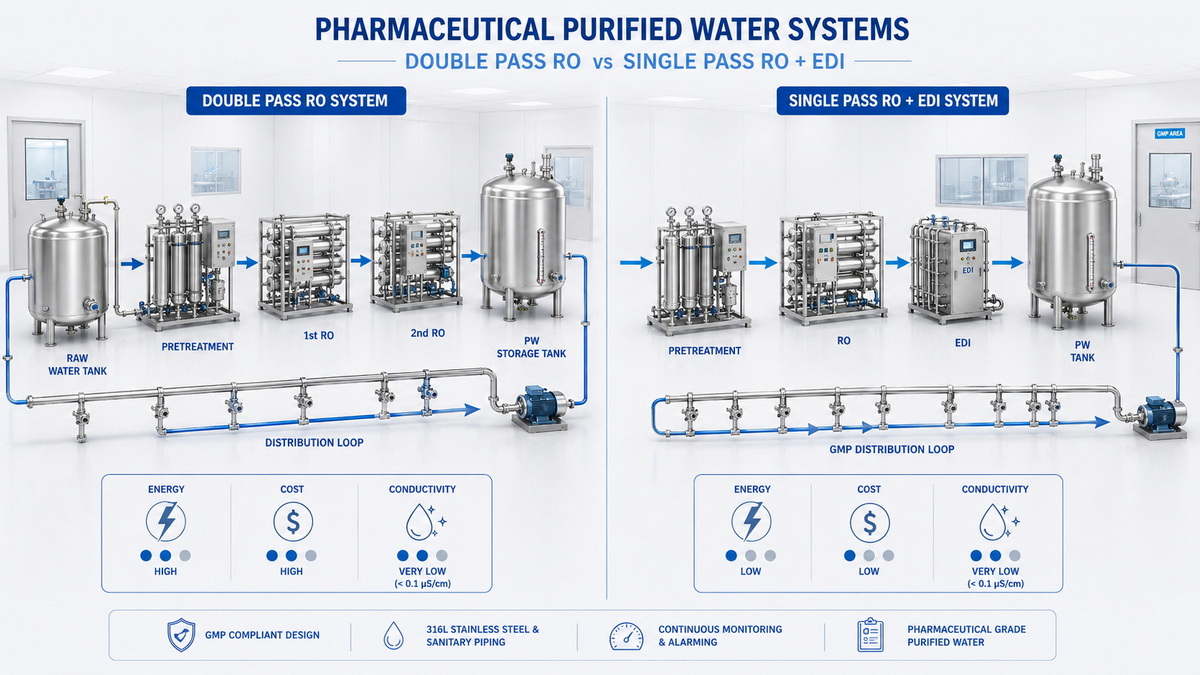
Quick Overview – How Each Technology Works
What is Double Pass RO in Pharma Water?
In a double pass RO design, feed water passes through two RO stages in series: the permeate of the first RO becomes the feed to the second. This increases overall salt, silica, and organic removal and reduces conductivity compared with single pass RO alone. [vicol.co]
Typical characteristics for pharma applications include:
- High TDS rejection: Overall TDS removal often exceeds 99%, delivering very low conductivity permeate when combined with good pretreatment. [youtube]
- Improved microbial barrier: Two membrane stages provide better physical removal of microbes and endotoxins compared with a single pass only system. [vicol.co]
- Higher complexity than single pass: More pumps, more membranes, more controls, and higher energy consumption. [youtube]
Double pass RO can be used as the final purification step for Purified Water or as pretreatment for very high-purity applications like WFI or electronics-grade water. [ema.europa]
What is Single Pass RO + EDI?
In a single pass RO + EDI configuration, the RO performs bulk desalination and microbial reduction, while the EDI module "polishes" the permeate to ultra-low conductivity levels using ion-exchange resins and an electric field. [snowpure]
Key characteristics include:
- Very low conductivity: Modern EDI modules can deliver resistivity above 15–17 MΩ·cm (ultra-pure water range) when fed with suitable RO permeate. [roagua]
- Continuous operation: Unlike traditional mixed-bed polishers, EDI regenerates continuously using electricity, avoiding chemical regeneration and downtime. [snowpure]
- Smaller footprint: For the same output quality, single pass RO + EDI usually needs fewer membrane stages than double pass designs. [vicol.co]
Regulators explicitly recognize combinations of single or double pass RO with EDI and other technologies as acceptable methods for producing pharma-grade Purified Water and even WFI under a risk-based control strategy. [ema.europa]
Regulatory and Compliance Considerations
Alignment with EMA, USP, and GMP Guidance
The EMA guideline on water for pharmaceutical use states that non-distillation methods such as single-pass or double-pass RO, coupled with EDI, ultrafiltration, or nanofiltration, are acceptable for producing high-grade water. The key is not the specific configuration but whether the overall design meets microbial, endotoxin, and conductivity limits and is fully validated. [ema.europa]
From a QA and validation standpoint:
- Both double pass RO and single pass RO + EDI can be made compliant if combined with appropriate pretreatment, sanitization, monitoring, and distribution loop design. [molewater]
- Regulators expect full IQ/OQ/PQ documentation, robust data logging (conductivity, TOC, temperature, sanitization cycles), and a risk-based justification for the chosen technology. [molewater]
For new builds, many regulators now favour multi-technology trains (RO + EDI + UF/UV) because they provide layered control and easier justification under a quality-by-design and risk‑based approach. [molewater]
Microbiological Risk and Low-Conductivity Targets
In pharma environments, a system is only as strong as its weakest microbial barrier and control loop. Pretreatment, RO, EDI, storage, and distribution all contribute. [vicol.co]
- Double pass RO reduces microbial load more than single pass alone, but RO membranes are still vulnerable to biofouling and need regular chemical cleaning and sanitization. [youtube]
- EDI adds a polishing layer that can help reduce residual ions and some charged contaminants, but it needs good pretreatment (low hardness, low CO₂, controlled organics) to remain stable. [snowpure]
From an expert perspective, the microbial risk difference between "RO–RO" and "RO–EDI" is less about the technology label and more about:
- Hygienic design (316L, orbital welding, minimal dead legs). [molewater]
- Effective heat/chemical sanitization and loop velocity.
- Online monitoring and alarm strategies.
Technical Comparison – Double Pass RO vs Single Pass RO + EDI
Side-by-Side Technical View
| Aspect | Double Pass RO | Single Pass RO + EDI |
| Core concept | Two RO stages in series for higher desalination. (youtube) | RO for bulk removal, EDI for polishing. (snowpure) |
| Typical conductivity | Very low; can reach sub‑1 µS/cm with good feed and design. (youtube) | Ultra-low; 15–18 MΩ·cm reported in pharma/medical applications. (roagua) |
| Ion removal profile | Excellent TDS; some limitations for weakly ionized silica/boron. (youtube) | Very high for most ions; good polishing of RO permeate. (snowpure) |
| CO₂ sensitivity | Less sensitive; CO₂ passes RO and affects conductivity. (snowpure) | More sensitive; CO₂ reduces EDI performance unless degassed. (snowpure) |
| Microbial control | Good, with proper sanitization; risk of biofilm in membranes. (vicol.co) | Good when combined with UV/UF and loop design; EDI not a microbiological barrier by itself. (vicol.co) |
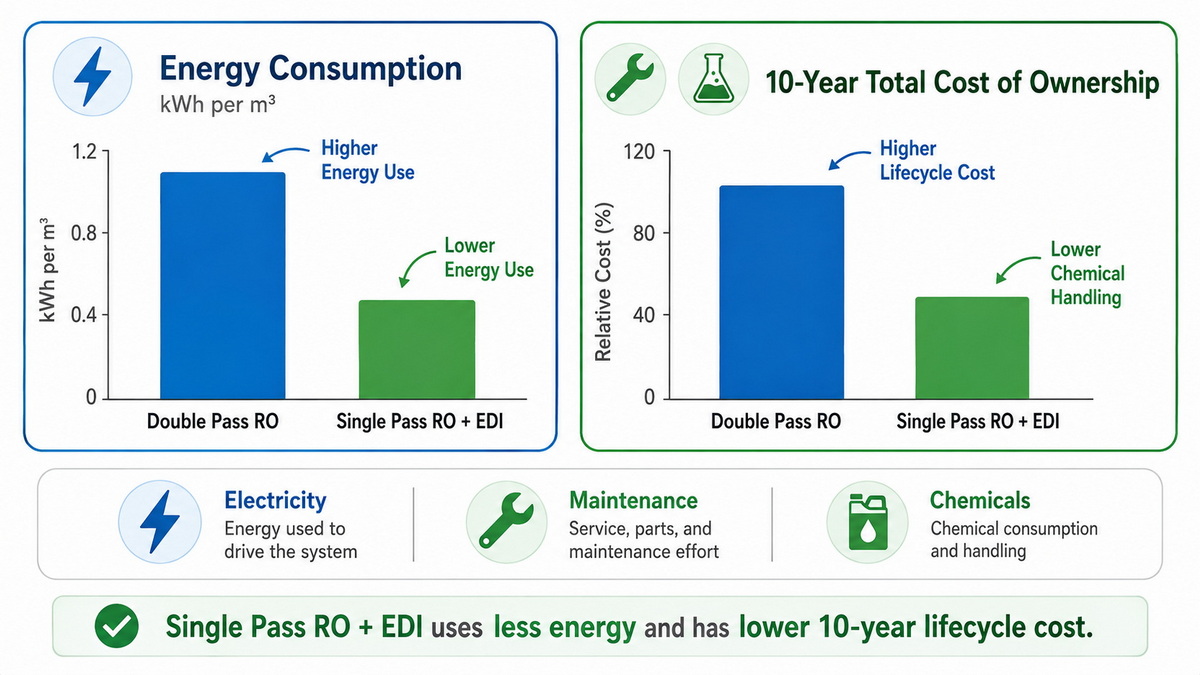
| Energy use | Higher, due to two high‑pressure stages. (youtube) | Moderate; one RO stage plus low-pressure DC power for EDI. (snowpure) |
| Chemical consumption | Chemicals for CIP and antiscalant; no regeneration resins. (vicol.co) | Limited chemicals; no acid/caustic regeneration, but RO/EDI cleaning needed. (snowpure) |
| Footprint | Larger (more skids, pumps, membranes). (youtube) | Often more compact for same product quality. (snowpure) |
| CAPEX | Typically higher than single pass RO; comparable or higher than RO + EDI depending on spec. (snowpure) | Often cost‑competitive; savings in resin handling and footprint. (snowpure) |
| OPEX | Higher energy and membrane replacement; moderate CIP. (vicol.co) | Lower energy; EDI modules with long life, reduced chemical handling. (snowpure) |
| Best fit | High TDS feeds, legacy designs, or where EDI is not desired. (snowpure) | Modern low‑conductivity PW/WFI systems with strong validation focus. (snowpure) |
This table shows that while double pass RO remains powerful, single pass RO + EDI typically provides a more energy‑efficient route to very low conductivity, especially in regions with moderate feed-water quality. [youtube]
Pretreatment – The Foundation for Both Configurations
Regardless of your final train, pretreatment quality determines life, stability, and OPEX of RO and EDI systems. Inadequate pretreatment leads to scaling, fouling, unexpected downtime, and validation headaches. [vicol.co]
Typical pretreatment for pharma water systems includes: [vicol.co]
- Multimedia or cartridge filtration – protects RO from suspended solids.
- Water softening or antiscalants – reduces hardness and scaling on RO membranes.
- Activated carbon filtration – removes chlorine/chloramines that can attack membranes.
- Fine filtration (e.g., 5 µm) – final barrier before high-pressure pump.
For single pass RO + EDI, extra attention is usually given to CO₂ management and low silica, often by integrating membrane degassers or optimized RO recovery to reduce CO₂ loading into the EDI stage. [snowpure]
Expert Design Perspectives from a Turnkey Supplier
How Ningbo Everheal Approaches System Selection
As a supplier of purified water systems, pure steam generators, and full pharma production lines, Everheal typically starts from three questions when advising clients: [everhealgroup]
1. What quality grade and regulatory framework apply? (PW vs WFI, EMA vs FDA vs NMPA, etc.) [ema.europa]
2. What are the feed water characteristics and local utilities constraints? TDS, hardness, microbial load, CO₂, power tariffs, and space. [molewater]
3. What is the lifecycle strategy? Expected plant life, expansion plans, maintenance capabilities, and digitalization level. [everhealgroup]
Based on these, a design envelope is defined where both double pass RO and single pass RO + EDI are evaluated against CAPEX, OPEX, risk, and validation effort. For many greenfield pharma facilities targeting global markets, we see growing preference for RO + EDI with integrated PLC/SCADA, TOC monitoring, and automated sanitization, because this architecture aligns with modern data integrity and audit-readiness expectations. [everhealgroup]
When Double Pass RO Still Makes Sense
Despite industry interest in EDI, double pass RO remains a practical choice in several scenarios:
- High TDS or variable feed waters, where robust RO–RO trains with conservative recovery provide a stable base. [youtube]
- Regions with limited EDI service expertise, where operators are more comfortable managing RO membranes and chemical cleaning. [vicol.co]
- Upgrades of legacy systems, where adding a second RO pass fits into existing infrastructure more easily than re‑piping for EDI modules.
In such cases, Everheal typically emphasizes sanitizable RO skids, hygienic design, and integration with UV/UF and hot water loops to ensure that regulatory and microbiological expectations are still met. [everhealgroup]
Practical Case Snapshot – Low-Conductivity Pharma Water with RO + EDI
A representative configuration for low-conductivity pharma water using single pass RO + EDI might include: [roagua]
1. Pretreatment skid
- Multimedia filtration, softening, carbon, and fine filtration.
2. Single pass RO system
- 316L high-pressure pump, low‑fouling membranes, online SDI monitoring.
3. Membrane degasser (optional)
- Reduces CO₂ to enhance EDI performance.
4. EDI polishing unit
- Delivers 15–18 MΩ·cm water at the outlet, suitable for ultra-pure applications. [roagua]
5. Storage and distribution
- 316L tank, loop with 1.5–2 m/s velocity, hot water or chemical sanitization, UV at return. [ema.europa]
This type of system is already proven in hospitals and pharma plants for ultra-pure and low-conductivity water, and can be designed to integrate with Everheal's broader portfolio, including pure steam generators, WFI distillation, and filling lines. [everhealgroup]
Step-by-Step Decision Framework for Engineering Teams
To move from concept to specification, engineering and QA teams can follow a structured six‑step decision framework:
1. Define water quality envelopes
- Specify conductivity, TOC, microbial, endotoxin, and flow requirements at all points of use. [ema.europa]
2. Characterize feed water and utilities
- Analyze seasonal TDS, hardness, organics, and microbiology; evaluate available power and space. [vicol.co]
3. Select target architecture
- Shortlist double pass RO and single pass RO + EDI based on quality and risk envelopes.
4. Model CAPEX and OPEX
- Compare pumps, membranes, EDI modules, energy consumption, cleaning chemicals, and spares. [snowpure]
5. Validate compliance pathway
- Draft IQ/OQ/PQ, define critical process parameters (CPPs), and ensure full data logging and alarm strategy. [molewater]
6. Plan lifecycle and service support
- Secure long-term membrane/module supply, training, remote monitoring, and on‑site service from a qualified OEM. [everhealgroup]
Working with a partner like Everheal that provides turnkey layout design, system fabrication, FAT/SAT, and validation support can significantly reduce project risk and internal coordination burden. [everhealgroup]
When to Choose Which – Expert Recommendation
From an engineering and lifecycle perspective:
- Choose double pass RO when:
- Feed water is high TDS or highly variable, making RO–RO more robust. [youtube]
- Local teams are already experienced with RO membrane maintenance and CIP.
- Regulatory expectations are met without needing extraordinarily low conductivity.
- Choose single pass RO + EDI when:
- You target very low conductivity and resistivity (e.g., 15–18 MΩ·cm) with strong data integrity requirements. [roagua]
- You want to minimize chemical handling and regeneration steps. [snowpure]
- You are building a modern, digitally monitored facility with centralized SCADA and integrated alarms. [molewater]
In many 2020s‑era pharma projects, single pass RO + EDI offers the best balance of quality, efficiency, and validation‑friendliness. Double pass RO remains a solid choice when feed water or organizational constraints favour a more conservative, membrane‑only architecture. [youtube]
About Ningbo Everheal – Partnering for Tailored Pharma Water Systems
Ningbo Everheal is a specialized Chinese manufacturer of pharmaceutical equipment, with a portfolio that includes purified water preparation systems, pure steam generators, multifunctional distillation units, and complete filling and sterilization lines. Based in Xiangshan, Ningbo, and backed by ISO 9001, ISO 14001, and ISO 45001 certifications, Everheal supports both small‑batch and large‑scale pharma production globally. [everhealgroup]
For each project, Everheal's engineering team provides:
- Factory layout planning and 3D pipeline design for Purified Water and WFI loops.
- Process selection support, comparing double pass RO and single pass RO + EDI under real feed‑water and regulatory conditions.
- End‑to‑end services from URS review, equipment design, and FAT/SAT to on‑site commissioning and validation documentation. [everhealgroup]
Call to Action – Discuss Your Pharma Water Strategy with Everheal
If your team is currently evaluating double pass RO vs single pass RO + EDI for a new or upgraded pharma facility, a short technical consultation can save months of redesign and hidden OPEX later. By sharing your target markets, water quality specifications, and feed‑water data, Everheal can quickly model a tailored purified water solution that aligns with both regulatory expectations and budget realities. [everhealgroup]
To move forward, prepare your basic URS and a recent feed-water analysis, then contact Everheal's engineering team to schedule a design review and preliminary PFD proposal. This creates a clear, data-backed path to a validated and efficient pharma water system that is future-ready.
FAQ
Q1: Can single pass RO alone ever be sufficient for pharma Purified Water?
In some cases with excellent feed-water quality and conservative specifications, single pass RO with strong pretreatment and post‑treatment can meet Purified Water limits, but it offers less safety margin and design flexibility than RO + EDI or RO–RO for low-conductivity targets. [gd-jiajie]
Q2: Does EDI replace all ion-exchange resin systems?
EDI eliminates the need for chemical regeneration of mixed-bed polishers in many applications, but some facilities still use traditional resin beds as backup or for specific process streams. [snowpure]
Q3: How often do RO membranes and EDI modules need replacement?
Membrane and module life depends heavily on pretreatment, operating conditions, and cleaning strategy; in well‑designed pharma systems, RO membranes and EDI modules can often run for several years before performance-based replacement. [snowpure]
Q4: Can both configurations be hot-water sanitized?
Yes, modern RO and EDI systems can be specified with hot-water‑sanitizable components, but temperature limits and sanitization cycles must be confirmed with the OEM and validated in IQ/OQ/PQ. [molewater]
Q5: How important is automation for regulatory compliance?
High levels of automation, data logging, and alarm management simplify compliance with GMP data integrity expectations and make audits smoother, regardless of whether the core process is double pass RO or RO + EDI. [ema.europa]
References
1. European Medicines Agency. *Guideline on the quality of water for pharmaceutical use* (EMA/CHMP/CVMP/QWP/496873/2018). [ema.europa]
2. Molewater. "Top 5 Considerations When Selecting a Pharmaceutical Water Purification System." [molewater]
3. Vicol. "Water Purification in the Pharmaceutical Industry: Why System Design and Supplier Expertise Matter." [vicol.co]
4. SnowPure. "RO Pretreatment for EDI Systems: Single vs Double Pass." [snowpure]
5. Everheal Group. "Company Profile and Services – Pharmaceutical Equipment and Purified Water Systems." [everhealgroup]
6. Roagua. "Double pass RO system with EDI system for hospital medical – 500 LPH ultra pure water 15–18 MΩ·cm." [roagua]
7. YouTube. "Single vs Double Pass RO System | Design, Working & Applications." [youtube]


