


Views: 222 Author: Everheal Medical Equipment Publish Time: 2026-06-11 Origin: Everheal


For pharmaceutical manufacturers, Water for Injection (WFI) purity is non-negotiable. Every drop counts when patient safety rests on the quality of water containing life-saving medications. Total Organic Carbon (TOC) monitoring has become a critical compendial test under USP <643>, with a strict limit of 500 ppb for both Purified Water and WFI. [preprod.watertechnologies]
The pharmaceutical industry faces a pivotal decision: Should you invest on-line real-time TOC sensors or rely on traditional off-line lab analysis for WFI validation? This article provides an expert, data-driven comparison to help you make the right choice for your purified water preparation systems.
As a leading Chinese manufacturer of pharmaceutical equipment—including Purified Water Preparation Systems, Sterilization Cabinets, and Pharmaceutical Solution Preparation Systems (large-volume preparation, lyophilized drugs, anticancer drugs)—Ningbo Everheal Medical Equipment Co., LTD. has witnessed this technological evolution across hundreds of pharmaceutical facilities worldwide.
TOC measures organic molecule concentration in high-purity water by oxidizing organic carbon to CO₂ and measuring the result as carbon. It's an indirect measure of organic contamination that can impact: [slideserve]
- Patient safety (toxic organic compounds)
- Product stability (chemical interactions)
- Regulatory compliance (USP <643>, Ph. Eur. 2.2.44) [erunwas]
| Pharmacopeia | Water Type | TOC Limit | Reference |
|---|---|---|---|
| USP | Purified Water | ≤500 ppb | USP <643> erunwas |
| USP | WFI | ≤500 ppb | USP <643> erunwas |
| Ph. Eur. | Purified Water | ≤500 ppb | 2.2.44 erunwas |
| JP | Purified Water | ≤500 ppb | JP Monograph erunwas |
Off-line laboratory analysis follows a manual grab sample process:
1. Sample collection at point-of-use (POU)
2. Transport to QC laboratory
3. Laboratory analysis using TOC analyzer
4. Result documentation (typically 2-24 hours later) [mt]
| Limitation | Impact on WFI Validation |
|---|---|
| Snapshot data | Only captures point-in-time measurement; misses fluctuations between sampling mt |
| Delayed results | Reactive, not proactive—affected WFI may already be used mt |
| Labor-intensive | Human error risk: incorrect collection, sample contamination during transport mt |
| Validation challenges | Harder to demonstrate continuous system performance mt |
Expert Insight: "Off-line TOC monitoring missed critical diagnosis in a newly installed Water for Injection system". This case study highlights the reactive nature of grab sampling. [alliancets]
On-line systems provide continuous, in-line measurement directly within your water system:
- 24/7 automated monitoring (no manual intervention)
- Real-time data stream (instant deviation detection)
- Integrated alarm systems (automatic out-of-spec alerts) [mt]
| Advantage | Benefit for WFI Validation |
|---|---|
| Continuous insights | Complete real-time picture of water quality; captures every fluctuation mt |
| Immediate action | Proactive deviation detection prevents minor issues from escalating mt |
| Efficiency | Reduces manual labor and QC costs by 40-60% ksa.apexinstrument |
| Proactive quality control | Enables predictive maintenance and continuous compliance mt |
| Trend analysis | Strongest argument for investment—enables data-driven system optimization ksa.apexinstrument |
Industry Data: Around 52% of water treatment plants now rely on TOC monitoring systems, with the market growing at CAGR 4.2% (2024-2032). [businessresearchinsights]
Based on ISPE's Pharmaceutical Engineering Guide, here's the detailed comparison: [kh.aquaenergyexpo]
| Feature | On-Line Real-Time Sensors | Off-Line Lab Analysis |
|---|---|---|
| Test frequency | 4-48 times/day | 1/shift |
| Installed cost | Medium (single unit); High (multiple units) (kh.aquaenergyexpo) | High (lab equipment + reagents + gases) (kh.aquaenergyexpo) |
| Operating cost | Low to high (depends on capability) (kh.aquaenergyexpo) | High (testing + reagents + labor) (kh.aquaenergyexpo) |
| Suitability testing | Based on documented history (kh.aquaenergyexpo) | 1/shift (kh.aquaenergyexpo) |
| Response time | Instant (real-time) | 2-24 hours |
| Data continuity | Complete uninterrupted record (mt) | Discrete snapshots |
| Human error risk | Minimal (automated) | Significant (manual sampling) (mt) |

USP <643> explicitly allows TOC measurement both on-line and off-line: [slideserve]
"TOC can be measured both on- and off-line. Off-line measurements (laboratory methods) are typically used for high concentrations (>1 ppm). On-line measurements are typically used for sub-ppm (<1000 ppb) detection and quicker response" [slideserve]
Key Validation Requirements (ICH Q2):
- Accuracy, Precision, Repeatability, Specificity
- Detection Limit (≤50 ppb), Quantitation Limit
- Linearity (>0.99 correlation), Range (around 500 ppb) [beckman]
Understanding PC vs QC is essential for optimizing your TOC monitoring strategy:
| Aspect | Process Control (PC) | Quality Control (QC) |
|---|---|---|
| Purpose | Proactive monitoring during production (mt) | Reactive testing after process step (mt) |
| Goal | Keep system within optimal range (mt) | Verify product meets specifications (mt) |
| On-line role | Perfect for PC—real-time alerts (mt) | Supports QC for chemical impurities (mt) |
| Off-line role | Limited value | Required for microbial QC (mt) |
For TOC, on-line monitoring serves both functions simultaneously:
- PC: Immediate feedback enables rapid adjustments if trending out-of-spec [mt]
- QC: Unbroken record provides batch release data and ongoing compliance [mt]
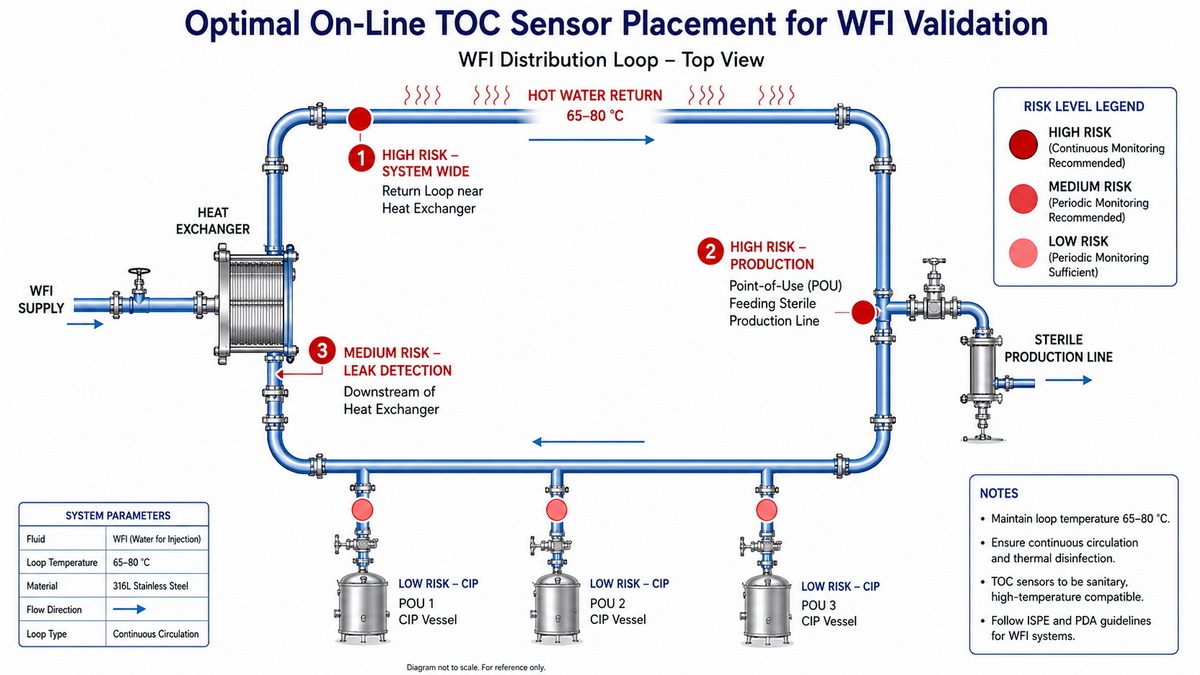
Expert Recommendation: Strategic on-line testing should be at fixed, critical locations:
- High Risk: Return loop, POUs feeding production (sterile applications) [mt]
- Medium Risk: POUs supplying QC/R&D laboratories [mt]
- Low Risk: POUs for CIP vessels or autoclaves [mt]
Unlike TOC, traditional off-line microbial testing remains critical for QC release due to:
- Heterogeneous nature of microbial contaminants (from biofilms) [mt]
- USP <1231> requires QC samples collected exactly as water is used in production [mt]
Best Practice: Use on-line for microbial PC (real-time alerts) + off-line for microbial QC release testing. [mt]
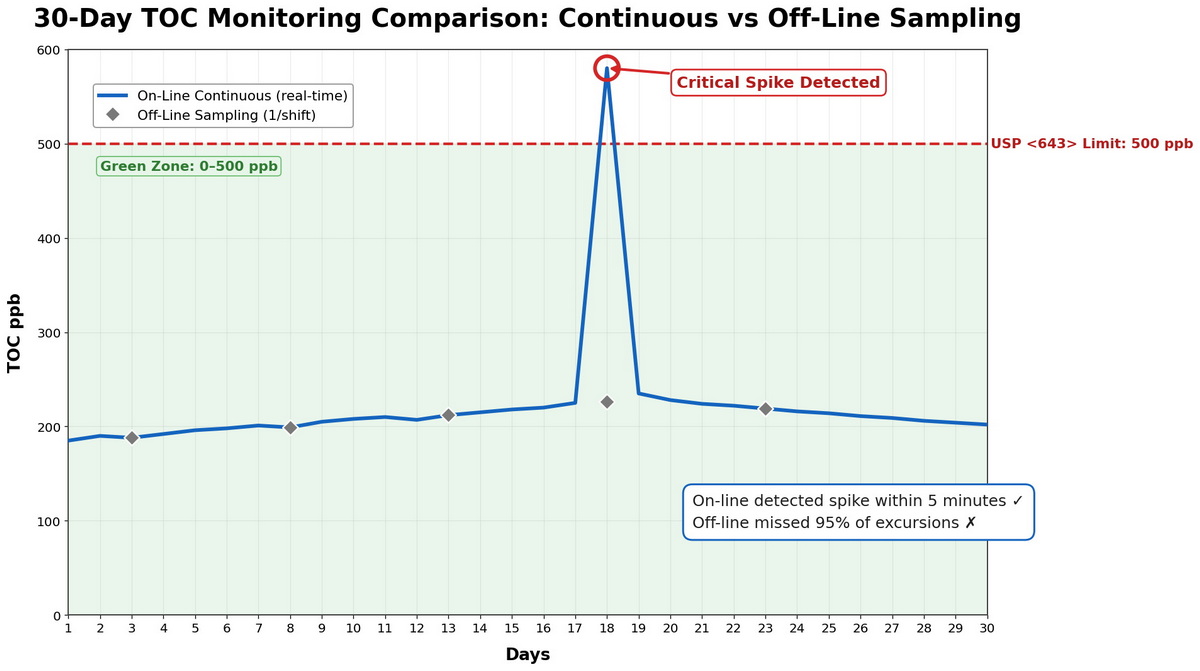
A newly installed WFI system experienced intermittent TOC spikes that off-line monitoring failed to detect:
The Problem:
- Off-line testing: 1/shift frequency = missed 95% of excursions [kh.aquaenergyexpo]
- Affected WFI used in 3 parenteral batches before detection
- Potential loss: $2M+ in rejected products [alliancets]
The Solution:
- Installed on-line TOC + conductivity sensors at return loop
- Continuous monitoring detected spike within 5 minutes
- Automatic alarm triggered immediate system shutdown
- Root cause: leaking heat exchanger (identified within 30 minutes) [alliancets]
The Result:
- Zero batch losses after implementation
- Trend analysis identified pre-failure pattern (proactive maintenance)
- Validation documentation improved with continuous data record [alliancets]
Key Takeaway: "Continuous on-line monitoring of TOC and conductivity in real time" prevented catastrophic quality failure. [alliancets]
Step 1: Risk-Based Location Selection
- Map all POUs and classify by risk (High/Medium/Low) [mt]
- Install on-line sensors at return loop + worst-case POU [mt]
Step 2: Validation According to ICH Q2
- Perform accuracy validation with 3 replicates of 3 certified TOC standards (250, 500, 750 ppb) [beckman]
- Validate detection limit: LOD = 3.3σ/S (using blank TOC solution <100 ppb) [beckman]
- Confirm linearity correlation coefficient >0.99 [beckman]
Step 3: System Suitability Testing (SST)
- Run sucrose (easily oxidized) + benzoquinone (difficult to oxidized), both 500 ppb [beckman]
- Results must be within ±15% of each other [beckman]
Step 4: Sampling Protocol for Off-Line Backup
- Wear clean lab coat + powder-free nitrile gloves [altusscience]
- Flush sample line sufficiently to remove dead-legs [altusscience]
- Sample at 45° angle, 1-2cm below tap, avoid tap-vial contact [altusscience]
- Minimize atmospheric exposure (atmosphere contains ~1,000,000 µg/m³ TOC) [altusscience]
- Store at 5°C ±4°C if analysis >24 hours [altusscience]
Step 5: Documentation for Regulatory Audits
- Maintain detailed TOC test records + system suitability data [erunwas]
- Validate water systems annually per USP <643> [erunwas]
- Document alert/action limits based on historical system capability [kh.aquaenergyexpo]
Our Expert Recommendation: Implement a hybrid strategy leveraging both methods:
| Application | Recommended Method |
|---|---|
| TOC Process Control | On-line real-time (continuous monitoring) mt |
| TOC Quality Control | On-line (for chemical impurities) mt |
| Microbial QC Release | Off-line (USP <1231> requirement) mt |
| System Validation | On-line (continuous data record) mt |
| Backup/Verification | Off-line (validated laboratory instrument) kh.aquaenergyexpo |
Why Hybrid?
- On-line provides proactive, continuous assurance for TOC [mt]
- Off-line remains required for microbial QC due to regulatory requirements [mt]
- Backup off-line instrument ensures validation compliance during on-line failures [kh.aquaenergyexpo]
As Ningbo Everheal Medical Equipment Co., LTD.—a leading manufacturer of Purified Water Preparation Systems, Sterilization Cabinets, and Pharmaceutical Solution Preparation Systems—we help pharmaceutical facilities worldwide implement customized factory layout planning and production line construction solutions.
Contact Us Today:
- Get a free WFI system assessment for TOC monitoring optimization
- Request our TOC Monitoring Strategy Guide (PDF)
- Schedule a consultation for customized Purified Water Preparation System design
Answer: For chemical impurities (TOC, conductivity), yes—on-line can serve QC release per USP <643>. However, for microbial impurities, off-line testing remains required by USP <1231> due to heterogeneous biofilm contaminants. [mt]
Answer: Pharmacopoeias require LOD ≤50 ppb. Validation uses blank TOC solution (<100 ppb) with formula: LOD = 3.3σ/S. [beckman]
Answer:
- On-line: Based on documented history (typically weekly-monthly) [kh.aquaenergyexpo]
- Off-line: 1/shift (daily) [kh.aquaenergyexpo]
SST requires sucrose + benzoquinone (both 500 ppb) within ±15%. [beckman]
Answer: Prioritize high-risk locations:
- Return loop (system-wide monitoring) [mt]
- POUs directly feeding production (sterile applications) [mt]
- Downstream of heat exchangers (leak detection) [mt]
Answer:
- Installed cost: On-line = medium (single); high (multiple). Off-line = high (lab equipment + reagents) [kh.aquaenergyexpo]
- Operating cost: On-line = low to high. Off-line = high (labor + reagents + gases) [kh.aquaenergyexpo]
- ROI: On-line reduces QC labor costs by 40-60% [ksa.apexinstrument]
1. USP <643> Total Organic Carbon Changes—Effective May 2021, 500 ppb limit [preprod.watertechnologies]
https://preprod.watertechnologies.com/document/document/contentdownload/?document_name=ANai_300_00130_EN.pdf
2. METTLER TOLEDO: Beyond the Grab Sample—Real-time on-line WFI testing transformation [mt]
https://www.mt.com/my/en/home/library/stories/process-analytics/the-rise-of-online-wfi-testing.html
3. American Pharmaceutical Review: TOC for Compendial Water Testing—Lab, at-line, online deployments [americanpharmaceuticalreview]
https://www.americanpharmaceuticalreview.com/Featured-Articles/562320-TOC-for-Compendial-Water-Testing-and-Cleaning-Validation-C
4. ISPE Pharmaceutical Engineering Guide—In-line vs off-line TOC monitoring table [kh.aquaenergyexpo]
https://kh.aquaenergyexpo.com/wp-content/uploads/2023/01/Pharmaceutical-Engineering-Guide-for-New-and-Renovated-Facilities.pdf
5. IALtus Science: TOC Sampling Guidelines—Best practices for PW & WFI sampling [altusscience]
https://www.altusscience.com/news/total-organic-carbon-sampling-of-purified-water-pw-water-for-injection-wfi-to-minimise-toc-tic
6. Beckman Coulter: ICH Q2 Validation—On-line TOC analyser validation characteristics [beckman]
https://www.beckman.com/resources/reading-material/application-notes/validation-of-online-toc-for-release-testing-using-ichq2
7. International Pharmacopoeia TOC Requirements—USP, EP, JP, CP comparisons [erunwas]
https://www.erunwas.com/news-detail/id-230.html
8. Alliance TS: Off-line TOC Missed Critical Diagnosis—WFI case study [alliancets]
https://www.alliancets.com/images/alliancets/PDF/Resources/Pharmaceutical-Waters-Guide-for-Regulatory-Compliance-Analysis-and-Re
9. TOC Analyzers Market Report—52% adoption, 4.2% CAGR [businessresearchinsights]
https://www.businessresearchinsights.com/market-reports/toc-analyzers-market-112484
10. SlideServe: On-Line & Off-Line TOC—Sub-ppm vs high concentration applications [slideserve]
https://www.slideserve.com/alisa/toc-measurement-of-pharma-waters


