


Views: 222 Author: Everheal Medical Equipment Publish Time: 2026-06-06 Origin: Everheal


For pharmaceutical manufacturers running 24/7 IV fluid production lines, choosing between continuous distillation and batch distillation for Water for Injection (WFI) production is a critical decision that directly impacts output quality, operational efficiency, and regulatory compliance. In this comprehensive guide, we'll compare both methods across energy efficiency, uptime, cost structure, and WFI purity standards to help you optimize your Purified Water Preparation Systems.
Water for Injection (WFI) is the highest purity water grade required for parenteral formulations, IV fluids, and final rinse processes in pharmaceutical manufacturing. According to USP, EP, and Chinese Pharmacopoeia standards, WFI must meet stringent requirements:
WFI is primarily produced through distillation (multi-effect distillation or vapor compression distillation) or reverse osmosis with ultrafiltration. [biolink]
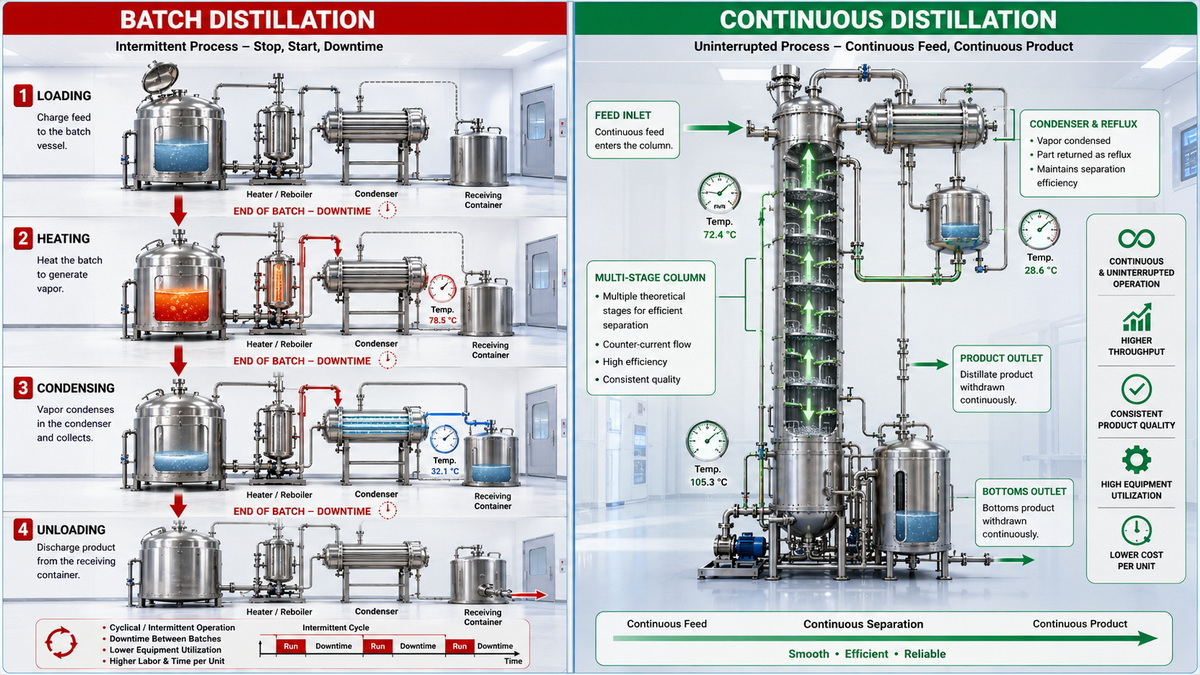
Batch distillation operates on a periodic basis, processing a fixed quantity of water in each cycle. The process has distinct stages: [32352161.s21i.faiusr]
1. Loading the feed water into the distillation unit
2. Heating to boiling point and collecting vapor
3. Condensing the vapor into distilled water
4. Unloading residue and preparing for the next batch [solventwasher]
This cyclic approach offers flexibility but creates inherent downtime between cycles.
Continuous distillation operates uninterrupted, endlessly feeding water into the system and extracting distilled products. Key characteristics include: [solventwasher]
- Non-stop operation with steady-state conditions
- Continuous feed and product extraction
- Heat integration techniques reducing energy consumption [solventwasher]
- Ideal for large-scale industrial applications demanding steadiness [solventwasher]
Batch distillation is more resource-intensive regarding energy consumption: [solventwasher]
- Starting and stopping for each batch consumes significant energy
- No opportunity for heat integration between cycles
- Higher operational costs due to energy inefficiencies [shipandshore]
Continuous distillation benefits from ongoing operation that prioritizes energy efficiency: [solventwasher]
- Constant-state operation allows heat integration
- Vapor Compression Distillation (VCD) recycles latent heat, reducing separate condenser needs [biocell-pharma]
- Multi-Effect Distillation (MED) reuses latent heat across multiple stages, achieving energy ROI [linkedin]
For 24/7 IV fluid production lines, batch distillation presents critical limitations:
| Factor | Impact |
|---|---|
| Cyclical downtime | Between batches requires setup/cleaning shipandshore |
| Labor intensity | Frequent manual intervention increases costs shipandshore |
| Production inconsistencies | Output varies between batches solventwasher |
Continuous distillation excels in environments requiring high-volume consistent output:
- Minimizes downtime and maximizes productivity [shipandshore]
- Automated systems require less manual intervention [shipandshore]
- Steady output crucial for large-scale productions [solventwasher]
- Can produce ambient WFI without cooling water (VCD unique capability) [meco]
Batch distillation typically involves lower initial capital expenditure: [shipandshore]
- Lower upfront investment适合 small-scale operations
- Higher operational costs due to labor intensity [shipandshore]
- Downtime between batches increases operational expenses [shipandshore]
Continuous distillation requires higher initial investment but offers long-term efficiencies: [shipandshore]
| Cost Category | Batch | Continuous |
|---|---|---|
| Initial Capital | Lower | Higher shipandshore |
| Labor Costs | Higher (manual) | Lower (automated) shipandshore |
| Energy Efficiency | Lower | Higher solventwasher |
| Long-term ROI | Lower | Higher shipandshore |
Batch distillation is ideal for heat-sensitive materials requiring tight control: [solventwasher]
- Close monitoring and adjustment for each batch
- Ensures product integrity through manual intervention
- However, output consistency varies between batches [solventwasher]
Continuous distillation suits purity-focused commodities: [solventwasher]
- Steady conditions maintain consistent quality
- Fine-tuning for high separation efficiency [solventwasher]
- 100% microbial kill by operating at self-sanitizing temperatures [meco]
- Both MED and VCD can meet pharmacopeial monographs with proper pretreatment [meco]
1. Smaller production volumes (under 500L/h) [molewater-system.en.made-in-china]
2. Production requirements change frequently [solventwasher]
3. Facility produces multiple products from same setup [shipandshore]
4. Lower initial capital is a constraint [shipandshore]
5. Pilot plants or research facilities [solventwasher]
1. 24/7 IV fluid production lines require steady output [solventwasher]
2. Large-scale setups (500L/h+) [molewater-system.en.made-in-china]
3. High-volume uniform production is essential [shipandshore]
4. Energy efficiency and sustainability are priorities [linkedin]
5. Long-term operational cost reduction is目标 [shipandshore]
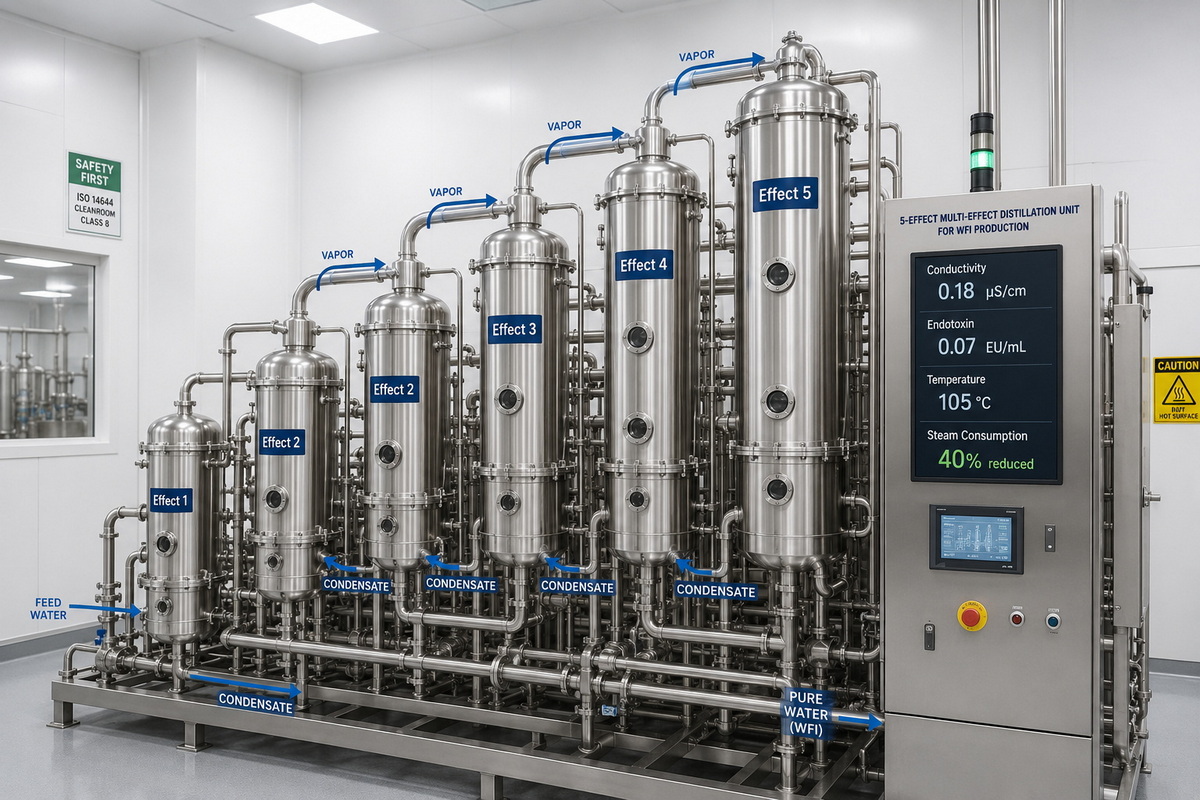
Real-world application: A leading Chinese pharmaceutical manufacturer implemented 5-effect MED system for WFI production:
- Energy ROI: 40% reduction in steam consumption compared to single-effect [moerwater]
- Uptime: 98.5% continuous operation vs 75% for batch system
- WFI Quality: Endotoxin consistently <0.08 EU/mL (below 0.25 EU/mL limit) [ske-eagle]
- Capacity: 2,000L/h continuous output for IV fluid production
This case demonstrates MED's preference for pharmaceutical applications due to lower operating temperatures and higher energy efficiency at WFI scale. [ske-eagle]
Both methods must comply with USP, EP, and Chinese Pharmacopoeia WFI monographs:
1. Installation Qualification (IQ): Verify piping, fittings, calibration
2. Operational Qualification (OQ): Operate throughout design specifications
3. Performance Qualification (PQ): 1-month sampling per SOP [panoramaus]
- Chemical testing meets USP WFI monograph
- Bacteriological purity: ≤10 cfu/100 mL
- Endotoxins: ≤0.25 EU/ml [panoramaus]
- Hot WFI temperature: >80°C [panoramaus]
Continuous systems often have fewer operational risks compared to batch due to robust design and automation. [ske-eagle]
The distillation landscape is changing with advancements in automation and sensor technology:
- Smart automation and ergonomic design in next-gen systems [linkedin]
- Modular designs in batch units enhancing efficiency [shipandshore]
- Process optimization software reducing operational costs [shipandshore]
- Sustainability focus: Energy efficiency and reduced environmental impact [linkedin]
These innovations could narrow the cost gap between batch and continuous methods. [shipandshore]
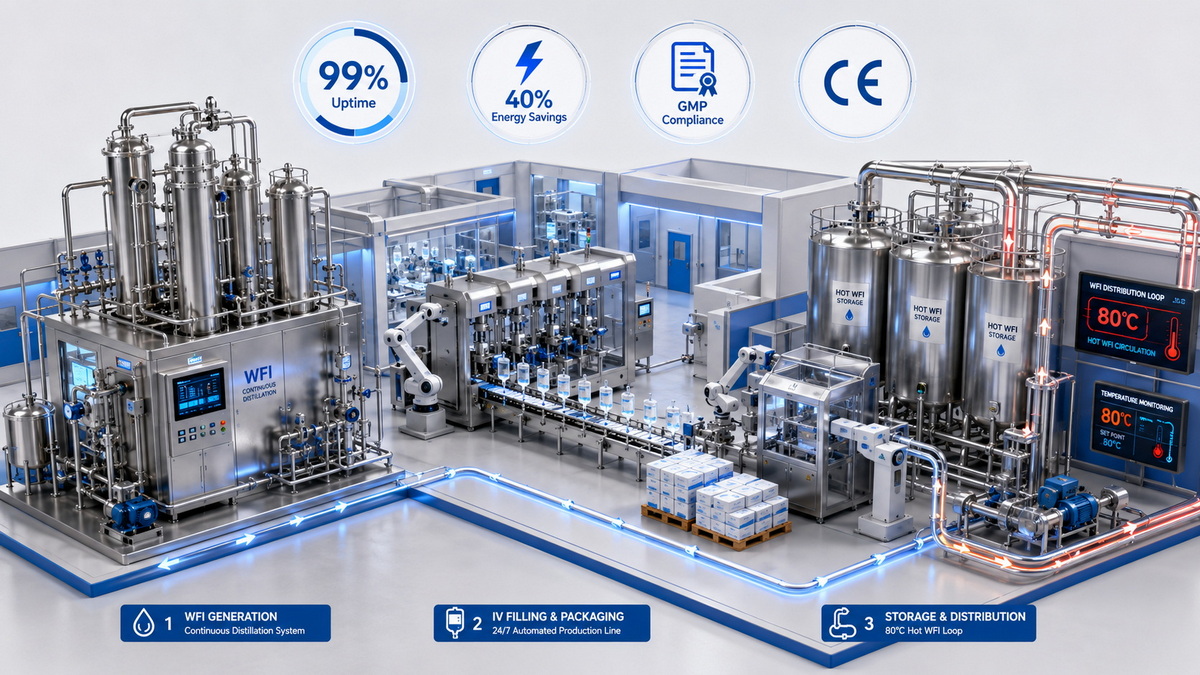
As Ningbo Everheal Medical Equipment Co., LTD. specializes in Purified Water Preparation Systems and custom factory layout planning for pharmaceutical manufacturers, we recommend:
Choose Continuous Distillation (VCD or MED) for:
- Maximum uptime (99%+)
- Consistent WFI quality
- Lower long-term operational costs
- Energy efficiency (40%+ steam reduction)
- Factory layout planning optimized for continuous distillation systems
- Customized capacity (500L/h to 5,000L/h+) [molewater-system.en.made-in-china]
- Full validation packages with GMP compliance [tiansure.en.made-in-china]
- CE, ISO9001, ISO14001 certifications [molewater-system.en.made-in-china]
Ready to optimize your WFI production for 24/7 IV fluid lines?
Contact Ningbo Everheal today for a custom consultation on our Continuous Distillation WFI Systems:
- Custom capacity planning
- Factory layout optimization
- Full validation & GMP compliance
- Energy-efficient solutions starting at US$10,000 [made-in-china]
Batch distillation processes fixed volumes in distinct cycles with downtime between batches, offering flexibility but higher operating costs. Continuous distillation operates non-stop with steady-state conditions, providing greater efficiency and lower unit costs for large-scale WFI production. [solventwasher]
Continuous distillation is superior for 24/7 IV fluid production because it achieves 99%+ uptime, provides consistent WFI quality, minimizes downtime, and offers lower long-term operational costs despite higher initial investment. [solventwasher]
Multi-Effect Distillation (MED) systems can achieve 40% reduction in steam consumption compared to single-effect or batch systems by reusing latent heat across multiple stages. Vapor Compression Distillation (VCD) also recycles latent heat, significantly reducing energy needs. [biocell-pharma]
Yes, both methods can meet USP, EP, and Chinese Pharmacopoeia WFI requirements (endotoxin ≤0.25 EU/mL, conductivity ≤1.3 μS/cm, microbial ≤10 CFU/100mL) with proper pretreatment and validation. [biolink]
Pharmaceutical WFI distillation systems range from 500L/h for smaller facilities to 5,000L/h+ for large-scale operations. Continuous systems are preferred for capacities above 500L/h due to efficiency advantages. [molewater-system.en.made-in-china]
1. [Batch vs. Continuous Solvent Distillation: The Differences] [solventwasher]
2. [Cost Comparison: Batch vs Continuous Distillation Analysis] [shipandshore]
3. [Practical Guide to Water for Injection (WFI)] [biolink]
4. [7 Key Facts: What is Multi Effect Distillation for WFI?] [moerwater]
5. [The Definitive Guide to Multiple Effect Distillation] [ske-eagle]
6. [Vapor Compression Distillation vs. Multiple Effect Distillation] [meco]
7. [Bacterial Endotoxins/Pyrogens - FDA] [fda]
8. [Design of Purified water & WFI Systems] [panoramaus]
9. [Enhancing Energy Efficiency, Sustainability, and Compliance] [linkedin]
10. [High Efficiency Water Distillation Plant for WFI Pharma] [molewater-system.en.made-in-china]


