In pharmaceutical piping design, dead-leg minimization is not a styling preference; it is a contamination-control decision that affects cleaning effectiveness, microbial risk, and long-term GMP compliance. This article compares the traditional 3D rule with zero-static valves and explains when each approach is strongest in real pharmaceutical water and process systems. [linkedin]
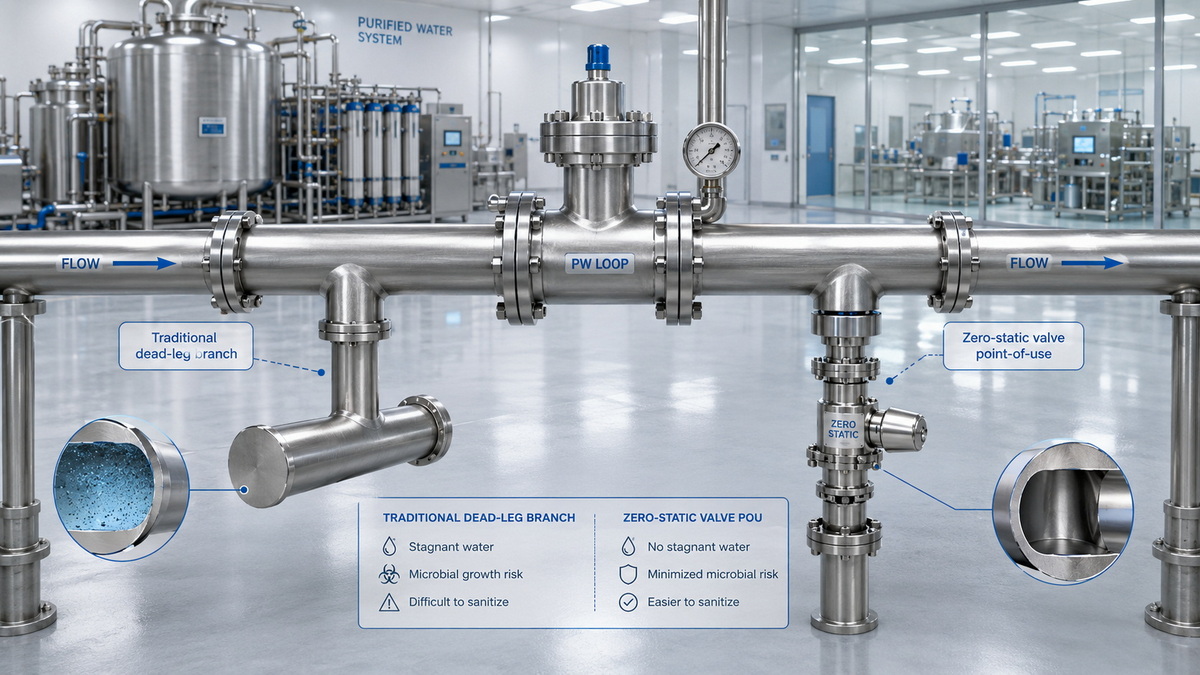
Why dead legs matter in pharmaceutical piping
A dead leg is a section of pipe or component pocket where flow is weak, intermittent, or absent, which creates a stagnation zone that can support biofilm growth and compromise sanitization. In purified water preparation systems, WFI loops, and hygienic process skids, this risk is especially important because water quality can deteriorate quickly when flow is not continuous and fully drainable. [fda]
From an engineering standpoint, dead legs are not only a microbiological problem. They also create validation burden, make routine sanitation less reliable, and increase the likelihood of recurring deviations during monitoring, especially where piping layouts include sampling points, instruments, or unused branches. That is why dead-leg control must be considered early in layout planning, not after installation. [gmp-compliance]
What the 3D rule really means
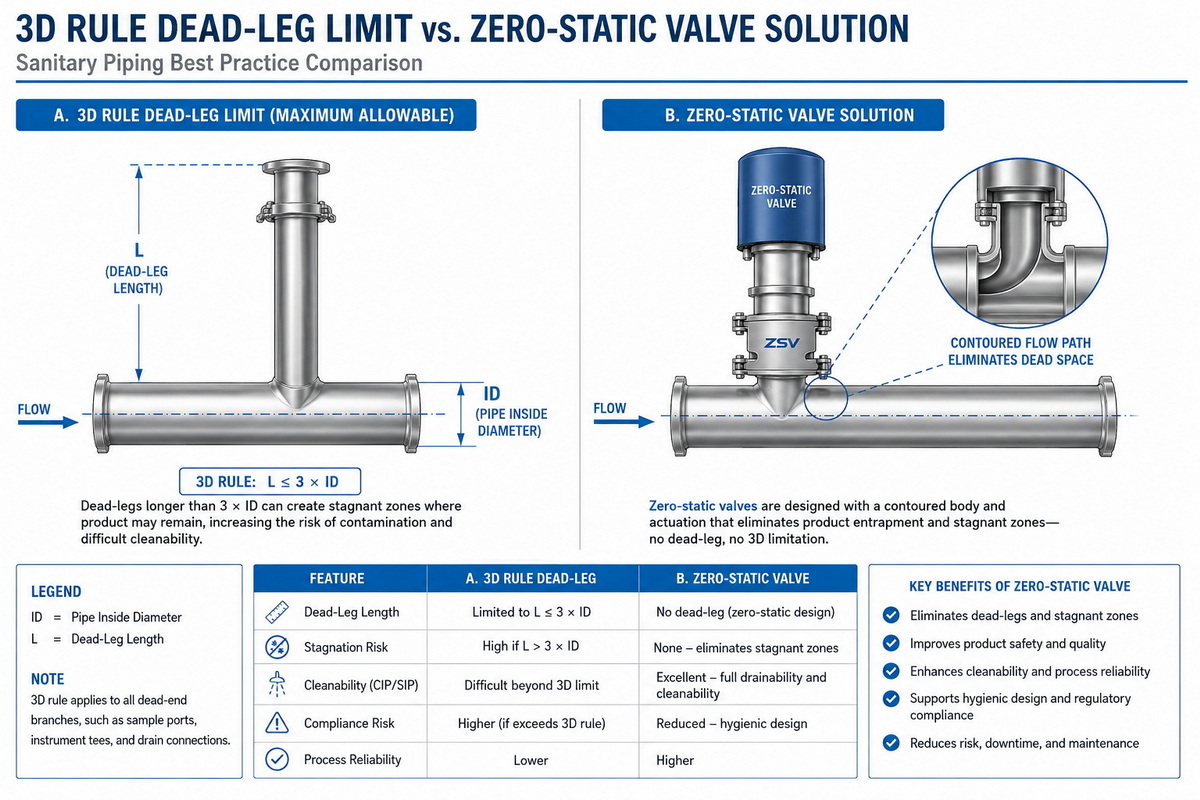
The 3D rule is a widely used pharmaceutical guideline that limits dead-leg length to three times the pipe diameter, measured from the pipe wall in many contemporary interpretations. It is often treated as a practical benchmark for water systems because it balances hygiene, constructability, and cost more effectively than ultra-short rules in many plant layouts. [gmp-compliance]
The key advantage of the 3D rule is simplicity. Designers, fabricators, and validation teams can evaluate branch geometry quickly, and the rule is familiar across many pharmaceutical projects. However, the 3D rule is still a minimum hygienic benchmark, not an automatic guarantee of cleanability, because the real risk depends on flow regime, cleaning strategy, product sensitivity, and the component's internal geometry. [files.asme]
What zero-static valves do differently
Zero-static valves are designed to eliminate or drastically reduce stagnant pockets inside the valve body, especially near seat areas and flow diversion zones. In practice, they are used to improve drainability, support more reliable SIP/CIP performance, and lower the chance that a valve becomes the hidden source of contamination. [duvasanitary]
Compared with conventional valve arrangements that may create a small trapped volume, zero-static valves are a more aggressive engineering answer to the same problem: remove the area where fluid can remain unmoved. This is particularly valuable in high-purity water loops, biotech utilities, and lines where sanitation frequency is high or the product risk is severe. In those applications, a well-chosen zero-static valve can deliver stronger hygienic performance than simply trying to "stay within 3D." [linkedin]
3D Rule Vs Zero-Static Valves
| Criteria | 3D Rule | Zero-Static Valves |
| Core idea | Keep dead-leg length within an accepted ratio (linkedin) | Remove stagnant geometry at the valve level (duvasanitary) |
| Best use case | General hygienic piping and utility loops (gmp-compliance) | High-risk, high-purity, and highly sanitized systems (duvasanitary) |
| Design complexity | Lower | Higher |
| Cost impact | Usually lower | Usually higher |
| Validation benefit | Good baseline control (gmp-compliance) | Stronger contamination-risk reduction |
| Retrofit suitability | Easier in many plants | Best planned early in design |
| Risk reduction level | Moderate to strong, depending on layout | Strong, especially where pockets are critical |
The most important takeaway is that these two approaches are not identical substitutes. The 3D rule is a design limit for branch geometry, while zero-static valves are a component-level strategy to remove trapped volumes more aggressively. In many real projects, the best solution is not choosing one universally, but combining both intelligently. [duvasanitary]
Which option is better in practice
For standard purified water distribution and many utility branches, the 3D rule may be sufficient when the layout is well engineered, flow is stable, and sanitization is effective. For more sensitive systems, especially where microbial control is tight and cleaning validation is demanding, zero-static valves often provide a stronger safety margin. [zamann-pharma]
As a practical rule, choose 3D optimization when you need a cost-effective, maintainable baseline design. Choose zero-static valves when your process risk is high, the consequences of contamination are severe, or the system includes repeated low-flow transitions and complex valve manifolds. In many pharmaceutical facilities, especially those adding more automation and more frequent batch changeovers, the second option is becoming more attractive. [linkedin]

Latest industry perspective
Industry guidance has increasingly moved away from treating dead-leg ratios as a single universal answer. Modern hygienic design thinking emphasizes risk assessment, drainability, sanitizability, and product criticality, rather than geometry alone. That means the best design is the one that can be effectively cleaned, inspected, and validated over time. [files.asme]
In real projects, we also see a shift toward more integrated design decisions: piping layout, skid arrangement, valve selection, instrument placement, and maintenance access are planned together instead of separately. For a company like Ningbo Everheal Medical Equipment Co., LTD., which delivers Purified Water Preparation Systems and custom plant-layout solutions, this integrated approach is especially important because dead-leg problems are often created by poor spatial coordination rather than by valve choice alone. [everhealgroup]
How to design out dead legs
A good dead-leg strategy is built into the project from day one. Here is a practical workflow:
1. Map every branch and use point early. Identify sampling points, drain points, instruments, and future expansion ports before equipment layout is frozen.
2. Keep flow paths continuous. Avoid unused tees and blind-ended branches whenever possible.
3. Choose valve technology based on risk. Use zero-static valves where stagnation risk is critical, and use conventional hygienic valves only where the risk is justified.
4. Check drainability in 3D layout review. A branch that looks acceptable on paper can still trap liquid when slopes, elevations, and support steel are considered.
5. Validate with the cleaning strategy. Design must align with CIP, SIP, thermal sanitization, or chemical sanitization requirements. [gmp-compliance]
This workflow is where strong engineering teams create real value. It is also where a supplier who understands both equipment and plant layout can reduce rework, shorten commissioning time, and improve GMP readiness.
Case-based design lesson
A common mistake in pharmaceutical water projects is to focus only on equipment specifications and ignore how the piping fits into the plant. A branch that meets a nominal dead-leg ratio can still perform poorly if it is placed at the wrong elevation, lacks proper slope, or sits outside the most effective circulation path. In practice, layout quality often determines whether a design is robust or fragile. [dentechindustrial]
For example, in a purified water loop serving multiple production areas, a designer may add a branch for a future point of use. If that branch is kept for "later use" but not actively circulated, it can become a hygienic weak point even if its geometry is technically acceptable. In that scenario, a zero-static valve or a fully reworked loop layout is usually a better decision than simply defending the branch under the 3D rule. [fda]
Expert view from plant design
From a plant design perspective, dead-leg minimization should be treated as part of facility strategy, not just piping detail. The best pharmaceutical plants are built around flow logic: raw material movement, purified water generation, utility circulation, maintenance access, and future expansion are coordinated together. When that happens, the engineering team has more freedom to eliminate stagnation before it becomes a validation problem. [dentechindustrial]
This is one reason manufacturers that provide both equipment and layout support are well positioned. A supplier with experience in purified water systems can identify where dead legs are likely to emerge, recommend component changes, and adjust the physical layout before fabrication starts. That reduces change orders and improves the likelihood of first-pass validation success. [everhealgroup]
CTA for manufacturers
If your project involves purified water systems, hygienic piping design, or GMP plant layout planning, the best next step is to review dead-leg risk at the concept stage rather than after fabrication. Everheal can support pharmaceutical manufacturers with customized equipment selection, piping layout planning, and complete production-line solutions designed to improve drainability, sanitation efficiency, and validation readiness. [everhealgroup]
FAQ
1. Is the 3D rule still acceptable in pharmaceutical piping?
Yes, in many pharmaceutical water applications the 3D rule is still used as a practical hygienic benchmark, but it should be applied through risk assessment rather than as a universal guarantee. [gmp-compliance]
2. Are zero-static valves always better than 3D design?
Not always. Zero-static valves usually provide stronger contamination control, but they also increase cost and design complexity, so they are best used where the risk justifies the investment. [duvasanitary]
3. What is the biggest mistake engineers make with dead legs?
The biggest mistake is treating dead-leg control as a pipe-length check only. In reality, layout, flow direction, cleaning method, and valve internals all affect contamination risk. [gmp-compliance]
4. Can dead legs be fully eliminated?
In many systems, they can be greatly reduced but not always fully eliminated. The goal is to make every branch short, drainable, cleanable, and appropriate to the product risk. [fda]
5. Which system needs tighter dead-leg control?
High-purity water loops, WFI systems, biotech utilities, and any line with strict microbial limits or frequent sanitization cycles typically require tighter control than general process piping. [zamann-pharma]
References
1. [Dead legs in piping systems – hygienic design!] — discussion of 1D, 2D, 3D, and 6D rules, plus hygienic design context.
2. [The Truth about the 3D/6D Rule] — explanation of measurement differences and practical use in water systems.
3. [High Purity Water System (7/93) - FDA] — classic FDA guidance describing stagnant water risk in high-purity systems.
4. [Dead Leg Elimination in Sanitary Design] — practical explanation of valve selection and sanitary flow-path design.
5. [What is the correct Maintenance of a Pharmaceutical Water System?] — maintenance, sanitization, and lifecycle considerations.
6. [Everheal official website] — company background, pharmaceutical equipment positioning, and purified water system capability.
7. [Pharmaceutical Water Trearment Equipment - Everheal] — Everheal's GMP-friendly configuration and maintenance-oriented design philosophy.
8. [Process Piping Design and Installation] — general process piping design and installation stages.


