As a process engineer supporting pharmaceutical and fine chemical projects in Asia and Europe, I have seen both jacketed mixing tanks and external heat exchangers perform brilliantly—and sometimes fail—depending on how well they were matched to the reaction and plant layout. When you are scaling up an exothermic synthesis or sterile formulation, choosing the wrong thermal control strategy can mean runaway temperatures, poor product quality, or expensive retrofits. [tex-tanks]
For equipment manufacturers like Ningbo Everheal Medical Equipment Co., Ltd., who already design complex BFS, FFS and filling–sealing lines, integrating the "right" reaction temperature control solution into upstream mixing and compounding is a natural extension of the overall plant design strategy. [everhealgroup]
What Are Jacketed Mixing Tanks?
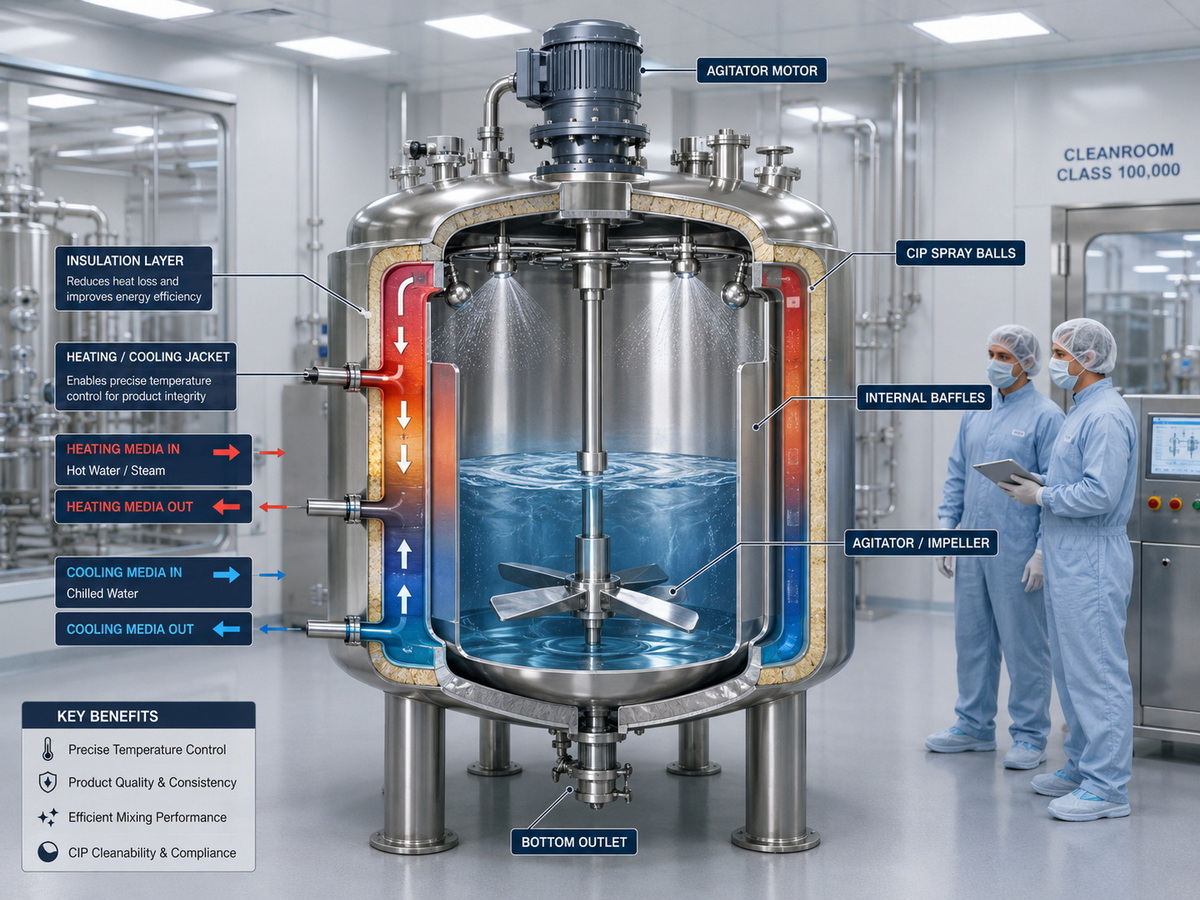
Jacketed mixing tanks are vessels with an outer jacket that allows heating or cooling media (steam, hot water, thermal oil, chilled water, glycol) to circulate around the product. This design provides direct area contact between the tank wall and heat-transfer fluid, enabling stable temperature profiles during exothermic or endothermic reactions. [tex-tanks]
Typical design features include: [sharpsvillecontainer]
- Single‑wall, dimple‑jacket, or full‑coil jacket configurations
- Vertical agitators with baffles for controlled mixing and shear
- Insulation and cladding to reduce heat loss and improve energy efficiency
- Optional sanitary designs (CIP/SIP) for pharmaceutical and biotech applications
For exothermic reactions, jacketed tanks are often preferred at lab and pilot scale because they are easy to operate, visually intuitive, and compact. [cnkosun]
What Are External Heat Exchangers?
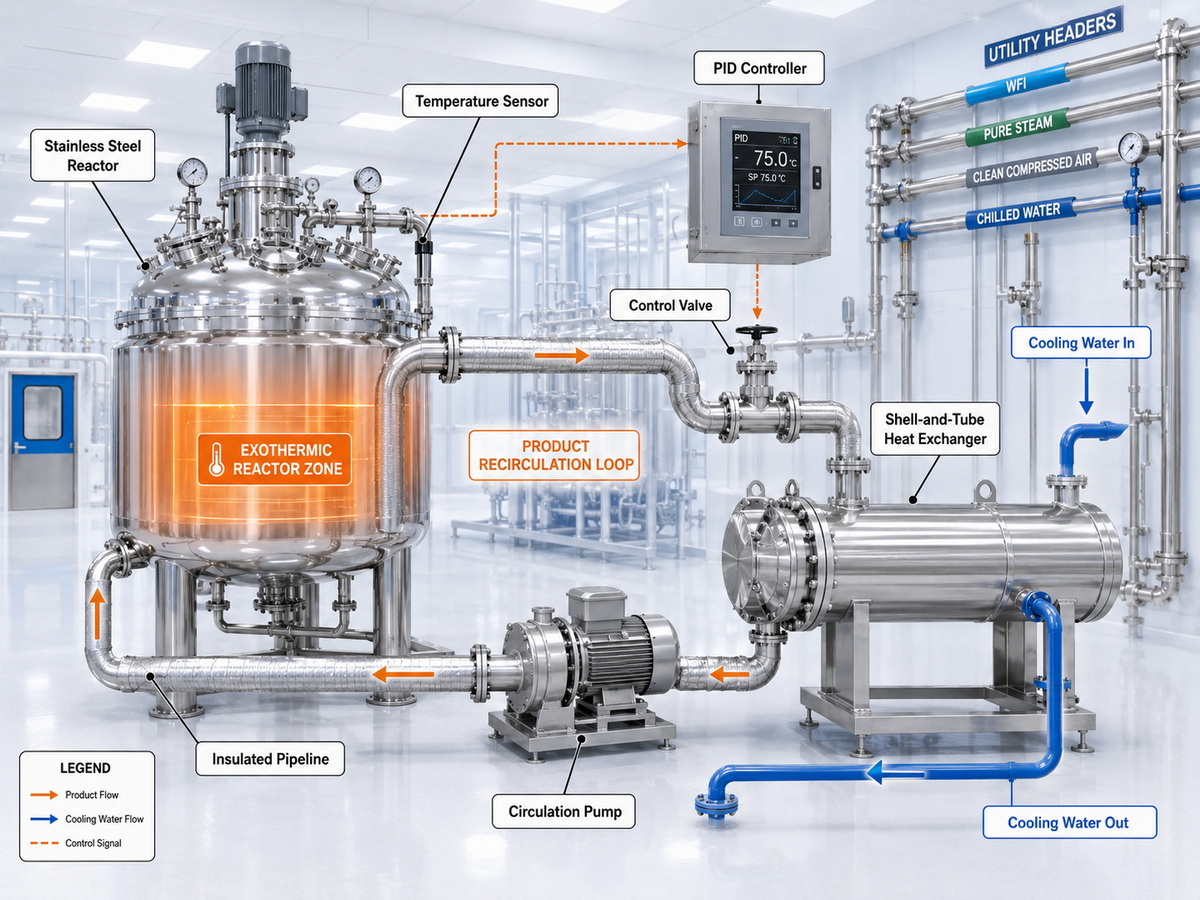
External heat exchangers are separate units—such as shell‑and‑tube, plate, or coil‑in‑shell exchangers—connected to the reactor or mixing tank via a recirculation loop. Product is pumped through the exchanger while a secondary utility (cooling water, brine, thermal oil) flows on the other side of a thermal boundary to remove or supply heat. [hal]
Key characteristics: [hal]
- Very high heat‑transfer area per footprint compared with jackets
- Flexible utility integration (multiple circuits, multi‑stage cooling)
- Easy expansion by adding exchangers in parallel or series
- Suitable for continuous processing and high throughput
In strongly exothermic systems—such as catalytic oxidations or polymerizations—external heat‑exchanger reactors are widely used to prevent hotspot formation and maintain narrow temperature windows. [sciencedirect]
Side‑By‑Side Comparison: Jacketed Tanks Vs External Heat Exchangers
Core Technical Differences
| Aspect | Jacketed Mixing Tanks | External Heat Exchangers |
| Primary function | Combined mixing and heat transfer in one vessel tex-tanks | Dedicated heat transfer with separate mixing vessel hal |
| Heat transfer area | Limited by tank wall surface tex-tanks | Easily increased via plates or tubes hal |
| Temperature uniformity | Good with proper agitation; risk of wall hotspots if mixing is poor sharpsvillecontainer | Excellent bulk control; risk of local film overheating if flow is low hal |
| Scale and throughput | Ideal for small to medium batches tex-tanks | Better for large scale or continuous duty sciencedirect |
| Cleaning & sterilization | CIP/SIP designs standard in pharma tanks cnkosun | Hygienic exchangers needed for sterile service hal |
| Footprint and layout | Compact, vertical installation sharpsvillecontainer | Requires floor space for exchanger skid and piping hal |
| CAPEX | Lower for simple batch systems tex-tanks | Higher initial investment but scalable hal |
Reaction Safety and Runaway Control
For highly exothermic reactions, the ability to remove heat faster than it is generated is critical to avoid runaways and thermal degradation. Heat‑exchanger/reactor concepts were developed specifically to enhance heat removal by tightly coupling reaction and heat transfer surfaces. [hal]
In practice:
- Jacketed tanks work well when the heat generation rate is moderate, the batch size is manageable, and agitator design ensures good wall wetting and mixing. [tex-tanks]
- External heat exchangers outperform jackets for strongly exothermic reactions, where a large and controllable heat‑transfer area is required to keep the reactor in a safe operating window. [sciencedirect]
Precision Temperature Control for Exothermic Reactions
Control Strategies in Jacketed Mixing Tanks
In a jacketed tank, temperature control typically uses: [tex-tanks]
- A PID temperature controller reading from an in‑tank RTD or thermocouple
- A control valve regulating steam, hot water, or cooling media in the jacket
- Sometimes a cascade loop between jacket outlet and product temperature for tighter control
To achieve precision temperature control in an exothermic batch, process engineers focus on: [sharpsvillecontainer]
1. Agitator design and speed to eliminate dead zones.
2. Optimized jacket zoning (multi‑zone jackets on large tanks).
3. Feed strategy (semi‑batch dosing of reactant) to spread out heat release.
This configuration is particularly attractive in pharmaceutical formulation, where maintaining narrow temperature bands during solution compounding or buffer preparation is essential for product stability. [cnkosun]
Control Strategies With External Heat Exchangers
For external exchangers, the control architecture often includes: [hal]
- A circulation pump drawing product from the reactor and returning it after cooling
- A control valve on the utility side (cooling water or brine)
- Flow and temperature interlocks to protect against pump failure or fouling
Advanced strategies, described in applied research on catalytic heat‑exchanger reactors, add side streams, staged cooling, and inert packing to smooth temperature profiles in highly exothermic systems. This makes external exchangers more suitable for high‑duty applications like nitration, hydrogenation, or high‑solids polymerization. [sciencedirect]
7 Practical Selection Criteria for Plant Engineers
From real project experience, most pharmaceutical and specialty chemical clients decide between jacketed tanks and external exchangers based on seven practical questions:
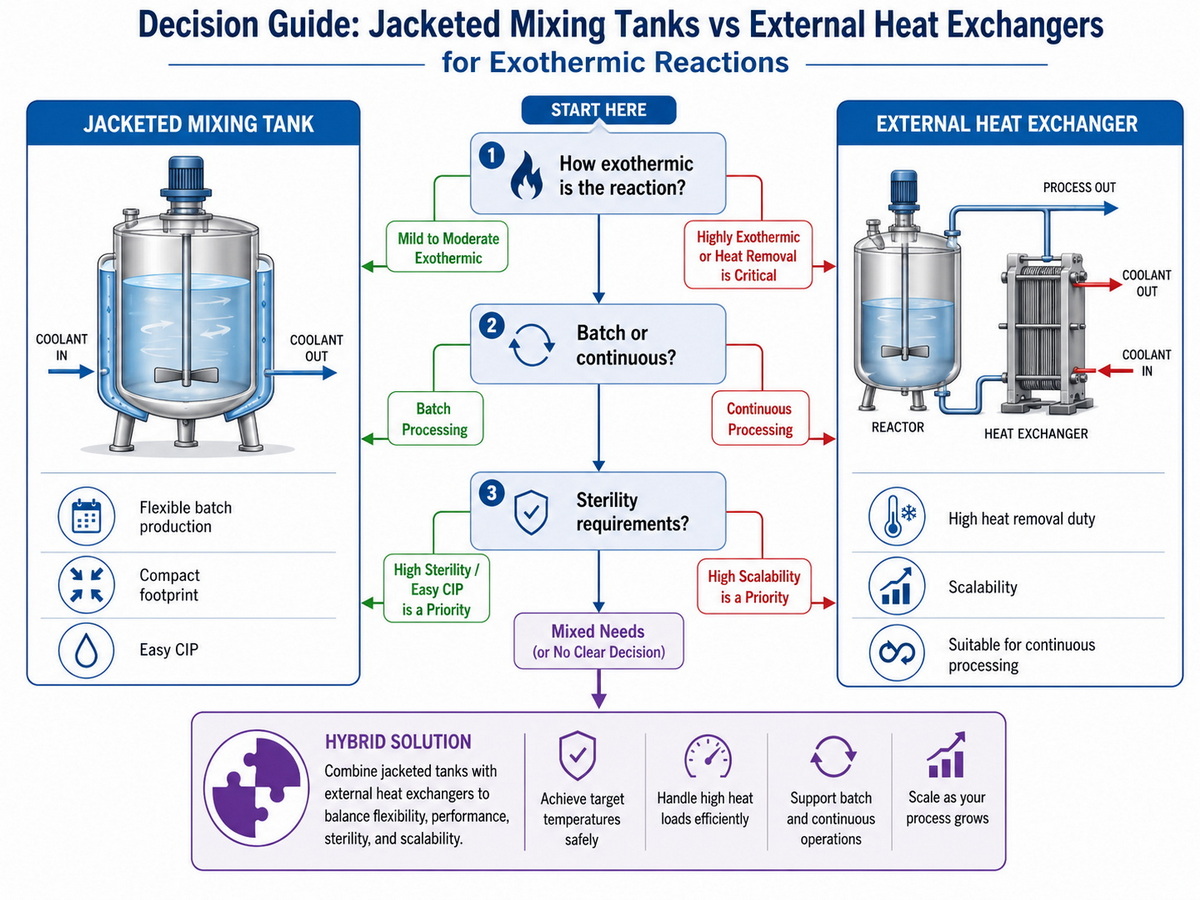
1. How exothermic is the reaction?
- Mild to moderate heat release → jacketed mixing tank usually sufficient. [tex-tanks]
- Strongly exothermic with tight safety margins → external heat exchanger or HEX‑reactor recommended. [sciencedirect]
2. Batch vs continuous?
- Batch or campaign production with frequent changeovers favors jacketed tanks for flexibility and simpler CIP. [cnkosun]
- Continuous or long campaigns at high throughput favor external exchangers. [hal]
3. Viscosity and solids content
- High‑viscosity or high‑solids slurries can be difficult to pump through plate or tube exchangers, making jacketed tanks with robust agitators more reliable. [sharpsvillecontainer]
4. Available footprint and layout
- Space‑constrained cleanrooms or mezzanines often push designers toward vertical jacketed vessels. [sharpsvillecontainer]
- Greenfield plants with central utility corridors can easily accommodate exchanger skids. [hal]
5. Cleanability and sterility
- In sterile pharmaceutical production, jacketed tanks with hygienic design and CIP/SIP are proven solutions. [cnkosun]
- External exchangers must be specified as sanitary plate or tubular designs and validated for cleanability. [hal]
6. Scalability and future capacity
- External exchangers are easier to scale by adding units in parallel or upgrading area, without replacing the main reactor. [hal]
7. Total cost of ownership
- While a bare reactor with jacket may be cheaper upfront, frequent campaigns of highly exothermic reactions can justify external exchangers due to improved safety, yield, and cycle time. [sciencedirect]
Step‑By‑Step: How a Design Review Typically Proceeds
When our engineering team works with pharmaceutical factories—especially those adding BFS or FFS filling lines—we usually follow a structured design review for exothermic reactors:
1. Define the reaction envelope
- Identify adiabatic temperature rise, maximum allowable temperature, and reaction order from lab and pilot data. [farabi]
2. Estimate heat duty and removal rate
- Calculate worst‑case heat release rate and required heat‑transfer area using standard reactor heat‑exchange models. [hal]
3. Shortlist technology options
- Option A: jacketed mixing tank with optimized agitation and multi‑zone jacket. [tex-tanks]
- Option B: basic reactor plus external plate or shell‑and‑tube exchanger. [hal]
- Option C: advanced heat‑exchanger reactor for catalytic or highly exothermic systems. [sciencedirect]
4. Check mechanical and hygienic constraints
- Available height, floor loading, CIP/SIP requirements, sterilization temperatures, and integration with downstream sterile filling (BFS/FFS). [everhealgroup]
5. Evaluate lifecycle economics
- Capex, expected cycle time, cleaning time, product yields, and energy consumption. [hal]
6. Run a HAZOP / safety review
- Assess runaway risk, cooling failure scenarios, valve failure, and emergency quench strategies. [hal]
This structured process produces a clear, auditable justification for selecting either a jacketed tank or an external exchanger as the primary temperature control solution.
Integration With Pharmaceutical Production Lines (BFS, FFS, Filling)
For Ningbo Everheal and similar OEMs, the choice between jacketed tanks and external heat exchangers is not isolated—it impacts the entire upstream‑to‑downstream value chain. Jacketed formulation tanks are widely used for preparing solutions, suspensions, and bulk intermediates that are later filled into BFS or FFS machines. [truking]
A few practical integration points we emphasize during plant layout planning:
- Upstream jacketed mixing tanks maintain tight temperature windows for active ingredients to protect stability before aseptic filling. [cnkosun]
- For extremely exothermic synthesis steps (for APIs or intermediates) located in a separate chemical area, external exchangers can shorten cycle times and stabilize process variability, feeding more consistent material to formulation rooms. [sciencedirect]
- The selected heat‑transfer strategy must accommodate CIP/SIP procedures and avoid cross‑contamination risks ahead of BFS and FFS packaging stages. [everhealgroup]
Expert Insights: When Jacketed Tanks Win—and When They Don't
Based on industry practice and published guidance on jacketed vessels and HEX reactors, some patterns emerge. [tex-tanks]
Jacketed mixing tanks are typically the better choice when:
- You are producing multiple products in campaign mode with frequent recipe changes. [cnkosun]
- Required heat removal is moderate and the reaction window is not ultra‑tight. [sharpsvillecontainer]
- Sterile or hygienic design is critical and CIP/SIP is mandatory. [cnkosun]
- Plant layout is vertical and space is constrained. [sharpsvillecontainer]
External heat exchangers usually win when:
- The reaction is strongly exothermic and safety margins are tight. [sciencedirect]
- You are designing a continuous or semi‑continuous line targeting high throughput. [hal]
- Future capacity expansion is expected and you want modular scalability. [hal]
- Your utility system and maintenance team can support more complex skids. [hal]
For many modern facilities, the optimal solution is hybrid: a jacketed reactor for baseline control, plus a high‑duty external exchanger loop for peak loads or emergency cooling. [hal]
How Ningbo Everheal Can Support Your Project
As a manufacturer of BFS machines, FFS equipment, and filling and sealing systems, Ningbo Everheal is already familiar with integrating process, packaging, and plant layout into turnkey solutions. Extending this scope upstream to jacketed mixing tanks or external heat‑exchanger loops gives you a single engineering partner from reaction design to final sterile filling. [truking]
When we support clients on large exothermic projects, we typically help with: [everhealgroup]
- Concept studies comparing jacketed reactors vs exchanger‑based systems for specific reactions
- 2D/3D layout planning to integrate mixing, heat transfer, and downstream BFS/FFS lines
- Utility balance calculations (steam, chilled water, brine, compressed air)
- Equipment specification, FAT/SAT, and validation support for regulated markets
This holistic approach reduces coordination risk, shortens commissioning time, and creates a clear single‑point responsibility for performance.
Actionable Next Step (CTA)
If you are evaluating jacketed mixing tanks versus external heat exchangers for an exothermic reaction—especially in a pharmaceutical or sterile filling context—the most effective next step is a brief, data‑driven feasibility review. Based on your reaction data, throughput targets, and plant layout, our engineering team can propose a clear, side‑by‑side design concept with estimated heat‑transfer area, safety margins, and integration into BFS/FFS lines. [truking]
Call to action:
Share your basic process parameters (reaction type, batch size or flow rate, solvent system, target temperature range) and we will outline a tailored temperature‑control concept, including whether a jacketed mixing tank, external heat exchanger loop, or hybrid solution will give you the safest and most economical path to scale‑up.
FAQs
Q1: Are jacketed mixing tanks safe enough for strongly exothermic reactions?
A1: Jacketed tanks can handle moderately exothermic reactions safely when properly sized and mixed, but for highly exothermic systems many studies recommend external heat‑exchanger reactors or hybrid designs to ensure sufficient heat‑removal capacity. [tex-tanks]
Q2: Do external heat exchangers complicate cleaning in pharmaceutical plants?
A2: External exchangers do add complexity, but sanitary plate or tubular exchangers are widely used in pharma and biotech; with validated CIP/SIP procedures they can meet the same hygienic standards as jacketed tanks. [hal]
Q3: Which option is more energy‑efficient?
A3: Energy efficiency depends on design, but external exchangers often achieve higher overall heat‑transfer coefficients and can be optimized for utility recovery, while well‑insulated jacketed tanks minimize distribution losses and are very efficient for smaller batches. [sharpsvillecontainer]
Q4: How does this choice affect downstream BFS or FFS packaging quality?
A4: Consistent reactor temperature control stabilizes product properties—such as viscosity, particle size, or API stability—which directly improves filling accuracy, sterility assurance, and defect rates on BFS and FFS lines. [truking]
Q5: Can I retrofit an existing jacketed tank with an external exchanger loop?
A5: Yes, many plants retrofit high‑duty external exchangers onto existing jacketed reactors to improve safety and capacity, provided the vessel nozzles, pump selection, and piping layout can support the required circulation flow. [sharpsvillecontainer]
Reference
1. TEX Tanks – *What Is a Jacketed Tank? Uses, Benefits, and Applications* – [Link] [tex-tanks]
2. Sharpsville Container – *A Guide to Different Types of Jacketed Tanks* – [Link] [sharpsvillecontainer]
3. Kosun – *Jacketed mixing tanks are essential equipment in many industries* – [Link] [cnkosun]
4. Anxionnaz et al. – *Heat exchanger/reactors (HEX reactors): Concepts, technologies* – [Link] [hal]
5. ScienceDirect – *Catalytic heat-exchanger reactor for strongly exothermic reactions* – [Link] [sciencedirect]
6. Farabi University – *Lecture 12: Heat Exchange in Reactors and Its Effect on Reaction* – [Link] [farabi]
7. Everheal – *China BFS Machine Manufacturer – Everheal* – [Link] [everhealgroup]
8. Truking – *Blow-Fill-Seal (BFS) Solution* – [Link] [truking]
9. GMI – *Form-Fill-Seal Machines Market Size 2025–2034* – [Link] [gminsights]
10. Mordor Intelligence – *Form-Fill-Seal Packaging Machine Market Size* – [Link] [mordorintelligence]
11. Foremost Media – *Google's E-E-A-T Algorithm Rewards Quality Content* – [Link] [foremostmedia]
12. WG Content – *E-E-A-T for Content Quality* – [Link] [wgcontent]
13. TopRank Marketing – *E-E-A-T and SEO: Optimizing for Google's Guidelines* – [Link] [toprankmarketing]


