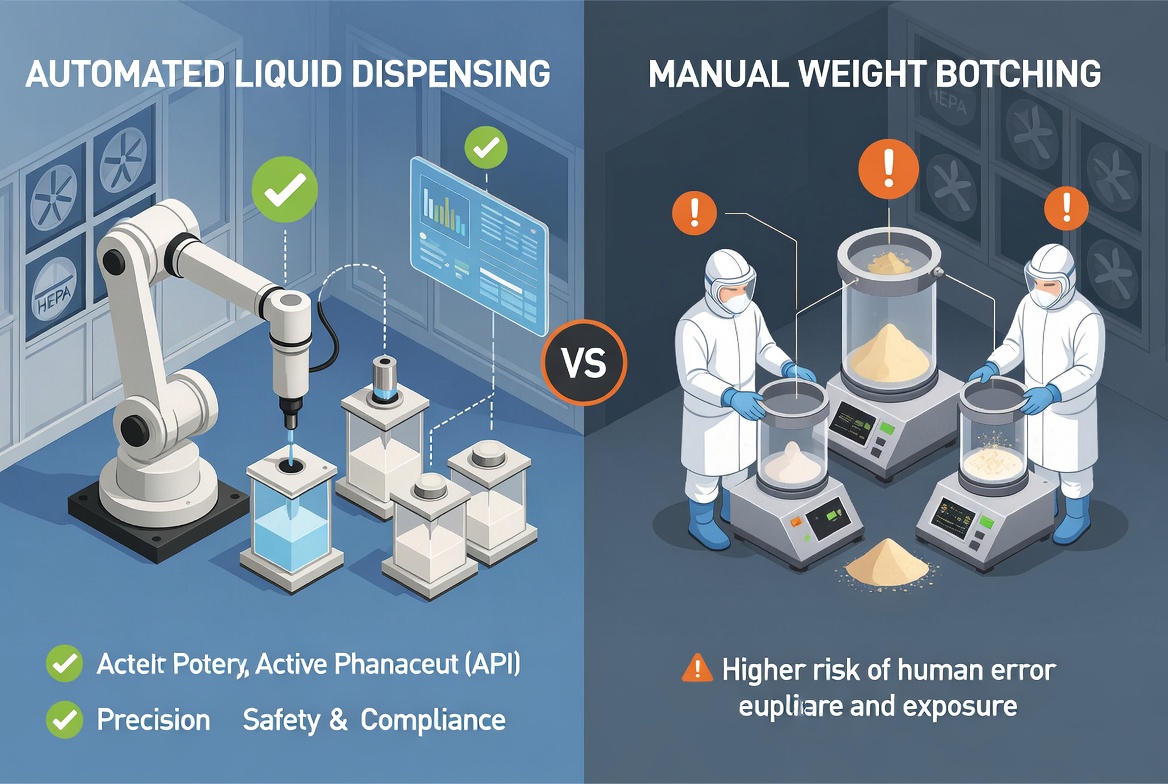
Automated liquid dispensing dramatically reduces human error and operator exposure in potent API handling compared with manual weight‑batching, especially when integrated into closed, aseptic filling and sealing lines such as BFS and FFS systems. For CDMOs and pharma manufacturers scaling highly potent APIs (HPAPIs), the right choice directly impacts containment, compliance, and long‑term OPEX. [pharmaceutical-technology]
Understanding Potent API Handling Today
Potent APIs and HPAPIs deliver therapeutic effects at very low concentrations, which makes even minor handling errors critical for both product quality and operator safety. In practice, this means that every microliter dispensed and every gram weighed must be controlled, documented, and traceable. [seqens]
Regulators now expect robust containment, closed transfer, and a clearly demonstrated strategy for minimizing manual interventions in high‑risk areas. As a result, pharma manufacturers are moving away from open, manual weight‑batching toward automated liquid dispensing integrated into fully or partially closed lines. [optima-packaging]
Automated Liquid Dispensing: What It Is
Automated liquid dispensing systems use pumps, valves, sensors, and software to deliver defined volumes of liquid APIs or concentrates into process vessels, intermediate containers, or directly into primary packaging. These systems are often embedded in filling and sealing equipment such as BFS (Blow‑Fill‑Seal), FFS (Form‑Fill‑Seal), or high‑speed vial/syringe lines. [truking]
Modern platforms combine sensor‑controlled pipetting or dosing with real‑time monitoring and feedback loops, which detect anomalies like clogs, air bubbles, or misaligned containers and stop the process before batch impact. When you connect these dispensers to an MES or SCADA system, they become a closed, data‑rich node in your overall manufacturing execution strategy. [sciencedirect]
Manual Weight‑Batching: Still Common, Increasingly Risky
Manual weight‑batching relies on operators weighing solid APIs or concentrated liquids on scales, often using scoops, spatulas, or syringes, and transferring them into mixers or compounding vessels. Even with SOPs and PPE, there are unavoidable human factors: fatigue, inconsistent technique, and varying interpretation of visual cues. [pharmaceutical-technology]
For potent APIs, manual operations typically require segregated rooms, high‑efficiency particulate air (HEPA) filtration, and extensive PPE, driving up facility and operational costs. In multi‑product plants, every manual touchpoint increases the risk of cross‑contamination and the burden of cleaning validation. [seqens]
Key Differences: Automated Liquid Dispensing vs Manual Weight‑Batching
High‑level comparison table
How Automated Liquid Dispensing Eliminates Human Error
1. Recipe‑driven dosing and interlocks
In automated systems, recipes are encoded in software, not in operator memory. The system enforces ranges for volume, density, and temperature; if readings drift outside limits, dosing stops and alarms trigger. [formulatrix]
This prevents common manual mistakes such as mis‑reading a decimal point, mixing up unit scales, or using an incorrect container size. Integrated barcode or RFID checks can also confirm material ID and lot, blocking dosing if the wrong API is connected. [bioprocessintl]
2. Sensor‑based verification and feedback
Advanced liquid handlers deploy sensors for pressure, flow, weight, or force to verify that each dispensed dose matches the target. If a pipette tip hits an obstruction or a bottle is missing, collision detection stops motion, preventing spillage and container breakage. [dispendix]
Instead of relying on a person to visually confirm each transfer, the system records every cycle, enabling statistical process control and continuous improvement. These data points feed into ongoing process validation and trending, supporting regulatory inspections. [bioprocessintl]
3. Closed systems for potent API containment
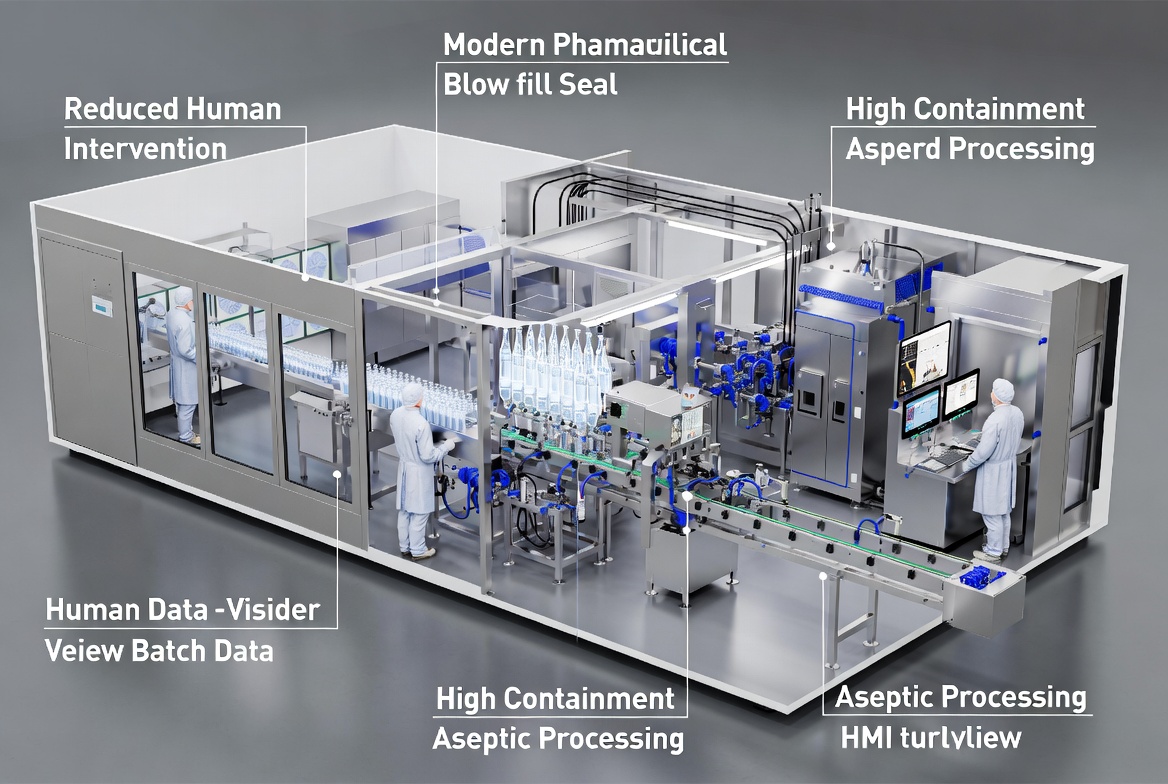
When automated liquid dispensing is integrated into BFS or FFS lines, filling and sealing occur within a closed or near‑closed aseptic environment. Blow‑Fill‑Seal technology, for example, extrudes, forms, fills, and seals plastic containers within 12–14 seconds under sterile, controlled air, with minimal human access. [mordorintelligence]
For potent APIs, combining automated dosing heads with isolators, gloveboxes, or closed system transfer devices (CSTDs) creates a containment barrier that significantly reduces airborne and surface contamination risk. This directly improves operator safety and simplifies occupational hygiene monitoring. [optima-packaging]
Risks and Limitations of Manual Weight‑Batching for Potent APIs
Even in well‑run facilities, manual weight‑batching introduces predictable failure modes.
- Weighing inaccuracies at low target masses due to balance resolution, environmental drift, or mis‑taring [pharmaceutical-technology]
- Spills and dust generation while scooping or pouring potent powders, even inside laminar flow hoods [optima-packaging]
- Documentation errors, such as illegible handwriting, wrong material codes, or missing timestamps [seqens]
- Operator variability, where different technicians interpret "good practice" differently despite SOPs [pharmaceutical-technology]
For HPAPIs, each of these issues carries a disproportionate impact, because the acceptable exposure levels (OELs) and cross‑contamination limits are extremely low. As exposure bands tighten and product portfolios become more diverse, purely manual weight‑batching becomes progressively harder to justify in risk assessments. [seqens]
Industry Trend: Automation and Robotics in HPAPI Manufacturing
Current HPAPI best‑practice guidance emphasizes isolators, engineered containment, and a shift toward automated and robotic handling wherever possible. Continuous manufacturing and closed transfer are highlighted as core strategies for both safety and efficiency. [optima-packaging]
Automation reduces manual touches, but it also standardizes how APIs are handled across lines, shifts, and sites. This harmonization makes it easier for global pharma companies to demonstrate consistent control to regulators while rolling out new products and scaling up capacity. [seqens]
Where BFS, FFS and Filling Lines Fit In
Form‑Fill‑Seal and Blow‑Fill‑Seal technologies are now widely adopted in sterile and non‑sterile liquid packaging due to their integration of forming, filling, and sealing in one machine. Market analyses show the global FFS machine segment exceeding 9 billion USD in value and continuing to grow at over 5% CAGR, driven by pharma and healthcare demand. [gminsights]
When potent APIs are formulated into liquid dose forms, combining automated liquid dispensing with BFS or FFS systems offers three key advantages: reduced packaging steps, fewer open transfers, and higher throughput in a compact plant footprint. Chinese and global manufacturers of BFS machines are increasingly designing their platforms around these containment and automation expectations. [chinese.alibaba]
Practical Implementation Steps for Moving from Manual to Automated
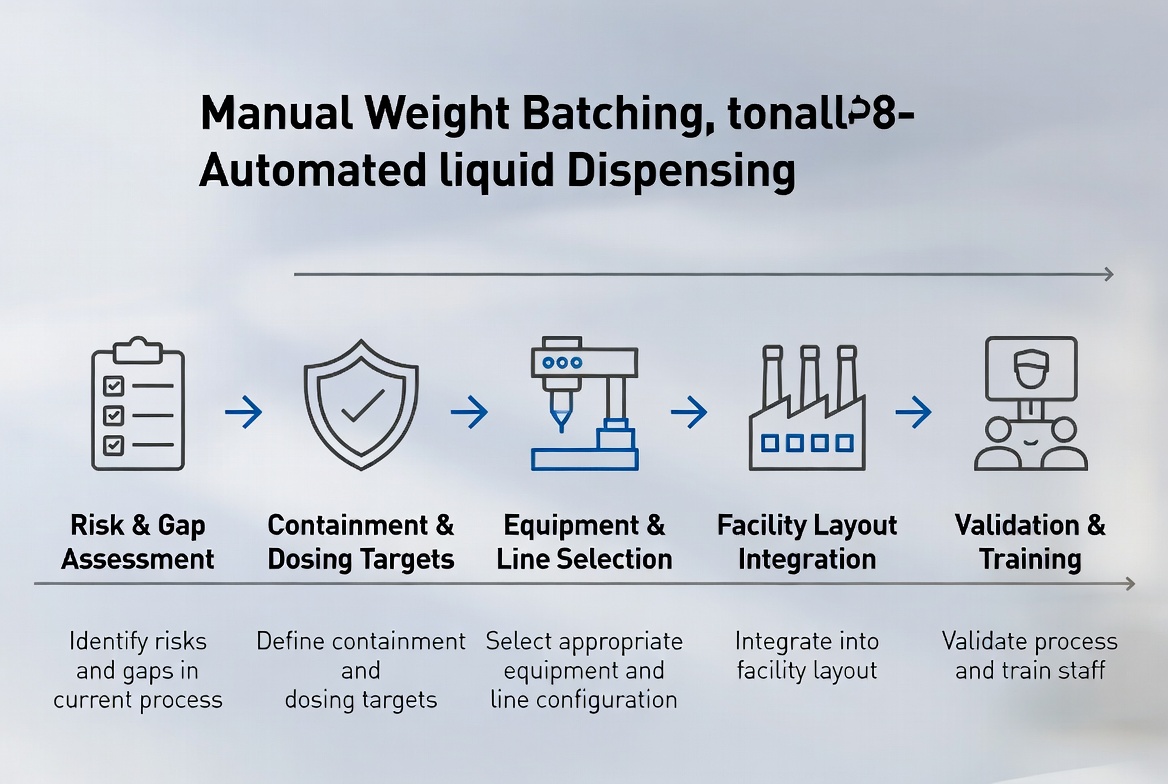
From a plant‑design and project perspective, transitioning from manual weight‑batching to automated liquid dispensing in potent API handling typically follows a phased roadmap.
1. Risk and gap assessment
- Map current manual weight‑batching steps, exposure points, and deviation history. [pharmaceutical-technology]
- Quantify OELs, operator exposure data, and cross‑contamination events.
2. Define containment and dosing targets
- Set performance requirements for dose accuracy, exposure limits, and target batch sizes. [optima-packaging]
- Align with regulatory expectations and internal quality standards.
3. Select equipment and line architecture
- Evaluate automated liquid dispensing platforms compatible with HPAPI containment (isolators, CSTDs). [dispendix]
- Decide on BFS, FFS, or conventional vial lines based on product mix and market needs. [sinoped]
4. Integrate with facility layout and utilities
- Align machine placement with directional airflow zones, cleanroom classes, and operator flows. [pharmaceutical-technology]
- Plan for CIP/SIP, buffer preparation, and waste handling.
5. Validation, training, and change management
- Develop URS, FAT/SAT protocols, and process validation plans addressing automated dosing and containment performance. [seqens]
- Retrain operators from weighing roles to supervisor and monitoring roles, emphasizing system alarms and data integrity.
Expert Perspective: When Manual Weight‑Batching Still Makes Sense
From an industry‑expert viewpoint, manual weight‑batching is not obsolete, but its role is changing. It still fits when:
- Working with early‑phase R&D and very small batches where flexible experimentation is needed [seqens]
- Handling low‑potency or non‑hazardous APIs where exposure and cross‑contamination risks are limited [optima-packaging]
- Operating in micro‑scale niche facilities where full automation is not economically viable [gminsights]
However, for commercial HPAPI production or global supply, automated liquid dispensing linked to closed systems provides a more robust, auditable, and scalable answer to both safety and quality requirements. [dispendix]
CTA: Design Your Next Potent API Line Around Automation
If your facility is still relying on manual weight‑batching for potent APIs, now is the time to reassess the risk profile and lifecycle costs. By integrating automated liquid dispensing into closed BFS, FFS, or filling and sealing lines, you can reduce human error, protect operators, and standardize quality across every batch.
Consider partnering with an equipment supplier that combines line‑level automation expertise with custom factory layout design, so your next HPAPI project is built on containment, efficiency, and regulatory confidence from day one. [everhealgroup]
FAQs
1. Is automated liquid dispensing always more accurate than manual weight‑batching?
Automated liquid dispensing systems are designed for high precision and repeatability, especially when combined with sensor feedback and validated recipes. Manual weight‑batching can achieve good accuracy, but it is more vulnerable to operator variability and fatigue over time. [sciencedirect]
2. How does automation improve operator safety with potent APIs?
Automation shifts many direct handling tasks into closed systems or isolators, drastically reducing the need for operators to weigh and transfer potent materials directly. This leads to lower airborne exposure, less surface contamination, and a reduced PPE burden. [pharmaceutical-technology]
3. What type of products benefit most from BFS with automated dispensing?
Unit‑dose liquids such as ophthalmic solutions, inhalation products, sterile injectables, and oral liquids with potent APIs benefit strongly from BFS lines with integrated automated dosing and sealing. These configurations provide high throughput, aseptic assurance, and minimized manual intervention. [truking]
4. Is it possible to retrofit existing manual processes with automation?
Yes, many manufacturers phase in automated liquid dispensing modules, isolators, or semi‑automated stations into existing layouts rather than rebuilding entire plants. A structured risk and gap assessment can identify the highest‑value manual steps to automate first. [dispendix]
5. How does automation support regulatory inspections and audits?
Automated systems typically provide electronic batch records, alarm logs, and trend data that clearly document dosing accuracy, containment performance, and cleaning validation. This transparency makes it easier to demonstrate control of potent APIs compared with paper‑based manual processes. [optima-packaging]
References
1. Pharmaceutical Technology – "The rules on HPAPI containment in high potent manufacturing." [Link] [pharmaceutical-technology]
2. SEQENS – "Enhancing Safety and Efficiency in HPAPI Manufacturing – Best Practices and Trends." [Link] [seqens]
3. Optima Packaging – "Safe processing of highly potent active ingredients." [Link] [optima-packaging]
4. DISPENDIX – "Liquid Handlers: Advantages and Applications." [Link] [dispendix]
5. ScienceDirect – "Piston‑driven automated liquid handlers." [Link] [sciencedirect]
6. BioProcess International – "Automated Liquid Handlers as Sources of Error." [Link] [bioprocessintl]
7. BFS solution overview – "Blow‑Fill‑Seal Solution" (PDF). [Link] [truking]
8. Mordor Intelligence – "Form‑Fill‑Seal Packaging Machine Market." [Link] [mordorintelligence]
9. Global Market Insights – "Form‑Fill‑Seal Machines Market Size." [Link] [gminsights]
10. MedicalExpo – "Blow‑fill‑seal machines and pharma filling equipment." [Link] [medicalexpo.com]


