Magnetic agitators and mechanical shaft mixers can both support delicate pharmaceutical protein formulations, but they manage shear stress, contamination risk, and overall lifecycle costs in very different ways. For biologics, mAbs, and high-value injectables, the mixing technology you choose can be the difference between a robust, scalable process and repeated batch failures. [hollandapt]
Understanding Shear Stress in Protein Mixing
In biopharmaceutical manufacturing, shear stress arises from velocity gradients and turbulence around impellers, baffles, and vessel walls. Excessive shear can denature proteins, cause aggregation, and increase sub‑visible particles in final drug products. [pharmafocuseurope]
Biologics like monoclonal antibodies, fusion proteins, and complex vaccines are particularly sensitive because their tertiary and quaternary structures are easily disrupted by mechanical forces. This is why low‑shear mixing has become a core design criterion in upstream and downstream process engineering. [kewaunee]
From an operator's perspective on a fill‑finish line, every time you see unexplained viscosity shifts, filtration clogging, or potency drift, you should suspect either temperature excursions or hidden shear events during mixing or recirculation. [pharmafocuseurope]
Magnetic Agitators: Design, Benefits, and Limitations
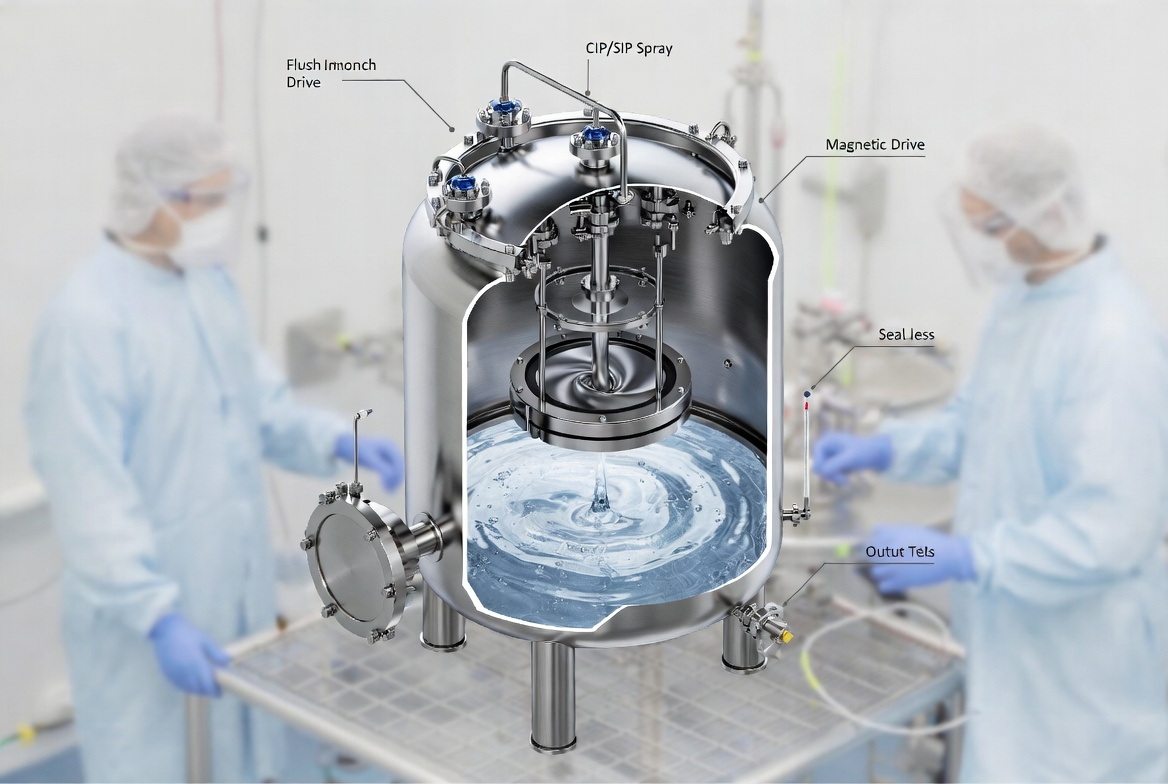
Magnetic agitators use an external drive magnet to transmit torque through the tank wall to an internal impeller, eliminating the need for a rotating shaft and mechanical seal. This seal‑less architecture is now standard in many sterile formulation and holding vessels for parenteral drugs. [zeta]
Key design features
- Bottom‑mounted drive with an internal impeller coupled magnetically through a containment shell. [hollandapt]
- Smooth, fully drainable surfaces, often in 316L stainless steel with electropolished finishes for CIP/SIP compatibility. [zeta]
- Optimized low‑shear impeller geometries for gentle agitation of suspensions and protein solutions. [zeta]
Advantages for protein formulations
- No shaft seal, no lubrication point: This removes a major contamination risk and significantly simplifies aseptic validation in fill‑finish environments. [hollandapt]
- Very low risk of dead zones around seals or bearings, which helps control bioburden and endotoxin levels in biologics. [hollandapt]
- Lower mechanical shear than high‑speed top‑entry mixers, especially at the bottom of tall, narrow vessels used in formulation and feed tanks. [zeta]
- Reduced utility consumption because there is no steam‑or gas‑barrier requirement for shaft seals, and SIP cycles are more straightforward. [zeta]
Practical limitations
- Torque limits: Magnetic couplings can decouple at very high viscosities or when attempting aggressive solid suspension, which limits their role in heavy slurries. [zeta]
- Typically best suited for low to medium viscosity protein formulations, buffers, and excipient blends, rather than bulk powder wetting or high‑solid slurries. [hollandapt]
- Retrofitting older vessels may require vessel modification and careful magnetic coupling design.
Mechanical Shaft Mixers: Design, Strengths, and Risks
Mechanical shaft mixers use a motor, gearbox, and a physical shaft that penetrates the vessel head or side, transferring torque to one or more impellers. This design is still dominant in large‑scale reactors, buffer prep tanks, and CIP vessels where high power input and flexibility are required. [kewaunee]
Key design features
- Top‑entry or side‑entry shafts with one or multiple impellers (e.g., Rushton, pitched‑blade, hydrofoil) tailored to target Reynolds numbers and mixing regimes. [hollandapt]
- Mechanical seals or double mechanical seals with barrier fluid systems to prevent product leakage. [hollandapt]
- Highly scalable with standard agitation correlations used in large fermenters and process vessels. [kewaunee]
Advantages for bioprocessing
- High torque capacity: Ideal for high‑viscosity media, powder wetting, and bulk suspension where more aggressive mixing is needed. [kewaunee]
- Flexible impeller selection to balance shear, mixing time, and oxygen transfer in upstream processes. [kewaunee]
- Well‑understood hydrodynamics and scale‑up relationships for process engineers.
Risks and drawbacks for delicate proteins
- Shaft seals introduce shear and contamination risk, especially if operated at high speeds or with inadequate barrier fluid management. [hollandapt]
- High tip speeds can create localized zones of intense shear that damage sensitive proteins, even when average power input appears acceptable. [pharmafocuseurope]
- More complex cleaning, with potential product hold‑up around seals, bearings, and shaft entries. [hollandapt]
Side‑by‑Side Comparison: Magnetic Agitators vs Mechanical Shaft Mixers
Mixing technology comparison for protein formulations
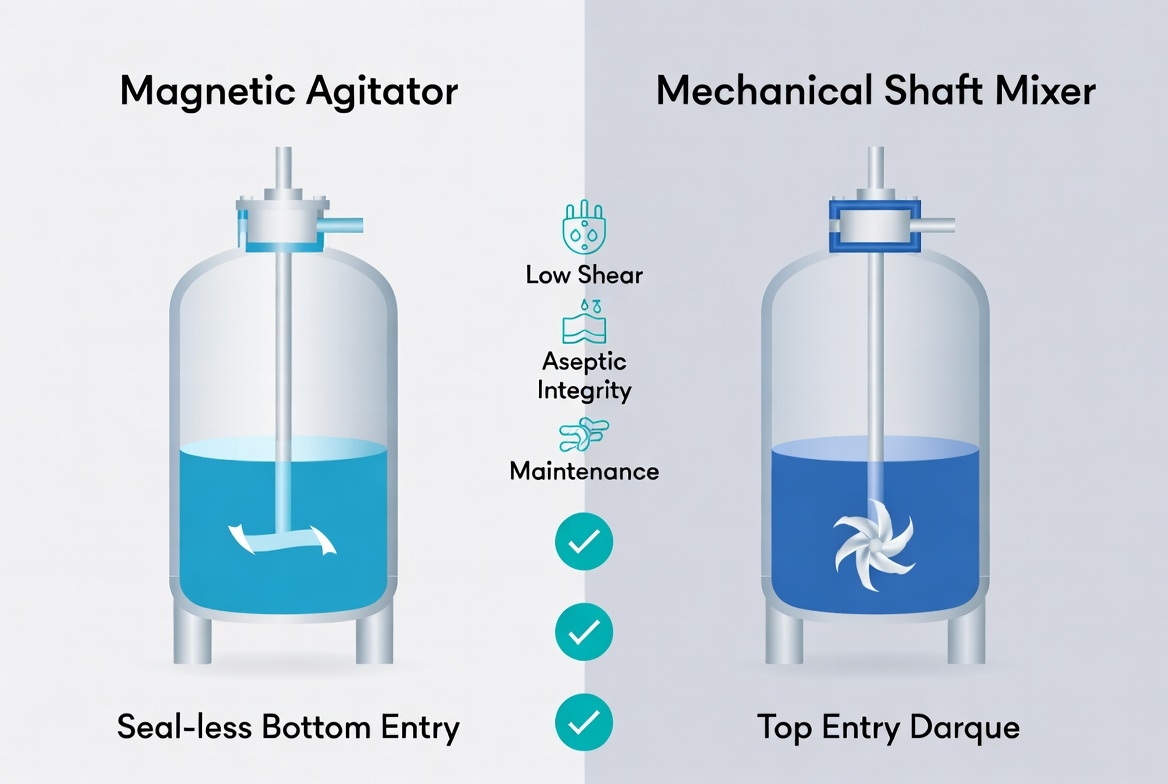
| Aspect | Magnetic agitators | Mechanical shaft mixers |
| Contact seal | Seal‑less, magnetically coupled. (hollandapt) | Mechanical seals or double seals. (hollandapt) |
| Shear profile | Low, gentle agitation suitable for delicate proteins. (hollandapt) | Highly variable; can be high near impeller tips. (hollandapt) |
| Aseptic integrity | Excellent, minimal leakage paths. (hollandapt) | More challenging; seals are critical failure points. (hollandapt) |
| Viscosity range | Best for low–medium viscosity liquids. (zeta) | Handles a wide range up to high viscosity. (kewaunee) |
| Maintenance | Lower; no seal replacement. (hollandapt) | Higher; periodic seal and bearing service. (hollandapt) |
| CIP/SIP effort | Simpler, fewer dead zones. (hollandapt) | More complex, especially around seals and shafts. (hollandapt) |
| Capital cost | Higher per vessel in many cases. (zeta) | Often lower initial cost but higher lifecycle cost. (hollandapt) |
| Preferred use | Final formulation, hold and feed tanks, aseptic processing. (hollandapt) | Bulk mixing, upstream reactors, viscous slurries. (hollandapt) |
For biologics formulated in FFS, BFS, or traditional vial lines, process engineers now frequently standardize on magnetic agitators for final compounding and holding tanks, while retaining mechanical shaft mixers in upstream and utility vessels. [pharmafocuseurope]
How Mixing Choice Prevents Shear‑Induced Protein Damage
From the standpoint of a process engineer responsible for commercial monoclonal antibody lines, preventing shear damage comes down to four practical levers: impeller design, power input, residence time near high‑shear zones, and process integration with your filling equipment. [pharmafocuseurope]
1. Impeller geometry and speed
- Magnetic agitators typically use wide‑blade, low‑shear impellers, operating at moderate speeds to minimize localized shear peaks. [zeta]
- Mechanical shaft mixers may use hydrofoils or pitched blades, but if speed is set purely to meet mixing time targets, protein damage can occur in the vicinity of the impeller. [kewaunee]
2. Residence time in shear zones
- In a shaft mixer, fluid elements can repeatedly pass close to high‑shear regions near the impeller and seal, increasing cumulative mechanical stress on proteins. [hollandapt]
- With a well‑designed magnetic agitator, the absence of seals and the smoother flow pattern reduces repeated exposure to extreme shear. [zeta]
3. Integration with filling lines
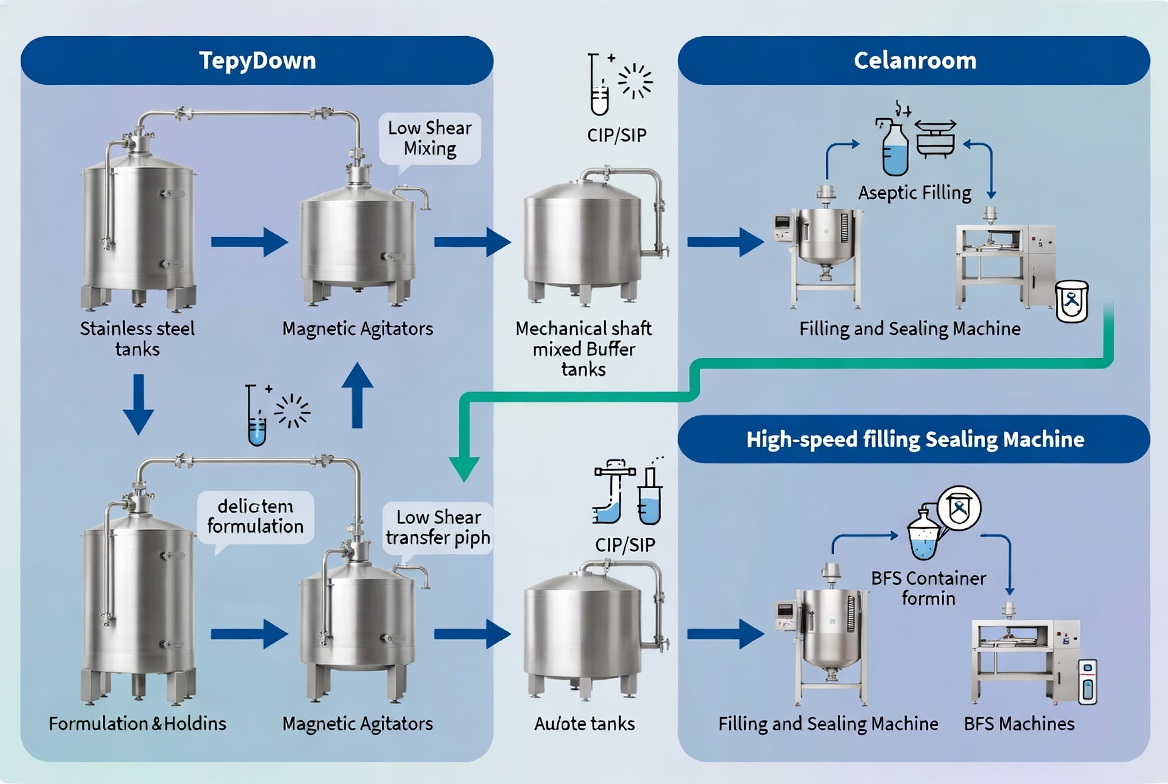
In fill‑finish operations feeding FFS, BFS, or conventional filling and sealing machines, shear can also arise in pumps, recirculation loops, and narrow transfer lines. An integrated design approach that pairs low‑shear vessel agitation with low‑shear transfer reduces overall protein damage risk. [truking]
Expert Perspective: How Integrated Lines Reduce Shear Risk
As an equipment partner designing end‑to‑end pharmaceutical production lines, a practical way to protect delicate proteins is to design the mixing strategy together with filling and sealing equipment selection from the start. [everhealgroup]
For example, Ningbo Everheal Medical Equipment Co., Ltd. delivers customized lines where:
- Upstream formulation and intermediate tanks can use magnetic agitators to maintain homogeneity of protein solutions with minimal shear. [everhealgroup]
- High‑capacity mixing or buffer prep vessels may retain mechanical shaft mixers for more demanding operations like powder wetting and CIP solution preparation. [everhealgroup]
- Downstream, Filling and Sealing Machines, FFS Machines, and BFS Machines are specified with appropriate pumps, nozzles, and transfer piping that avoid unnecessary pressure drops and cavitation, further minimizing mechanical stress on proteins. [chinese.alibaba]
From a user experience standpoint on the plant floor, this integrated approach reduces unplanned deviations, simplifies cleaning validation, and provides a clear logic: low‑shear, aseptic equipment where the protein is most vulnerable; high‑power equipment where bulk processing is required.
Step‑by‑Step: Selecting the Right Mixer for Protein Formulations
When helping a pharma plant team choose between magnetic agitators and mechanical shaft mixers, a structured decision path keeps projects on schedule and within budget. [pharmafocuseurope]
1. Define the product and sensitivity
- Identify protein type, concentration, excipients, and known shear sensitivity from development studies. [pharmafocuseurope]
2. Clarify the process step
- Final formulation, intermediate hold, buffer prep, or upstream bioreaction will have different shear and mixing requirements. [kewaunee]
3. Determine viscosity and solids load
- Low‑viscosity, clear solutions favor magnetic agitators; high‑viscosity media and powder suspensions may require mechanical shaft mixers. [zeta]
4. Set aseptic and cleaning requirements
- For high‑risk aseptic fills (injectables, ophthalmics, vaccines), seal‑less magnetic systems usually provide superior contamination control. [zeta]
5. Integrate with the filling line
- Align mixer selection with FFS/BFS/filling machine design, pump selection, and recirculation strategy to manage total shear exposure. [everhealgroup]
6. Evaluate lifecycle cost, not just CAPEX
- Compare seal replacement, unplanned downtime, and cleaning validation overhead against the higher initial investment in magnetic technologies. [kewaunee]
Real‑World Use Cases in Biopharma Facilities
Case 1: mAb formulation tank for BFS line
A biopharma producer preparing a monoclonal antibody solution for a BFS line adopted a bottom‑mounted magnetic agitator for the final formulation tank to minimize shear and avoid contamination risk from shaft seals. Paired with a low‑shear feed loop into the BFS machine, this configuration helped maintain protein stability and reduced filter fouling incidents between batches. [truking]
Case 2: High‑viscosity vaccine adjuvant mixing
For a high‑viscosity adjuvant suspension, a mechanical top‑entry shaft mixer with a carefully selected impeller and controlled speed offered sufficient torque to keep particles uniformly suspended without excessive shear. In this scenario, the team focused on seal reliability, barrier fluid management, and robust CIP to control contamination risk. [kewaunee]
These examples illustrate an important principle: both technologies have a place in a modern plant, but the optimal choice depends on viscosity, aseptic risk, and protein sensitivity.
Industry Trends: Biologics, Personalized Medicine, and Mixing Strategy
As the biopharmaceutical industry moves toward more complex biologics, gene therapies, and personalized medicines, the tolerance for batch loss due to mixing‑related instability is shrinking. Manufacturers face shorter timelines, higher product value per liter, and tighter regulatory scrutiny around particulate matter and product quality attributes. [ppd]
Trends that are shaping mixing strategy include:
- Growth of next‑generation biologics (bispecifics, fusion proteins, mRNA‑based products) that are often more shear‑sensitive than traditional small molecules. [pharmafocuseurope]
- Increased use of single‑use technologies and modular cleanroom architectures, where compact magnetic agitators integrate well with disposable systems and hybrid stainless‑steel lines. [kewaunee]
- Expanded use of AI and advanced analytics to model mixing, predict shear hot spots, and optimize impeller designs before equipment procurement. [ppd]
In this context, low‑shear, aseptic‑friendly technologies like magnetic agitators align closely with the direction of modern biologics facilities, especially when paired with automated FFS and BFS lines.
How Ningbo Everheal Supports Low‑Shear Protein Lines
Ningbo Everheal Medical Equipment Co., Ltd. provides complete pharmaceutical production line solutions, from engineering design and equipment integration to installation and commissioning. For clients focused on delicate protein formulations, the company can: [everhealgroup]
- Specify and integrate magnetic agitators in key formulation and holding vessels to minimize shear and contamination risk. [everhealgroup]
- Combine mechanical shaft mixers where high‑torque bulk mixing is required, ensuring appropriate impeller designs and operating parameters. [everhealgroup]
- Match vessel agitation strategies with high‑performance Filling and Sealing Machines, FFS Machines, and BFS Machines, delivering a coherent, low‑shear solution from mixing tank to final container. [chinese.alibaba]
For global pharma manufacturers, partnering with an equipment provider that understands both mixing technology and high‑speed filling is a practical way to de‑risk biologics scale‑up and commercialization.
FAQs: Magnetic Agitators, Mechanical Mixers, and Protein Shear
Q1. Are magnetic agitators always better for biologics?
Not always. Magnetic agitators are often ideal for low‑viscosity, aseptic protein formulations, but high‑viscosity or high‑solid operations may still require mechanical shaft mixers with carefully controlled shear. [hollandapt]
Q2. Can mechanical shaft mixers be used safely with sensitive proteins?
Yes, if impeller type, speed, and process conditions are carefully optimized to limit local shear, and if seals are well maintained to preserve aseptic conditions. [kewaunee]
Q3. Do magnetic agitators reduce cleaning and validation effort?
They typically simplify CIP/SIP because there are fewer dead zones and no shaft seals to clean, which can reduce validation complexity in aseptic environments. [zeta]
Q4. How does mixing choice affect BFS or FFS filling quality?
If mixing or transfer generates shear‑induced aggregates or bubbles, downstream BFS/FFS filling can suffer from foaming, nozzle dripping, and filter fouling, so low‑shear mixing directly improves filling stability. [truking]
Q5. When should a plant consider upgrading from mechanical to magnetic mixing?
Common triggers include biologics pipeline expansion, rising batch failure rates linked to instability, or regulatory findings related to particulates or aseptic risk around mechanical seals. [pharmafocuseurope]
References
1. Holland Applied Technologies. "Sanitary Mag Mixers. When Should You Use One?" [](https://hollandapt.com/sanitary-mag-mixers-when-should-you-use-one/)
2. ZETA. "Magnetic Agitators." [](https://www.zeta.com/product/magnetic-agitators/)
3. PharmaFocus Europe. "Emerging Trends and Technologies in Biopharmaceuticals." [](https://www.pharmafocuseurope.com/biopharma/emerging-trends-and-technologies-in-biopharmaceuticals)
4. Kewaunee. "Biopharmaceutical Production: Innovations and Trends." [](https://www.kewaunee.in/blog/biopharmaceutical-production-innovations-and-trends/)
5. PPD. "Five Key Trends Shaping Biopharma and Biotech in 2025." [](https://www.ppd.com/blog/2025-biopharma-biotech-trends/)
6. Ningbo Everheal Medical Equipment Co., Ltd. "Customized Pharmaceutical Production Line Manufacturers." [](https://www.everhealgroup.com/pharmaceutical-production-line.html)
7. Ningbo Everheal Medical Equipment Co., Ltd. "Customized Pharmaceutical Filling Equipment Manufacturers." [](https://www.everhealgroup.com/pharmaceutical-filling-equipment.html)
8. Truking. "Blow‑Fill‑Seal Solution (BFS)." [](https://www.truking.com/uploadfiles/2024/09/20240909141902002.pdf)
9. Alibaba. "Liquid Blow‑Fill‑Seal Auto‑Form Medical Packaging System." [](https://chinese.alibaba.com/product-detail/Modern-Liquid-Blow-Fill-Seal-Auto-1601256063906.html)


