316L stainless steel and Hastelloy alloys represent two fundamentally different material choices for pharmaceutical mixing tanks handling acidic intermediates, with Hastelloy offering superior corrosion resistance in highly aggressive environments while 316L provides cost-effective performance for moderate applications. As a pharmaceutical equipment manufacturer specializing in BFS machines, FFS systems, and complete production line solutions at Ningbo Everheal Medical Equipment Co., LTD., we've witnessed firsthand how material selection directly impacts production efficiency, product purity, and long-term operational costs in pharmaceutical manufacturing. [huaxiaometal]
Understanding Material Composition and Corrosion Mechanisms
316L Stainless Steel Composition
316L stainless steel contains approximately 16% chromium, 10% nickel, 2-3% molybdenum, and less than 0.03% carbon. The "L" designation indicates low carbon content, which minimizes carbide precipitation during welding and enhances corrosion resistance. The molybdenum content provides improved resistance to pitting and crevice corrosion compared to standard 304 stainless steel, making it a popular choice for pharmaceutical equipment, process piping, and storage tanks. [engmotion]
The passivation layer formed on 316L surfaces provides general corrosion protection in mildly acidic environments. However, this protective layer becomes vulnerable when exposed to halogen-containing acids or highly concentrated corrosive media. In pharmaceutical intermediate production, where processes may involve hydrochloric acid, sulfuric acid, or chloride-bearing solutions, this limitation becomes critically important. [facebook]
Hastelloy Alloy Composition
Hastelloy C-276, the most common grade for pharmaceutical applications, is a nickel-based superalloy containing remainder nickel (approximately 57%), 15-17% molybdenum, 14.5-16.5% chromium, 3-4.5% tungsten, and 4-7% iron. This composition delivers exceptional resistance to both oxidizing and reducing environments. The high nickel content provides foundational corrosion resistance and high-temperature performance, while molybdenum enhances resistance to pitting and crevice corrosion in chloride-containing solutions. [megamex]
Unlike stainless steels that rely on a passive chromium oxide layer, Hastelloy's corrosion resistance stems from its dense, stable surface film that remains intact even in highly aggressive chemical environments. This fundamental difference explains why Hastelloy maintains structural integrity where 316L fails rapidly. [haynesintl]
Corrosion Resistance in Acidic Pharmaceutical Environments
Hydrochloric Acid Resistance
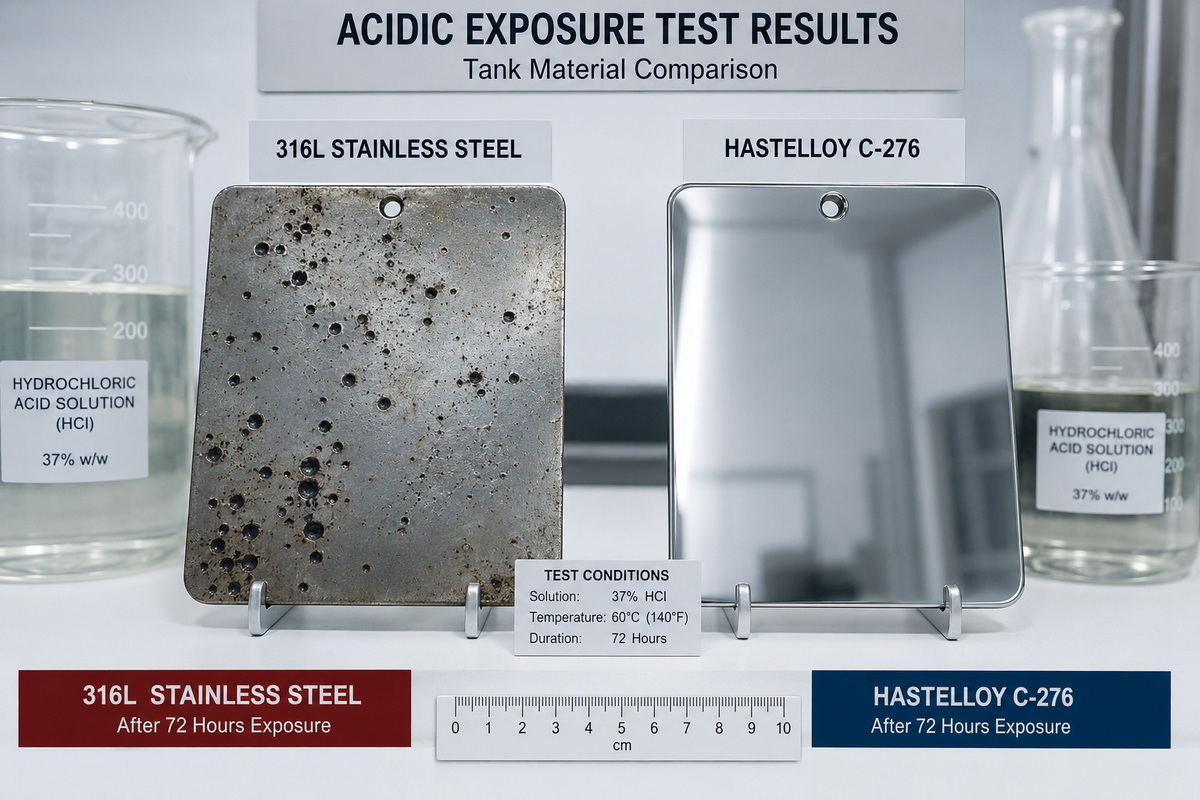
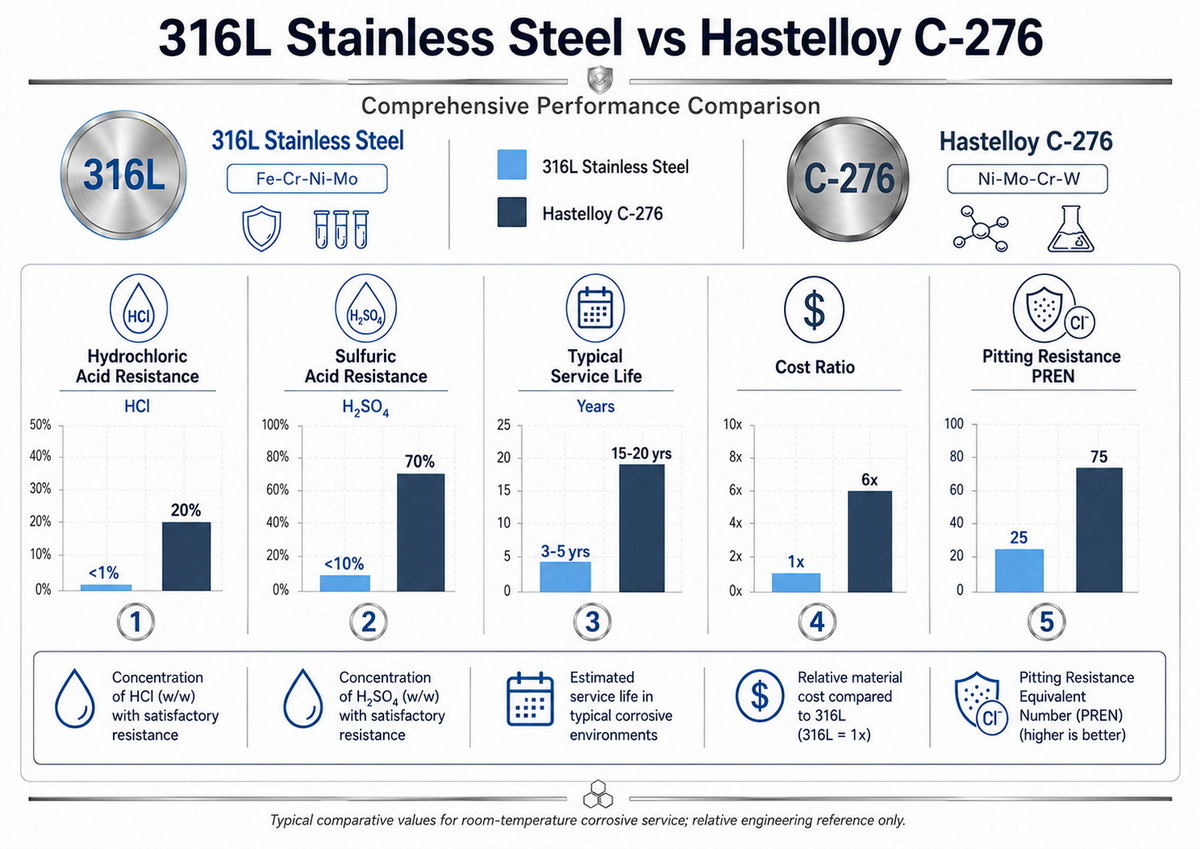
The performance gap between 316L and Hastelloy becomes most pronounced in hydrochloric acid (HCl) environments. Common stainless steel types including 304 and 316 should be considered non-resistant to hydrochloric acid at any concentration and temperature. Even at concentrations below 3% and ambient temperatures, 316L may suffer localized attack through crevice and pitting corrosion. [bssa.org]
In stark contrast, Hastelloy C-276 provides quantum improvement over stainless steels at HCl concentrations above 5%, offering resistance to concentrations up to the 20% azeotrope limit. Laboratory testing demonstrates this difference dramatically: when immersed in concentrated hydrochloric acid for just 30 minutes, 316L stainless steel develops a black corrosion layer indicating significant material degradation, while Hastelloy C-276 shows no visible damage under identical conditions. [facebook]
Sulfuric Acid and Mixed Acid Performance
For sulfuric acid resistance, 316L shows limited capability at low concentrations and temperatures—typically up to 5% concentration at temperatures below 120°F (49°C). Higher concentrations or elevated temperatures rapidly accelerate corrosion rates. Pharmaceutical intermediate synthesis often requires higher acid concentrations and processing temperatures, making 316L unsuitable for these applications. [metalshims]
Hastelloy C-276 exhibits outstanding resistance to sulfuric acid across a broader concentration and temperature range. The alloy's high molybdenum and tungsten content specifically targets resistance to reducing acids like sulfuric acid. Additionally, Hastelloy demonstrates exceptional resistance to mixed acid environments commonly encountered in pharmaceutical intermediate production, including formic acid, acetic acid, phosphoric acid, and combinations with chloride contaminants. [csidesigns]
Oxidizing Media and Chloride Solutions
While 316L performs adequately in mildly oxidizing conditions, its molybdenum content actually reduces resistance to highly oxidizing acids such as nitric acid compared to basic 18-8 stainless steels. This limitation affects pharmaceutical processes involving oxidizing cleaning agents or certain synthesis pathways. [metalshims]
Hastelloy's balanced chromium and molybdenum contents enable it to withstand both oxidizing and non-oxidizing acids. The alloy shows exceptional resistance to ferric and cupric chlorides, hot contaminated organic and inorganic media, chlorine gas, hypochlorite solutions, and chlorine dioxide—all potentially present in pharmaceutical intermediate manufacturing or cleaning cycles. Hastelloy's resistance to stress corrosion cracking in chloride-bearing solutions addresses a critical failure mode that plagues austenitic stainless steels like 316L. [megamex]
Practical Implications for Pharmaceutical Mixing Tank Selection
Pitting and Crevice Corrosion Prevention
Pitting corrosion represents one of the most insidious failure modes in pharmaceutical mixing tanks because it initiates at microscopic surface defects and propagates rapidly once started. The resistance to pitting and crevice corrosion correlates directly with the Pitting Resistance Equivalent Number (PREN), calculated from chromium, molybdenum, and nitrogen content. [unifiedalloys]
For 316L stainless steel, the PREN typically ranges from 24-26, providing moderate pitting resistance suitable for clean water and mild chemical environments. Hastelloy C-276's PREN exceeds 70, placing it in the highest resistance category. In pharmaceutical intermediate production, where even minor contamination from corrosion products compromises product quality and regulatory compliance, this difference becomes mission-critical. [haynesintl]
From our experience designing customized production line layouts for pharmaceutical facilities, we've observed that mixing tanks in areas handling chloride-containing intermediates or acidic synthesis reactions consistently show superior performance when constructed from Hastelloy rather than 316L. The initial cost premium for Hastelloy material is offset by extended service life, reduced maintenance downtime, and elimination of product contamination from corrosion byproducts.
Surface Finish and Cleanability
Pharmaceutical applications demand highly polished internal surfaces to prevent bacterial growth, facilitate cleaning validation, and minimize product adhesion. For 316L stainless steel, standard pharmaceutical finishes achieve Ra ≤ 0.38 μm (15 μin) for product-contact surfaces, with electropolishing potentially reaching Ra ≤ 0.25 μm (10 μin) in critical applications. [engmotion]
Hastelloy alloys can be finished to equivalent surface roughness specifications, but the polishing process requires specialized techniques due to the material's work-hardening characteristics. However, Hastelloy's superior corrosion resistance means the polished surface maintains its integrity longer, even after repeated exposure to aggressive cleaning agents and sanitizing solutions. This translates to more predictable cleaning validation and reduced risk of microbial contamination over the equipment lifecycle.
Welding and Fabrication Considerations
The low carbon content in 316L (≤0.03% carbon) minimizes carbide precipitation during welding, reducing susceptibility to intergranular corrosion in heat-affected zones. This makes 316L relatively straightforward to fabricate using standard TIG or MIG welding processes, with readily available filler materials and established welding procedures. [thriveinternational]
Hastelloy C-276 was specifically engineered with extremely low carbon and silicon contents to address welding concerns. Despite this optimization, Hastelloy welding requires more stringent process controls, including proper shielding gas selection, interpass temperature management, and post-weld surface treatment. The added fabrication complexity increases initial manufacturing costs but delivers leak-free, corrosion-resistant joints that maintain parent material properties. [haynesintl]
Cost-Benefit Analysis for Tank Procurement
Initial Investment Comparison
Material costs represent the most visible difference between 316L and Hastelloy mixing tanks. Hastelloy C-276 raw material typically costs 8-12 times more than 316L stainless steel on a per-pound basis. For a typical 1,000-liter pharmaceutical mixing tank, this translates to a material cost differential of $15,000-$25,000 depending on wall thickness and design complexity.
However, total acquisition cost includes fabrication labor, which increases disproportionately for Hastelloy due to specialized welding requirements and more challenging machining characteristics. When fully burdened, a Hastelloy mixing tank might cost 4-6 times more than an equivalent 316L tank. For pharmaceutical manufacturers operating on tight capital budgets, this difference can seem prohibitive.
Lifecycle Cost Evaluation
The true economic comparison emerges through lifecycle cost analysis incorporating operational factors:
Replacement frequency: A 316L tank in moderate acidic service might require replacement every 5-7 years due to pitting corrosion and surface degradation, while a Hastelloy tank can deliver 20-30 years of service in the same application. Over a 20-year planning horizon, purchasing three 316L tanks costs more than one Hastelloy tank. [huaxiaometal]
Downtime costs: Pharmaceutical production downtime for tank replacement typically costs $50,000-$200,000 per day when considering lost production, line reconfiguration, cleaning validation, and regulatory documentation. Avoiding two additional replacement cycles saves substantial operational costs.
Product quality risks: Corrosion-induced contamination can result in batch rejection, investigation costs, and potential regulatory action. A single contamination event might cost more than the price differential between tank materials.
Maintenance intensity: Hastelloy tanks require less frequent inspection and maintenance due to superior corrosion resistance, reducing ongoing labor costs and inspection-related downtime. [unifiedalloys]
From our perspective designing complete pharmaceutical production systems, we recommend Hastelloy for critical mixing operations involving highly acidic intermediates, concentrated chloride solutions, or processes where corrosion could compromise product purity. For buffer preparation, water-for-injection storage, or other low-corrosivity applications, 316L provides excellent performance at lower cost.
Material Selection Decision Framework
When to Specify 316L Stainless Steel
316L remains the optimal choice for pharmaceutical mixing applications involving:
- pH ranges of 4-10 without significant chloride content
- Dilute acids (< 3% concentration) at ambient temperatures
- Water-based formulations and buffer solutions
- Clean-in-place (CIP) systems using standard alkaline and mild acid cleaners
- Applications where budget constraints are paramount and process conditions are well-controlled
The widespread availability of 316L, extensive industry experience with the material, and lower skilled labor requirements for maintenance make it a pragmatic choice for non-aggressive pharmaceutical applications. [thriveinternational]
When to Specify Hastelloy Alloys
Hastelloy becomes essential for applications involving:
- Hydrochloric acid concentrations above 3% at any temperature
- Sulfuric acid concentrations exceeding 5% or elevated process temperatures
- Mixed acid environments typical in active pharmaceutical ingredient (API) synthesis
- Chloride-bearing solutions above 1,000 ppm chloride
- Processes where even minor iron contamination affects product quality
- High-value intermediates where batch loss would be catastrophic
For pharmaceutical intermediate manufacturing—particularly multi-step synthesis reactions involving strong acids or aggressive chloride donors—Hastelloy provides the only reliable material solution. [csidesigns]
Hybrid Material Strategies
Sophisticated pharmaceutical facilities sometimes employ hybrid material strategies to optimize both performance and cost:
- Hastelloy wetted components (tank shell, agitator shaft, baffles) with 316L external supports and structural elements
- Hastelloy lining over carbon steel substrate for large-volume tanks
- 316L tanks with Hastelloy agitators and internal coils for processes with localized high corrosivity
These approaches require careful engineering to prevent galvanic corrosion at dissimilar metal interfaces but can deliver substantial cost savings while maintaining process integrity.
Regulatory and Compliance Considerations
FDA and cGMP Requirements
The U.S. Food and Drug Administration (FDA) does not mandate specific construction materials but requires that equipment materials be compatible with intended use and not affect product safety, identity, strength, quality, or purity. Current Good Manufacturing Practice (cGMP) regulations emphasize that equipment surfaces contacting pharmaceutical products must be cleanable, maintainable, and non-reactive. [unifiedalloys]
Both 316L and Hastelloy meet these fundamental requirements when properly applied. However, the superior corrosion resistance of Hastelloy provides greater assurance of long-term compliance in aggressive chemical environments. Corrosion-induced surface roughening can create harborage points for microorganisms and prevent effective cleaning—a significant cGMP violation.
Material Certification and Traceability
Pharmaceutical equipment manufacturers must provide material certification documenting chemical composition, mechanical properties, and heat treatment history. Both 316L and Hastelloy are available with full mill test reports (MTRs) traceable to specific heats of material. [megamex]
For Hastelloy components, verify that the supplier provides certification to ASTM B575 (plate, sheet, strip), B619 (welded pipe), or B622 (seamless pipe and tube) specifications. For 316L, ASTM A240 (plate) and A312 (pipe) specifications are standard. Proper documentation supports equipment qualification and regulatory inspections.
Industry Expert Perspective: Real-World Implementation
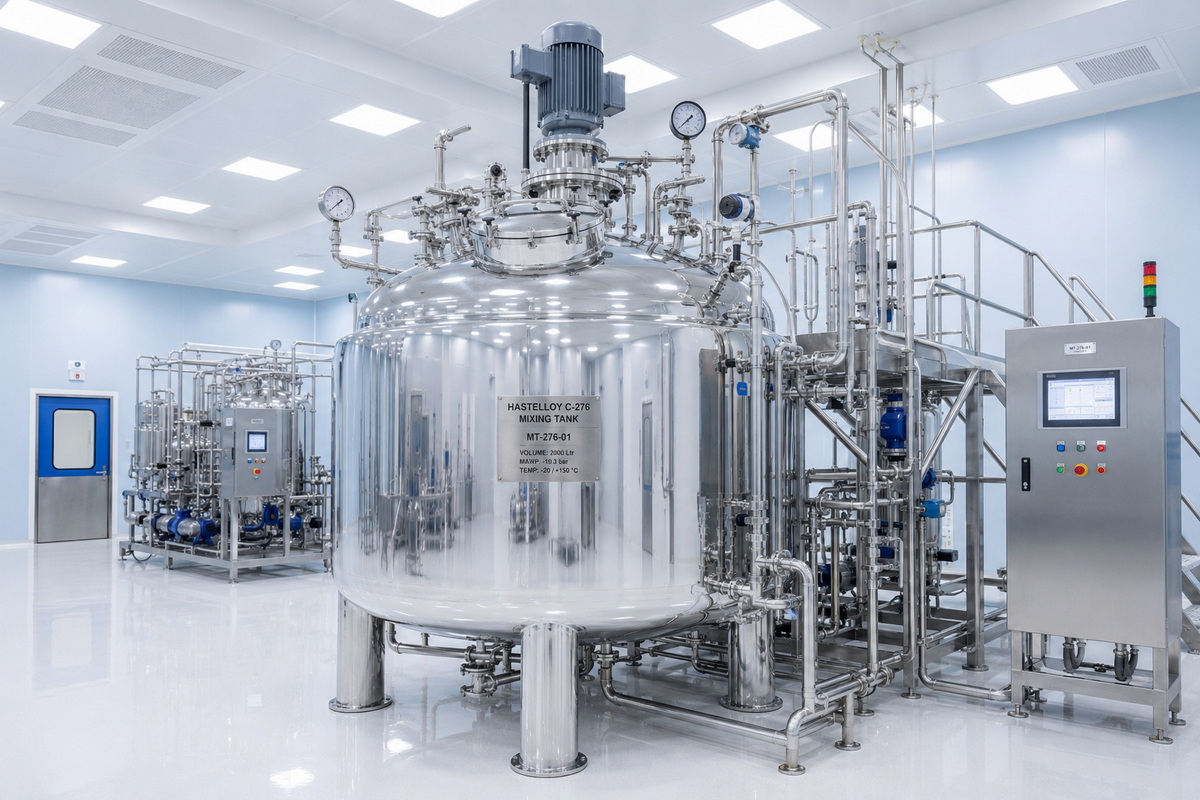
As a pharmaceutical equipment manufacturer with over a decade of experience providing BFS machines, filling and sealing systems, and complete production lines, we've implemented both material solutions across diverse pharmaceutical applications. Our engineering team has observed distinct performance patterns:
Case observation - API intermediate production: A client manufacturing pharmaceutical intermediates for injectable drugs initially specified 316L mixing tanks to reduce capital costs. Within 18 months, significant pitting corrosion appeared on internal surfaces exposed to 8% hydrochloric acid during synthesis steps. The contamination risk forced tank replacement with Hastelloy C-276 units, which have now operated for 8 years without measurable corrosion.
Case observation - buffer and excipient preparation: Conversely, another facility preparing formulation buffers and excipient solutions using 316L tanks has operated successfully for 15+ years. The mild pH environments (5.5-7.5) and absence of aggressive chlorides allow 316L to perform reliably at significantly lower initial and lifecycle costs than Hastelloy alternatives would require.
Engineering recommendation: During factory layout planning and production line design—our core expertise—we conduct thorough process chemistry review to identify maximum acid concentrations, chloride levels, operating temperatures, and cleaning chemical specifications. This data-driven approach ensures material specifications align with actual service conditions rather than generic recommendations.
For facilities producing diverse product portfolios, we often recommend segregating equipment by corrosivity class. High-corrosivity processes (strong acids, high chlorides) utilize Hastelloy mixing tanks in dedicated production suites, while standard formulation and compounding operations employ cost-effective 316L equipment. This segmentation optimizes total capital investment while ensuring robust material selection where it matters most.
Emerging Considerations and Future Trends
Sustainability and Material Recycling
Both 316L stainless steel and Hastelloy nickel alloys are fully recyclable, supporting pharmaceutical industry sustainability initiatives. Stainless steel recycling infrastructure is more mature and widely available, potentially offering better end-of-life value recovery. However, Hastelloy's extended service life means fewer replacement cycles, reducing overall material consumption and carbon footprint over multi-decade timeframes.
Advanced Surface Treatments
Recent developments in electropolishing and passivation technologies have improved 316L corrosion resistance in moderately aggressive environments. Specialized treatments can enhance the passive layer stability, potentially expanding 316L's application range. However, these treatments add cost and cannot match Hastelloy's inherent resistance in truly aggressive conditions. [engmotion]
For Hastelloy, advanced surface treatments focus on achieving ultra-smooth finishes (Ra < 0.15 μm) for biotech applications requiring absolute cleanliness. These surfaces resist protein adhesion and biofilm formation, supporting single-use technology integration in modern pharmaceutical manufacturing.
Digital Monitoring and Predictive Maintenance
Integration of corrosion monitoring sensors and predictive maintenance algorithms allows real-time assessment of tank condition regardless of material selection. For 316L tanks in marginal service conditions, continuous monitoring provides early warning of corrosion initiation, enabling proactive intervention before product contamination occurs. This technology partially mitigates the material performance gap but cannot eliminate fundamental corrosion susceptibility differences.
Frequently Asked Questions (FAQ)
Q1: Can 316L stainless steel be used for pharmaceutical mixing tanks handling acidic intermediates?
316L can be used for mildly acidic pharmaceutical applications (pH 4-6) with low chloride content and ambient temperatures. However, for concentrated acids above 3-5%, particularly hydrochloric acid or chloride-containing solutions, 316L shows insufficient corrosion resistance and should be replaced with Hastelloy or other nickel-based alloys to prevent product contamination and equipment failure. [bssa.org]
Q2: What is the typical service life difference between 316L and Hastelloy mixing tanks in acidic environments?
In moderate acidic service (5-10% acid concentrations), 316L tanks typically last 5-7 years before requiring replacement due to pitting corrosion, while Hastelloy tanks can deliver 20-30 years of reliable service under identical conditions. The extended lifecycle of Hastelloy often justifies the higher initial cost through reduced replacement frequency and lower total cost of ownership. [huaxiaometal]
Q3: How does the initial cost of Hastelloy compare to 316L for pharmaceutical mixing tanks?
Hastelloy C-276 raw material costs approximately 8-12 times more than 316L stainless steel per pound. When including specialized fabrication requirements, a complete Hastelloy mixing tank typically costs 4-6 times more than an equivalent 316L tank. However, lifecycle cost analysis including replacement frequency, downtime, and contamination risk often favors Hastelloy for aggressive chemical applications.
Q4: Are there any pharmaceutical applications where 316L outperforms Hastelloy?
316L performs comparably to Hastelloy in non-aggressive pharmaceutical applications such as buffer preparation, water-for-injection storage, and formulation mixing at neutral pH ranges (6-8). In highly oxidizing nitric acid environments, 316L actually shows better resistance than Hastelloy C-276. For these applications, 316L's significantly lower cost and easier fabrication make it the preferred choice. [metalshims]
Q5: What surface finish requirements apply to pharmaceutical mixing tanks, and can both materials achieve them?
Pharmaceutical mixing tanks typically require surface finishes of Ra ≤ 0.38 μm (15 μin) for product-contact surfaces, with critical applications potentially demanding Ra ≤ 0.25 μm (10 μin). Both 316L and Hastelloy can be electropolished to achieve these specifications. However, Hastelloy's superior corrosion resistance helps maintain the polished surface longer, even after repeated exposure to aggressive cleaning agents and sanitizing solutions. [engmotion]
References
1. Engmotion - AISI 316L and Surface Treatments for Pharma Use
https://engmotion.com/tpost/y9ehcux0c1-aisi-316l-and-surface-treatments-for-pha
2. Huaxiao Metal - Hastelloy Vs Stainless Steel Complete Comparison
https://www.huaxiaometal.com/blogs/hastelloy-vs-stainless-steel.html
3. Haynes International - HASTELLOY® C-276 Technical Specifications
https://haynesintl.com/en/alloys/alloy-portfolio/corrosion-resistant-alloys/hastelloy-c-276/
4. Chemical Engineering Facebook - Comparison of Corrosion Resistance: Stainless Steel 316L vs Hastelloy C276
https://www.facebook.com/Chem.Eng.2017/videos/comparison-of-corrosion-resistance-stainless-steel-316l-vs-hastelloy-c276-in-con/
5. AEETHER - Hastelloy Applications in Pharmaceutical Industry
https://www.aeether.com/AEETHER/media/media-109/media.html
6. Unified Alloys - The Stainless Steel Solution: Enhancing Pharmaceutical Manufacturing
https://www.unifiedalloys.com/blog/stainless-steel-benefits-pharma
7. Mega Mex - Hastelloy C-276 Nickel Alloy, UNS N10276 Specifications
https://megamex.com/hastelloy-c-276/
8. Metal Shims - 316L Stainless Steel Technical Data Sheet
https://metalshims.com/pages/316l-stainless-steel-technical-data-sheet
9. British Stainless Steel Association - Selection of Stainless Steels for Handling Hydrochloric Acid
https://bssa.org.uk/bssa_articles/9-selection-of-stainless-steels-for-handling-hydrochloric-acid-hcl/
10. Terra Universal - 304 vs 316 vs 304L vs 316L Stainless Steel for Cleanroom Equipment
https://www.terrauniversal.com/blog/304L-vs-316L-cleanroom-stainless-steel-differences-advantages-benefits
11. Thrive International - Why SS 316L is Preferred in Biotech and Pharmaceutical Piping
https://thriveinternational.in/blog/f/why-ss-316l-is-preferred-in-biotech-and-pharmaceutical-piping
12. CSI Designs - Hastelloy C-22 vs C-276: Key Differences & Chemical Composition
https://www.csidesigns.com/blog/articles/hastelloy-c-22-or-hastelloy-c-276-which-is-right-for-your-processing-environment


