


Views: 222 Author: Everheal Medical Equipment Publish Time: 2026-05-29 Origin: Everheal


Purified water (PW) and WFI storage tanks sit at the heart of every pharmaceutical purified water system, so any biofilm on the tank surface quickly becomes a system‑wide contamination risk. For manufacturers using BFS, FFS, and filling lines, choosing between electropolished 316L and standard stainless steel for these tanks is not just a materials decision—it is a long‑term microbial control strategy that directly impacts batch release, deviations, and regulatory inspections. [biocell-pharma]

Biofilm is a structured community of microorganisms embedded in a self‑produced matrix tightly attached to internal surfaces such as tank walls, nozzles, and welds. Once established, biofilm continuously sheds bacteria and endotoxins into circulating PW, leading to out‑of‑spec results and expensive system sanitization campaigns. [pubmed.ncbi.nlm.nih]
In real purified water systems, several design and operational factors drive biofilm formation:
- Rough or poorly finished stainless steel surfaces that trap organic residues. [linkedin]
- Dead legs and low‑flow areas in piping and tank nozzles. [tsareverseosmosis]
- Stagnation in oversized tanks or poorly mixed vessels. [biocell-pharma]
- Infrequent or non‑validated heat or chemical sanitization. [linkedin]
From a process engineer's perspective, surface finish and material choice are two of the few "passive" controls that work 24/7, even when operations are busy and people make mistakes. This is where the difference between standard stainless steel and electropolished 316L becomes critical. [harrisonep]
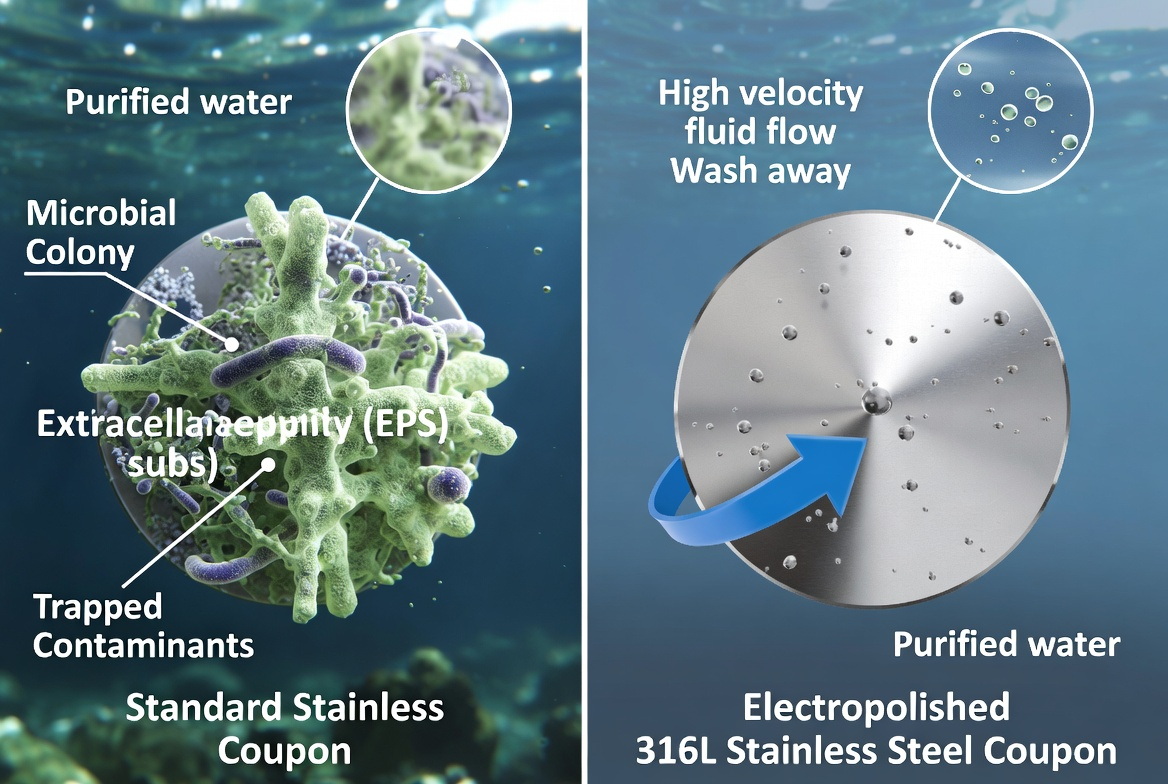
In purified water applications, "standard stainless steel" typically refers to mechanically polished 304 or 316/316L tanks without final electropolishing, often with surface roughness in the range of Ra 0.6–0.8 µm or higher. Such tanks rely mainly on the natural passive chromium oxide film for corrosion resistance but may still have microscopic grooves, inclusions, and machining defects. [stark-water]
These imperfections create micro‑niches where microorganisms, organic residues, and particles can lodge, survive sanitization, and form the nucleus of a mature biofilm. Over long‑term operation, especially in cold PW loops, these sites can become persistent contamination hot spots that are difficult to clean, even with aggressive chemicals. [pubmed.ncbi.nlm.nih]
Electropolished 316L combines the corrosion resistance of low‑carbon 316 stainless steel with an additional electrochemical finishing step that dissolves the microscopic peaks on the surface. This controlled removal of surface material produces a smoother, more chromium‑enriched, and easier‑to‑clean surface compared with purely mechanically polished steel. [harrisonep]
ASME BPE describes typical electropolished surface categories such as SF4 with Ra ≤ 0.38 µm, compared with mechanically polished-only finishes up to 0.76 µm. In high‑purity water systems, tanks and distribution piping manufactured in 316L and electropolished to these levels are widely accepted as industry best practice for minimizing biofilm and facilitating validated cleaning. [harrisonep]
From both research and field experience, surface roughness directly influences how easily microorganisms attach and form biofilm. Rougher surfaces with grooves and pits provide shelter from shear forces and from heat or chemical sanitization, while smooth surfaces expose bacteria more directly to cleaning agents and high‑velocity flow. [cambridge]
- Electropolished 316L surfaces can achieve Ra values around 0.38 µm (SF4) or better. [harrisonep]
- Standard mechanically polished surfaces in many industrial tanks are often around Ra 0.6–0.8 µm or higher. [stark-water]
In long‑term water studies, stainless steels already show better fouling behavior than carbon steel or plastics, but smoother stainless surfaces further reduce the kinetics of biofilm development and improve cleanability. For a pharmaceutical PW system, this translates into lower baseline microbial counts, fewer excursions, and shorter downtime during cleaning campaigns. [cambridge]
| Aspect | Electropolished 316L | Standard Stainless Steel (mechanical only) |
|---|---|---|
| Typical grade | 316L for PW/WFI tanks tsareverseosmosis | 304 or 316/316L tsareverseosmosis |
| Surface roughness | Ra ~0.38 µm (SF4) or better harrisonep | Often Ra 0.6–0.8 µm or higher tsareverseosmosis |
| Micro‑defects | Micro‑peaks removed, fewer crevices harrisonep | More grooves, inclusions, machining marks tsareverseosmosis |
| Biofilm adhesion | Reduced bacterial foothold and easier removal cambridge | Higher risk of stable biofilm colonies pubmed.ncbi.nlm.nih |
| Cleaning/sanitization | Faster, more effective CIP/SIP cycles tsareverseosmosis | Longer exposure and harsher chemicals often needed biocell-pharma |
| Corrosion behavior | Enhanced passive layer, better resistance harrisonep | Good, but more sensitive to rouging and crevice sites tsareverseosmosis |
| Regulatory acceptance | Aligns with ASME BPE, high‑purity norms harrisonep | Acceptable but often questioned for high‑risk loops stark-water |
For purified water storage specifically, the combination of low Ra, minimal crevices, and robust passivation makes electropolished 316L the more robust choice when the main design goal is minimizing biofilm risk rather than just minimizing upfront capital expense. [harrisonep]
From an industry practitioner's point of view, surface finish is one piece of a broader, interlocking control strategy for PW systems. Even the best electropolished tank will fail if design and operations are weak. A robust strategy typically combines: [biocell-pharma]
1. Hygienic design
- 316L electropolished tanks and piping with orbital welds. [tsareverseosmosis]
- Proper slope for complete drainage and minimum dead legs (3D rule). [linkedin]
2. Continuous circulation and temperature control
- Hot PW loops maintained above 75–80 °C. [biocell-pharma]
- Sufficient recirculation velocity (≥1.0–1.5 m/s) to prevent stagnation. [linkedin]
3. Validated sanitization regime
- Routine heat sanitization or ozone/chemical sanitization at defined intervals. [biocell-pharma]
- Proper passivation and re‑passivation of stainless surfaces after maintenance. [tsareverseosmosis]
Electropolished 316L amplifies the impact of these measures by making each cleaning cycle more efficient and by reducing the number of sites where biofilm can survive between sanitizations. [cambridge]
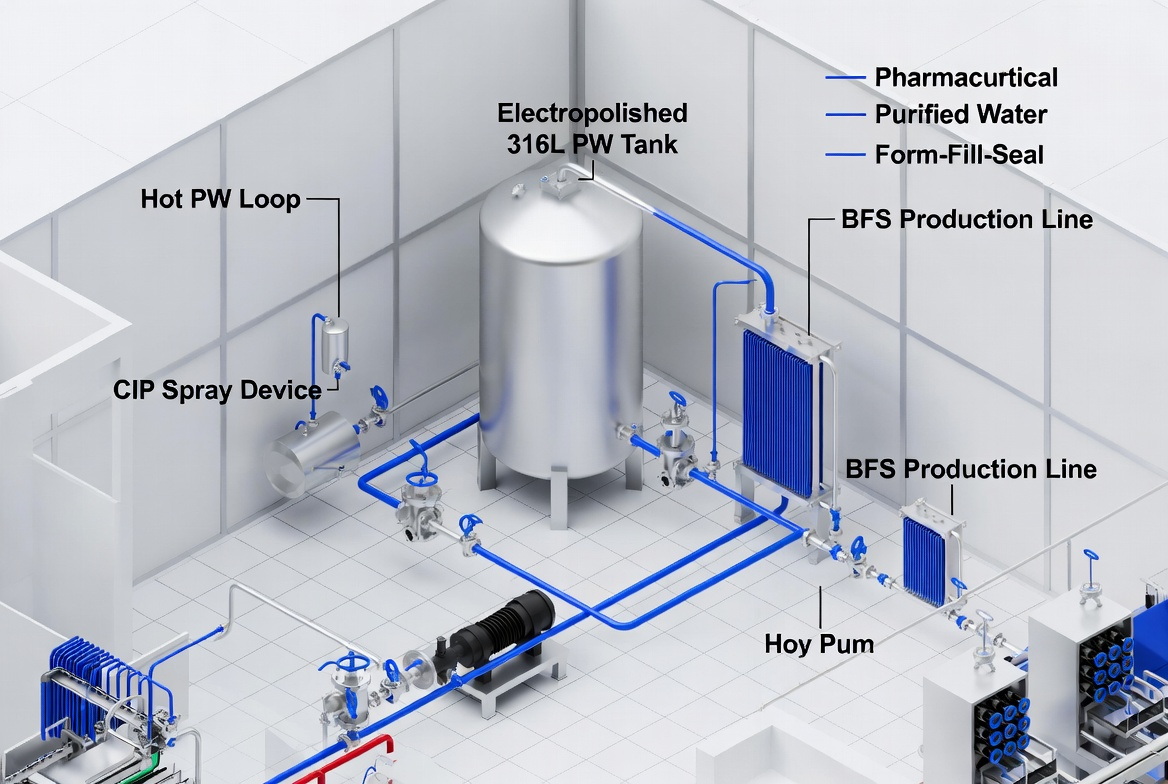
When specifying a purified water storage tank for a new BFS or FFS plant—or upgrading an existing line—the following steps help translate theory into a practical, auditable design: [stark-water]
1. Define the water quality and loop concept
- PW vs WFI, cold vs hot loop, buffer volume relative to daily demand. [stark-water]
2. Specify materials and finish
- 316L stainless steel with electropolished internal surfaces to at least SF4 (Ra ≤ 0.38 µm) for all product‑contact areas. [harrisonep]
- Electropolished internal nozzles, manways, and spray devices as far as practical. [tsareverseosmosis]
3. Engineer hygienic geometry
- Closed tank with inert gas blanketing where needed to avoid atmospheric contamination. [ergil]
- Orbital welds, sloped bottom for full drainage, minimal flat areas, and no internal ledges. [linkedin]
4. Integrate CIP/SIP capability
- Properly sized spray ball or rotary jet devices sized to reach all internal surfaces. [stark-water]
- Validation protocols that demonstrate removal of biofilm surrogates and microbial load. [biocell-pharma]
5. Link monitoring to risk
- Trending of microbial counts, conductivity, and TOC at tank outlet and critical user points. [linkedin]
- Enhanced sampling after any maintenance that affects tank surfaces. [biocell-pharma]
Many pharmaceutical plants initially install standard mechanically polished tanks, then later face repeated PW microbial excursions, especially after capacity increases or line extensions. Typical symptoms include frequent out‑of‑limit total microbial counts, sporadic endotoxin spikes, and visible rouging inside the tank despite aggressive sanitization. [tsareverseosmosis]
When such plants retrofit to electropolished 316L tanks, combined with improved sanitization and removal of dead legs, they often see:
- Lower baseline microbial counts and fewer trend excursions. [tsareverseosmosis]
- Shorter CIP/SIP cycles with less chemical consumption. [stark-water]
- Stronger documentation during inspections, as surface finish is now aligned with ASME BPE and high‑purity best practice. [harrisonep]
For an equipment provider that also delivers BFS and FFS turnkey lines, being able to demonstrate this type of before/after performance improvement is a powerful differentiator when supporting clients in factory layout and water system design. [molewater]
In BFS, FFS, and filling lines, purified water is not just a utility—it is intimately linked to:
- Final product quality (especially for large volume parenterals, ophthalmics, and rinsing). [robenmfg]
- Cleaning of filling, forming, and sealing equipment. [molewater]
- Environmental control in classified areas where moisture and aerosols interact with machinery. [robenmfg]
From an expert layout and engineering perspective, choosing electropolished 316L tanks in these facilities:
- Reduces cross‑contamination risk between batches and product variants sharing the same water system. [biocell-pharma]
- Supports more compact, high‑throughput lines because the water system can reliably support extended runtimes without unplanned sanitization. [molewater]
- Helps align with global regulatory expectations (GMP, pharmacopoeias, ISPE) that increasingly reference ASME BPE‑aligned hygienic design. [harrisonep]
Not every application demands electropolished 316L. In lower‑risk utilities or non‑critical water uses, standard mechanically polished tanks can still be suitable: [stark-water]
- Non‑product‑contact technical water or utilities without stringent microbial limits. [tsareverseosmosis]
- Short‑residence‑time buffer tanks with frequent complete turnover and aggressive heat sanitization. [biocell-pharma]
- Early‑stage pilot facilities with limited budget but well‑defined upgrade plans. [stark-water]
However, for purified water storage feeding BFS, FFS, and other sterile or high‑risk pharmaceutical processes, most modern engineering teams now default to electropolished 316L as the baseline standard rather than the premium option. [linkedin]
A manufacturer of BFS machines, FFS machines, and filling and sealing lines that also supports factory layout and process engineering can help pharma clients move beyond component purchasing into fully integrated risk control: [everhealgroup]
- Designing the purified water storage and distribution system around electropolished 316L tanks, hygienic piping, and proper loop velocities. [molewater]
- Matching tank sizing and location to the cycle times of BFS/FFS and filling equipment to avoid stagnation, ensuring continuous water movement even during shift changes. [ergil]
- Providing lifecycle support—surface inspection, rouging assessment, and recommendations for re‑passivation or tank replacement when biofilm or corrosion risks increase. [tsareverseosmosis]
Positioning your company as a solutions partner rather than a standalone equipment vendor helps build trust with engineering, quality, and validation teams who are accountable for system performance for decades. [robenmfg]
For pharmaceutical purified water storage tanks that feed BFS, FFS, and aseptic filling operations, electropolished 316L stainless steel clearly offers superior biofilm control, better cleanability, and stronger regulatory defensibility than standard mechanically polished stainless steel. [cambridge]
If you are planning a new facility or upgrading an existing water system, consider:
- Standardizing on electropolished 316L for all PW/WFI tanks and critical loop segments. [harrisonep]
- Reviewing current microbial trends and excursion history to identify tanks where surface finish may be part of the root cause. [linkedin]
- Engaging a turnkey equipment partner who can integrate tank design with your BFS/FFS and filling lines, ensuring consistent hygienic standards from utilities to final product. [everhealgroup]
Call to action: If your purified water storage tanks are still standard stainless steel and you are seeing biofilm‑related deviations, the next engineering review should include a surface‑finish upgrade path to electropolished 316L—before regulators ask for it during your next inspection. [linkedin]
No, but for tanks feeding high‑risk pharmaceutical processes, electropolished 316L is widely regarded as best practice and increasingly expected during inspections. [stark-water]
Electropolishing significantly reduces biofilm adhesion but does not replace good design, continuous circulation, and validated sanitization. All elements are required for robust control. [cambridge]
In some cases, internal electropolishing can be performed on installed tanks, but feasibility depends on access, geometry, and safety considerations; many facilities choose replacement instead. [tsareverseosmosis]
Smoother electropolished 316L surfaces tend to be less prone to rouging and are easier to de‑rouge and re‑passivate when compared with rough mechanical finishes. [harrisonep]
You should obtain surface roughness measurements (Ra), material certificates for 316L, weld maps, electropolishing certificates, and passivation records aligned with ASME BPE where applicable. [harrisonep]
1. Molewater – "Purified Water Storage and Distribution System Pollution Control" [](https://www.molewater.com/purified-water-storage-and-distribution-system-pollution-control)
2. Roben Mfg – "Ultra‑Pure Water Storage Vessels: Your Comprehensive Guide" [](https://www.robenmfg.com/ultra-pure-water-storage-your-comprehensive-guide/)
3. Biocell Pharma – "How to Maintain a PW Storage Tank for Long‑Term Stability and System Reliability" [](https://www.biocell-pharma.com/how-to-maintain-a-pw-storage-tank-for-long-term-stability-and-system-reliability.html)


