In high‑volume pharmaceutical and healthcare liquid packaging, even small homogeneity problems can trigger batch failures, recalls, and regulatory findings. From my perspective as a process and equipment strategist working with liquid filling and sealing lines in Asia and global markets, the shift from traditional batch mixing to continuous in-line blending is no longer just a trend—it is a core lever for improving yield, sterility assurance, and cost per unit on filling and sealing, FFS, and BFS lines. For manufacturers using integrated filling and sealing machines, FFS machines, and BFS blow–fill–seal systems, choosing the right mixing philosophy is now a strategic decision, not a purely technical one. [medicalexpo.com]
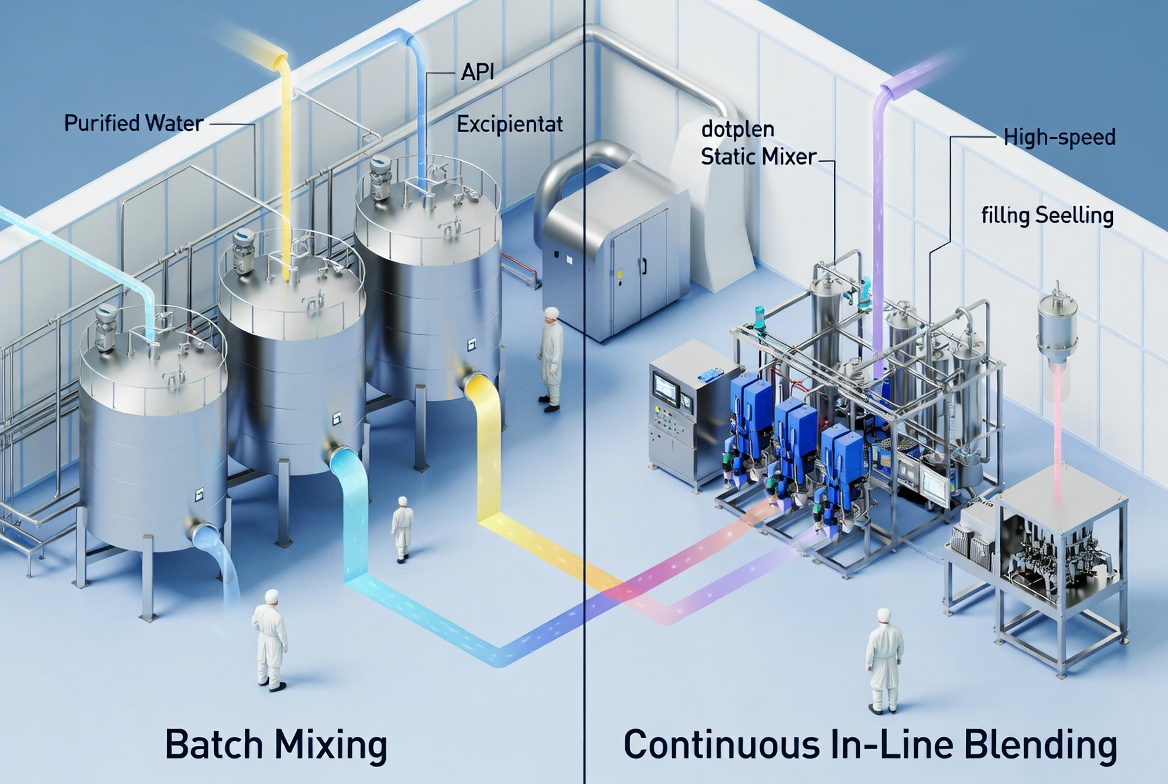
What Is Batch Mixing in Large-Scale Liquid Packing?
In a batch mixing model, ingredients (active substances, excipients, solvents) are added to a mixing vessel, processed for a defined time, and then released as a discrete batch for downstream filling and sealing. This is still the dominant approach in many legacy pharmaceutical plants and in facilities where formulation changes frequently or volumes are moderate. [truking]
How Batch Mixing Typically Works
A standard batch mixing workflow for liquid pharmaceuticals looks like this: [medicalexpo.com]
1. Charge the mixing tank with bulk solvent and excipients.
2. Add APIs or concentrates via controlled dosing.
3. Apply agitation, heating/cooling, and sometimes vacuum or inert gas.
4. Sample the batch at defined intervals for QC labs.
5. Release the batch to buffer tanks feeding filling and sealing, FFS, or BFS equipment when lab results pass.
Strengths of batch mixing in this context include: [medicalexpo.com]
- High flexibility for multi‑product plants and seasonal SKUs.
- Straightforward validation and documentation—each batch has a clear identity.
- Mature SOPs and operator familiarity, especially in older facilities.
However, as volumes scale and OEE targets rise, its limitations around homogeneity and cycle time become obvious.
What Is Continuous In-Line Blending?
Continuous in-line blending (CIB) creates the final formulation on the fly by continuously metering and mixing streams of water, concentrates, and additives directly on the way to the filler. Instead of one large tank, you rely on precise dosing skids, static or dynamic mixers, and real-time monitoring of critical quality attributes. [pmecchina]
How Continuous In-Line Blending Works in Practice
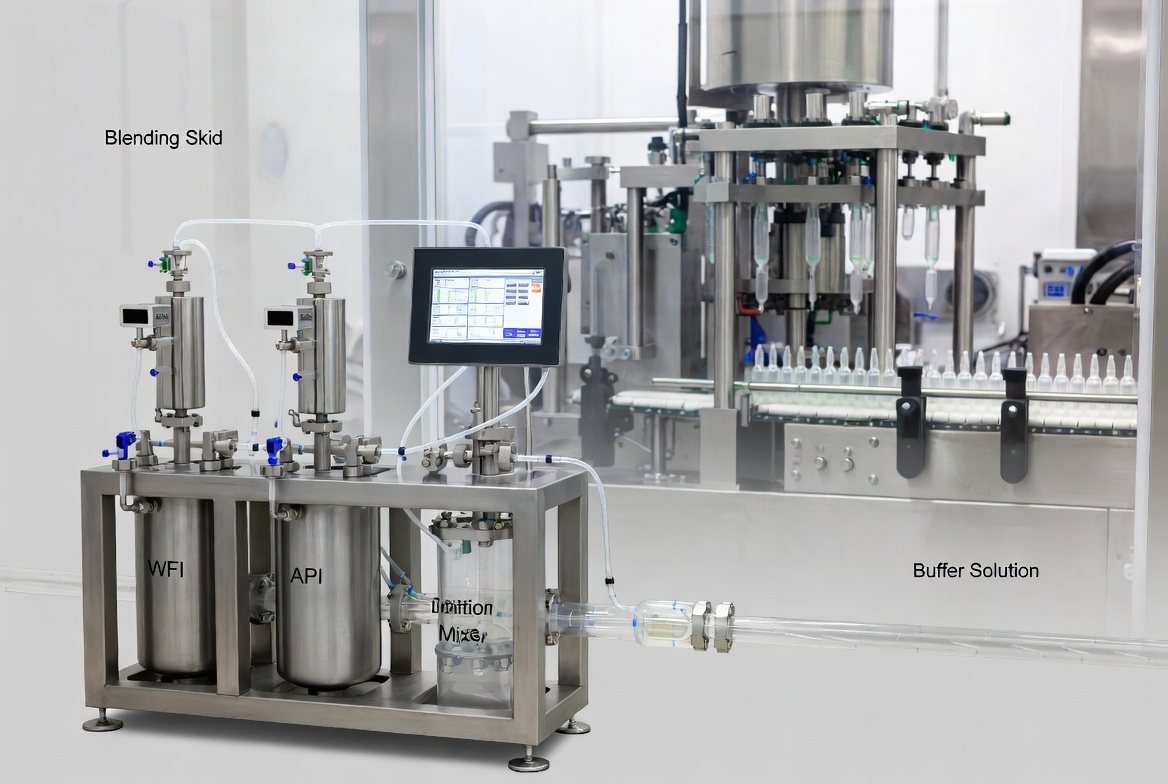
A typical CIB arrangement feeding a BFS or FFS line includes: [everhealgroup]
- Multiple feed streams (WFI/purified water, API concentrate, buffer, flavor, preservatives).
- Mass flow meters or Coriolis meters for high‑accuracy dosing.
- Static in‑line mixers and sometimes small dynamic mixers for rapid homogenization.
- Inline sensors (density, conductivity, pH, and sometimes NIR) for real‑time verification.
- Short hold-up volume to minimize material at risk and reduce response time.
This architecture aligns naturally with continuous operation of filling and sealing machines, FFS, and BFS lines, which are designed to run for long aseptic campaigns with minimal stops. [everhealgroup]
Homogeneity Challenges in Large-Scale Liquid Packing
From a quality and regulatory perspective, homogeneity sits at the heart of liquid dose reliability. On large aseptic lines, I commonly see four homogeneity pain points: [truking]
- Stratification in large tanks (especially viscous syrups or suspensions).
- Dead zones and poor mixing geometry causing local over‑ or under‑concentration.
- Temperature gradients affecting solubility and viscosity.
- Delayed detection of out‑of‑spec composition due to lab‑based, offline QC.
For BFS and FFS lines, where product is formed, filled, and sealed in a tight aseptic envelope within seconds, any hidden inconsistency at the mixing stage can quickly propagate into tens of thousands of non‑conforming units before the deviation is detected. This is exactly where continuous in-line blending starts to show its structural advantage. [sinoped]
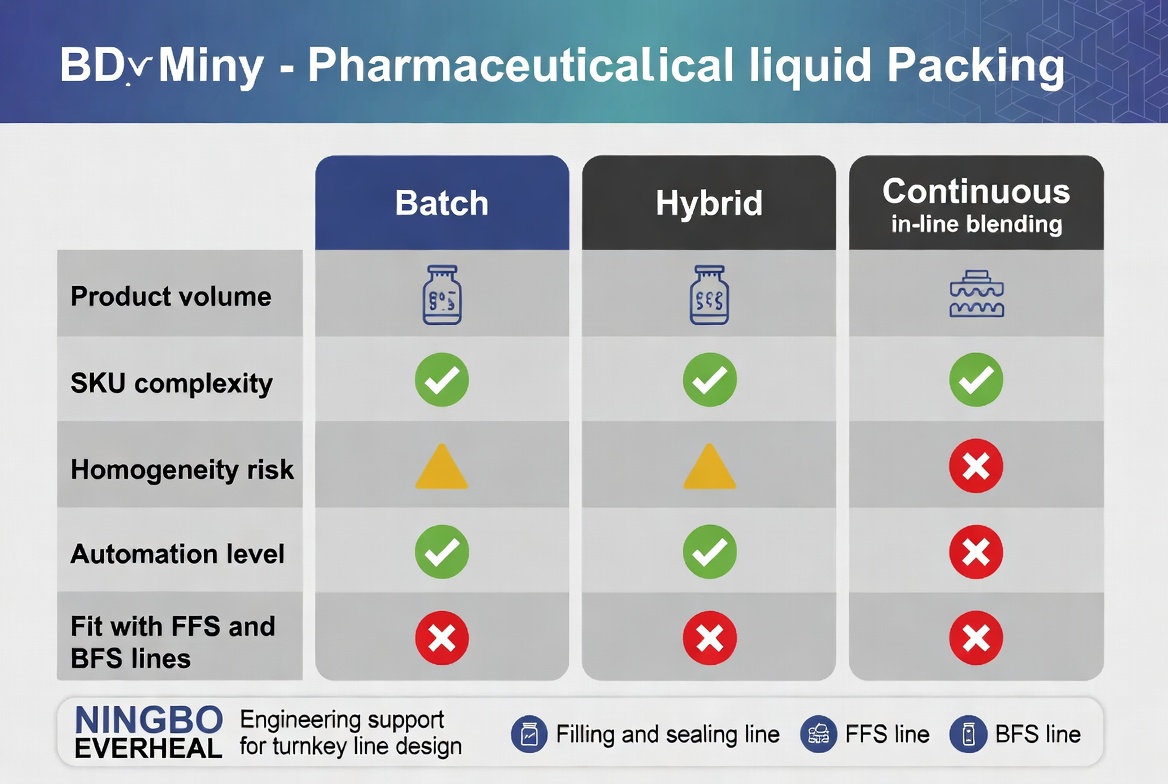
Batch Mixing vs Continuous In-Line Blending – A Practical Comparison
Below is a concise, practitioner‑level comparison focused on large‑scale pharma and healthcare liquid packing lines feeding filling and sealing, FFS, and BFS equipment. [medicalexpo.com]
Key Differences at a Glance
| Dimension | Batch Mixing | Continuous In-Line Blending |
| Homogeneity control | Dependent on tank design, agitation, and sampling intervals (truking) | Real-time controlled via flow, sensors, and inline mixers (truking) |
| Response to deviations | Slow; entire tank can be at risk (medicalexpo.com) | Fast; affected volume limited by hold-up (truking) |
| Scale-up to higher throughputs | Larger tanks, longer mixing times (medicalexpo.com) | Add parallel lines or increase flow, not tank size (truking) |
| Campaign length and changeovers | Frequent flushing and CIP between batches (medicalexpo.com) | Longer continuous runs with structured CIP windows (truking) |
| Data for QbD/CPV | Discrete lab data per batch (medicalexpo.com) | Continuous process data and trends (truking) |
| Fit with BFS/FFS aseptic philosophy | Often relies on large buffer inventories (medicalexpo.com) | Directly synchronized with line speed and aseptic cycles (truking) |
As an equipment partner, I typically see batch mixing favored where product portfolios are diverse and daily volumes per SKU are modest, while continuous in-line blending dominates in high‑volume oral liquids, eye drops, and parenteral solutions on modern BFS or high‑speed FFS lines. [mordorintelligence]
Industry Trends and Market Data You Should Not Ignore
Global data on FFS and BFS equipment shows why continuous philosophies are gaining traction. [gminsights]
- The form–fill–seal packaging machine market is projected to grow from about 9.56 billion USD in 2024 to 12.27 billion USD by 2029, at roughly 5.1% CAGR. [mordorintelligence]
- The broader filling and sealing machinery market is expected to grow from an estimated 9.2 billion USD in 2025 to around 14.5 billion USD by 2034, about 5.2% CAGR. [gminsights]
- BFS technology is increasingly adopted for sterile ophthalmic solutions, small‑volume parenterals, and respiratory products due to its integrated blow‑fill‑seal process and reduced contamination risk. [sinoped]
All of these trends favor higher OEE, longer campaigns, and reduced variability, which is why pharma engineering teams are re‑evaluating their mixing and blending architecture alongside equipment upgrades. [pmecchina]
Real-World Example – Homogeneity on a BFS Line
Consider a high‑speed BFS line producing unit‑dose eye drops. The line blows, fills, and seals plastic ampoules within 12–14 seconds, with total cycle times extremely tight and aseptic constraints high. [sinoped]
In a pure batch setup: [truking]
- Product is prepared in a large tank and transferred through buffers to the BFS machine.
- Minor stratification or dosing drift in the tank may remain undetected for hours.
- By the time QC identifies a concentration deviation, a large quantity of units has already been sealed and may require rework or destruction.
With continuous in-line blending feeding the same BFS system: [everhealgroup]
- Precise concentrate and WFI streams feed a small mixing volume close to the BFS infeed.
- Inline sensors monitor density or refractive index continuously.
- If the system detects drift, it can automatically adjust flow rates or trigger a rapid stop, limiting the affected batch size to minutes instead of hours.
From the perspective of plant leaders, this shrinks quality risk and improves material yield, especially for high‑value APIs.
Expert Insights – When Batch Mixing Still Makes Sense
Even as an advocate for continuous technologies, I would not recommend in-line blending for every scenario. There are still strong cases for keeping batch mixing as the primary model: [medicalexpo.com]
- Complex, shear‑sensitive formulations where residence time distribution is critical and not easily modeled.
- Low‑volume, high‑mix plants where frequent changeovers and clinical or development batches dominate.
- Sites with limited automation maturity, where moving directly to advanced flow control and PAT would overwhelm current capabilities.
In these environments, optimizing batch mixing—better tank geometry, improved impellers, more strategic sampling, and integration with modern filling and sealing lines—may deliver the best ROI in the short term. [medicalexpo.com]
Practical Implementation Roadmap – Moving from Batch to Hybrid or Continuous
From implementation projects across pharma and health‑care liquids, I generally recommend a phased roadmap rather than a big‑bang replacement. [pmecchina]
Step 1 – Map Current Product Portfolio and Risk
- Identify products with highest volume and highest homogeneity risk (e.g., suspensions, high‑potency actives).
- Assess which of your filling and sealing, FFS, and BFS lines are already running near capacity or face frequent deviations. [medicalexpo.com]
Step 2 – Start with Continuous Dosing of a Single Stream
- Introduce inline dosing for critical components (e.g., APIs or solvents) into existing batch tanks.
- Use flow meters and inline sensors to stabilize concentration even within a batch setup. [pmecchina]
Step 3 – Add Full In-Line Blending Skid for a Flagship Product
- Deploy a dedicated blending skid feeding one high‑volume FFS or BFS line. [everhealgroup]
- Integrate control logic with the filling machine's PLC to synchronize flow with speed.
Step 4 – Standardize, Validate, and Scale
- Develop standard validation packages for continuous processes, aligning with regulatory expectations around residence time distribution and PAT. [truking]
- Use lessons from the pilot line to roll out similar skids for other products or sites.
This phased approach helps quality, engineering, and operations teams build competence without jeopardizing supply.
How Ningbo Everheal Supports Both Approaches
As a Chinese manufacturer of large‑scale pharmaceutical equipment, Ningbo Everheal Medical Equipment Co., LTD. provides: [everhealgroup]
- Integrated filling and sealing machines for a wide range of liquid dosage forms. [everhealgroup]
- High‑efficiency FFS (Form‑Fill‑Seal) machines for sachets, bags, and flexible pharma packaging. [gminsights]
- Advanced BFS (Blow‑Fill‑Seal) lines for sterile eye drops, inhalation solutions, and oral unit doses. [sinoped]
Beyond the equipment itself, our engineering teams work with clients to co‑design the process architecture, whether that means: [pmecchina]
- Optimized batch mixing systems feeding multiple filling lines.
- Hybrid setups combining batch pre‑mix with in‑line dilution or polishing.
- Full continuous in-line blending skids synchronized with BFS or FFS aseptic campaigns.
This integration of production line design, plant layout planning, and equipment selection ensures homogeneity and sterility are designed in from the start, instead of being patched later. [truking]
UX and Operations – What the Operators Actually Experience
From an operator's viewpoint, the user experience of the mixing system often decides whether a project succeeds. [pmecchina]
- Batch mixing UX: familiar tank‑based workflows, but higher manual sampling, more waiting for lab results, and frequent partial reworks. [medicalexpo.com]
- Continuous in-line blending UX: more automation and digital dashboards, lower manual sampling once validated, but requires stronger training in flow control and alarm handling. [truking]
Modern filling, FFS, and BFS machines from vendors like Everheal increasingly expose unified HMIs, where operators see both mixing status and packaging line status on a single screen. This reduces cognitive load and improves response time when deviations occur. [everhealgroup]
Conclusion – How to Decide for Your Plant
When I look at new or upgraded liquid packing projects, my rule of thumb is simple: match the mixing philosophy to product risk, volume, and equipment strategy. [medicalexpo.com]
- If you are planning high‑volume BFS or FFS sterile lines, continuous in-line blending offers a more robust way to manage homogeneity, material yield, and real‑time quality.
- If you run a broad portfolio with many low‑volume SKUs, optimized batch mixing may still be the most economical, especially as a stepping stone toward hybrid systems.
Whichever path you choose, it should be tightly integrated with your filling and sealing, FFS, and BFS equipment, your plant layout, and your long‑term digitalization roadmap.
Call to action:
If you are evaluating new filling and sealing, FFS, or BFS lines or planning to retrofit existing equipment to reduce homogeneity risk, consider engaging a partner who can co‑design the mixing concept and packaging line together. Ningbo Everheal's engineering team can review your current layout, volumes, and formulations and propose a data‑driven batch, hybrid, or continuous in-line blending strategy tailored to your plant. [truking]
FAQ – Batch Mixing vs Continuous In-Line Blending in Pharma Packing
1. Does continuous in-line blending always reduce costs compared to batch mixing?
Not always. It tends to reduce cost per unit in high‑volume, stable portfolios, but initial capex and validation effort can be higher than incremental improvements to existing batch systems. [medicalexpo.com]
2. How does in-line blending affect regulatory inspections?
Regulators increasingly expect strong process understanding and continuous verification. Well‑documented in-line blending with PAT and residence time studies can support Quality by Design and Continued Process Verification narratives. [pmecchina]
3. Can I use the same filling line for both batch and continuous blending?
Yes. Many modern filling and BFS/FFS lines can be fed from either batch tanks or in-line blending skids, provided the control integration and piping layout are designed properly. [everhealgroup]
4. Is continuous in-line blending suitable for suspensions?
It can be, but suspensions are more complex. You need to understand particle settling, shear sensitivity, and residence time. Some plants retain a batch pre‑mix plus in‑line polishing approach for suspensions. [medicalexpo.com]
5. What is the typical payback period for continuous in-line blending investments?
For high‑volume lines, I often see payback in 2–4 years, driven by lower material loss, fewer deviations, and higher OEE. For low‑volume sites, the payback can be longer and should be modeled carefully. [mordorintelligence]
References
1. Truking – *Blow‑Fill‑Seal (BFS) Solution* (Chinese/English brochure). [https://www.truking.com/uploadfiles/2024/09/20240909141902002.pdf] [truking]
2. Global Market Insights – *Form‑Fill‑Seal Machine Market Size, 2025–2034* (Chinese report overview). [https://www.gminsights.com/zh/industry-analysis/form-fill-seal-machines-market] [gminsights]
3. Mordor Intelligence – *Form‑Fill‑Seal (FFS) Packaging Machine Market Size & Trends*. [https://www.mordorintelligence.com/zh-CN/industry-reports/form-fill-seal-packaging-machine-market] [mordorintelligence]
4. MedicalExpo – *Pharmaceutical Filling and Sealing Machines*. [https://www.medicalexpo.com.cn/zhizaoshang-yiliao/zhi-yao-guan-zhuang-feng-kou-ji-50863.html] [medicalexpo.com]
5. MedicalExpo – *Aseptic and Sterile Filling and Sealing Machines*. [https://www.medicalexpo.com.cn/zhizaoshang-yiliao/wu-jun-guan-zhuang-feng-kou-ji-50905.html] [medicalexpo.com]
6. PMEC China – *Smart Pharmaceutical Packaging and Equipment Trends*. [https://www.pmecchina.com/archives/58613] [pmecchina]
7. Ningbo Everheal – *China BFS Machine Manufacturer*. [https://www.everhealgroup.com/bfs-machine-manufacturer.html] [everhealgroup]
8. Sinoped – *Aseptic BFS System and Oral Liquid Packaging Machine* (product information). [https://www.sinoped.com/zh-CN/products-detail-274348] [sinoped]


