In vial filling, pump choice directly affects particle count, product integrity, and batch risk. For aseptic and high-value pharmaceutical products, the practical question is not only which pump fills accurately, but which pump introduces fewer subvisible particles under real production conditions. [pubmed.ncbi.nlm.nih]
Introduction: Why Pump Type Matters
Vial filling machines are a critical control point in sterile manufacturing. After final filtration, the filling pump becomes one of the last mechanical interfaces before the drug product enters the vial, which means any shedding, shear stress, or recirculation can influence particle formation. For sensitive products such as monoclonal antibodies, lyophilized drugs, and high-concentration formulations, this matters even more because particle control is closely tied to patient safety and regulatory scrutiny. [fda]
From an engineering and manufacturing standpoint, the debate between peristaltic pumps and rotary piston pumps is really a debate about how each design handles fluid stress, contact surfaces, and contamination risk. That makes it especially relevant for companies building purified water systems, aseptic liquid preparation systems, and vial filling line solutions, where process consistency and GMP compliance must work together. [tian-sure]
Pump Working Principles
Peristaltic Pump
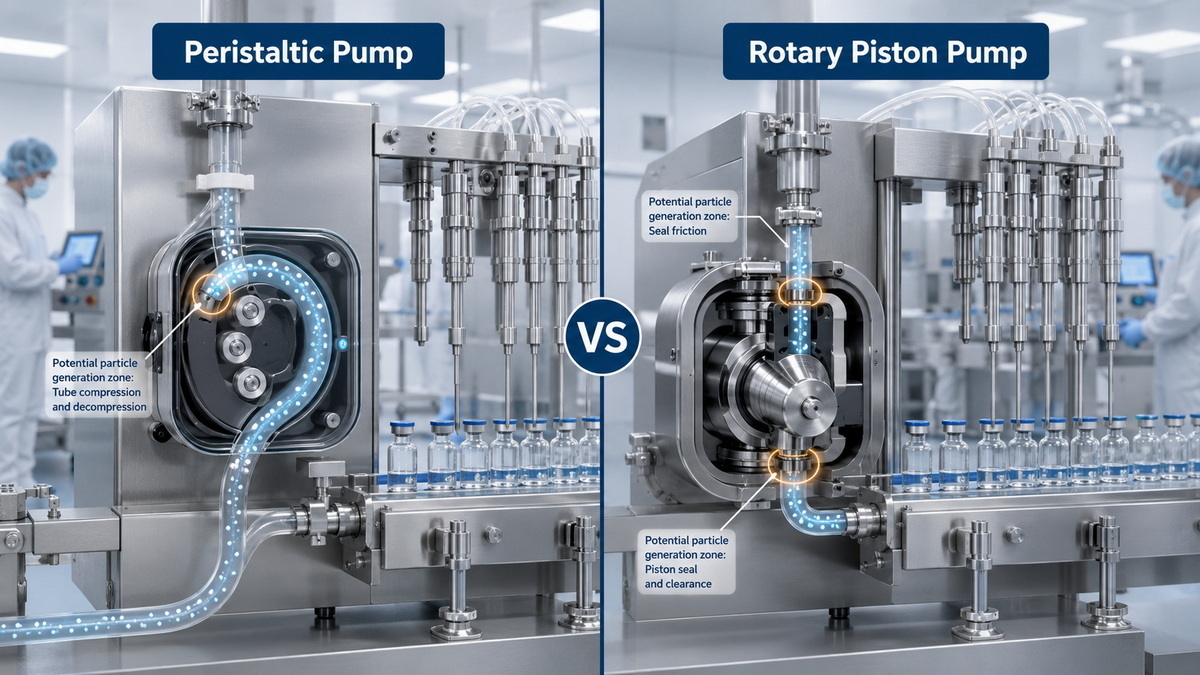
A peristaltic pump moves liquid by compressing flexible tubing in a rolling motion. The liquid only contacts the tubing, not the pump head, so the wetted path is simple and easy to isolate. In pharma filling, this is attractive because tubing can be qualified, replaced, and controlled as a critical consumable. [pubmed.ncbi.nlm.nih]
Rotary Piston Pump
A rotary piston pump uses a rotating piston inside a cylinder to displace liquid. This design can be effective for dosing, but it creates internal flow recirculation zones and repeated exposure to shear in the chamber, which may increase subvisible particle formation in delicate formulations. In low-volume aseptic filling studies, rotary piston pumps showed the highest subvisible particle counts above 2 µm among the compared dosing systems. [pubmed.ncbi.nlm.nih]
Particle Count Comparison
The most relevant difference is not just theoretical design, but observed particle behavior during filling. One study found that peristaltic filling pump performance was strongly influenced by tubing type, operating parameters, and surfactants, and that some tubing materials produced much higher particle levels than others. Another study comparing dosing systems reported the highest subvisible particle counts in the rotary piston pump, even though a radial peristaltic pump generated the highest shear rate in that experiment. [pubmed.ncbi.nlm.nih]
| Factor | Peristaltic Pump | Rotary Piston Pump |
| Product contact surface | Mainly tubing | Internal cylinder and piston surfaces |
| Particle risk driver | Tubing shedding, tubing quality, operating speed | Recirculation and repeated shear exposure |
| Sensitivity to formulation | High | High |
| Typical particle-control focus | Tubing qualification and speed optimization | Chamber design and process stress reduction |
| Best fit | Sensitive biologics, flexible aseptic lines | Certain dosing applications where robust design is acceptable |
The practical takeaway is that lower mechanical contact does not automatically mean lower particles, but peristaltic systems often offer more controllable particle-risk management because the tubing can be selected, qualified, and changed with less complexity. Rotary piston systems may still perform well in some applications, but when subvisible particles are critical, their internal recirculation behavior deserves closer scrutiny. [pubmed.ncbi.nlm.nih]
What Drives Particle Formation
Tubing Quality
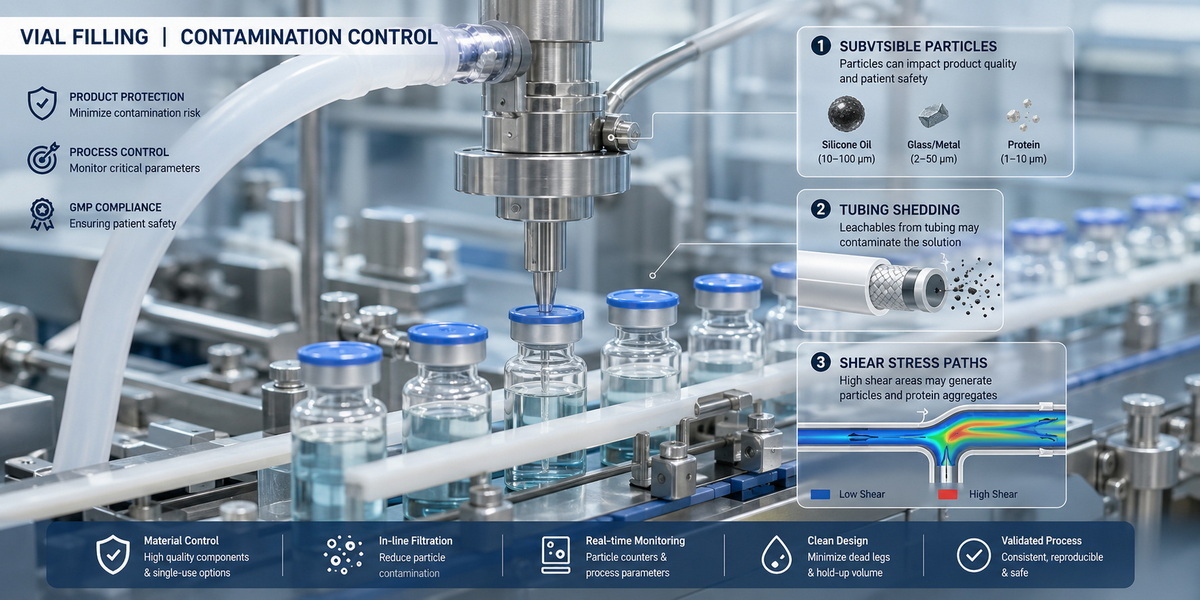
For peristaltic systems, tubing is the main variable that can shed particles. A published study found that different silicone tubing types behaved differently, and surface roughness inside the tubing was a determining factor for particle shedding. That means pump selection alone is not enough; tubing specification is part of the particle-control strategy. [pubmed.ncbi.nlm.nih]
Pump Speed and Acceleration
Higher speed can worsen nanoparticle formation in some cases. In the 2020 peristaltic pump study, acceleration did not measurably affect particle levels, but higher velocity at 400 rpm increased nanoparticle formation in some cases. This means line tuning matters just as much as hardware selection. [pubmed.ncbi.nlm.nih]
Formulation Sensitivity
Protein-based products are especially vulnerable. Surfactants reduced pumping-induced particle formation in the mAb study, showing that formulation chemistry interacts with mechanical stress. In practice, this is why filling validation should never be separated from formulation development. [pubmed.ncbi.nlm.nih]
Which Pump Fits Which Product
For high-value sterile drugs, the best pump depends on the product's fragility, batch size, filling speed, and acceptable particle threshold. Peristaltic pumps are often preferred when the priority is simple wetted-path control and fast changeover. Rotary piston pumps can be suitable when the process tolerates more internal contact and when dosing accuracy, chamber design, and maintenance discipline are strong.
Use this rule of thumb:
1. Choose a peristaltic pump when product sensitivity and contamination control are the top priorities.
2. Choose a rotary piston pump when your process demands a rigid dosing mechanism and your product can tolerate the associated mechanical stress.
3. Requalify both options when you change formulation, tubing, speed, or vial size.
Expert View for Pharma Plants
From a plant-design perspective, pump choice should be made together with the upstream purified water system, downstream sterilization equipment, and the aseptic preparation layout. A well-designed vial filling line is not just a machine selection; it is a contamination control strategy that includes utilities, cleaning philosophy, automation, and documentation. This is where an equipment manufacturer with full-line engineering experience can add value by aligning water quality, formulation transfer, and fill-finish architecture in one integrated design. [centec]
For global buyers, the most competitive vial filling projects now focus on three things: particle control, GMP validation readiness, and scalable layout planning. That is especially important for facilities handling large-volume preparations, lyophilized drugs, and oncology products, where operational consistency can affect both compliance and yield.
Practical Validation Steps
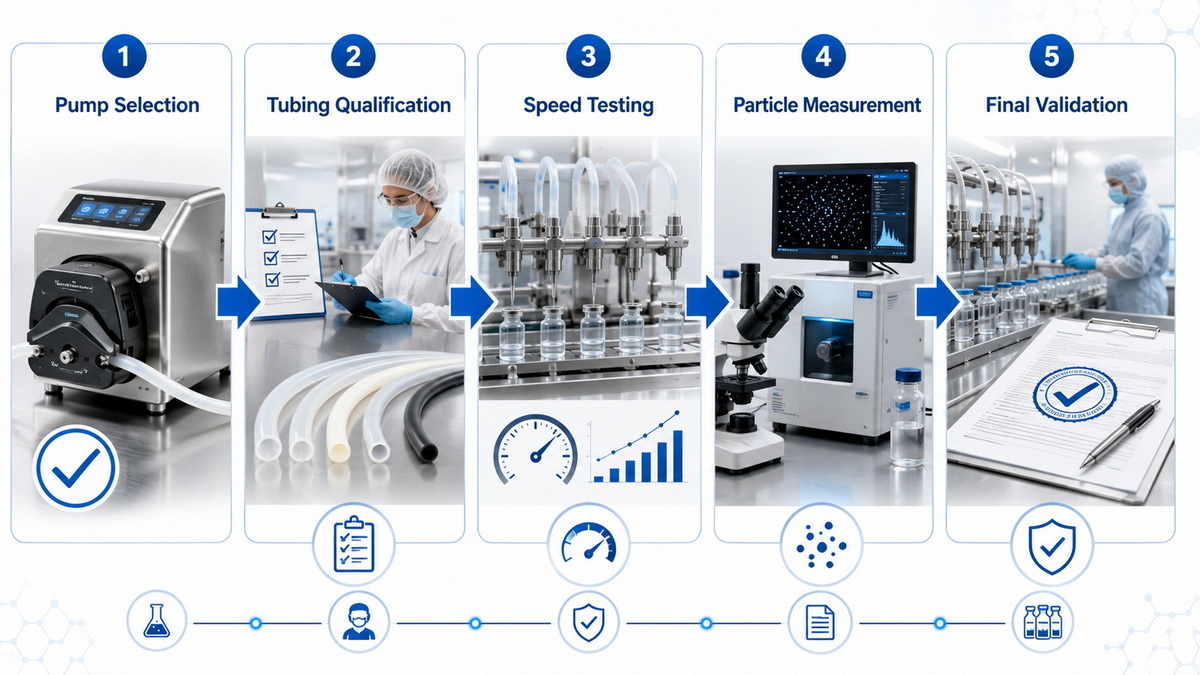
To reduce particle risk during project design or line upgrade, use this validation workflow:
1. Define the target product sensitivity and acceptable particle limits.
2. Test candidate tubing or pump components with the actual formulation.
3. Measure both microparticles and nanoparticles, not only one size range. [pubmed.ncbi.nlm.nih]
4. Compare fill results at multiple speeds and operating settings.
5. Document cleaning, replacement intervals, and qualification criteria.
6. Revalidate after formulation or packaging changes.
This approach is more reliable than relying on catalog claims alone, because published research shows that particle behavior depends on formulation, tubing, and process settings. [pubmed.ncbi.nlm.nih]
CTA for Buyers
If your project involves sterile vial filling, high-value biologics, or sensitive injectable formulations, your pump decision should be made during line design, not after installation. A custom engineering review of pump type, tubing selection, utility design, and filling validation can reduce particle risk before production starts.
FAQ
1. Which pump produces fewer particles in vial filling?
There is no universal answer, but published data suggest that peristaltic systems can be easier to control for particle risk, while rotary piston pumps may show higher subvisible particle counts in some low-volume aseptic filling conditions. [pubmed.ncbi.nlm.nih]
2. Is tubing really that important in peristaltic pumping?
Yes. Research shows tubing type and inner-surface roughness can materially affect particle shedding, so tubing qualification is essential. [pubmed.ncbi.nlm.nih]
3. Does faster filling always mean more particles?
Not always, but higher operating speed can increase nanoparticle formation in some cases, so speed should be validated with the actual formulation. [pubmed.ncbi.nlm.nih]
4. Are rotary piston pumps unsuitable for sterile filling?
No. They can be used in appropriate applications, but their internal recirculation and shear behavior should be assessed carefully for sensitive products. [pubmed.ncbi.nlm.nih]
5. What should be tested during pump qualification?
Test particle counts, shear impact, tubing or chamber compatibility, fill accuracy, and the effect of different operating speeds and formulations. [pubmed.ncbi.nlm.nih]
References
1. Her C, et al. "Effects of Tubing Type, Operating Parameters, and Surfactants on Particle Formation During Peristaltic Filling Pump Processing of a mAb Formulation." *Journal of Pharmaceutical Sciences* (2020). [PubMed] [pubmed.ncbi.nlm.nih]
2. Dreckmann T, et al. "Low volume aseptic filling: Impact of pump systems on shear stress." *European Journal of Pharmaceutics and Biopharmaceutics* (2020). [PubMed] [pubmed.ncbi.nlm.nih]
3. Saller V, et al. "Particle shedding from peristaltic pump tubing in biopharmaceutical drug product manufacturing." *Journal of Pharmaceutical Sciences* (2015). [PubMed] [pubmed.ncbi.nlm.nih]
4. FDA. "Guidance for Industry." [PDF] [fda]
5. Centec GmbH. "PW Generator — Purified Water System." [Product page] [centec]


