In sterile pharmaceutical manufacturing, the smallest workflow decision can have a major impact on contamination risk, operator burden, and line efficiency. Automatic vial loading vs manual tray loading is not just an equipment choice—it is a GMP, sterility assurance, and productivity decision that directly affects Grade A zone performance.
For manufacturers building or upgrading aseptic filling lines, the central question is simple: how can you move containers into the critical zone with the least possible human intervention while maintaining speed, consistency, and compliance?
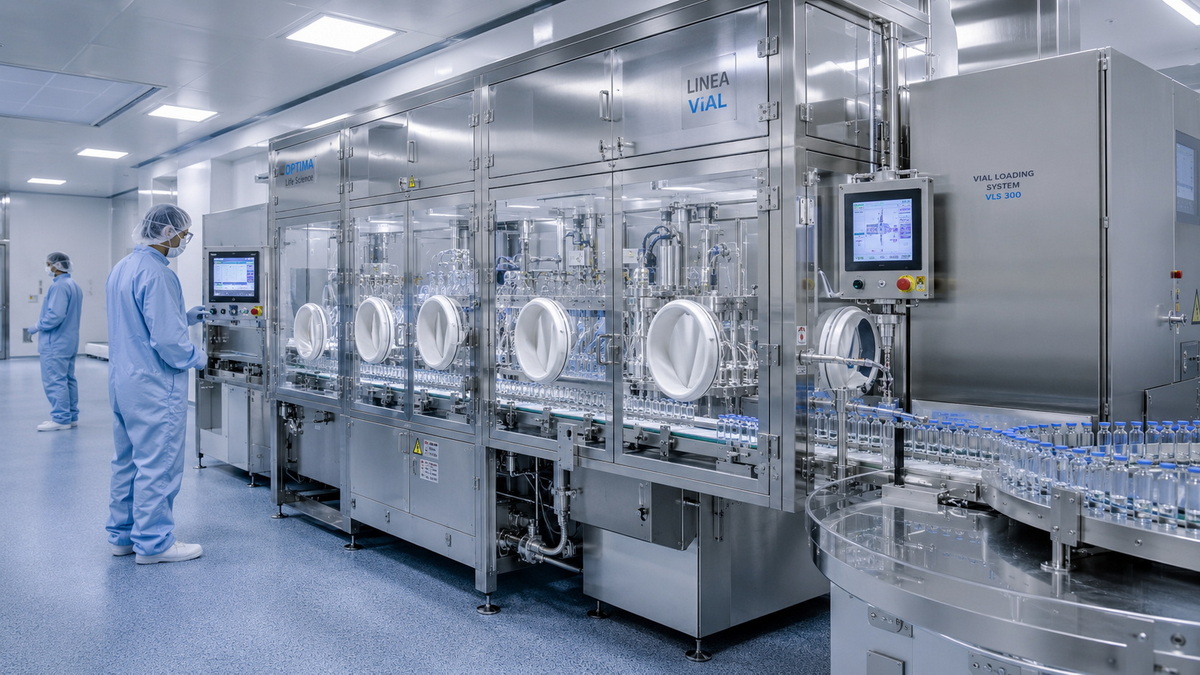
Why Grade A Zones Demand Minimal Human Intervention
Grade A zones are designed to protect the most critical aseptic operations, where exposed sterile products or components are highly vulnerable to contamination. In this environment, every manual touchpoint introduces additional risk, even when operators follow strict gowning and SOPs.
Human presence brings three unavoidable variables: movement, variability, and error potential. Even highly trained operators can create turbulence, interrupt airflow patterns, or introduce handling inconsistency during loading. That is why the industry increasingly favors automated vial feeding and transfer solutions whenever process design, budget, and product sensitivity allow it.
For plants planning new sterile lines, the loading method should be evaluated as part of the broader contamination control strategy, not as an isolated machine function.
What Manual Tray Loading Involves
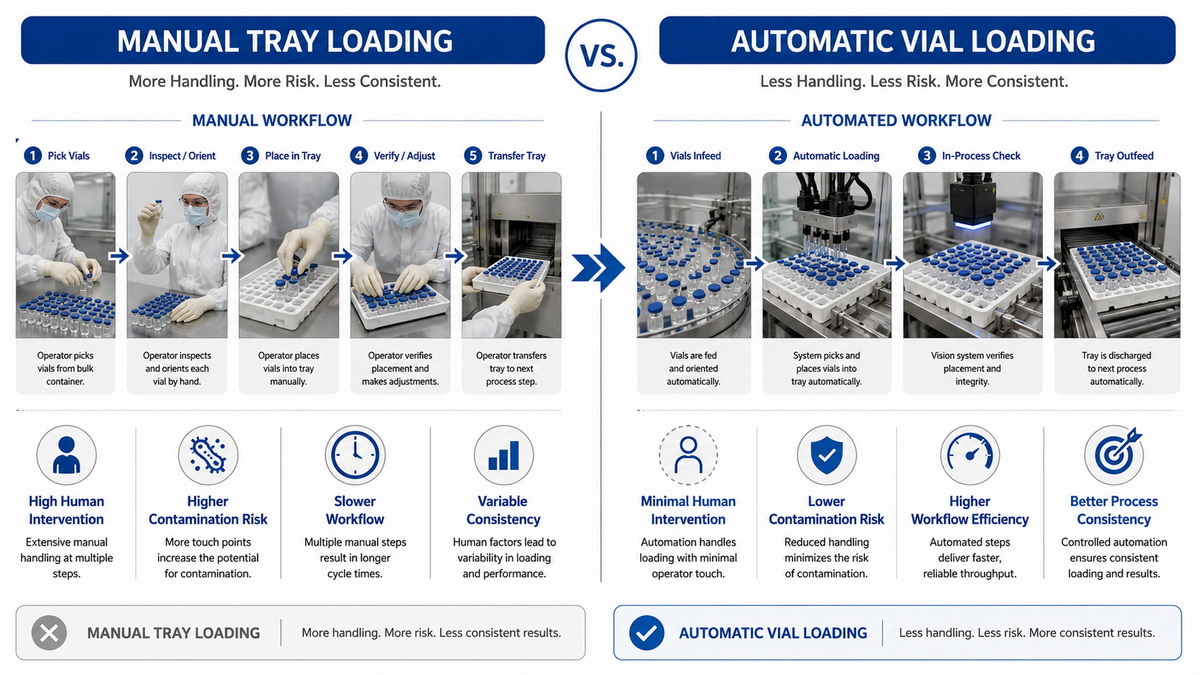
Manual tray loading typically means operators transfer vials, nests, or trays into the line by hand. In many facilities, this remains common because it is familiar, lower in initial capital cost, and easier to implement on legacy lines.
However, manual loading usually requires:
- More operator intervention in the aseptic area.
- More interventions for alignment, staging, and replenishment.
- Greater dependence on human consistency.
- Higher exposure of components to the environment during transfer.
Manual tray loading may still be appropriate for low-throughput operations, early-stage facilities, or lines that handle frequent product changeovers. But in Grade A zones, every manual step should be justified against contamination risk and operational efficiency.
What Automatic Vial Loading Does Differently
Automatic vial loading uses mechanical, pneumatic, robotic, or conveyor-based systems to transfer vials from upstream packaging or staging areas into the critical process zone. The goal is to reduce or eliminate direct human handling inside the most sensitive area.
In modern aseptic lines, automated loading can support:
- Continuous or semi-continuous vial transfer.
- Controlled orientation and spacing.
- Reduced operator entry into critical zones.
- More stable line speed and repeatability.
- Better compatibility with isolators and RABS-based setups.
When integrated well, automatic loading becomes part of a closed or semi-closed aseptic workflow. That makes it especially valuable in high-value injectable production, biologics, and other products where contamination control is a top priority.
Side-by-Side Comparison
| Factor | Automatic Vial Loading | Manual Tray Loading |
| Human intervention | Very low | Higher |
| Contamination risk | Lower when properly designed | Higher due to direct handling |
| Throughput consistency | Strong | Depends on operator performance |
| Capital investment | Higher upfront | Lower upfront |
| Labor demand | Lower | Higher |
| GMP/validation complexity | Higher engineering effort | Simpler initial setup |
| Long-term scalability | Better | More limited |
| Best use case | High-volume aseptic lines, Grade A-critical operations | Small batches, legacy lines, budget-limited projects |
The table shows the basic trade-off clearly: automation improves control, but manual loading lowers upfront cost. In modern sterile manufacturing, the long-term value often lies in contamination reduction, labor savings, and repeatable performance.
Contamination Control Impact
From a sterility assurance perspective, the strongest argument for automatic loading is simple: fewer human touches usually mean fewer contamination opportunities. That matters because the Grade A environment is not only about clean air; it is also about controlling all interventions that could compromise the critical zone.
Automatic systems can help reduce:
- Direct contact with primary containers.
- Repeated opening of pathways into the aseptic area.
- Operator-related variability during loading.
- Unplanned stoppages caused by handling errors.
Manual tray loading, by contrast, can increase the number of interventions required per batch. Even when SOPs are strong, more interventions create more opportunities for deviation, line disruption, or environmental challenge.
Efficiency and Line Economics
Many manufacturers initially focus on machine price, but the real business case should include labor, downtime, rejection risk, and future expansion. Automatic vial loading often pays back through higher repeatability, reduced staffing intensity, and fewer operational interruptions.
This is especially true when a facility runs multiple shifts or plans to scale output over time. In that scenario, the long-term cost of manual handling can exceed the initial savings of a simpler system.
A useful way to assess economics is to compare:
1. Operator time per 1,000 vials
2. Intervention frequency per batch
3. Scrap and rejection impact
4. Downtime caused by loading issues
5. Training and requalification burden
If a line will process critical sterile products for many years, automation usually becomes a stronger strategic choice.
Validation and Compliance Considerations
Regulatory expectations increasingly emphasize contamination control strategy, process robustness, and reduction of human intervention. That means loading design should be documented as part of the overall aseptic process justification.
Automatic vial loading can support a stronger compliance story because it helps demonstrate:
- Reduced human interaction.
- More controlled material transfer.
- More consistent process execution.
- Better alignment with modern aseptic design principles.
Manual tray loading is not inherently non-compliant, but it may require more justification, more procedural controls, and more monitoring. In practical terms, the simpler the human pathway, the easier it is to defend the process during inspection and audit.
Where Manual Still Makes Sense
Manual tray loading is not obsolete. It still has value in specific cases, especially when production volume is modest or product formats change frequently.
It may be the better fit when:
- The line is used for small-batch or clinical supply.
- Budget constraints limit automation investment.
- The factory is upgrading legacy equipment in phases.
- Production requires flexibility more than maximum throughput.
- Container formats vary too widely for stable automation.
In those situations, a well-controlled manual process may be the most practical solution, provided that the contamination risk is accepted and managed.
New Insight: The Real Decision Is About Intervention Design
A useful industry insight is that the best line design does not simply choose "automation" or "manual." Instead, it asks: where should human intervention be moved, minimized, or redesigned?
For example, a facility may keep manual loading outside the Grade A zone while using automated transfer into the critical area. That hybrid approach often delivers the best balance of cost, compliance, and flexibility.
This matters because many contamination events do not come from the main process itself—they come from the transitions between zones. If you can redesign those transitions, you often achieve a bigger sterility benefit than by optimizing one machine alone.
Engineering Perspective for New Facilities
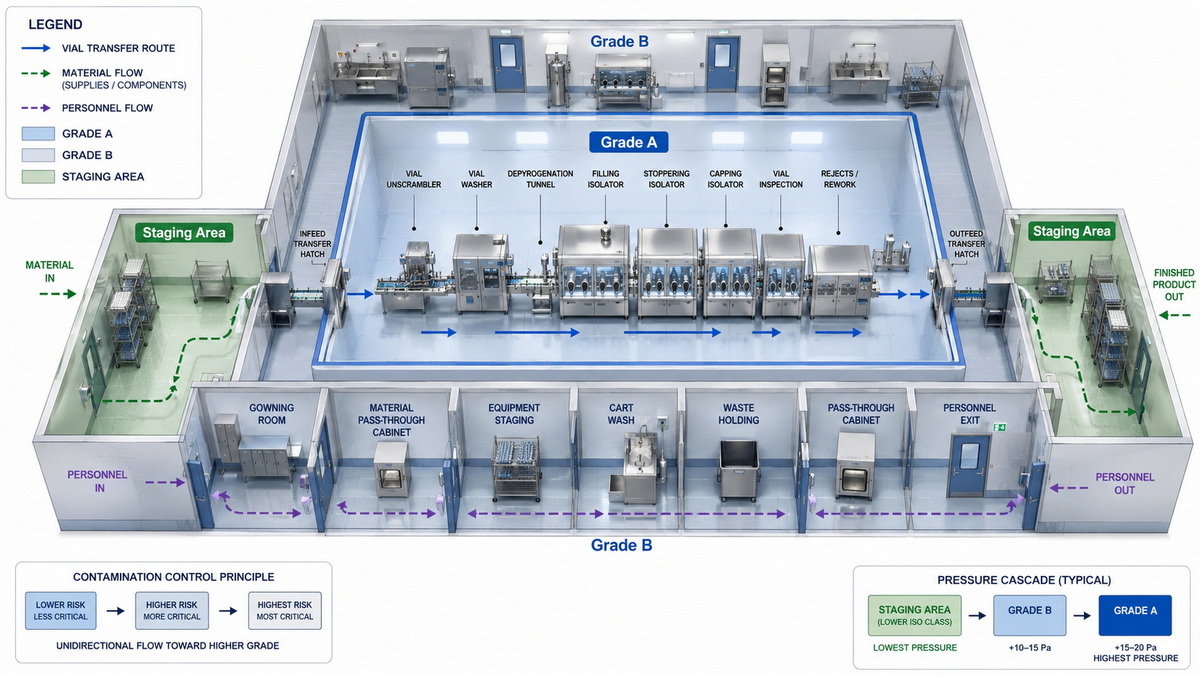
From a factory planning standpoint, automatic vial loading should be considered early in the layout stage. It affects room zoning, airflow design, operator access, staging areas, and equipment footprint.
For new sterile production lines, the following questions should be answered before finalizing the layout:
- How will containers enter the aseptic core?
- How many interventions will occur per batch?
- Can the transfer path be closed or semi-closed?
- What is the expected throughput over 3–5 years?
- How will maintenance be performed without compromising the zone?
For companies like Everheal that support customized plant layout and production line planning, this is where system engineering creates real value. The best solution is rarely just a machine; it is an integrated flow that supports water systems, sterilization, preparation, and aseptic handling as one connected design.
Practical Selection Guide
Choose automatic vial loading if your priorities are:
- Lower human intervention in Grade A zones.
- Better contamination control.
- Higher throughput consistency.
- Scalable production.
- Stronger long-term ROI.
Choose manual tray loading if your priorities are:
- Lower initial investment.
- Simpler implementation.
- Flexible low-volume production.
- Transitional use on legacy lines.
A simple rule of thumb: the more critical the product, the more valuable automation becomes.
Conclusion
For sterile pharmaceutical manufacturers, the choice between automatic vial loading and manual tray loading is ultimately a choice between control and convenience. Manual loading may be cheaper at the start, but automatic loading usually offers stronger contamination control, better repeatability, and a more scalable aseptic strategy.
If your goal is to reduce human intervention in Grade A zones, the best approach is to design the loading method as part of the entire contamination control system—not as an isolated equipment decision. For new facilities, this is where integrated engineering, layout planning, and automation strategy can make the biggest difference.
CTA: If you are planning a new aseptic line or upgrading an existing sterile filling room, evaluate your vial transfer strategy early. A well-designed loading system can reduce risk, simplify validation, and improve long-term production performance.
FAQ
1. Is automatic vial loading always better than manual tray loading?
Not always. Automatic loading is usually better for contamination control and scale, but manual loading can still suit low-volume or budget-limited operations.
2. Why is human intervention a problem in Grade A zones?
Because every manual action adds risk of contamination, airflow disturbance, and process inconsistency in the most critical aseptic area.
3. Does automatic loading simplify GMP compliance?
It can support compliance by reducing interventions and improving process consistency, but it still requires proper validation and documentation.
4. When is manual tray loading still acceptable?
It is often acceptable for small-batch production, legacy equipment, or operations where flexibility matters more than maximum automation.
5. What is the biggest hidden cost of manual loading?
Often it is not the labor alone, but the combined cost of interventions, downtime, training, deviation handling, and contamination risk.
References
Below are the types of sources you should cite and hyperlink in the final published version:
1. EU GMP Annex 1 — Sterile manufacturing and contamination control guidance.
2. FDA guidance on sterile drug products / aseptic processing — Expectations for aseptic operations and interventions.
3. PDA Technical Reports on aseptic processing — Industry best practices on interventions and contamination control.
4. ISPE guidance on sterile facility design — Room zoning, layout, and aseptic engineering principles.
5. Vendor documentation from aseptic equipment suppliers — For automatic vial loading, isolators, and sterile transfer systems.


