Content Menu
● Why CPAP Machines Use Water
>> Role of Humidification in CPAP Therapy
>> Why Water Quality Matters
● Steamed Distilled vs Normal Distilled Water
● Can I Use Steamed Distilled Water in My CPAP?
● Why Not Tap, Mineral, or Boiled Water?
>> Problems with Tap Water
>> Mineral and Spring Water
>> Boiled or Hot Water
● Purified, Filtered, and Reverse Osmosis Water
● How a Distillation Water Machine Works
● Distillation Water Machine in CPAP Water Production Lines
● Practical Tips for Daily CPAP Water Use
>> Choosing the Right Water
>> Filling and Emptying the Humidifier
>> Cleaning the Humidifier Chamber
● Travel and Emergency Situations
● How Distilled Water Benefits CPAP Manufacturers and Service Providers
● Conclusion
● FAQ
>> (1) Is steamed distilled water safer for CPAP than ordinary tap water?
>> (2) Can I use bottled mineral or spring water in my CPAP humidifier?
>> (3) Is purified or reverse osmosis water good enough if I cannot find distilled water?
>> (4) How often should I change and clean the water in my CPAP humidifier?
>> (5) Why do hospitals and sleep labs use Distillation Water Machines?
Steamed distilled water is produced by heating water until it becomes steam and then condensing that steam back into liquid in a separate, clean area. The evaporation step leaves behind most dissolved minerals, heavy metals, and other non‑volatile impurities, while the condensate becomes highly purified water. In industry, this process is automated and controlled inside a Distillation Water Machine.
Compared with tap water or mineral water, steamed distilled water has extremely low mineral content and very low conductivity. That purity is exactly what makes it suitable for sensitive applications such as medical devices, laboratory instruments, and pharmaceutical production. When used in a CPAP humidifier, steamed distilled water reduces scale formation and supports better hygiene.
Why CPAP Machines Use Water
Role of Humidification in CPAP Therapy
CPAP therapy works by delivering a continuous flow of air that keeps the upper airway open during sleep. Without humidification, that airflow can feel very dry, leading to a sore throat, nasal irritation, or congestion, especially for new users. The built‑in humidifier adds moisture to the air stream so that breathing feels more natural and comfortable through the night.
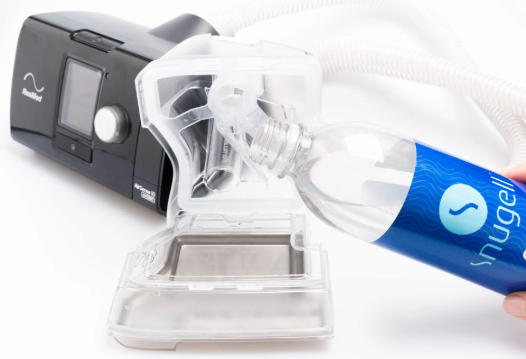
The humidifier typically contains a small chamber that you fill with water before use. The CPAP device either warms this water or passes the airflow directly over it, allowing water molecules to evaporate into the air. The quality of that water directly affects both your therapy experience and the condition of your CPAP equipment over time.
Why Water Quality Matters
When the humidifier evaporates water, minerals and other non‑volatile substances remain behind in the chamber instead of going into the air. If the water contains calcium, magnesium, or other dissolved solids, these will accumulate as visible residue, scale, or discoloration on the chamber walls and heater plate. Over time this can cloud the plastic, reduce heating efficiency, and make cleaning much more difficult.
Water can also act as a breeding ground for microorganisms if the chamber is not cleaned regularly or the water is left standing for too long. While distilled water does not eliminate all risk, using cleaner water reduces nutrient load and helps limit biofilm formation compared with untreated tap water. Combined with good cleaning habits, this significantly improves hygiene.
Steamed Distilled vs Normal Distilled Water
From a CPAP perspective, steamed distilled water and regular distilled water are functionally the same product. Both are created by boiling water into steam and condensing it so that minerals and most other impurities are left behind. The differences in wording—“steam‑distilled”, “vapor‑distilled”, or plain “distilled”—usually reflect marketing language rather than a fundamentally different process.
The real point to check is the ingredient list on the bottle. The water should be labeled as distilled or steam‑distilled and should list only “water” with no added minerals, salts, or flavorings. If a bottle describes itself as “distilled” but then advertises “added electrolytes for taste”, that version is not ideal for CPAP humidifiers because those added minerals will still deposit on the chamber surfaces.
Can I Use Steamed Distilled Water in My CPAP?
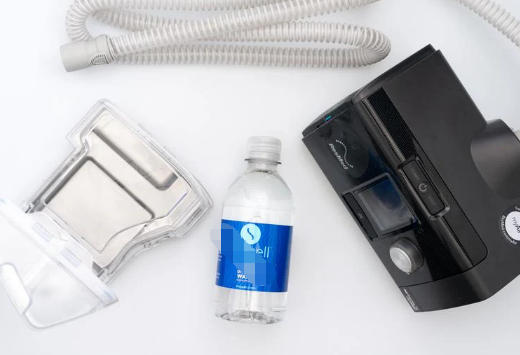
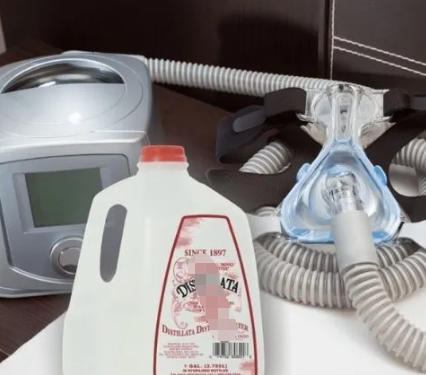
If the bottle clearly states that the water is distilled or steam‑distilled and contains no additives, then it is a suitable and recommended choice for your CPAP humidifier. Many sleep specialists and CPAP manufacturers explicitly state that distilled water is preferred for protecting the humidifier, reducing mineral buildup, and supporting better hygiene.
For home use, buying commercially packaged steam‑distilled water from the supermarket is usually sufficient. For clinical environments, sleep labs, or companies that manufacture CPAP consumables, a Distillation Water Machine can continuously produce steam‑distilled water that meets internal quality specifications and allows better control of conductivity, total organic carbon (TOC), and microbiological parameters.
Why Not Tap, Mineral, or Boiled Water?
Problems with Tap Water
Tap water quality varies by region, but it generally contains dissolved minerals like calcium and magnesium, as well as trace levels of metals and other substances. When tap water is used in a CPAP humidifier, those minerals remain behind as the water evaporates and gradually form limescale on the bottom and sides of the chamber. This scale is difficult to remove completely and can shorten the life of the chamber.
Tap water can also contain microorganisms that are safe for most people to drink but are not ideal for inhalation when aerosolized into the airways. In a device like a CPAP humidifier that can produce fine droplets and vapor, it is safer to minimize this risk by using water that has gone through distillation or equivalent high‑level purification.
Mineral and Spring Water
Bottled mineral water and spring water are intentionally rich in dissolved minerals to improve taste for drinking. Those same minerals, however, are precisely what cause heavy residue in a CPAP humidifier. Even if the water looks clean, repeated use will produce thick white or yellowish deposits on the chamber surfaces.
For this reason, bottled mineral water is not recommended for CPAP use, even if it comes from a trusted brand. Distilled water is a better choice because it has most of these dissolved solids removed.
Boiled or Hot Water
Boiling tap water is helpful for killing many types of microorganisms, but it does not remove minerals or most chemical contaminants. After boiling and cooling, the water still has the same hardness as before, so mineral buildup will continue if you use it in the CPAP humidifier. Boiled water is sometimes used as a short‑term emergency option when nothing else is available, but it is not ideal for long‑term daily use.
By contrast, water produced by a Distillation Water Machine is both heated and separated physically through evaporation and condensation, which removes most minerals rather than simply inactivating microbes.
Purified, Filtered, and Reverse Osmosis Water
Some bottled waters are labeled “purified” rather than “distilled”. These products may be made using reverse osmosis, deionization, or multi‑stage filtration systems. Such water often has a much lower mineral content than typical tap water and is generally safer for CPAP use than hardened tap water.
However, purified water might still contain small amounts of minerals or dissolved solids depending on the process and quality control. Over a long period, this can still lead to minor residue and may require more frequent cleaning of the CPAP chamber compared with true distilled water. If distilled or steam‑distilled water is available, it remains the first choice.
In cases where only purified or filtered water is available, many clinicians accept short‑term use under the condition that the user cleans the humidifier regularly and switches back to distilled water as soon as possible. A stable supply of distilled water from a Distillation Water Machine is the best way to avoid uncertainty about water quality in clinical settings.
How a Distillation Water Machine Works
A Distillation Water Machine automates the entire distillation process, starting from feed water (often pre‑treated tap water) and delivering consistent distilled water at the outlet. The typical stages include:
- Heating and evaporation: Feed water enters an evaporation chamber where it is heated until it boils and produces steam.
- Separation: Non‑volatile impurities, including most salts and heavy metals, remain in the liquid phase and do not travel with the steam.
- Condensation: The steam moves to a condenser, where it is cooled and converted back into liquid water.
- Collection and storage: The distilled water is collected in a sanitary tank and often circulated or stored under conditions that minimize re‑contamination.
Advanced Distillation Water Machines may use multiple effects or stages, pure steam generators, and hygienic designs that follow pharmaceutical GMP standards. Parameters such as conductivity, temperature, flow, and level can be monitored and controlled automatically. This type of system is ideal for hospitals, pharmaceutical factories, and medical device manufacturers that need continuous supply of high‑purity water for CPAP humidifiers, sterile formulations, and cleaning processes.
Distillation Water Machine in CPAP Water Production Lines
For companies that bottle water specifically for CPAP use or for hospitals that want to supply respiratory wards, integrating a Distillation Water Machine into a complete line brings several advantages:
- Stable quality: The Distillation Water Machine ensures each batch has similar purity, making it easier to comply with internal or regulatory standards.
- Scalability: The system can be sized to produce enough steam‑distilled water for multiple CPAP units, nebulizers, and other respiratory devices.
- Compatibility with downstream equipment: Distilled water can be fed into pure steam generators, storage and distribution loops, and automatic liquid filling and sealing machines with minimal fouling risk.
A full CPAP water production line might combine: pre‑treatment, the Distillation Water Machine, pure steam generation, storage tanks, sterilization systems, and automatic bottling solutions. This integrated approach reduces manual handling and improves traceability of water quality across the process.
Practical Tips for Daily CPAP Water Use
Choosing the Right Water
When purchasing water for home CPAP use, read the label carefully and look for the following:
- Words such as “distilled”, “steam‑distilled”, or “vapor‑distilled”.
- Ingredient list showing only water, with no added minerals, salts, or flavors.
- No marketing phrases that emphasize electrolytes, enhanced taste, or mineral content.
If you are using CPAP in a hospital or clinic, ask whether the water supplied for humidifiers is produced by a centralized system, such as a Distillation Water Machine or purified water loop. This indicates that the facility is paying close attention to water quality and equipment protection.
Filling and Emptying the Humidifier
Each night, fill the humidifier chamber up to the indicated line with steamed distilled water. Avoid overfilling, because this can lead to water entering the hose or mask and may interfere with temperature control. In the morning, empty any remaining water, gently shake out droplets, and allow the chamber to air‑dry.
Never top up old water by adding new water on top of it. Discarding the leftover water daily reduces the time microbes have to multiply and helps keep the chamber cleaner.
Cleaning the Humidifier Chamber
Manufacturers usually recommend cleaning the chamber at least once a week using mild soap and warm water, followed by thorough rinsing and air‑drying. If you use anything other than distilled water, you may need to clean more frequently to remove mineral deposits. Avoid harsh chemicals or abrasive tools that can scratch the plastic and create niches where microorganisms can hide.
Even when using high‑purity distilled water, regular cleaning is important. Distilled water reduces deposits but does not completely eliminate the possibility of contamination, especially if the CPAP is used daily in a warm environment.
Travel and Emergency Situations
When traveling, you might not always find distilled water at your destination. In such cases, you have several options:
- Check local supermarkets or pharmacies for distilled, steam‑distilled, or vapor‑distilled water.
- Use purified bottled water temporarily if distilled water is not available, and clean your humidifier more frequently.
- If you must use tap water for a short period, make sure you clean and descale the humidifier chamber once you return to distilled water.
Some CPAP users choose to travel with a small amount of distilled water from home, particularly for short trips. Others rely on compact travel‑sized humidifiers designed to cope better with varying conditions. Even so, using true distilled water whenever possible remains the best way to protect the device.
How Distilled Water Benefits CPAP Manufacturers and Service Providers
CPAP machine manufacturers, rental services, and sleep labs also benefit from standardizing on distilled water:
- Reduced maintenance costs: Devices that operate with distilled water show fewer cases of severe scaling or early humidifier failure.
- Improved customer satisfaction: Patients experience more consistent performance and fewer unpleasant odors or discoloration in the chamber.
- Simplified training: Staff can deliver clear, simple instructions: “Use distilled or steam‑distilled water only, and clean regularly.”
By integrating a Distillation Water Machine into their utility systems, facilities can supply their own distilled water at scale rather than relying entirely on external bottled water suppliers. This approach provides better cost control and quality assurance, especially in regions with variable tap‑water quality.
Conclusion
Steamed distilled water is not only safe to use in a CPAP machine, it is the type of water most experts and manufacturers recommend for daily humidifier use. Because it is produced by evaporation and condensation, steamed distilled water leaves behind minerals and most other impurities that could otherwise cause scale buildup, discoloration, and hygiene concerns inside the humidifier chamber.
Using steamed distilled water produced by a professional Distillation Water Machine gives both individual users and healthcare providers an extra level of confidence in water quality. For hospitals, clinics, and OEM brands, integrating a Distillation Water Machine into purified water systems and filling lines makes it easier to deliver high‑purity CPAP water at scale while protecting devices and supporting long‑term, reliable respiratory therapy.
FAQ
(1) Is steamed distilled water safer for CPAP than ordinary tap water?
Yes. Steamed distilled water has most minerals and many impurities removed, so it does not leave the hard deposits that tap water does and usually supports better hygiene in the long term. Tap water can still be safe for drinking but may not be ideal when aerosolized in a CPAP humidifier.
(2) Can I use bottled mineral or spring water in my CPAP humidifier?
It is not recommended. Bottled mineral and spring water contain high levels of dissolved minerals that will remain behind as residue when the water evaporates. Over time, these minerals can create heavy scale and stains on the humidifier chamber and heater plate.
(3) Is purified or reverse osmosis water good enough if I cannot find distilled water?
Purified or reverse osmosis water is usually better than hard tap water and can be used temporarily if distilled water is unavailable. However, it may still contain small amounts of minerals, so it is wise to clean the humidifier more frequently and switch back to distilled or steam‑distilled water as soon as possible.
(4) How often should I change and clean the water in my CPAP humidifier?
Empty any remaining water each morning, allow the chamber to air‑dry, and refill it with fresh distilled water before use each night. Clean the chamber at least weekly with mild soap and warm water, and follow your manufacturer's instructions for deeper disinfection or replacement intervals.
(5) Why do hospitals and sleep labs use Distillation Water Machines?
Hospitals and sleep labs need large volumes of consistent, high‑purity water for CPAP devices, nebulizers, and other respiratory therapy equipment. A Distillation Water Machine allows them to produce steam‑distilled water on site with controlled purity, improving device protection, supporting regulatory compliance, and reducing reliance on external bottled water suppliers.


