Content Menu
● What is a banana bag?
● CPT basics you need
● Why banana bags code as infusion, not hydration
● Coding pathways for banana bags
● Documentation that supports correct CPT
● Practical scenarios
● Operational tips for hospitals and clinics
● Infusion Bag production and Everheal's role
● Risk management and compliance
● Training and quality assurance
● Suggested visuals for your final page build
● Conclusion
● FAQ
>> 1) Are banana bags billed as infusion or hydration?
>> 2) What CPT code usually applies to the initial hour?
>> 3) When do hydration codes 96360–96361 apply?
>> 4) Can hydration and therapeutic infusion be billed together?
>> 5) What documentation prevents denials for banana bag claims?
● Citations:
Banana bags are typically charged under IV infusion for therapy/prophylaxis CPT (e.g., 96365 for the initial hour) rather than hydration (96360–96361), since the bag contains thiamine, folate, magnesium, and multivitamins administered for therapeutic benefit. Hydration codes are intended for pre-packaged fluids/electrolytes when the sole intent is volume repletion and not the administration of drugs or other substances.
What is a banana bag?
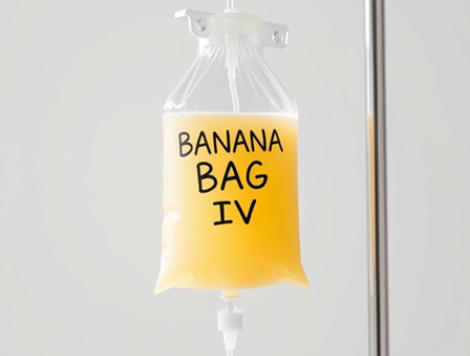
A banana bag is an IV Infusion Bag containing fluids plus thiamine, folate, magnesium, and multivitamins that are delivered to treat or prevent deficiencies, commonly in emergency and inpatient settings. Because these are active therapeutic substances, the administration fits the CPT definition of a therapeutic infusion, not hydration. In practice, facilities document the therapeutic ingredients, clinical intent, and start/stop times to support appropriate coding.
CPT basics you need
- Hydration (96360 initial 31–60 minutes; +96361 each additional hour): Used only for pre-packaged fluids and electrolytes when the service is hydration alone; not reportable for 30 minutes or less and not used to report drugs/substances.
- Therapeutic infusion (96365 initial up to 1 hour; +96366 each additional hour): Used for IV administration of drugs/substances for therapy, prophylaxis, or diagnosis, which includes vitamin/mineral admixtures in a banana bag.
- Hierarchy: If both therapeutic infusion and hydration occur in the same encounter, the therapeutic infusion is primary; hydration may be secondary only if distinct, medically necessary, and properly documented.
Why banana bags code as infusion, not hydration
- Contents: Banana bag solutions include drugs/substances (e.g., thiamine, magnesium, multivitamins) beyond simple electrolytes.
- Clinical intent: The purpose is treatment or prophylaxis (deficiency correction, prevention), not solely fluid replacement.
- Policy and education: Coding education and payer guidance consistently treat vitamin/mineral admixtures as therapeutic infusions rather than hydration.
Coding pathways for banana bags
- Initial therapeutic infusion: Report 96365 when the banana bag runs 16–90 minutes as the initial service.
- Additional time: Report +96366 for each medically necessary additional hour beyond the first.
- Avoid hydration codes for the same banana bag: Do not report 96360–96361 for the banana bag itself because it is not purely pre-packaged fluids/electrolytes.
Documentation that supports correct CPT
- State clinical intent (treatment or prophylaxis) and list all substances in the Infusion Bag (thiamine, folate, magnesium, multivitamins).
- Record precise start/stop times to determine initial and subsequent hours.
- Note sequencing/concurrency with any other injections/infusions to follow the CPT hierarchy and payer policy.
Practical scenarios
- ED treatment for suspected deficiency with a banana bag: Code as therapeutic infusion (96365 for the initial hour), because active substances are infused.
- Outpatient dehydration with only pre-packaged fluids/electrolytes and no drugs: Hydration codes (96360–96361) may apply if time and medical necessity requirements are met.
- Mixed services: When both a therapeutic infusion and hydration are provided, the therapeutic infusion is primary; hydration may be reportable as a secondary, distinct, medically necessary service with complete time documentation.
Operational tips for hospitals and clinics
- Pharmacy-EMR alignment: Ensure compounded banana bag ingredients flow to the infusion documentation to prevent misclassification as hydration.
- Time capture discipline: Use pump logs/EMR flowsheets for accurate start/stop times and rate changes.
- Payer policy cross-checks: Some payers specify additional rules for hydration (e.g., minimum volume or exclusions when concurrent with therapy).
Infusion Bag production and Everheal's role
As a manufacturer of sterile Infusion Bag production lines, Everheal helps ensure consistent quality of the bags used for banana bag therapy through:
- High-purity utilities: Purified-water and pure-steam systems for reliable aseptic operations.
- WFI generation and distillation: Multi-effect distillers that secure water-for-injection quality for compounding workflows.
- Liquid filling and sealing: Precision filling/sealing machines that support container integrity and accurate labeling for vitamin/mineral admixtures.
- Sterilization: Terminal sterilization systems that underpin safety for ready-to-use Infusion Bag formats.
- Turnkey layout: Custom factory layout and validation support that align with GMP and enable consistent documentation, which downstream providers rely on for safe administration and correct coding pathways.
Risk management and compliance
- Labeling clarity: Ingredient lists and concentrations should be unambiguous to support both safe administration and billing specificity.
- Stability and compatibility: Validated formulations help avoid precipitation or instability that could trigger therapy changes and documentation gaps.
- Audit readiness: Maintain compounding logs, batch records, and change control; align with EMR documentation to withstand payer audits on therapeutic infusion claims.
Training and quality assurance
- Staff training: Educate clinical and billing teams on the difference between hydration and therapeutic infusion, emphasizing how banana bag contents and intent drive CPT selection.
- Policy standardization: Create clear SOPs for documentation (intent, contents, times) and for choosing the initial service when multiple infusions occur.
- Continuous improvement: Track denials, identify documentation root causes, and update templates and training accordingly.
Suggested visuals for your final page build
- Anatomy of a banana bag Infusion Bag: callouts for thiamine, folate, magnesium, multivitamins.
- Decision flow: “Reason for encounter → Contents of bag → CPT path (hydration vs therapeutic infusion).”
- Documentation checklist: Intent, ingredients, start/stop times, sequencing.
- Production-line infographic: Purified water → WFI → filling/sealing → sterilization → labeling → distribution.
Conclusion
Banana bags are generally billed as therapeutic IV infusions (e.g., 96365 initial hour) because they contain active drugs/substances—not just fluids/electrolytes—and are administered for treatment or prophylaxis. Hydration codes (96360–96361) are reserved for pre-packaged fluids/electrolytes when hydration is the sole service and time/documentation thresholds are met. Clear documentation of clinical intent, complete ingredient listing, and precise start/stop times ensures accurate coding and reduces denials.
FAQ
1) Are banana bags billed as infusion or hydration?
They are billed as therapeutic IV infusions because they deliver drugs/substances (vitamins and minerals) for treatment or prophylaxis, not solely fluid replacement.
2) What CPT code usually applies to the initial hour?
Report 96365 for the initial hour when the banana bag runs 16–90 minutes; use +96366 for each additional medically necessary hour.
3) When do hydration codes 96360–96361 apply?
Use hydration codes only when administering pre-packaged fluids/electrolytes for hydration alone, with at least 31 minutes of time and clear medical necessity, and when no drugs/substances are infused.
4) Can hydration and therapeutic infusion be billed together?
Yes, but the therapeutic infusion is primary; hydration can be reported only if it is distinct, medically necessary, and fully documented with intent and times.
5) What documentation prevents denials for banana bag claims?
Document the clinical reason (treatment/prophylaxis), list the infused substances, capture precise start/stop times, and specify sequencing/concurrency relative to other infusions or injections.
Citations:
[1](https://www.aapc.com/blog/23016-infuse-yourself-with-coding-knowledge/)
[2](https://www.cms.gov/medicare-coverage-database/view/article.aspx?articleId=53778)
[3](https://www.bcbsnd.com/providers/policies-precertification/reimbursement-policy/coding-guidelines-for-injection-and-infusion-services)
[4](https://www.bcbstx.com/docs/provider/tx/standards/clinical-pay-coding/2025/cpcp026-9-26-2025.pdf)
[5](https://www.cgsmedicare.com/partb/pubs/news/2012/0512/cope18821.html)
[6](https://apps.para-hcfs.com/para/Documents/Q&A_Hydration_vs_Medication_Infusion_Rev_2_edited.pdf)
[7](https://mtpin.org/wp-content/uploads/2019/10/MT-Flex-Webinar-Infusion-Services-Reporting.pdf)
[8](https://mcweb.apps.prd.cammis.medi-cal.ca.gov/file/manual?fn=injecthydra.pdf)
[9](https://publications.aap.org/codingnews/article/doi/10.1542/pcco_book039_document003/27427/Coding-Hydration-Therapeutic-Prophylactic-and)


