Content Menu
● Definition of Equipment Validation
● Why Equipment Validation Matters
● Qualification vs Validation
● Regulatory Expectations and Standards
● Lifecycle Approach to Equipment Validation
● Core Stages: DQ, IQ, OQ, PQ
>> Design Qualification (DQ)
>> Installation Qualification (IQ)
>> Operational Qualification (OQ)
>> Performance Qualification (PQ)
● Documentation and Data Integrity
● Risk-Based Validation Strategy
● Typical Validation Workflow for Pharmaceutical Equipment
● Examples Across Key Pharmaceutical Equipment Types
● Integration of Utilities and Process Equipment
● Common Pitfalls and How to Avoid Them
● Digital Tools and Automation in Validation
● How Everheal Supports Equipment Validation
● Conclusion
● FAQ About Equipment Validation in Pharmaceutical Industry
>> FAQ 1: What is the main purpose of equipment validation in pharma?
>> FAQ 2: What are DQ, IQ, OQ, and PQ in pharmaceutical equipment validation?
>> FAQ 3: When should pharmaceutical equipment be requalified or revalidated?
>> FAQ 4: How does equipment validation support GMP compliance?
>> FAQ 5: What type of pharmaceutical equipment requires the most rigorous validation?
Equipment validation in the pharmaceutical industry is the documented process of proving that pharmaceutical equipment is properly designed, installed, operated, and maintained so it consistently produces products meeting predefined quality standards and GMP requirements. For a company like Everheal, which supplies purified water systems, pure steam generators, multifunction distillers, filling–sealing machines, and sterilization systems, robust equipment validation is essential to win regulatory approvals and customer trust worldwide.[1]

Definition of Equipment Validation
Equipment validation in the pharmaceutical industry is the documented act of demonstrating that pharmaceutical equipment, utilities, and support systems are fit for their intended purpose and consistently perform within specified limits. It forms a key part of the broader process validation framework required by GMP regulators such as the FDA and EMA to protect patient safety and product quality.[2][3]In practice, equipment validation covers the full lifecycle of pharmaceutical equipment—from user requirement specifications and design checks to installation, operational testing, performance trials, and ongoing monitoring during routine production. For example, Everheal’s purified water preparation systems and pure steam generators must be validated to prove they can reliably deliver water and steam quality that meet pharmacopoeial standards batch after batch.[4]
Why Equipment Validation Matters
Regulators link equipment validation directly to GMP compliance because unqualified pharmaceutical equipment can cause contamination, dosage errors, and unstable product quality. A well-structured validation program reduces the risk of recalls, deviations, and inspection findings, which can otherwise lead to delays, financial loss, and damage to a company’s reputation.[3][5]For owners of new plants or expansion projects, validated pharmaceutical equipment also improves process understanding and operational efficiency. When purified water systems, pure steam generators, distillation units, filling and sealing machines, and sterilization systems are validated as an integrated line, it becomes easier to troubleshoot, optimize output, and document performance for audits.[4]
Qualification vs Validation
In pharmaceutical practice, “equipment qualification” is usually considered a subset of the broader “validation” concept. Qualification focuses on proving that a specific piece of pharmaceutical equipment and its utilities are installed and functioning correctly, while validation focuses on the overall process and its ability to deliver consistent product quality.[1][2]A typical framework divides equipment qualification into stages such as Design Qualification (DQ), Installation Qualification (IQ), Operational Qualification (OQ), and Performance Qualification (PQ). Process validation then uses data from these qualification stages plus ongoing monitoring to show that manufacturing processes using the pharmaceutical equipment remain under control during routine production.[3][4]
Regulatory Expectations and Standards
Major authorities, including the FDA and EMA, require pharmaceutical manufacturers to implement lifecycle-based process validation, with equipment qualification as a central element. FDA process validation guidance and EU GMP Annex 15 emphasize science- and risk-based approaches, clear acceptance criteria, and documented evidence for each stage of validation.[6][3]Inspections typically review whether pharmaceutical equipment is qualified and maintained in a state of control, whether calibration and preventive maintenance are documented, and whether data from qualification and routine monitoring support the claimed process capability. For export-oriented pharmaceutical equipment suppliers like Everheal, understanding these expectations helps design systems, documentation templates, and FAT/SAT protocols that make regulatory approval smoother for global clients.[7]
Lifecycle Approach to Equipment Validation
Modern guidelines treat validation as a lifecycle that begins with process and equipment design, continues through qualification and initial process validation, and then extends into ongoing verification during commercial manufacturing. Equipment validation is not a one-time event; it must be maintained through change control, periodic review, and requalification as needed.[5][4]Revalidation or partial requalification may be required after major changes such as capacity upgrades, control system modifications, relocation, or recurring deviations that signal loss of control. For pharmaceutical equipment installed by Everheal, offering structured requalification services and remote support can be a strong added-value proposition for international customers.[5]
Core Stages: DQ, IQ, OQ, PQ
Design Qualification (DQ)
Design Qualification confirms that the proposed design of pharmaceutical equipment and utilities meets user requirements, regulatory guidelines, and relevant standards before fabrication or installation. For example, during DQ of a purified water preparation system, engineers verify that capacity, materials of construction, layout, control philosophy, and sampling points will meet pharmacopoeial and GMP expectations.[2][4]DQ provides a traceable link between User Requirement Specifications (URS) and vendor design documents, including P&IDs, equipment datasheets, and control system descriptions. For Everheal’s pharmaceutical equipment, a strong DQ file reassures customers that the system is engineered for long-term compliance and maintainability from day one.[2]
Installation Qualification (IQ)
Installation Qualification demonstrates that pharmaceutical equipment is installed according to approved drawings, manufacturer recommendations, and GMP requirements. Typical IQ checks include verifying equipment tags, materials, utilities connections, instrumentation, wiring, software versions, lubrication, and availability of manuals and certificates.[8][1]During IQ for a pure steam generator or multifunction distillation water machine, teams document utilities (steam, water, electricity), piping slopes, insulation, drainability, and the presence of sanitary design features. Well-structured IQ reports with photos, annotated diagrams, and detailed checklists help show inspectors that the pharmaceutical equipment installation follows best engineering practice.[2]
Operational Qualification (OQ)
Operational Qualification tests pharmaceutical equipment under defined operating ranges to confirm it functions as intended and that control limits are understood. OQ protocols typically include alarm testing, interlock checks, sequence simulations, and challenge tests to verify that the system reacts correctly to normal and abnormal conditions.[9][10]For a filling and sealing machine, OQ could include speed ramp tests, stop–start cycles, sensor checks, and in-process weight control or volume accuracy tests. For purified water or pure steam systems, OQ might involve running the system through sanitization cycles, storage tank mixing, and distribution loop circulation at different loads while recording temperature, conductivity, and flow.[11][4]
Performance Qualification (PQ)
Performance Qualification verifies that pharmaceutical equipment consistently performs under routine production conditions, using representative product or simulated loads. PQ emphasizes long-term, statistically meaningful data showing that critical quality attributes remain within specifications when the equipment is used as intended.[4][3]In a liquid filling line, PQ typically involves several consecutive batches where filling accuracy, closure integrity, visual defects, and microbiological conditions are monitored and documented. For a sterilization system, PQ may include temperature distribution mapping, biological indicator studies, and worst-case loading patterns to prove sterilization efficacy.[12][11]
Documentation and Data Integrity
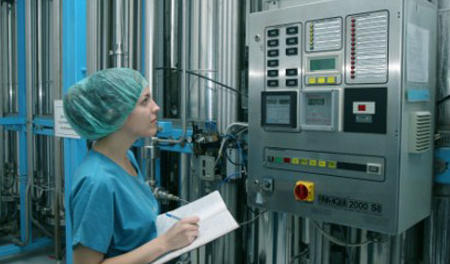
Documentation is the backbone of equipment validation because regulators require “documented evidence” that pharmaceutical equipment meets specification and remains under control. Key documents include URS, risk assessments, DQ/IQ/OQ/PQ protocols and reports, calibration records, maintenance logs, change-control forms, and standard operating procedures.[6][1]Data integrity principles such as ALCOA (Attributable, Legible, Contemporaneous, Original, Accurate) apply to all electronic and paper records generated during equipment validation. When designing control systems for purified water, pure steam, and sterilization hardware, suppliers can greatly help clients by providing audit trails, electronic signatures, and secure data storage features that simplify compliance.[13][6]
Risk-Based Validation Strategy
Current GMP expectations encourage using a risk-based approach to decide the depth and extent of equipment validation activities. Systems that have a critical impact on product quality and patient safety—such as pharmaceutical equipment for aseptic filling, sterilization, or WFI production—receive more intensive testing than non-critical utilities.[14][3]Tools like Failure Mode and Effects Analysis (FMEA) and risk matrices help identify which components, parameters, and failure modes require the most attention during DQ, IQ, OQ, and PQ. For Everheal, incorporating risk-based thinking into project proposals and validation master plans makes it easier for clients to justify their approach during inspections and to focus resources where they matter most.[4]
Typical Validation Workflow for Pharmaceutical Equipment
A practical roadmap for validating pharmaceutical equipment often includes several linked steps that form a clear project workflow. Below is a typical sequence that global pharmaceutical manufacturers use when introducing new pharmaceutical equipment to a GMP facility.[4][2]- Define User Requirement Specifications describing capacity, critical parameters, materials, regulatory expectations, and integration with existing systems. - Perform risk assessment to categorize the equipment and identify critical functions and parameters. - Develop a Validation Master Plan (VMP) that explains scope, responsibilities, strategies, and documentation structure for the equipment and associated processes. - Execute Design Qualification to confirm that the proposed design of the pharmaceutical equipment meets the URS and relevant regulations. - Conduct Factory Acceptance Testing (FAT) at the supplier’s site to verify key functions before shipment. - Install the equipment on site and complete Installation Qualification, including calibration and documentation checks. - Perform Site Acceptance Testing (SAT) and Operational Qualification to challenge controls, alarms, and operating ranges. - Run Performance Qualification using real or simulated product to show consistent performance under routine conditions. - Transfer the system into routine operation with defined SOPs, training, and ongoing monitoring plans. - Maintain the pharmaceutical equipment in a validated state using preventive maintenance, calibration, change control, and periodic reviews. This structured workflow can be adapted for different categories of pharmaceutical equipment, from purified water systems and pure steam generators to filling lines and sterilization systems.[2]
Examples Across Key Pharmaceutical Equipment Types
In a purified water preparation system, validation focuses on demonstrating that the combination of pretreatment, RO, EDI, storage, and distribution can consistently meet conductivity, TOC, and microbiological limits under both normal and worst-case conditions. PQ might include extended operation at high and low demand, sanitization validation, and sampling at representative points around the loop.[13][4]For a liquid filling and sealing machine, validation addresses aspects like fill-volume accuracy, capping torque, vial or ampoule breakage, and cleanability under different container sizes and line speeds. Sterilization equipment, such as autoclaves or pure steam-based systems, requires chamber mapping, penetration studies, and biological indicator tests to confirm lethality for defined cycles.[11][12]Everheal’s portfolio of pharmaceutical equipment can be presented in marketing content with separate sections explaining the typical validation focus for each system, plus diagrams that show how water systems, steam systems, and filling–sterilization lines connect in a complete plant layout.
Integration of Utilities and Process Equipment
One of the challenges in modern facilities is integrating different pieces of pharmaceutical equipment into a coherent, validated system. Purified water, pure steam, clean compressed air, HVAC, and process skids must not only function correctly individually but also work together to support sterile, controlled manufacturing environments.[3][2]This integrated view is especially important in turnkey projects where an engineering partner supplies plant layout, utilities, and process equipment. By designing pharmaceutical equipment with validation and interconnection in mind, Everheal can help clients reduce interface issues, simplify documentation, and shorten the time from installation to commercial production.[2]
Common Pitfalls and How to Avoid Them
Many validation problems can be traced back to incomplete URS, underestimation of timelines, and poor coordination between engineering, quality, and production teams. Another frequent issue is treating equipment validation as a “checklist exercise” instead of a risk-based, science-driven activity integrated with process understanding.[5][4]To avoid these pitfalls, manufacturers should invest time in developing realistic URS, involve multidisciplinary teams early, and base test plans on critical quality attributes and process knowledge. Pharmaceutical equipment vendors that offer standardized documentation packages, clear maintenance instructions, and validation support services make it easier for clients to implement robust validation without reinventing everything from zero.[13][3]
Digital Tools and Automation in Validation
As pharmaceutical manufacturing becomes more digital, validation activities are also evolving to include electronic protocols, automated data capture, and advanced analytics. Electronic validation management systems can route protocols, manage approvals, and store reports, improving traceability and reducing manual errors.[15][6]For pharmaceutical equipment with PLC/SCADA or DCS control systems, integrated historian databases and audit trails support both routine monitoring and validation evidence. When Everheal designs pharmaceutical equipment with built-in data logging, user management, and secure exports, customers gain a stronger foundation for electronic batch records and data-driven continuous improvement.[6]
How Everheal Supports Equipment Validation
As a specialist in pharmaceutical equipment, Everheal can design and supply turnkey solutions that are validation-ready, with GMP-oriented layouts and integrated utilities tailored to each project. This includes purified water systems, pure steam generators, multifunction distillation machines, liquid filling and sealing equipment, and sterilization systems designed to align with global regulatory expectations.Everheal can also support customers with documentation sets for DQ, IQ, OQ, FAT/SAT, and maintenance, plus guidance on sampling points, instrumentation, and automation to facilitate PQ and lifecycle monitoring. By combining engineering, pharmaceutical equipment expertise, and validation know-how, Everheal helps international clients shorten project schedules and achieve smoother regulatory inspections.[15][4]
Conclusion
Equipment validation in the pharmaceutical industry is the structured, documented process of proving that pharmaceutical equipment and utilities are designed, installed, and operated to consistently deliver products that meet quality, safety, and regulatory requirements. Through DQ, IQ, OQ, PQ, and lifecycle monitoring, manufacturers build an evidence trail that their purified water systems, pure steam generators, distillation units, filling and sealing machines, and sterilization systems perform reliably in real-world conditions.[1][4]A proactive, risk-based approach—supported by robust documentation, data integrity, and digital tools—reduces failures, supports GMP compliance, and strengthens market trust in both the medicines and the pharmaceutical equipment used to make them. For global customers investing in new facilities, partnering with a validation-focused supplier like Everheal ensures that equipment and project execution are aligned with modern regulatory expectations from the first design review to routine production.[3]
FAQ About Equipment Validation in Pharmaceutical Industry
FAQ 1: What is the main purpose of equipment validation in pharma?
The main purpose of equipment validation is to demonstrate and document that pharmaceutical equipment performs as intended, consistently producing products that meet predetermined quality and safety specifications. It provides assurance to manufacturers and regulators that processes are under control and that risks to patients are minimized.[1][3]
FAQ 2: What are DQ, IQ, OQ, and PQ in pharmaceutical equipment validation?
DQ, IQ, OQ, and PQ are the key stages of equipment qualification in the pharmaceutical industry. Design Qualification (DQ) verifies that the design meets requirements, Installation Qualification (IQ) confirms correct installation, Operational Qualification (OQ) checks functional performance across operating ranges, and Performance Qualification (PQ) proves consistent performance during routine production.[4][2]
FAQ 3: When should pharmaceutical equipment be requalified or revalidated?
Pharmaceutical equipment should be requalified or revalidated after major changes such as relocation, significant repairs, control system upgrades, or repeated deviations that suggest the process may no longer be in a state of control. Periodic review and risk-based assessments also help determine whether partial or full requalification is needed over the equipment lifecycle.[7][5]
FAQ 4: How does equipment validation support GMP compliance?
Equipment validation supports GMP compliance by providing the documented evidence regulators expect to see during inspections and submissions. It demonstrates that pharmaceutical equipment, utilities, and processes are qualified, monitored, and maintained in line with regulatory expectations, reducing the likelihood of non-compliance findings.[6][3]
FAQ 5: What type of pharmaceutical equipment requires the most rigorous validation?
Pharmaceutical equipment with direct impact on product sterility, dose, or critical quality attributes requires the most rigorous validation, such as purified water systems, WFI production units, aseptic filling lines, cleanroom HVAC with HEPA filtration, and sterilization systems. Because failures in these areas pose high risk to patients, regulators expect deeper risk assessment, more extensive testing, and tighter ongoing monitoring.[14][3]


