Content Menu
● What Is A Pressure Infusion Bag?
● Typical Pressure Range For Inflation
● How The Pressure Infuser Works Around An Infusion Bag
● Safety Features And Over‑Inflation Protection
● Matching Pressure To Fluid Type And Clinical Scenario
● Step‑By‑Step Use In Practice
● Design Details And Materials
● Infusion Bags And Industrial Production
● Educational Use Of Infusion Bag Content
● Conclusion
● FAQ
>> 1. What pressure should a pressure infusion bag be inflated to?
>> 2. Can over‑inflation damage the Infusion Bag or IV line?
>> 3. Are all pressure infusion bags suitable for any Infusion Bag size?
>> 4. How do manufacturers ensure their Infusion Bags can tolerate pressure?
>> 5. How does Everheal's equipment support pressure‑compatible Infusion Bag production?
● Citations:
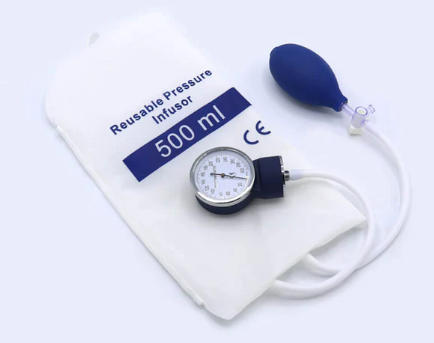
A pressure infusion bag is an inflatable cuff that fits around an IV fluid or blood Infusion Bag and uses air pressure to drive fluid into a patient's bloodstream faster than gravity alone. In most clinical scenarios, these devices are inflated to a controlled range up to about 300 mmHg, guided by the pressure gauge and the manufacturer's operating instructions.
What Is A Pressure Infusion Bag?
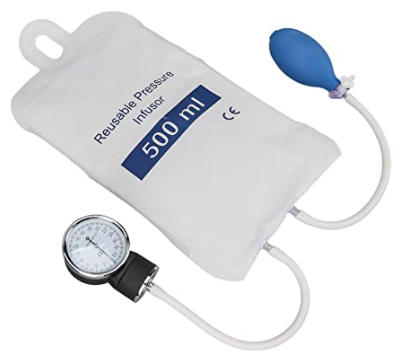
A pressure infusion bag is a specialized device consisting of an air bladder, outer sleeve, hand pump, stopcock, and pressure gauge that surrounds a standard IV Infusion Bag. It is designed to compress the Infusion Bag evenly so that fluid flows rapidly into the IV line, especially in emergencies, operating rooms, and critical care environments.
These bags are typically compatible with common Infusion Bag sizes such as 250 mL, 500 mL, 1000 mL, and 3000 mL. The cuff's design distributes pressure uniformly over the Infusion Bag, helping maintain consistent flow while protecting the bag from localized overstress.
Typical Pressure Range For Inflation
Most pressure infusion bags are intended to operate within an approximate range from low tens of mmHg up to around 300 mmHg. For many devices, the gauge is scaled from 0–300 mmHg and is color‑coded to show safe, caution, and high‑pressure zones.
In rapid transfusion of blood or plasma from a blood Infusion Bag, clinicians commonly use a target of about 300 mmHg as a practical standard for achieving high flow while staying in the safe operating zone of the device. When the clinical situation is less urgent, or when the fluid in the Infusion Bag is a crystalloid such as saline or Ringer's solution, lower pressures can be adequate and more comfortable.
How The Pressure Infuser Works Around An Infusion Bag
To use a pressure infusion bag, a filled IV Infusion Bag is hung on the hook inside the cuff, and the transparent sleeve is closed around it. The air bladder is then inflated by repeatedly squeezing the hand bulb while watching the gauge. As air enters the bladder, it squeezes the Infusion Bag, increasing hydrostatic pressure and accelerating flow through the line.
The stopcock allows three basic functions:
- Inflation of the bladder by directing air from the bulb into the cuff.
- Maintenance of pressure on the Infusion Bag by locking the system.
- Deflation when the clinician wants to release pressure and remove or change the Infusion Bag.
Throughout the infusion, the gauge provides real‑time feedback, so staff can fine‑tune the pressure as the Infusion Bag empties and conditions change.
Safety Features And Over‑Inflation Protection
Modern pressure infusion bags include several safety features to protect the Infusion Bag, the IV system, and the patient:
- Color‑coded pressure gauge: Safe ranges are usually marked in green, caution in yellow, and dangerous high pressures in red. This visual cue helps clinicians avoid overstressing the Infusion Bag.
- Pressure relief valve: Many devices incorporate an automatic safety valve that begins venting air above a specified threshold (commonly somewhere above 300 mmHg) to prevent accidental over‑inflation of the cuff and the Infusion Bag.
- Robust hanger and hook: The internal hook is designed not to puncture the Infusion Bag, and the rigid hanger helps keep the system stable on the IV pole even if pressure changes suddenly.
If a pressure infusion bag is over‑inflated beyond its recommended range, the Infusion Bag can be exposed to excessive mechanical stress, which increases the risk of leaks, rupture, or damage to blood components. For that reason, clinicians are trained to use only the pressure needed for adequate flow and never to force the gauge into the red zone.
Matching Pressure To Fluid Type And Clinical Scenario
The ideal inflation pressure depends on what is inside the Infusion Bag and how urgently fluid is needed:
- Blood and blood products: Because these are more viscous, higher pressures around 300 mmHg are often used for rapid transfusion in trauma and massive hemorrhage settings. The goal is to move blood quickly through the line while respecting device limits and protecting the Infusion Bag.
- Crystalloids and colloids: For fluids like saline or Ringer's solution, lower pressures can often achieve satisfactory flow. Clinicians may start at moderate pressures, then adjust upward if the Infusion Bag is not flowing fast enough for the clinical need.
- Arterial flush bags: When the Infusion Bag is used to maintain arterial line patency rather than rapid volume resuscitation, moderate pressures are usually sufficient. In these cases, the focus is on stable pressure rather than maximum flow.
Institutional protocols frequently define preferred pressure settings for various fluids and access types so that staff have clear guidance on how much to inflate the pressure cuff around each kind of Infusion Bag.
Step‑By‑Step Use In Practice
A typical workflow for a nurse or doctor using a pressure infusion bag with an Infusion Bag looks like this:
1. Prepare the Infusion Bag
- Select the correct fluid or blood Infusion Bag (correct drug, volume, and expiry).
- Spike the Infusion Bag and prime the IV tubing, removing air from the line.
2. Load the Infusion Bag into the cuff
- Open the pressure cuff and hang the Infusion Bag on the internal hook.
- Close the sleeve, ensuring the Infusion Bag label and fluid level are visible through any clear window.
3. Inflate to the target pressure
- Set the stopcock to the inflation position.
- Squeeze the bulb repeatedly while watching the gauge.
- Stop inflating when the gauge reaches the desired pressure, often around 300 mmHg for rapid blood infusion, or a lower value for less urgent infusions.
4. Monitor the infusion
- Observe the IV site for pain, swelling, or signs of infiltration while the Infusion Bag is under pressure.
- Check the gauge periodically; as the Infusion Bag empties, pressure may drop slightly and may need minor adjustment.
5. Deflate and change bags
- When the Infusion Bag is nearly empty, switch the stopcock to deflate and let the pressure out of the cuff.
- Remove the used Infusion Bag, discard according to policy, and load a new Infusion Bag if ongoing fluid or blood therapy is required.
This sequence allows fast, controlled delivery while maintaining safe conditions around the Infusion Bag and the IV system.
Design Details And Materials
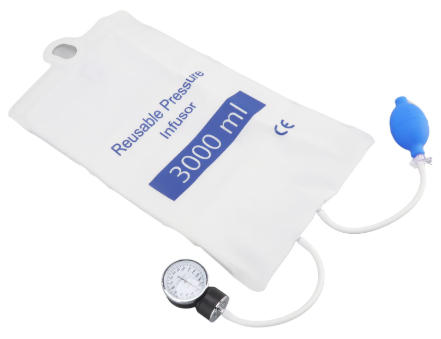
Pressure infusion bags are usually made from durable materials such as urethane‑coated nylon and reinforced mesh or PVC for the outer sleeve, so they can withstand repeated inflation cycles. The bladder material is selected to distribute uniform pressure around the Infusion Bag, and the clear window or clear backing allows continuous visual inspection of the fluid level and appearance.
The gauge assembly, tubing, and stopcock are typically constructed from medical‑grade plastics and elastomers that resist cracking and leakage even under repeated pressurization. For single‑use models, the entire cuff that contacts the Infusion Bag is disposed of after one patient; in reusable systems, the gauge and inflation assembly may be reused while the part that encloses the Infusion Bag is either single‑patient‑use or reprocessed according to validated cleaning procedures.
Infusion Bags And Industrial Production
Behind each clinical pressure infusion setup is a sterile Infusion Bag manufactured under strict pharmaceutical standards. The Infusion Bag must tolerate not only normal hanging and gravity flow, but also repeated compression up to the device's intended pressure range.
To achieve this, pharmaceutical factories rely on:
- High‑purity water preparation systems to produce WFI‑grade water used for solutions filled into Infusion Bags.
- Pure steam generators and multi‑function distillers to support sterilization and clean utility needs.
- Automated liquid filling and sealing machines that precisely meter fluids into each Infusion Bag and seal ports reliably.
- Sterilization systems that validate sterility assurance without compromising Infusion Bag integrity.
A company such as Everheal, which supplies purified water systems, pure steam generators, distillers, liquid filling and sealing machines, and sterilization equipment, enables pharmaceutical manufacturers to build integrated production lines for Infusion Bags. With customized factory layout planning and turnkey line design, these plants can produce Infusion Bags that remain stable under both conventional gravity use and pressure infusion conditions, meeting global regulatory and OEM expectations.
Educational Use Of Infusion Bag Content
For training and marketing, clear explanations of how a pressure infusion bag interacts with an Infusion Bag help clinicians and procurement managers understand product advantages. Even without embedding actual images or videos, article sections can describe:
- The appearance of the cuff wrapped around an Infusion Bag, including where the gauge sits and how the hook supports the bag.
- The meaning of each color zone on the gauge and how they relate to safe compression of the Infusion Bag.
- Demonstration sequences where a nurse loads a blood Infusion Bag, inflates to approximately 300 mmHg, and monitors the infusion until the bag is nearly empty.
Such descriptive content supports brochures, catalogs, and digital marketing pages that position both pressure infusion devices and high‑quality Infusion Bags within a complete solution for emergency and critical care.
Conclusion
In daily practice, a pressure infusion bag should be inflated only enough to achieve the required flow rate while staying within the manufacturer's recommended range, which for many devices extends up to about 300 mmHg. When used correctly, the pressure cuff, its safety valve, and the color‑coded gauge work together to compress the Infusion Bag safely and efficiently, enabling rapid fluid and blood delivery without compromising bag integrity or patient safety. High‑quality, reliably manufactured Infusion Bags—supported by advanced equipment such as that provided by Everheal—are essential for ensuring consistent performance whenever pressure infusion technology is used in hospitals, emergency services, and surgical centers worldwide.
FAQ
1. What pressure should a pressure infusion bag be inflated to?
In many clinical situations, a pressure infusion bag is inflated to a level up to about 300 mmHg, especially for rapid transfusion of blood products from a blood Infusion Bag. Lower pressures can be used for crystalloids or less urgent infusions, and clinicians always follow the specific device instructions and hospital protocols.
2. Can over‑inflation damage the Infusion Bag or IV line?
Yes. If the cuff is inflated beyond its intended limits, excessive force on the Infusion Bag and tubing can increase the risk of leaks, rupture, or damage to blood components, and it may also harm the IV site. This is why pressure gauges are color‑coded and why safety valves are built in to release air if pressure rises too high.
3. Are all pressure infusion bags suitable for any Infusion Bag size?
No. Pressure cuffs are usually designed around specific capacities, such as 250 mL, 500 mL, 1000 mL, or 3000 mL Infusion Bags. Using a cuff that is too large or too small for the Infusion Bag can lead to uneven pressure, reduced efficiency, and greater risk of mechanical stress, so the cuff size should match the Infusion Bag volume.
4. How do manufacturers ensure their Infusion Bags can tolerate pressure?
Manufacturers select strong, compatible films and use precise forming and sealing processes to build Infusion Bags that hold their shape under compression. They test bags for leakage and strength at pressures similar to those generated by pressure infusion devices, and they rely on reliable utilities—such as purified water, pure steam, and controlled sterilization—to protect both integrity and sterility.
5. How does Everheal's equipment support pressure‑compatible Infusion Bag production?
Everheal supplies purified water preparation systems, pure steam generators, multi‑function distillers, liquid filling and sealing machines, and sterilization systems, along with customized factory layout and production‑line solutions. With these integrated systems, pharmaceutical manufacturers can design and operate Infusion Bag lines that produce sterile, mechanically robust bags ready for safe use inside pressure infusion cuffs across global markets.
Citations:
[1](https://spacelabshealthcare.com/product/pressure-infusion-bag-500ml-disposable-box-of-24-3/)
[2](https://connect.myairlife.com/resources/TDS-20112-C1%20Vital%20Signs%20Pressure%20Infusor%20Bag%20Technical%20Data%20Sheet%20Rev1.pdf)
[3](https://www.merit.com/product/pib-pressure-infusor-bag/)
[4](https://www.fannin.eu/wp-content/uploads/2024/05/TDS-20025-C1_InfuSurg-Hook_Rev1-Fannin.pdf)
[5](https://www.vitalitymedical.com/sunmed-infu-surg-pressure-infusion-bag.html)
[6](https://spacelabshealthcare.com/product/pressure-infusion-bag-part-reusable-1000ml-box-of-24/)
[7](https://myairlife.com/product/infu-surg-pressure-infusion-bag/)
[8](https://www.boundtree.com/iv-drug-delivery/infusion-pumps-accessories-sets/disposable-pressure-infusers/p/group001780)
[9](https://www.american-hospitalsupply.com/products/ahs-pressure-infusion-bags)


